
Newest online casinos with no-deposit bonuses for Australian players — the 2026 honest read
A new online casino aimed at Australian players launches every few weeks. Some are crypto-first offshore brands built from scratch; others are established white-label platforms freshly rebranded for the AU market. They promise free spins on signup, welcome packages worth thousands, and instant PayID deposits. The truth underneath the splash banner is harder. Every one of these operators is offshore. None holds an Australian gambling licence, because no such licence exists. The no-deposit bonus is a trial, not a strategy — and the fine print costs the player more than the headline ever admits.

This page ranks ten offshore casinos reaching Australian players in 2026 by their no-deposit-bonus relevance, lays out the wagering math behind every offer, and puts the whole market in its honest legal frame. Where current bonus terms are not confirmed, the page says so — a missing figure is information the reader can use.
Current as of 18 October 2026; licence claims verified against the Australian Communications and Media Authority (ACMA) register and operator terms pages.
- What “newest” actually means for an Australian casino site in 2026
- No-deposit bonuses at new casinos: what the fine print costs you
- PayID, crypto and the payment puzzle for Australian players
- The pokies behind the bonuses — and which ones actually pay
- New mobile casinos for Australian players
- The legal reality: offshore casinos and the Australian prohibition
- Responsible gambling: where the safety nets actually reach
- The newest online casinos for Australians: ranked and compared
- How we selected and ranked these casinos
- No-deposit bonuses are a trial, not a strategy — our verdict
- Frequently asked questions
What “newest” actually means for an Australian casino site in 2026
“Newest” in the Australian market does not mean what it means in a regulated market. There is no Australian licence to apply for, no Australian regulator to approve a launch, and no compliance milestone that defines a debut. A casino earns the “newest” label one of two ways: it has recently launched somewhere in the world and has begun accepting Australian sign-ups, or an established white-label platform has rebranded for the AU market with PayID support and a pokies-heavy library. Both routes leave the operator outside Australian consumer law.
How a casino earns the “newest” label in Australia’s offshore market
Launch date and AU-market debut date are not the same thing. A platform can have been live in Europe or Latin America for years before turning on Australian payment rails and PayID, and still count as “newest” in the AU-facing rankings affiliate sites publish. The rebranded-white-label pattern is the more common shape: the same backend re-skins with a fresh logo, an AU-focused bonus calendar, and a deposit page that lists PayID alongside the crypto wallets. A 2024 platform can still be a “newest” pick for an Australian reader in 2026 if its AU-facing relaunch was recent enough.
The shelf life of the “newest” label is short. Affiliate rankings rotate the badge every quarter, and a casino that held the slot in the previous cycle often reappears further down the same list with no operational change — only the date stamp on its AU market entry has been quietly refreshed. For a reader, the practical question is not whether a casino calls itself new, but whether it has changed since the last time an Australian punter put a deposit through it.
The offshore-only reality: every new casino an Australian plays at is unlicensed
The Interactive Gambling Act 2001 makes it an offence to provide online casino games, online pokies, or in-play sports betting to a person in Australia. There is no licence for online casino anywhere in the country — not federally, not in any state or territory. This is not a grey area; providing the service is banned in terms.
The Curaçao or Anjouan licence badge a new casino displays is real, in the sense that the regulator exists and the operator paid its fee. It is not Australian consumer protection. An Anjouan licence, like the one Rainbet holds, provides no independent dispute resolution. A Curaçao eGaming licence offers more procedural infrastructure but still routes complaints through a body that does not enforce on Australian players’ behalf. What the licence actually does for the player: almost nothing in the way of recourse if the operator refuses a withdrawal, voids a win, or vanishes.
What the licence does signal: the operator has chosen to register somewhere with low oversight and minimal capital requirements, and is reaching Australia knowing full well that the product is prohibited here. The payment methods a casino still accepts — credit card, crypto — are themselves a tell. Licensed Australian wagering has been banned from taking either since 11 June 2024. A deposit page that lists both is operating outside Australian rules by design.
What a new casino site launch actually looks like for Australian players
The first hour at a brand-new casino feels slick. The homepage loads with a sign-up button, a rotating banner of the welcome package, a game library of three to four thousand pokies, and a payments page that lists PayID, Visa, Bitcoin and a handful of altcoins. The terms and conditions link sits in the footer. Affiliate reviews are already in place — most new AU-facing casinos are seeded across review sites before they publicly launch, because the affiliate funnel is the entire customer-acquisition model.
Then the small print. A typical no-deposit bonus at a new AU-facing casino in 2026 is 20 to 50 free spins on a specific pokie, or a $10 to $20 cash chip. The wagering requirement on winnings runs 40x to 60x. The max cashout sits between $50 and $180. The validity window is anywhere from 24 hours to a week. The bonus splash banner shows the headline number. The terms page shows the rest of it.
Game libraries at new casinos tend to be multi-provider aggregations, which is the most generous reading of “newest” in this market. The Pragmatic Play and BGaming titles dominate; the newest launches of late 2026 include Bubble Up, Sleeping Dragon Ultra Dark, and Cosmic Clusters from Pragmatic Play, alongside Elvis Frog in Vegas, Bonanza Billion, and Merge Up from BGaming. RealTime Gaming-only casinos like Fair Go still exist and still work for players who want a familiar, narrow library. The first wave of player reviews for any new brand is the moment its real personality surfaces — payout speed, ID-check friction, the willingness of support to argue over a voided bonus.
No-deposit bonuses at new casinos: what the fine print costs you
A no-deposit bonus is free money in the sense that you did not have to put your own funds in to claim it. It is not free in the sense the page advertises. The wagering requirement, the max cashout cap, the validity window, and the max-bet rule together decide what the bonus is actually worth — and for most offers at new AU-facing casinos, that worth is small.
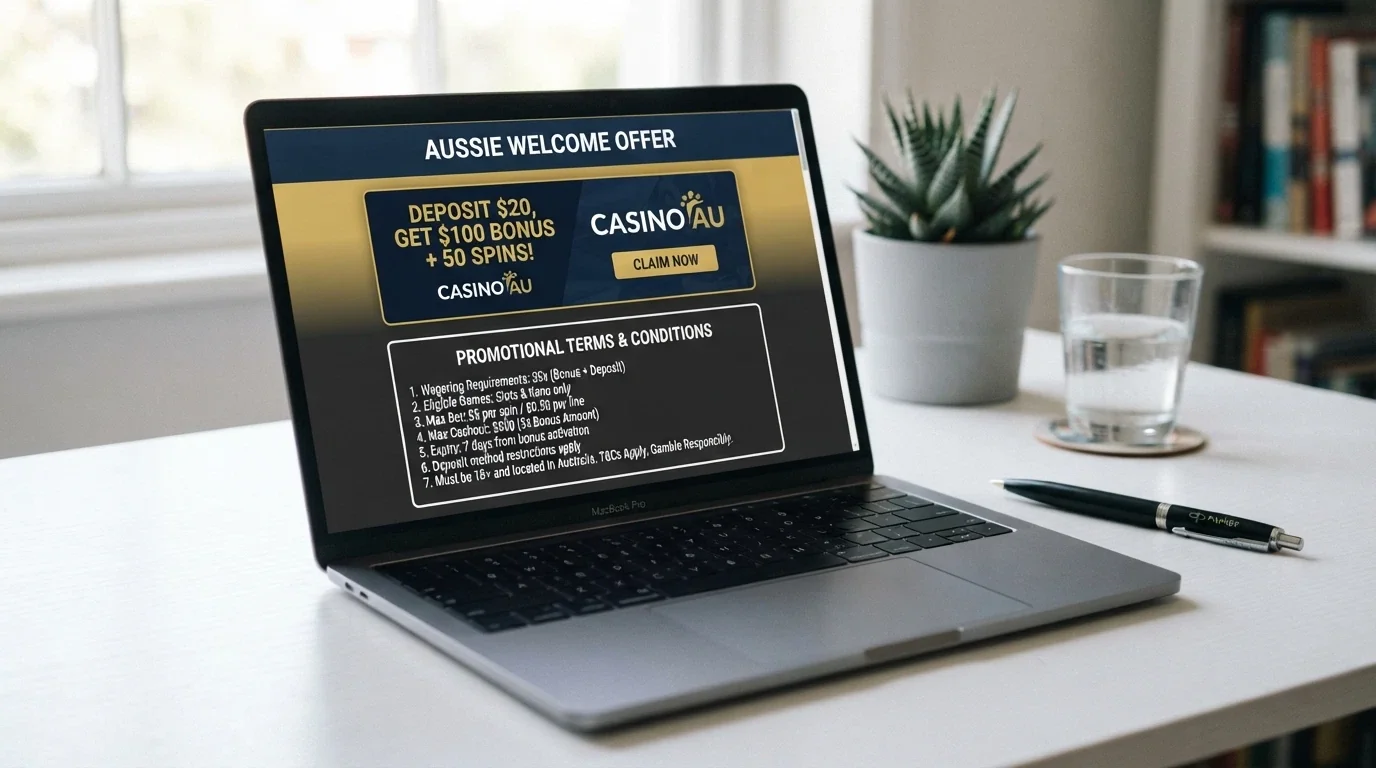
The expected cost of clearing a no-deposit bonus tells the story without needing to spin a single reel. Take a $10 free chip at 60x wagering: that is $600 of turnover required. At a typical 95% return-to-player, the player loses around $30 of that $600 in house edge before the bonus converts. If the max cashout is $180 and the player got lucky enough to clear $200 in winnings, they walk away with $180, having effectively given back $20 to a game they would not otherwise have played. The chip was free. The clearance was not.
| Casino | Offer | Wagering | Max cashout |
|---|---|---|---|
| Fair Go | 30 free spins | 60x | $180 |
| Slots Gallery | 20 free spins | 30x | $150 |
| ViperSpin | 25 free spins | 50x | $100 |
That is the model underneath the marketing word “free.”
Free spins vs free chips: the two shapes of a no-deposit bonus
Two formats dominate the no-deposit menu at new AU-facing casinos. Free spins are the more common — the operator picks a specific pokie, credits the player’s account with 20 to 50 spins at a fixed stake (often $0.10 to $0.20), and converts any winnings to bonus cash subject to wagering. Free chips are a flat bonus credit, usually $10 to $20, that the player wagers on a chosen game at their own stake.
The effective value of each depends on the terms. A 20-free-spin offer at 30x wagering with a $150 max cashout is generous by current standards — Slots Gallery runs something close to this on Zeus the Thunderer. A 20-free-spin offer at 50x, such as Caswino’s verification-triggered spins, is the opposite. A free chip at 60x with a $180 ceiling, like Fair Go’s $10 to $30 chip, sits in the middle: heavy wagering, but a real payout cap if the player clears it.
Free spins appear more often at newest casinos because they constrain the player to a specific game the operator has chosen, often a new release the operator wants exposure for. Free chips give the player more choice but come with heavier terms in almost every example this market produces. The format that suits a particular reader depends on whether they want to test a specific pokie or roam the library.
Wagering requirements: why 40x is never just 40x
The headline number on a wagering requirement is the multiplier. What it actually means is the total turnover the player has to push through the games before bonus winnings convert to withdrawable cash. A 40x wagering requirement on $50 of bonus winnings is $2,000 of turnover. The same 40x on $200 is $8,000. The same 40x on $5 — a low-win free-spins outcome — is $200.
The range across the featured set runs from 30x to 60x. Slots Gallery’s no-deposit free spins on Zeus the Thunderer sit at the floor at 30x. Rocketplay’s no-deposit free spin winnings sit at 35x. Bizzo’s 10 to 25 free spins carry a 40x requirement on spin winnings. Caswino’s verification spins carry 50x. ViperSpin runs 50x on a 25-free-spin offer with a $100 cap. Fair Go tops out at 60x on its $10 to $30 free chip and on its 30 free spins on Fu Long Treasures.
Wagering time multiplies fast because the max-bet cap is in force while it clears. A $5 max bet means the player needs hundreds of spins at minimum stakes to grind out a $200 wagering total. A $10 max bet — Fair Go’s rule — halves the spin count. At an average of five seconds per spin, even a generous $10 cap clears a $2,000 wagering requirement in several hours of steady play. At a $5 cap, the same clearance takes twice as long and twice as many decisions. The clearance is the same on paper. The experience is not.
Games that contribute less than 100% to wagering stretch the clearance further. Most pokies contribute 100%; table games often contribute 10% or are excluded entirely. The fine print matters here — a player who switches to blackjack to “speed up” clearance can find their wagering total barely moving.
Max cashout caps: the ceiling the headline never mentions
A no-deposit bonus can clear successfully and still pay out less than the player thinks. The max cashout cap is the ceiling on what walks out the door, regardless of how much the player won during the bonus. Across the featured set, the cap runs from around $50 to $180.
Rainbet’s no-deposit offer caps the payout at roughly A$50. That is the floor. Slots Gallery’s free spins cap at $150. ViperSpin’s 25 free spins cap at $100. Fair Go’s free chip and free spins both cap at $180, which is the ceiling in the featured set. The cap interacts with the wagering total to set the bonus’s real ceiling: a player who clears a bonus that produced $400 in pre-cap winnings at a $180 cap walks away with $180, having burned $220 of clearance value into the house edge.
Operators set the cap knowing the math. A $180 cap on a 60x-wagering free chip is not generosity — it is the highest number the operator calculated a player is likely to reach after the clearance cost has already been paid. Lower caps keep the bonus’s expected payout closer to zero; higher caps accept that some players will hit a real win and walk away with something. Either way, the cap is what the bonus is actually worth, and the headline number is what it looks like at a glance.
How to actually claim and clear a no-deposit bonus without losing it
The traps that void a no-deposit bonus mid-clearance are consistent across the featured set. Account verification is the trigger at most new casinos — the bonus does not credit until the player has uploaded ID and proof of address, which is also the moment the casino has the information to refuse withdrawals later. The max-bet rule is enforced strictly: a single spin above $5 at Bizzo voids the promotion entirely; the same spin above $10 at Fair Go forfeits the bonus. The game eligibility list is narrower than the casino’s full library — playing an excluded pokie burns the wagering progress the player has banked.
The validity window is the trap most players discover too late. Caswino’s 20 free spins expire 24 hours after verification. Slots Gallery’s free spins expire after 72 hours. ViperSpin’s 25 free spins carry a seven-day expiry. A player who clears $1,800 of a $2,000 wagering requirement and lets the bonus expire on day six walks away with nothing — the wagering total resets, the winnings vanish, and the casino has the house edge either way.
Withdrawal identity checks surface after clearance. The player has uploaded documents once to trigger the bonus; the casino asks for them again at withdrawal, sometimes with extra requirements. Offshore casinos use this stage to apply discretionary rules — “irregular play,” “bonus abuse,” “wagering pattern review” — that can void a cleared bonus. The player who has won $180 from a $10 chip at Fair Go has, in practice, won a review process the casino runs behind closed doors.
PayID, crypto and the payment puzzle for Australian players
The payment method a casino lists is not just a deposit option. It is a tell. PayID and debit-card deposits tell you the operator has wired into Australian banking rails, which most offshore casinos have done because Australian customers expect it. Crypto deposits tell you the operator is comfortable operating outside the licensed-payment perimeter, because licensed Australian wagering has been banned from taking crypto since 11 June 2024. Credit card deposits tell you the operator is ignoring the same ban, because licensed wagering has been banned from credit cards for the same period and the penalty for non-compliance is up to $247,500.
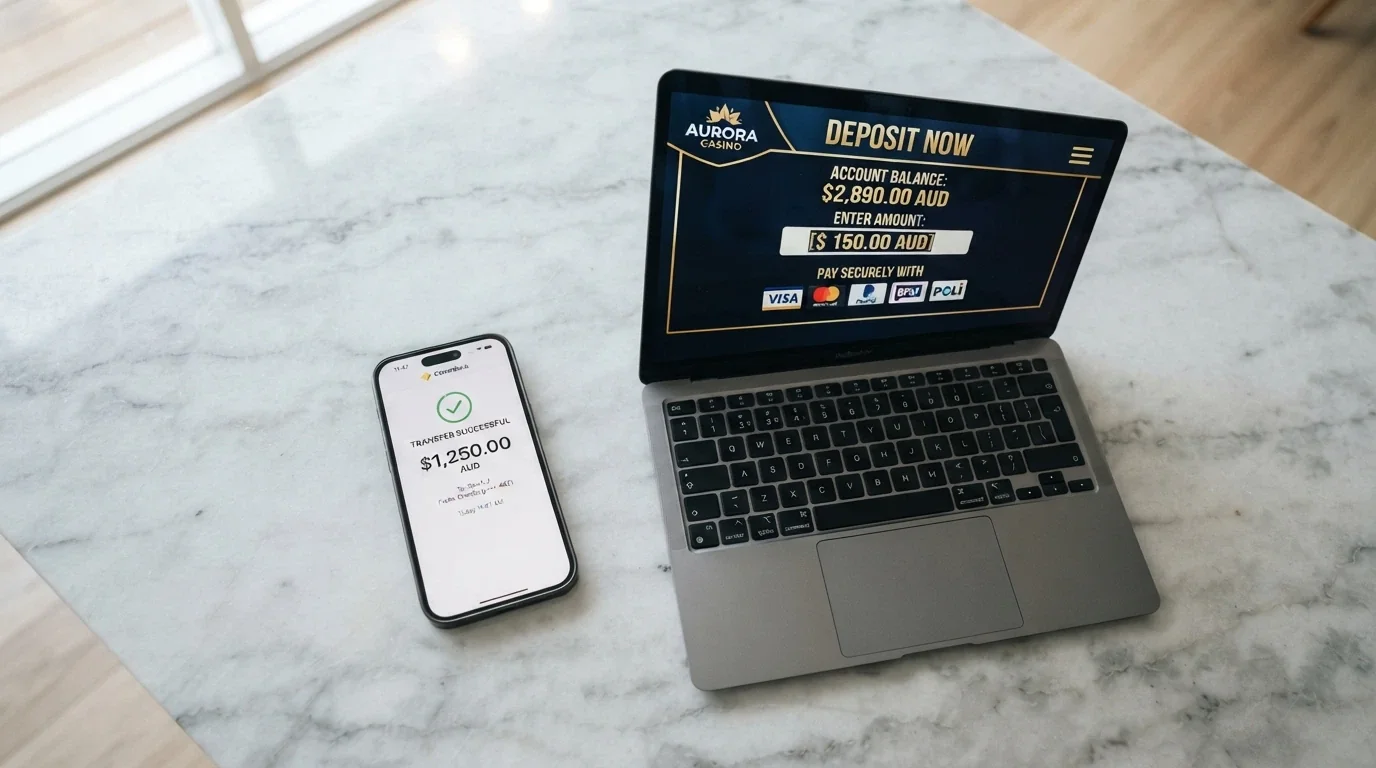
A licensed Australian wagering operator is legally restricted to debit card, bank transfer, PayID/Osko, and BPAY. An offshore casino is not. The methods it lists are unrestricted, and the choice of method tells the player what kind of operator they are dealing with.
PayID at new casinos: instant but not a safety guarantee
PayID deposits at AU-facing casinos are genuinely fast. A CommBank test run landed a $100 PayID deposit instantly; a crypto withdrawal on the same site was approved within 14 minutes. That speed is real. The protection is not.
PayID acceptance does not mean a casino is Australian-licensed. No online casino is Australian-licensed. PayID is just a payment rail — the New Payments Platform operates it, Australian banks process it, and any merchant with an Australian bank account can accept it. Offshore casinos accept PayID because it is what Australian customers reach for first. The instant settlement is a feature of the rail, not a sign of regulatory compliance.
From 1 January 2027, banks and payment providers gain express authority to block transactions to illegal gambling operators. The PayID express will still work for an Australian player funding an offshore casino account, but the bank on the other end will have the legal cover to refuse the transaction. That changes the deposit experience for every AU-facing offshore casino in a single day.
Low-deposit entry points and what they unlock
A $10 deposit casino and a no-deposit bonus casino are not the same thing, and the difference is more than the dollar. A $10 minimum deposit unlocks the welcome package at most new casinos — the multi-tier match bonus and the bulk of the free spins that come with it. The no-deposit bonus is the smaller offer that does not require the deposit, and it is usually a tighter version of the same terms: fewer spins, lower chip value, heavier wagering, lower cap.
For a player with a small bankroll, the choice is between putting $10 into a casino to claim the welcome package (and being subject to its full terms) and using a no-deposit offer to test the casino for free (and accepting the tighter conditions that come with it). The welcome package is bigger in headline value; the no-deposit offer is smaller but risk-free at the deposit stage. Neither is risk-free at the clearance stage — wagering, caps, and validity apply to both.
The pokies behind the bonuses — and which ones actually pay
A no-deposit free spin lands on a specific pokie. The pokie’s return-to-player figure is what decides whether the wagering clearance is achievable or punishing. RTP is the percentage of wagered money a game returns to players over a very large number of spins — most online pokies sit between 94% and 97%. The difference between a 94% pokie and a 97% pokie is the difference between losing $6 and losing $3 for every $100 wagered.

Pragmatic Play and BGaming dominate the AU-facing offshore library because their games are licensable to Curaçao and Anjouan operators, their RTPs are configurable within regulator-set ranges, and their newest releases ship with promotional hooks operators can attach to welcome offers. RTG-powered casinos like Fair Go run a different model — a single-provider library that is narrower, more familiar, and unchanged for years.
The newest pokies landing at AU-facing casinos in 2026
Pragmatic Play has shipped three titles of note in the second half of 2026 on its own. Bubble Up, launched 24 August 2026, runs a 6-reel 40-payline setup with a default RTP of 96.52%, medium volatility, and a maximum win of 10,000x the stake. Sleeping Dragon Ultra Dark, launched 23 July 2026, sits at a 5-reel 3-row 10-payline grid with a 96.50% RTP, high volatility, and a 20,000x ceiling. Cosmic Clusters, launched 16 July 2026, uses a 6×6 Cluster Pays mechanic with a 96.45% RTP, high volatility, and a 5,000x max win. Gates of Olympus 1000, the higher-variance follow-up to the original Gates of Olympus, runs a 6×5 pay-anywhere grid at 96.50% RTP, high volatility, and a 15,000x max win.
BGaming’s contribution to the high-RTP end of the AU-facing library is the Elvis Frog and Bonanza cluster. Elvis Frog in Vegas returns 96.70%. Bonanza Billion returns 96.97%. Merge Up leads the BGaming set at 97.25% RTP. Pragmatic Play’s average across its catalogue sits in the 95% to 97% range with a low-to-very-high volatility profile. The gap between a 96.50% Pragmatic Play pokie and a 97.25% BGaming pokie is the kind of detail that only matters over thousands of spins — but it is the kind of detail the bonus terms page never shows.
Pokies you can play for free before risking a dollar
Demo mode is the part of a new casino that the no-deposit bonus replaces — except the demo does not pay real money. Most new AU-facing casinos offer demo play on their pokies: the player spins with virtual credits, sees the bonus features trigger, and gets a feel for the game’s volatility without risking anything. Some casinos run demo without an account. Most require registration first.
The practical use of demo mode for a bonus-eligible pokie is to see how often the game produces a spin worth above the cap. A high-volatility pokie with a 5,000x max win will produce long dry stretches between payouts; demo play makes that pattern visible before the player commits a free spin. A low-volatility pokie with smaller, more frequent payouts is easier to grind through a wagering requirement on.
The difference between a demo spin and a no-deposit free spin is the wager attached. The demo spin returns nothing. The free spin returns whatever the pokie pays, converted to bonus cash, subject to wagering. The player who has used demo to scout the volatility profile has made the free spin a more informed bet — but the free spin is still a free spin, capped at the casino’s ceiling.
RTG-powered casinos and what a single-provider library means
RealTime Gaming (RTG) is the engine behind Fair Go and a small group of AU-facing casinos that have run on the same provider for over a decade. RTG’s catalogue is narrower than the multi-provider aggregations — a few hundred pokies, a smaller table-games suite, no live dealer. The trade-off is familiarity: the same titles, the same RTP profiles, the same bonus mechanics across every RTG casino.
Fair Go’s no-deposit offer runs on RTG pokies for that reason. Fu Long Treasures is the named title on the 30-free-spin offer, and the chip-format offer is playable across the RTG library. Payouts are processed via BTC, USDT, and bank wire — a narrower set than the PayID-and-Visa breadth of a multi-provider casino like Bizzo or Rocket Play. For a player who values consistency over breadth, the RTG model works. For a player who wants the newest releases every month, it does not.
New mobile casinos for Australian players
Mobile play at new AU-facing casinos runs through the browser. None of the featured operators in this market ships a native Australian app — the app-store restrictions, the IGA prohibition, and the offshore licensing model together make a native iOS or Android app impractical. The casino’s mobile site is a responsive web build, scaled for a phone screen, with the same game library and the same bonus terms as the desktop version.
What that means in practice: more than half of Australians who gamble are doing it mainly online, and the share is rising. The mobile casino is the casino for a growing number of players. Performance is browser-dependent, data use tracks against the game library’s size, and live dealer games — which most new casinos do offer — consume the most data of any category. The newest pokies, with their heavier animations and feature videos, sit at the heavier end of the data curve too.
The legal reality: offshore casinos and the Australian prohibition
The legal frame around every casino on this page is the same. They are all offshore. They are all offering a product that is prohibited to provide to a person in Australia under the Interactive Gambling Act 2001. They are not prosecuted for it directly — the IGA targets the provider, and ACMA enforcement works through DNS-level blocking, formal warnings, and civil penalty proceedings, not through criminal pursuit of offshore operators. Australian players are not prosecuted either. The IGA does not name the player as the offender.

What the player loses is consumer protection. No Australian complaints body will hear a dispute with a Curaçao or Anjouan operator. No Australian financial recourse applies if the casino refuses a withdrawal. The site can be ACMA-blocked at any time, with a balance still in the account. BetStop — the National Self-Exclusion Register — does not reach it. The player carries every risk.
The Interactive Gambling Act: what it actually bans and what it leaves alone
The prohibition covers online casino games, online pokies, and in-play sports betting. There is no licence for any of these products in Australia. Online wagering on races and sport placed before the event begins is licensed, by state and territory regulators, with the Northern Territory holding the largest concentration of online wagering licences. Lotteries and keno are licensed at state level. The minimum age for any commercial gambling activity is 18.
Because the product is banned outright, there is no federal deposit, loss or stake ceiling for online casino gambling in Australia. Australia caps how you can pay, not how much you can gamble. The credit card and crypto ban, in force since 11 June 2024, is a payment-method restriction on licensed operators; it does not apply to offshore casinos, which is why offshore casinos still take both.
The 2026 reform: rules that start 1 January 2027
Parliament passed the Interactive Gambling Amendment (Gambling Reform) Bill 2026 on 19 August 2026. The measures commence on 1 January 2027. The headline changes are three: a cap on wagering advertising, an inducement-marketing restriction, and bank blocking authority.
The advertising restrictions limit wagering ads to no more than three per hour between 6am and 8.30pm, with a live-sport blackout running from 15 minutes before kick-off to 5 minutes after the final whistle. No ads in sports venues, on player uniforms, or via athletes, celebrities, or influencers. A Wagering Advertising Opt-out Register lets individuals block wagering ads from their devices.
The inducement-marketing curbs stop licensed operators from sending sign-up offers for 14 days after a customer registers, from marketing to a person for three months after they deregister from BetStop, and from marketing to a customer flagged as at risk indefinitely. For offshore operators already breaking the IGA prohibition, these rules do not change their behaviour — but they tighten the licensed market around them.
Bank blocking authority is the most consequential change for offshore casinos. From 1 January 2027, banks and payment providers gain express authority to refuse or block transactions to illegal gambling operators. A PayID deposit that settles in seconds today could be refused at the bank level from the new year. The same applies to BPAY, direct debit, and any other Australian-rail payment to an offshore casino.
What the player risks: no consumer protection, no complaints body, no BetStop
The practical cost of playing at an unlicensed offshore casino is not whether it is illegal for the player — it is not — but what the player loses when something goes wrong. An operator that voids a bonus win on a discretionary rule has no Australian complaints body for the player to escalate to. An operator that delays a withdrawal past its advertised timeline has no financial ombudsman the player can call. An operator that closes an account with a balance inside has no regulator that will order the funds returned.
BetStop, the National Self-Exclusion Register, binds Australian-licensed wagering services. An offshore casino is not connected to it. A person who has self-excluded through BetStop because they recognised their own gambling was harming them can still open an account at any offshore casino, deposit, and play. The self-exclusion stops at the licensed border. The offshore casino keeps accepting the self-excluded person’s money.
The ACMA can block an offshore casino at any time. A block under section 313 of the Telecommunications Act 1997 is a DNS-level instruction to Australian ISPs — the site becomes unreachable from Australia. A player with funds on deposit at the moment of a block has no automatic payout mechanism and no Australian body to contact for help.
ACMA enforcement: the sites blocked, the services that withdrew and what it means for new casinos
Since November 2019, the ACMA has directed Australian ISPs to block more than 1,564 illegal gambling and affiliate websites. More than 225 illegal services have withdrawn from the Australian market since enforcement was strengthened in 2017. The blocking is DNS-level — the site’s domain name is unresolved for Australian customers — and it covers affiliate sites that promote the operators, not just the operators themselves.
The enforcement record tells a reader two things. The first is that ACMA blocking is real and ongoing, which means any offshore casino on this page can be added to the block list at any time. The second is that the operators keep launching new brands to replace the blocked ones — the 225 withdrawals were matched by a comparable number of new AU-facing launches. The blockade and the relaunch are in equilibrium.
Responsible gambling: where the safety nets actually reach
Australian responsible-gambling infrastructure is built around licensed operators. The National Self-Exclusion Register binds them. The state-based deposit limits apply to them. The activity statements come from them. The harm-reduction counselling is paid for by them, mostly through point-of-consumption tax revenue. Offshore casinos do not contribute to that infrastructure and are not covered by it.

The harm statistics are unambiguous. Approximately 2.1% of Australian adults experience problem gambling; high-risk gambling sits at 1.8%. As of March 2026, 13.0% of the adult population were experiencing some form of gambling harm from their own gambling. Total harm, including harm from another person’s gambling, reached 15.1% of adults. Australians lost $36.0 billion to gambling between March 2025 and March 2026. Risky gambling — measured by the Problem Gambling Severity Index — rose from 13.7% to 19.4% in a single year.
BetStop works for licensed operators — and stops at the offshore border
BetStop — the National Self-Exclusion Register — launched on 21 August 2023. One registration excludes a person from every Australian-licensed online and phone wagering service in a single step. As of 31 March 2026, 59,830 people had registered, with 37,247 active exclusions. Seventy-eight per cent of registrants were under 40; 38% chose lifetime exclusion.
The register’s blind spot is the offshore market. A Curaçao-licensed casino does not check the BetStop list. An Anjouan-licensed casino does not either. A self-excluded person who wants to keep gambling can open an account at any offshore casino listed on this page and start playing within minutes. The self-exclusion is a commitment the licensed market honours. The offshore market ignores it.
From 1 January 2027, the 2026 reform strengthens BetStop and adds a three-month post-deregistration marketing ban — licensed operators cannot target someone with bonus offers for three months after they come off the register. That change matters at the licensed end. It does not reach the offshore casino that keeps sending bonus offers to the same person throughout.
The harm in the numbers: what Australia’s gambling data actually shows
The Australian gambling-harm figures are sourced, current, and large. Roy Morgan’s July 2026 Gambling Harm Index puts own-behaviour harm at 13.0% of adults — roughly 2.86 million people. Total harm, including harm from others’ gambling, sits at 15.1% — roughly 3.32 million people. The Australia Institute’s 12-month figure, March 2025 to March 2026, puts total gambling losses at $36.0 billion.
ANU Polis Centre for Social Policy Research’s 2025 gambling participation data shows 58.8% of adults participating in some form of gambling, with 56.1% of those who did participate doing so mainly online. Risky gambling, measured by the PGSI, rose from 13.7% in 2024 to 19.4% in 2025. AIHW’s earlier 2022 data set problem gambling at 2.1% of adults and high-risk gambling at 1.8%. Approximately 5.9% of adults reported being harmed by another person’s gambling in the past 12 months.
These figures are the reason the policy debate exists. They are also the reason offshore casino access matters: every operator on this page is reachable by every Australian adult with a payment method and an email address, and the harm-prevention infrastructure that applies to the licensed market does not reach them.
The National Gambling Helpline — 1800 858 858 — is free, confidential, and staffed 24/7. Gambling Help Online (gamblinghelponline.org.au) runs online chat and counselling. BetStop (betstop.gov.au) is the self-exclusion register for licensed wagering services.
The newest online casinos for Australians: ranked and compared
The table below compares ten AU-facing offshore operators on the two dimensions a no-deposit-bonus reader cares about: what the bonus is, and what game providers sit behind it. Cells are filled only where the operator’s current terms are confirmed. The honest gaps are part of the comparison — a missing figure tells the reader the operator’s NDB terms were not surfaced this run, which is information.

Every operator in this table is offshore. None holds an Australian online-casino licence, because no such licence exists. The prohibition under the Interactive Gambling Act 2001 applies to every one of them.
| Casino | No-deposit bonus | Game providers |
|---|---|---|
| Rocket Play | 30 free spins, wagering 35x on winnings | Multi-provider |
| Skycrown | — | Multi-provider |
| Royal Reels | — | — |
| WinSpirit | — | — |
| Stake | — | Multi-provider + Stake Originals |
| Rainbet | NDB via promo codes, max cashout ~A$50, wagering 40x | Pragmatic Play and others |
| Scream Casino | — | — |
| Fair Go | $10–$30 free chip or 30 free spins on Fu Long Treasures, wagering 60x, max cashout $180 | RealTime Gaming (single provider) |
| Bizzo Casino | 10–25 free spins, wagering 40x | Multi-provider aggregator |
| Rocket Casino | — | — |
Rocket Play
Rocket Play holds 9.4% of the Australian-facing market by share, with $632.69 million in revenue. It is not licensed in Australia — it operates offshore under a Curaçao eGaming licence and reaches Australian players through affiliate funnels. The no-deposit offer is 30 free spins with 35x wagering on winnings, lighter than the 40x to 60x range the wider market sits in. The game library is multi-provider, which means Rocket Play can attach the free spins to whatever title it wants exposure for.
The market-share figure is the largest in this ranking and matters: more Australians deposit at Rocket Play than at any other casino on this list, which means more Australians also run into the no-deposit terms, the clearance math, and the offshore-status realities. The lighter 35x wagering is the operator’s pitch. The absence of an Australian licence is the cost.
For a player who wants a multi-provider library and a lighter-than-average wagering requirement on the NDB, Rocket Play is the largest AU-facing operator that ticks both boxes. The terms still apply. The offshore status still applies. The max cashout was not confirmed this run, which is the kind of gap a player should check on the operator’s terms page before claiming.
Skycrown
Skycrown holds 8.55% of the Australian-facing market by share, with $436.07 million in revenue. It operates offshore under a Curaçao eGaming licence, with a multi-provider game library and a multi-tier welcome package. The no-deposit offer is not confirmed this run — Skycrown may not run a standing NDB at the moment, or its NDB terms may be region-specific and not surfaced.
A casino of Skycrown’s size without a confirmed standing NDB is common in the offshore market: the bigger operators lean on deposit-match welcome packages and free-spin bundles tied to first deposits, because those convert better. The welcome package is the entry point for Skycrown, not the no-deposit offer. For a player specifically hunting a no-deposit bonus, Skycrown is a name to watch rather than a current claim.
Royal Reels
Royal Reels holds 2.51% of the Australian-facing market by share, with $243.99 million in revenue. It operates offshore; licence and bonus terms remain unverified this run.
A 2.51% share is mid-pack for the AU-facing offshore market and places Royal Reels as a known brand in the affiliate rankings without being a market leader. The absence of confirmed bonus specifics this run means a player interested in Royal Reels needs to check the operator’s terms page directly. The pattern of a mid-share operator with terms not surfaced is the kind of gap that the no-deposit-bonus affiliate pages fill with outdated or estimated figures. Do not trust the affiliate pages. Read the terms page.
WinSpirit
WinSpirit is present in the AU-facing market. Licence and promotion details are not currently verified.
For a player weighing WinSpirit against other operators on this list, the practical advice is the same as for Royal Reels: check the operator’s own terms page for the current no-deposit offer, the wagering requirement, the max cashout, and the validity window. The operator’s market position is real. The bonus specifics are not in front of the reader until they visit the site.
Stake
Stake is a Curaçao-licensed global brand with a multi-provider game library plus its proprietary Stake Originals suite. The platform is crypto-first by design, which is the tell that it sits outside Australian licensed-wagering rules — crypto has been banned as a payment method for licensed Australian wagering since 11 June 2024. The no-deposit offer varies by region, and no standard AU no-deposit offer was confirmed this run.
For an Australian player, Stake is a crypto-native casino that has not tailored a no-deposit offer to the AU market in the way some of the white-label operators on this list have. The Stake Originals — Dice, Crash, Mines, Plinko, Keno, Limbo — are the operator’s signature products and run on provably-fair mechanics that the player can verify per spin. The wagering requirements on Stake’s promotions are typically lower than the 40x to 60x range that dominates the rest of this page, but the absence of a confirmed no-deposit offer for AU means a player who wants a free-on-arrival bonus is betting on a region-specific promotion.
Rainbet
Rainbet operates under an Anjouan gaming licence — ALSI-152406029-FI2. Anjouan is an entry-level offshore licence with no independent dispute resolution, which means a player with a complaint about Rainbet has no third-party body to escalate to. Rainbet’s own terms restrict Australia — the operator treats the Australian market as a geo-restricted territory, which is the offshore equivalent of an operator saying it does not really want Australian customers but will not refuse their deposits.
The welcome package is the operator’s main offer: 250% up to $2,100 plus 60 free spins across three deposits (first deposit 100% up to $700 plus 20 free spins, second deposit 50% up to $700 plus 20 free spins, third deposit 100% up to $700 plus 20 free spins), with 40x wagering across the bonus funds. The no-deposit offer runs through promo codes, with a max cashout of roughly A$50 and 40x wagering. The game library centres on Pragmatic Play pokies.
The math on Rainbet’s NDB is the harshest in the featured set. A promo-code no-deposit offer capped at ~A$50 with 40x wagering means the player who clears $50 of bonus winnings has wagered $2,000 through games at roughly 95% RTP, losing around $100 of house edge to clear $50 of capped payout. The expected value is negative before the player spins a single reel. The geo-restriction in the operator’s own terms is the second tell: Rainbet does not believe it is in a strong legal position serving Australian players and has written its terms accordingly.
Scream Casino
Scream Casino is present in the AU-facing market. The licence is not confirmed this run. The welcome bonus and no-deposit offer are not confirmed this run.
A player looking at Scream Casino against the other operators on this list should treat it as an unverified entry until the operator’s own terms page is checked. The pattern is the same as for Royal Reels and WinSpirit: AU-facing brand, mid-tier market position, no confirmed terms to evaluate.
Fair Go
Fair Go is the RTG-powered single-provider casino on this list. The standard no-deposit offer is a $10 to $30 free chip or 100 free spins, with 60x wagering on bonus value or winnings and a $180 max cashout — the highest cap in the featured set. The current named-spin offer is 30 free spins on Fu Long Treasures with a $180 cap.
The 60x wagering requirement is the heaviest in the featured set. On a $30 free chip, 60x means $1,800 of turnover before the bonus converts. At $180 max cashout, the player walks away with at most $180 of the bonus winnings, having absorbed the rest in house edge over the clearance. The deposit bonus side is lighter — 300% welcome with 30x wagering — but the no-deposit path is heavier than the rest of the market by design.
Payouts at Fair Go run via BTC, USDT, and bank wire. No PayID, no debit card, no e-wallet. The narrower payout set is the trade-off for the RTG single-provider library — a familiar catalogue of pokies, no live dealer, no aggregation breadth. For a player who values consistency over variety and is comfortable with crypto payouts, Fair Go is the most distinctive operator on this list. The 60x wagering and the offshore status are the cost of that consistency.
Bizzo Casino
Bizzo is a multi-provider aggregator with one of the larger game libraries in the AU-facing offshore market. The no-deposit offer is 10 to 25 free spins with 40x wagering on spin winnings — middle-of-the-pack on the wagering scale, middle-of-the-pack on the spin count.
The standout term at Bizzo is the strict $5 max-bet rule. A single spin above $5 during the bonus wagering voids the entire promotion, including the winnings banked to that point. That rule is enforced more aggressively at Bizzo than at most of the featured operators. For a player who spins automatically at the pokie’s default stake, the default is often above $5 — and the player discovers the void only at withdrawal, when the casino’s audit flags the breach and the bonus is forfeit. The strictness is real and the consequence is total.
For a player who wants a multi-provider library and is willing to manually cap every spin at $5, Bizzo is a defensible choice. The 40x wagering is lighter than Fair Go’s 60x. The max-bet enforcement is heavier than most. The net experience depends on which side the player values more.
Rocket Casino
Rocket Casino is present in the AU-facing market. The licence is not confirmed this run. The welcome bonus and no-deposit offer are not confirmed this run.
The practical advice mirrors the other unverified entries on this list: check the operator’s own terms page. Rocket Casino is a known name in the affiliate rankings and a mid-tier player in the AU-facing offshore market. The absence of confirmed bonus specifics this run is the kind of gap a player should treat as a research gap, not a known offer.
How we selected and ranked these casinos
The ten operators on this page come from a combination of AU-facing affiliate rankings and operator databases that track market share for the Australian offshore market. They are ranked by relevance to the no-deposit-bonus topic, not by market share. A casino with a confirmed NDB ranks above a casino without one, even if the second casino is larger. A casino with light wagering ranks above one with heavy wagering, all else equal.
The evaluation criteria are five: NDB availability and current terms (wagering multiplier, max cashout, validity window), game-provider breadth (single-provider vs multi-provider), payment-method support (PayID, crypto, debit card), the operator’s AU-facing market presence, and the honesty of the operator’s own status disclosure. An operator that presents its Curaçao or Anjouan licence without implying Australian legality ranks higher than one that conflates the two.
The research’s limits matter. Bonus terms change without notice. An NDB available on Monday can be withdrawn by Friday. A wagering multiplier listed in an affiliate review from last month can be revised upward this month. Several operator specifics — Skycrown’s NDB, Royal Reels’ licence, WinSpirit’s bonus terms, Scream Casino’s offer, Rocket Casino’s terms — were not confirmed this run. Where the research carries a gap, the gap stays visible on the page. A reader who treats a confirmed number as a current offer should re-check the operator’s terms page before claiming.
No-deposit bonuses are a trial, not a strategy — our verdict
The maths on a no-deposit bonus is straightforward. A $10 free chip at 60x wagering requires $600 of turnover. At a typical 95% RTP across the eligible pokies, the player loses roughly $30 of that $600 to the house edge before the bonus converts. The max cashout caps the upside at $50 to $180 across the featured set, with most offers sitting closer to $100. The expected outcome for a player who claims the bonus and clears the wagering is small — sometimes a tiny payout, more often nothing, occasionally the cap.

The promotion is free in the sense that the player did not put their own funds in. It is not free in the sense of what it costs in time, in attention, and in the house edge the player pays over the clearance. The marketing word “free” sits above the wagering number on the splash banner; the wagering number sits below the cap and the validity window on the terms page. The two pages are describing the same offer.
The offshore reality compounds the cost. Every operator on this page is offshore. None holds an Australian licence. No Australian complaints body will hear a dispute. No Australian financial ombudsman will order a payout. The site can be ACMA-blocked with a balance on deposit. BetStop does not reach it. A self-excluded person can still open an account. The player who is concerned about their own gambling or has registered with BetStop should not use an offshore casino at all — the safety nets that exist for the licensed market stop at the border.
For a player who is not self-excluded and is not concerned about their gambling, the no-deposit bonus is best understood as a free trial of a casino’s pokies library. A small chance of a capped payout. No need to deposit to claim. No reason to deposit to chase the clearance. If the casino stops being free, walk away. The bonus is a sample, not a strategy. The marketing makes it sound like more; the maths is the part that decides what it actually is.
For help with gambling: National Gambling Helpline 1800 858 858 (free, confidential, 24/7). Gambling Help Online at gamblinghelponline.org.au. BetStop, the National Self-Exclusion Register, at betstop.gov.au.
Frequently asked questions
Do Australian players get prosecuted for playing at offshore online casinos?
No. The Interactive Gambling Act 2001 targets the provider of an online casino service to a person in Australia, not the player. Individual Australians who sign up and play at an offshore casino are not prosecuted. What the player loses is consumer protection — no Australian complaints body will hear a dispute, no Australian financial recourse applies if the operator refuses a withdrawal, and the site can be ACMA-blocked at any time with a balance on deposit. The IGA makes the act of providing the service illegal; the player’s risk is the absence of protection, not the threat of prosecution.
What happens if an offshore casino blocks my withdrawal — who do I contact?
There is no Australian body to contact. The operator holds an offshore licence (Curaçao, Anjouan, or similar) and is not subject to Australian financial ombudsman schemes or consumer-protection regulators. A complaint escalates only to the operator’s own licence authority, which in most cases (Anjouan, in particular) has no independent dispute resolution process. The practical recourse is prevention: read the terms page before claiming any bonus, document the wagering and the spin history, and withdraw any cleared winnings before the casino has a reason to invoke a discretionary rule. The protection does not exist after the fact.
Are credit cards and cryptocurrency accepted at licensed Australian gambling sites?
No. From 11 June 2024, credit cards and digital currency (crypto) are banned as payment methods for online wagering in Australia, under the Interactive Gambling Amendment (Credit and Other Measures) Act 2023. Licensed Australian wagering operators accept debit card, bank transfer, PayID/Osko, and BPAY. The penalty for a licensed operator that accepts credit cards or crypto is up to $247,500. An offshore casino that still takes credit cards or crypto is operating outside Australian rules by design — the payment method is a tell that the operator is not licensed.
What is BetStop and does it cover offshore casino sites?
BetStop is the National Self-Exclusion Register, launched on 21 August 2023. One registration excludes a person from every Australian-licensed online and phone wagering service in a single step. As of 31 March 2026, 59,830 people had registered, with 37,247 active exclusions. BetStop binds Australian-licensed wagering services only. An offshore casino is not connected to the register and will keep accepting a self-excluded person’s deposits and bets. The self-exclusion stops at the licensed border; the offshore market ignores it entirely.
How do wagering requirements work on no deposit free spins?
The wagering requirement is a multiplier applied to the winnings from the free spins, not to the bonus itself. A 40x wagering requirement on $50 of free-spin winnings means the player has to wager $2,000 through eligible games before the bonus converts to withdrawable cash. The requirement must be cleared within the validity window — 24 hours at Caswino, 72 hours at Slots Gallery, seven days at ViperSpin. While clearing, the player is subject to the max-bet rule ($5 at Bizzo, $10 at Fair Go), and exceeding it voids the promotion. After clearance, the max cashout cap applies ($50 to $180 across the featured set).
What is the maximum amount I can withdraw from a no deposit bonus?
The max cashout cap is set by the operator and ranges from $50 to $180 across the featured set. Rainbet caps the no-deposit payout at roughly A$50. Slots Gallery caps at $150. ViperSpin caps at $100. Fair Go caps at $180, the highest in the featured set. The cap applies regardless of how much the player won during the bonus — a $400 win on a $180 cap walks away with $180. The cap interacts with the wagering total to set the bonus’s real ceiling, and most players clear their bonus with a payout below the cap rather than at it.