
Bitcoin casinos in Australia: ten offshore operators, one prohibition, and the gap the marketing never mentions
Every casino that accepts bitcoin from a player in Australia is operating outside Australian law. That is not a warning at the top of a page designed to be skimmed past. It is the foundation of everything that follows, and the reader who does not absorb it will misread the comparison below it. Online casino games are prohibited under the Interactive Gambling Act 2001, no licence for them exists in any state or territory, and the Australian Communications and Media Authority has blocked 1,564 illegal gambling and affiliate websites since November 2019. More than 225 illegal services have withdrawn from the Australian market since enforcement was strengthened in 2017. The individual player is not prosecuted under the IGA, but the protection the Act exists to provide — a complaint body, player-funds segregation, self-exclusion that the operator must honour, advertising rules that limit inducements — is not extended to them.

The ten operators ranked on this page are the ones Australians actually use. They are ranked by what could be verified this run, which is market presence in Australia, measured by the share of the country’s online gambling spend that flows to each brand. None of them holds an Australian licence. None of them can, because the licence does not exist. The crypto payment ban that took effect on 11 June 2024 makes the point sharper: a site asking an Australian for a bitcoin deposit is, by definition, being served by someone outside the Australian rules.
Currency and licence data current as of 18 October 2026; verified against the ACMA public register and the Northern Territory Racing and Wagering Commission licence register.
- What a bitcoin casino is — and why it matters for Australian players
- The bitcoin casinos Australians are using in 2026
- No-ID play sounds like freedom — until something goes wrong
- The games bitcoin casinos offer, and the one feature that matters most
- Why your bitcoin casino bonus is smaller than the headline number
- Bitcoin deposits are instant — the withdrawal is where the risk lives
- Taking the casino in your pocket, and the protection you leave behind
- The legal reality: online casino is prohibited in Australia
- New bitcoin casinos in 2026: fresh names, same offshore rulebook
- Staying in control when the safety net doesn’t reach offshore
- How we chose and ranked these bitcoin casinos
- What to actually do about it: the honest next step for Australian players
- Frequently asked questions for Australian bitcoin casino players
What a bitcoin casino is — and why it matters for Australian players
A bitcoin casino is, structurally, the same product as any other online casino: pokies, table games, live dealer tables, a cashier that turns deposits into playing balance. The single point of difference is the payment rail. A fiat online casino settles deposits and withdrawals through a card processor or a bank transfer, with the operator’s jurisdiction in the merchant data. A bitcoin casino replaces that rail with an on-chain transfer from the player’s wallet to a casino-controlled address, and back again on the way out. The games, the random number generators, the bonus terms and the customer support are the same kind of machinery in either case.
For an Australian player, that single structural point of difference has cascading consequences. The credit and crypto payment ban that commenced on 11 June 2024 means no Australian-licensed operator can accept a bitcoin deposit — so the moment a casino asks for one, the operator has already announced that it is not licensed in Australia. The player-protection regime the Australian regulator has built — BetStop, the National Gambling Helpline, state-level complaints mechanisms, the activity-statement and deposit-limit conditions attached to state and territory wagering licences — does not extend to that operator. The site can be blocked at the DNS level by an Australian internet service provider on ACMA direction, and the ACMA has used that power 1,564 times.
How bitcoin casino deposits actually work
The deposit flow at a bitcoin casino is mechanical and fast. The player opens the cashier, selects BTC as the deposit method, and is shown a deposit address — a string of letters and numbers, often paired with a QR code for mobile wallets. The player copies the address (or scans the code), opens their own wallet, pastes the address, sets the amount, and sends. The transaction propagates through the BTC network; the casino’s wallet software watches for incoming transfers to its address; once the transfer reaches the casino’s confirmation threshold (commonly one to three block confirmations, occasionally six for very large deposits), the equivalent amount appears in the player’s casino balance, converted at the casino’s prevailing exchange rate at the moment of credit.
Three friction points sit inside that flow. First, network fees: BTC transaction fees vary with congestion and can run from a few cents to several dollars, paid by the sender. The casino does not absorb them. Second, confirmation time: a single confirmation averages around ten minutes on the BTC network, so a deposit takes minutes, not seconds, despite the marketing. Third, exchange-rate slippage: the BTC amount the player sends, the USD or AUD amount the casino credits, and the BTC amount that AUD buys back on withdrawal are three different numbers, and the gap between them is the casino’s edge on the conversion.
The Australian context: what you need to know before you play
The Interactive Gambling Act 2001 prohibits providing online casino games, online pokies and in-play sports betting to people in Australia. The Interactive Gambling Amendment Act 2017 strengthened that prohibition. There is no licence for online casino anywhere in the country, federally or in any state or territory, and no Australian operator can lawfully offer an Australian player a spin on a slot machine played over the internet. The Australian Communications and Media Authority has enforced this prohibition with vigour: 1,564 illegal gambling and affiliate websites blocked since November 2019, and more than 225 illegal services have withdrawn from the Australian market since enforcement was strengthened in 2017.
The Act targets the provider of the prohibited service, not the person using it. The individual player is not prosecuted under the IGA. But the corollary of that is harder than it sounds: there is no Australian consumer protection for the player, no complaints body for offshore casino disputes, no BetStop coverage at an offshore casino, and no recourse when an operator refuses a withdrawal, voids a win or closes an account. The protection the Act exists to provide is the very thing the offshore operator is not bound by. The full legal picture is set out under The legal reality: online casino is prohibited in Australia, and any reader who skips this section should at least hold these three facts: every site on this page is offshore, none of them holds an Australian licence because none exists, and the Australian safety net stops at the border.
The bitcoin casinos Australians are using in 2026
The table below ranks the ten operators by what could be verified about their Australian market presence — specifically, the share of Australia’s online gambling spend that flows to each brand, drawn from the market-tracked snapshot this run. Every operator listed is an offshore casino. None holds an Australian licence. Where research did not verify bitcoin acceptance, bonus terms or game-provider lists, the table leaves the cell open rather than printing an unverified figure. The comparison is honest because it has to be: the gap between the headline a casino advertises and the verifiable reality is the gap the reader needs to see before deciding.

| Operator | Status in Australia | Market share (AU, 2026) | Revenue (A$M, 2026) |
|---|---|---|---|
| Rocket Play | Offshore — no Australian licence | 9.4% | 632.69 |
| Skycrown | Offshore — no Australian licence | 8.55% | 436.07 |
| Royal Reels | Offshore — no Australian licence | 2.51% | 243.99 |
| WinSpirit | Offshore — no Australian licence | 1.55% | 110.3 |
| Rainbet | Offshore — no Australian licence | 1.28% | 83.13 |
| Scream Casino | Offshore — no Australian licence | 0.99% | 94.87 |
| FairGO | Offshore — no Australian licence | 0.8% | 69.11 |
| Bizzo Casino | Offshore — no Australian licence | 0.57% | 51.38 |
| Rocket Casino | Offshore — no Australian licence | 0.57% | 43.22 |
| Stake | Offshore — no Australian licence (Curaçao e-gaming, Antillephone N.V.) | 1.28% | 115.67 |
The licensed Australian wagering brands — SportsBet, Tab, Bet365, Ladbrokes, TABtouch, PointsBet and Neds — collectively hold the rest of the Australian market, and they appear in the underlying data as the dominant spend recipients. They are not on this page because they do not accept bitcoin, and none of them offers the product this page is about. The operators ranked above are the ones offering prohibited interactive gambling services to Australian persons, and the spend figure beside each is the size of the demand that flows to them despite the prohibition.
Stake is placed last in the market-share ordering because the operators-skill snapshot does not surface it in the same share bands as the others, but it is profiled first below because the crypto-native benchmark is the one the rest are measured against. The reader looking for the confirmed bitcoin acceptance rather than the largest offshore spender should start with Stake.
Stake
Stake is the crypto-native benchmark. It accepts BTC, ETH, LTC, DOGE and USDT, with several other cryptocurrencies supported, and it has built its product around the crypto rail rather than bolted it on. The Curaçao e-gaming licence it holds — issued through Antillephone N.V. — is the offshore licence most often carried by crypto-native casinos, and it confers no recognition in Australia. Stake is not licensed for any product in Australia, and offering prohibited interactive gambling services to Australian persons is what every casino on this page does.
Game providers confirmed by research this run include Pragmatic Play, Evolution, Hacksaw Gaming, Push Gaming, Nolimit City and Relax Gaming, with others likely but not verified. That list is unusually deep for a crypto casino and is the reason Stake carries weight as a benchmark — the games on the platform are the same games that appear at fiat casinos running on the same provider relationships. Welcome bonus, free-spins count, wagering multiple and bonus validity were not verifiable this run, and the table leaves those slots empty rather than printing a figure the live search could not confirm. Australian market-share data places Stake at 1.28% with revenue of A$115.67M, a meaningful presence but smaller than several offshore rivals whose game and bonus propositions are less differentiated.
For a reader who wants a crypto-native operator with confirmed bitcoin acceptance and a deep provider list, Stake is the operator the rest of this page is measured against. For a reader who wants the largest offshore casino by Australian spend, the market-share data says otherwise.
Rocket Play
Rocket Play is the largest offshore operator in the featured set by Australian market share, with 9.4% of the country’s online gambling spend flowing to it and revenue of A$632.69M for the period measured. That is a substantial share, considerably larger than several licensed wagering brands in the underlying data, and it is worth pausing on: more Australian gambling spend is going to an offshore, unlicensed casino than to several of the brands that hold NT or state wagering licences. The demand is real, even if the product is prohibited.
Rocket Play, lacking an Australian licence, is restricted by the Interactive Gambling Act. Our search did not yield verification for its bonus packages or bitcoin deposit flows, leaving those sections empty in our profile. Nonetheless, its market-share figure is a significant indicator of its reach, making it the most prominent operator in our featured list for those tracking Australian demand.
Skycrown
Skycrown’s position in the ranking is based on spend-share data, not marketing. Specifics like bitcoin acceptance and bonus terms could not be confirmed this run. The operator profile is light on verified details; what is verifiable is the spend share, which is the second largest among the offshore operators, and the significant revenue figure.
Skycrown’s position in the ranking is the spend-share data, not the marketing proposition, and a reader treating the market-share figure as a proxy for product quality should treat it as a proxy for nothing more than that. Several licensed Australian wagering brands sit below Skycrown in the underlying data, and the fact that an unlicensed offshore operator outperforms them in spend is a fact about where the demand goes, not a fact about the product on offer.
Royal Reels
Royal Reels takes third place by revenue, at A$243.99M, and holds a 2.51% market share. It is an unlicensed offshore casino that provides prohibited interactive gambling services to Australians. The available market-share and revenue figures are our only verified information, as product details like bonus terms and game libraries remain unverified.
The 2.51% share is a useful data point in context: it is roughly the share commanded by Neds, a licensed wagering brand, and roughly half the share commanded by PointsBet. An offshore casino matching a licensed bookmaker’s share is not a small operator. It is a brand with material Australian demand, operating outside the Australian regulatory system.
WinSpirit
WinSpirit holds 1.55% of Australian gambling spend, with revenue of A$110.3M. It is an offshore casino, unlicensed in Australia, and offers prohibited interactive gambling services to Australian persons. Verifiable product details—such as bitcoin acceptance, bonus offers, or game providers—are unavailable this run. The profile relies on the market-share data tracked for this analysis.
For a reader scanning the offshore set for a brand that fits a particular profile, WinSpirit is mid-pack on share and revenue, with no verified product detail to differentiate it from the rest of the offshore field. The honest position is that, on the verifiable data, WinSpirit is one of several offshore operators with material Australian demand and no verified product-level differentiator.
Rainbet
Rainbet commands 1.28% of the Australian market, with A$83.13M in revenue. It operates from offshore without an Australian licence, providing services that fall under the Interactive Gambling Act prohibition. Specific data regarding welcome offers or game collections is currently unavailable. Our profile for Rainbet is limited to the revenue and market data provided by the operators skill.
Rainbet is in the same position as several of the operators above it: verifiable presence, unverified specifics. A reader weighing operators should note that the market-share data places Rainbet alongside Stake in share terms, though the revenue gap is wider — Stake’s A$115.67M is the larger business on the underlying data.
Scream Casino
Scream Casino captures 0.99% of the Australian market, generating A$94.87M in revenue. Like others, it is an offshore operator without a local licence, providing prohibited interactive gambling products. We have no confirmed details regarding its bonus structure or bitcoin acceptance. The profile is drawn exclusively from the revenue and share data.
The revenue-to-share ratio here is interesting: at 0.99% share Scream Casino commands A$94.87M in revenue, a higher revenue-per-share than several operators above it. That suggests a higher-value customer base or higher-margin product mix, but the live search could not verify the specifics behind the figure. The honest position is that Scream Casino is a material offshore operator with a smaller share than the leaders and a revenue figure that suggests an unusually high-yield customer base.
FairGO
FairGO holds 0.8% of the Australian market, with revenue of A$69.11M. It is an offshore casino, no Australian licence held, offering prohibited interactive gambling services to Australian persons. The brand name carries an Australian-facing positioning — “Fair Go” is an Australian colloquialism — but that positioning is marketing, not licensing. The brand is not Australian-licensed because no such licence exists, and the colloquial resonance of the name does not change that.
Information on bitcoin acceptance, bonus terms, or game providers was not available this run. The profile is based on the revenue and market-share figures alone. For a reader drawn to the name’s apparent Australian flavour, the honest note is that the brand’s positioning is a marketing choice made by an offshore operator, not a signal of Australian regulatory recognition.
Bizzo Casino
Bizzo Casino holds 0.57% of the Australian market, with A$51.38M in revenue. It operates offshore and lacks an Australian licence, meaning it provides prohibited services to persons in this country. There is no verified information on its welcome bonuses or game library. The profile relies entirely on the market-share and revenue figures.
Bizzo Casino is at the smaller end of the offshore set on both share and revenue, but still commands a measurable slice of Australian gambling spend from outside the Australian regulatory system.
Rocket Casino
Rocket Casino holds 0.57% of the Australian market — matching Bizzo Casino — with revenue of A$43.22M. Like others in this list, it is an offshore operator providing prohibited services. The brand shares the “Rocket” name with Rocket Play, but they are separate entities. Verifiable product information, such as bitcoin support or bonus terms, is not available.
The smallest offshore operator in this ranking by revenue, Rocket Casino is still a material brand on the verifiable data, and the same caveats apply: offshore, no Australian licence, prohibited product. For a reader choosing between Rocket Casino and Rocket Play, the shared name element is the only thing connecting them, and the shared name element is the least important thing about either.
No-ID play sounds like freedom — until something goes wrong
The pitch for anonymous play at a bitcoin casino is built on a real attraction. The player does not upload a driver’s licence. They do not submit a utility bill to prove their address. They do not wait three days for a compliance team to clear a withdrawal. They send bitcoin, they play, they withdraw, and the casino does not know who they are. That pitch has weight. It also has a cost the marketing does not name.

What “no KYC” actually means at a bitcoin casino
KYC stands for know your customer, and the standard KYC process at a regulated casino is the document upload, the address verification, the source-of-funds check that compliance teams run before a withdrawal can be approved. A no-KYC casino skips all of it. The wallet address substitutes for identity, and the player is identified only by the email address they registered with, if that.
In practice, no-KYC casinos do not operate as a pure free-for-all. Most still impose withdrawal caps — daily, weekly or monthly limits on the amount that can be taken out without verification — and most reserve the right to demand identity documents when a withdrawal breaches those caps. The model is closer to “verification on demand” than “no verification ever,” and the moment a player hits a cap, the casino that advertised anonymity becomes the casino that wants a passport scan. The promise is real for small, regular withdrawals. The promise breaks at the moment it matters most — when the player has had a big win and wants the money out.
The trade-off: anonymity vs. protection when something goes wrong
The structural trade-off is straightforward. A regulated casino that has verified the player’s identity is bound, by the regulator, to a complaints procedure that escalates. An anonymous casino that has not verified the player has no such obligation, and the player has no such escalation path. The ACMA blocking power sits in the background of every dispute: the regulator can direct Australian internet service providers to block an offending site, and the ACMA has used that power 1,564 times since November 2019. When a site is blocked, any balance sitting in a player’s account on that site is not returned to the player. The block cuts the player off from the casino, not the casino off from the funds.
BetStop does not reach offshore casinos. The National Self-Exclusion Register binds Australian-licensed wagering services, and an offshore casino is not connected to it. A player who has registered with BetStop, gone through the assessment process and committed to a self-exclusion period can still deposit and play at any offshore bitcoin casino in the world. The protection the player thought they had bought does not apply to the product they are using.
The recourse gap is the concrete shape of the trade-off. No Australian consumer protection, no complaints body, no regulator to escalate to. When the casino holds the funds and the player has no verified identity, the player’s leverage is the size of the casino’s incentive to keep its reputation — and for an offshore operator with no Australian licence, that incentive is not the same one an Australian-licensed operator faces.
The games bitcoin casinos offer, and the one feature that matters most
Bitcoin casinos carry the same game categories a player would find at any other online casino: pokies and video slots as the largest category, table games — blackjack, roulette, baccarat — as the second, and live dealer games streamed from studios as the third. The depth of the library varies by operator, but the structure is the same. What makes a bitcoin casino genuinely different is provably fair, a cryptographic verification system a regular online casino cannot replicate.
Pokies and video slots: the biggest category at every bitcoin casino
Pokies dominate the game library at every bitcoin casino in the same way they dominate at every fiat online casino. The game count runs into the thousands on the larger platforms, drawing from the same provider relationships the rest of the online casino industry uses. Pragmatic Play, Hacksaw Gaming, Push Gaming, Nolimit City and Relax Gaming are the names confirmed for Stake this run, and the same provider list appears at most of the larger offshore operators. Specific title RTPs were not verifiable this run, and the page does not print a per-title figure the live search could not confirm.
A player choosing between bitcoin casinos on the basis of the slot library should treat the provider list as the verifiable signal. The number of titles is marketing; the providers are the substance. Pragmatic Play and Evolution are the heavyweight names that guarantee a familiar experience; Hacksaw Gaming, Push Gaming and Nolimit City are the names that have driven the high-volatility slot trend of the last few years; Relax Gaming is the provider behind several of the more volatile mechanic-driven releases. Where the operator profile confirms those names, the library is real. Where it does not, the page leaves the slot offering unverifiable.
Table games: blackjack, roulette and baccarat with bitcoin stakes
Table games are universal at every bitcoin casino. Blackjack in its standard, multi-hand and live-dealer variants. Roulette in European, American and lightning-style formats. Baccarat in punto banco and commission-free variants. The bitcoin denomination model means minimums can sit lower than at fiat casinos, because the casino is willing to accept a fraction of a coin as a stake and the network fee on a small deposit is a smaller proportion of the stake than at a fiat casino processing small card transactions.
Specific table limits were not verifiable this run, and the page does not print a minimum-stake figure the live search could not confirm. The structural point is that bitcoin table games are the same games the player would find anywhere else, with the same house edge the player would face anywhere else. The crypto denomination does not change the mathematics of the game; it changes only the unit of account. A 0.5% house edge on European roulette is still a 0.5% house edge whether the player bets in AUD, USD or BTC.
Provably fair: the one feature a regular online casino cannot match
Provably fair is the genuine innovation of crypto casinos, and it is the one differentiator that matters. A standard online casino runs its games on a random number generator that the player has to take on trust. The casino publishes the RTP of each game, and the regulator audits the math, but the player cannot verify that any individual spin or hand was not manipulated. Provably fair replaces that trust with cryptographic proof.
The mechanism runs on three pieces of data: a server seed the casino generates and commits to before the bet is placed, a client seed the player’s browser supplies, and a nonce that increments with each bet. After the bet, the casino reveals the server seed, the player can verify that the hash of the seed matches the commitment, and the combination of the three inputs can be independently hashed to produce the outcome. The player can run the math themselves and confirm the casino did not change the seed after seeing the bet.
The limit is what provably fair does not verify. It proves the casino did not manipulate the outcome of the spin. It does not prove the RTP of the game. A provably fair game with a 95% RTP is still a 95% RTP game — provably fair confirms the honesty of the outcome, not the generosity of the math. A player who treats provably fair as a substitute for understanding the house edge has been misled by their own enthusiasm.
Why your bitcoin casino bonus is smaller than the headline number
The welcome bonus at a bitcoin casino is the headline number. A 100% match up to 1 BTC, a free-spins package on a flagship slot, a no-deposit offer for new sign-ups. The number is the bait, and the wagering requirements are the hook. The bonus the player actually walks away with is smaller than the bonus the player thinks they claimed, and the gap is built into the structure of every bonus the casino offers.
Welcome bonuses and deposit matches: what the headline number hides
A deposit-match bonus is the most common welcome offer at a bitcoin casino. The casino matches a percentage of the player’s first deposit up to a cap — 100% up to 1 BTC is a typical structure. The bonus funds sit in a separate balance from the real-money balance, and the player must “wager” the bonus through the required number of times before the bonus funds convert to withdrawable cash.
The illustrative example makes the gap concrete. Assume a player claims a 100% match bonus on a 0.1 BTC deposit, receiving 0.1 BTC in bonus funds. With a 35x wagering requirement — typical for the offshore market — the player must place 3.5 BTC in qualifying bets before the bonus converts. At a typical slot stake of 0.0001 BTC per spin, that is 35,000 spins. At roughly five seconds per spin, that is around 48 hours of continuous play. The bonus did not cost the casino anything close to the headline figure, and the player’s path to converting it is two days of wagering at a house edge the player can calculate but cannot avoid.
The wagering multiple, the game contribution percentage and the validity window are the three numbers that determine what a bonus is actually worth. Where research did not verify those figures this run, the page does not print them — the live search could not confirm a specific operator’s current terms. The structural point is what survives: the headline number is the bait, and the bonus the player walks away with is smaller than the headline by a factor the wagering multiple makes plain.
Free spins and no-deposit offers at bitcoin casinos
Free spins and no-deposit bonuses are the lowest-commitment way to try a casino, and they carry the lowest-commitment terms. A no-deposit bonus gives the player a small amount of bonus funds or a handful of free spins without requiring a deposit. Free-spin packages attach to a deposit bonus or a standalone promotion and run on a specific slot or a small selection of slots.
The fine print is where the offer lives. Win caps limit the amount that can be withdrawn from a no-deposit bonus — A$100 is a common cap on a free-spins package. Game restrictions limit which slots the free spins can be used on. Wagering requirements on the winnings from free spins run high — 40x or 50x is typical — and the combination of win cap and high wagering means a free-spins package that looks like a gift often pays out less than the player would have won on a single paid spin.
Specific current offers for the featured operators were not verifiable this run, and the page does not print a free-spin count or a no-deposit amount the live search could not confirm. The structural point is what survives: free spins and no-deposit bonuses are promotional tools, and the terms on them are written by the casino, in the casino’s favour.
Wagering requirements: the number that decides whether a bonus is worth claiming
The wagering multiple is the single most important number on a bonus. The formula is straightforward: bonus amount multiplied by the wagering multiple equals the required turnover. A 35x requirement on a 0.1 BTC bonus means 3.5 BTC in turnover. A 50x requirement on the same bonus means 5 BTC. The difference between 35x and 50x is 1.5 BTC of additional play the player must complete before the bonus converts.
Game contribution weightings sit underneath the wagering multiple. Pokies typically count 100% toward wagering requirements, meaning every dollar wagered on a pokie contributes a full dollar to the turnover target. Table games typically count 10% to 20%, meaning a dollar wagered on blackjack contributes ten to twenty cents. Live dealer games often count 0% or are excluded entirely. A player trying to clear a bonus at the blackjack table will wager five to ten times as much as a player clearing the same bonus at the slots.
The validity window closes the bonus when it expires. A 30-day validity window is common; a 7-day window appears on aggressive promotions. When the window closes, the bonus and any winnings from it are forfeit. A player who cannot complete the wagering requirement inside the window walks away with nothing. The headline bonus figure is what the player could have won; the forfeited bonus is what the player actually got.
Bitcoin deposits are instant — the withdrawal is where the risk lives
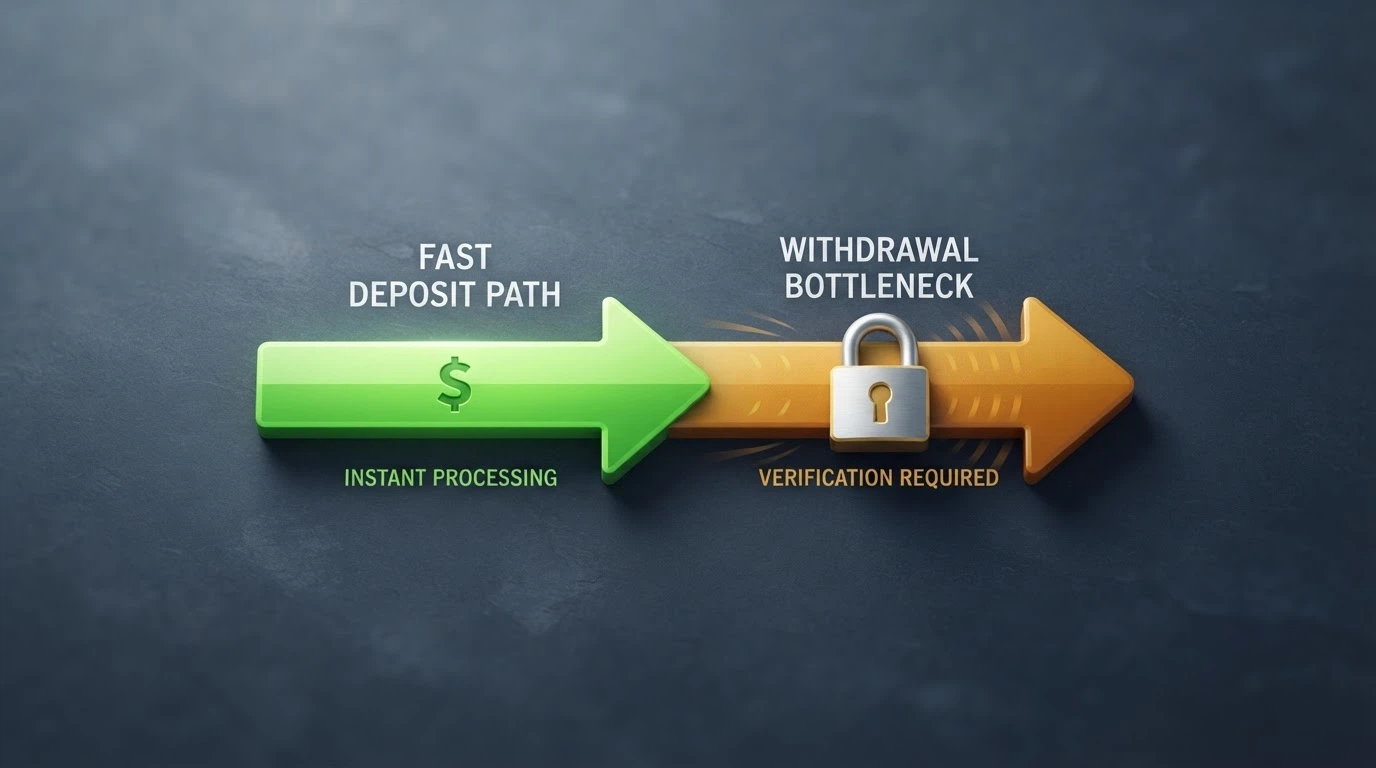
The deposit flow at a bitcoin casino is fast and technically straightforward. The player sends bitcoin, the casino credits the equivalent amount in their playing balance, and the player is at the tables within minutes. The withdrawal flow is where the operator’s real terms reveal themselves. Pending periods, withdrawal caps, manual reviews and bonus-related restrictions all sit on the way out, and the marketing the player read on the way in never mentioned them.
How to deposit bitcoin at an online casino
The deposit flow is mechanical. The player opens the cashier, selects BTC, and is shown a deposit address. The address is a string of letters and numbers, often paired with a QR code. The player copies the address, opens their wallet, pastes the address, sets the amount and sends. The transaction propagates through the BTC network; the casino’s wallet software watches for incoming transfers; once the transfer reaches the casino’s confirmation threshold — commonly one to three block confirmations — the equivalent amount appears in the player’s casino balance, converted at the casino’s prevailing exchange rate.
Three friction points sit inside the flow. First, network fees: BTC transaction fees vary with network congestion and can run from a few cents to several dollars, paid by the sender. The casino does not absorb them. Second, confirmation time: a single confirmation averages around ten minutes on the BTC network, so a deposit takes minutes, not seconds, despite the marketing. Third, exchange-rate slippage: the BTC amount the player sends, the USD or AUD amount the casino credits, and the BTC amount that AUD buys back on withdrawal are three different numbers, and the gap between them is the casino’s edge on the conversion.
The minimum deposit threshold is the casino’s smallest acceptable transfer. The threshold varies by operator, and specific thresholds were not verifiable this run. The structural point is that minimums exist to keep the network fee as a small proportion of the deposit; a casino accepting A$5 deposits at a A$2 network fee has built a loss into its deposit flow.
Withdrawal speed and the limits most players don’t read
The casino advertises “instant withdrawals.” The reality is a pending period, a review period, and a release. The pending period is the time between the player requesting a withdrawal and the casino beginning to process it — commonly 24 to 72 hours, during which the player can reverse the request and play again. The review period is the time the casino’s finance team takes to check the withdrawal against bonus terms, KYC requirements and fraud flags. The release is the moment the casino broadcasts the bitcoin transaction to the network, and from that point the deposit takes the same minutes it took on the way in.
Withdrawal caps are the limit the player does not read. Most offshore casinos impose daily, weekly or monthly caps on the amount that can be withdrawn, and a player who has had a big win may need weeks to withdraw the full amount. The cap resets on a rolling basis, and the player is paid in instalments. Where the cap is not disclosed upfront, the player finds out about it on the day they want their money out.
The hard limit is the operator’s discretion. An offshore operator can refuse a withdrawal, void a win or close an account without recourse, and the player has no Australian body to appeal to. The Australian regulator cannot compel an offshore operator to pay. The Australian court system cannot enforce a judgment against an offshore operator that does not hold Australian assets. From 1 January 2027, banks and payment providers gain express authority to block transactions to illegal gambling operators, which will further complicate the player’s ability to move money in and out of the offshore market — but that authority applies to the fiat on- and off-ramp, not to the bitcoin transfer itself.
Taking the casino in your pocket, and the protection you leave behind
A bitcoin casino works on a phone. The browser-based play is universal — every offshore operator on this page runs an HTML5 platform that adapts to a mobile screen, and most have dedicated apps for iOS and Android that download from the operator’s own site rather than the App Store or Google Play. The experience on a phone is the experience on a desktop, scaled down. The pokies spin, the live dealer tables stream, the cashier accepts the deposit.

The protection a mobile punter might expect does not apply. App-store vetting — the review process Apple and Google run to clear apps for their stores — does not reach a casino that distributes its app from its own website. The Australian consumer law that protects users of other apps — the Australian Consumer Law’s guarantees on goods and services, the eSafety Commission’s remit over harmful online content — does not extend to an offshore gambling product. The age-verification and identity-verification systems that an Australian-licensed wagering operator is required to run are not in place at an offshore casino. The mobile punter at an offshore bitcoin casino is the desktop punter at an offshore bitcoin casino, with a smaller screen.
The legal reality: online casino is prohibited in Australia
There is no grey area. The Interactive Gambling Act 2001 prohibits providing online casino games, online pokies and in-play sports betting to people in Australia. The Interactive Gambling Amendment Act 2017 strengthened that prohibition. No licence for online casino exists anywhere in the country, federally or in any state or territory. Every operator on this page is offshore, and every operator on this page is offering prohibited interactive gambling services to Australian persons. The Act targets the provider of the prohibited service, not the person using it. The individual player is not prosecuted. The corollary is the one the player needs to sit with: there is no Australian consumer protection for the player, no complaints body for offshore casino disputes, no BetStop coverage at an offshore casino, and no recourse when an operator refuses a withdrawal or closes an account.
The Interactive Gambling Act 2001: what it actually prohibits
The IGA prohibits the provision of online casino games, online pokies and in-play sports betting to people in Australia. What is permitted, and licensable, is wagering on races and sport placed before the event begins, through operators licensed by a state or territory. Online wagering licensing is state and territory business; in practice it concentrates with the Northern Territory Racing and Wagering Commission, administered through Licensing NT, with licences running for terms of up to 20 years. The large online bookmakers — SportsBet, Bet365, Ladbrokes and about fifty others — hold NT licences for race and sports wagering.
Land-based casinos in Australia exist and are state-licensed. Crown and The Star are the largest, and a small number of smaller operators run regional casinos. The land-based casino licence is a valid contrast: there is a licence, there is a state regulator, and there are harm-minimisation conditions attached. None of that extends to the online casino product. The land-based licence is not the licence under which an online casino operates, because no online casino licence exists. The minimum age for all commercial gambling in Australia is 18.
The crypto payment ban and what it tells you about a site
Since 11 June 2024, credit cards, credit-related products and digital currency — crypto — have been banned as payment for online wagering in Australia. The ban commenced under the Interactive Gambling Amendment (Credit and Other Measures) Act 2023. An operator that fails to enforce the ban faces penalties of up to A$247,500. The legal deposit routes for licensed Australian wagering operators are debit card, bank transfer, PayID/Osko and BPAY.
The ban is itself a tell. An Australian-licensed operator cannot accept a bitcoin deposit. A casino that does accept one is, by definition, not licensed in Australia. The payment method is the marker that the operator is outside the Australian regulatory system, and the player using that payment method is using an offshore operator without the protection the Australian regulator has built. The Interactive Gambling Amendment (Gambling Reform) Bill 2026 passed Parliament on 19 August 2026, with measures commencing 1 January 2027. From that date, banks and payment providers gain express authority to block transactions to illegal gambling operators, which will further compress the on- and off-ramps for Australian players at offshore sites. The bitcoin transfer itself is not affected; the fiat conversion at the edges of the transaction is.
BetStop, the ACMA, and the protections that don’t reach offshore
Australia has built a substantial player-protection system. BetStop — the National Self-Exclusion Register — has been live since August 2023 and enables one registration to exclude a person from every Australian-licensed online and phone wagering service in a single step. As at 31 July 2026, BetStop had 67,480 registrations, of which 41,290 exclusions were still active. Seventy-eight per cent of registrants were under 40, and 38% chose lifetime exclusion. The National Gambling Helpline — 1800 858 858 — is free, confidential and staffed 24 hours a day, with online chat and counselling through Gambling Help Online at gamblinghelponline.org.au.
The hard limit on this protection is the offshore boundary. BetStop binds Australian-licensed wagering services only. An offshore casino is not licensed in Australia, is not connected to the register, and will continue to accept a self-excluded person’s money. The ACMA has blocked 1,564 illegal gambling and affiliate websites since November 2019, and more than 225 illegal services have withdrawn from the Australian market since enforcement was strengthened in 2017. The blocking power is real and it is used. It does not reach the funds sitting in a player’s account on a blocked site.
What you get — and what you give up: licensed wagering vs. offshore bitcoin casinos
| What you get | With a licensed AU wagering service | With an offshore bitcoin casino |
|---|---|---|
| Australian licence | Yes — state or territory wagering licence (NTRWC/Licensing NT in practice) | No — no Australian online casino licence exists |
| Regulator oversight | ACMA and the state/territory wagering regulator | None in Australia |
| BetStop coverage | Yes — one registration excludes from every Australian-licensed service | No — offshore casinos are not connected |
| Crypto deposit acceptance | No — banned since 11 June 2024 | Yes — bitcoin and other cryptocurrencies supported |
| Consumer protection | Australian Consumer Law and state-level complaints mechanisms | None in Australia |
| Player-funds protection | Segregation and audit requirements under state/territory conditions | None required |
New bitcoin casinos in 2026: fresh names, same offshore rulebook
New bitcoin casinos launch every month. Some run on better bonuses than the established brands. Some carry newer game libraries with titles the older operators have not yet integrated. Some have modern platforms that load faster on mobile and handle the cashier flow more cleanly. The appeal is real, and a reader comparing operators should weigh it. The legal reality is unchanged. New or old, every bitcoin casino available to an Australian player is an offshore operator without an Australian licence. The ACMA’s blocking programme catches new sites as well as established ones, and the prohibition does not expire or grandfather older operators.
What to check before joining a newly launched casino is the same as what to check before joining an established one. The offshore licence jurisdiction — Curaçao, Malta, Anjouan and Kahnawake are the common ones, and the regulatory rigour of each varies. The withdrawal terms — the pending period, the cap, the manual review trigger. The player complaints history — an aggregator like AskGamblers or CasinoGuru surfaces complaint volumes and resolution rates, and an operator with a thick complaint file and a thin resolution file is an operator a reader should avoid. The bonus terms — the wagering multiple, the game contribution weightings, the validity window. A new casino offering a 200% welcome bonus with a 60x wagering requirement is not offering generosity; it is offering a bonus whose real value is close to zero.
Staying in control when the safety net doesn’t reach offshore
The Australian harm-prevalence data is the figure the rest of this page rests on. About 2.1% of Australian adults — roughly 430,000 people — experience problem gambling, and the Australian Institute of Health and Welfare put high-risk gambling at 1.8% in 2022. Those figures describe the population, not the offshore casino market specifically, but the offshore casino market is not exempt from the pattern. A player who has registered with BetStop, gone through the assessment process and committed to a self-exclusion period can still deposit and play at any offshore bitcoin casino in the world. The protection the player thought they had bought does not apply to the product they are using.
The help infrastructure is real. The National Gambling Helpline is 1800 858 858 — free, confidential, staffed 24 hours a day, 7 days a week. Gambling Help Online, at gamblinghelponline.org.au, provides live chat and phone counselling. BetStop, at betstop.gov.au, enables one registration to exclude from every Australian-licensed online and phone wagering service. The hard limit is the one already named: BetStop does not reach offshore bitcoin casinos. A self-excluded person can still deposit at any unlicensed site. The player’s own limits — the deposit ceiling they set themselves, the time limit they enforce themselves, the session length they cut themselves — are the only limits that apply offshore. The help services are the place to start when those limits are no longer holding.
How we chose and ranked these bitcoin casinos
The ranking on this page rests on three things research could verify. The first is Australian market presence — the share of the country’s online gambling spend that flows to each brand, drawn from the operators-skill snapshot of the Australian market. The second is the regulatory status — every operator on this page is offshore, no Australian licence held, and that fact is the same for every operator. The third is product-level verification — confirmed bitcoin acceptance, game-provider lists, bonus terms — and that is where the data runs out for most operators this run.
What could not be verified is the part the page does not fill in. Welcome bonus amounts, free-spins counts, wagering multiples, bonus validity windows, game-provider lists and BTC acceptance for most operators were not verifiable from the live search this run, and the page leaves those slots empty rather than printing a figure that has not been confirmed. The ranking prioritises what is verifiable over what is claimed, and the gaps in the table are the gaps in the data, not the gaps in the marketing. A reader who wants a complete picture of a specific operator’s current offer should treat the unverified slots as a reason to verify directly with the operator before depositing, not as a reason to trust the marketing the operator publishes.
The evaluation did not weight operators on subjective product-quality criteria — game library depth, mobile experience quality, customer support responsiveness — because those judgments were not verifiable at scale this run. The market-share and revenue data is the verifiable proxy, and the reader should treat it as such.
What to actually do about it: the honest next step for Australian players
Three things the reader now knows. First, every bitcoin casino available to an Australian player is offshore and unlicensed in Australia, and the prohibition is not a grey area but the explicit position of the Interactive Gambling Act 2001, enforced by the ACMA’s blocking programme and the credit and crypto payment ban that took effect on 11 June 2024. Second, the individual player is not prosecuted, but the corollary is the harder truth: there is no Australian consumer protection, no complaints body, no BetStop coverage at an offshore casino, and no recourse when an operator refuses a withdrawal or closes an account. Third, the help infrastructure exists — the National Gambling Helpline, Gambling Help Online, BetStop — but does not reach offshore sites, and the player’s own limits are the only ones that count at an unlicensed casino.
The decision the reader faces is the one the page cannot make for them. The licensed Australian wagering market offers race and sports betting through state and territory-licensed operators, with the consumer protections the regulator has built — BetStop, deposit limits, activity statements, the ability to escalate a dispute through Australian complaints mechanisms. The licensed market does not offer online casino, online pokies or bitcoin deposits, because the IGA prohibits them. The offshore market offers all three, and offers them without any of the protections the licensed market requires. The reader who values the protection chooses the licensed wagering product. The reader who wants the prohibited product accepts the absence of protection as the cost of getting it.
The closing judgement, argued from the figures the page carries: a player who chooses to use an offshore bitcoin casino is choosing a product the Australian regulator has prohibited, an operator the ACMA has the power to block at any time, and a protection regime that stops at the Australian border. The 1,564 sites already blocked are the regulator’s track record on acting. The 67,480 BetStop registrations and the 41,290 active exclusions are the demand for the protection the offshore market does not provide. The 2.1% of Australian adults experiencing problem gambling is the population-level cost the rest of this page exists to put a number on. A responsible course of action, given those facts, is to use the licensed Australian wagering market for what it offers, to use the help services — 1800 858 858, gamblinghelponline.org.au, betstop.gov.au — if the offshore product has become the only product, and to recognise that the bitcoin casino is not an alternative to the Australian system but a route around it.
Frequently asked questions for Australian bitcoin casino players
How do I deposit bitcoin at an online casino from Australia?
Open the casino cashier, select BTC as the deposit method, and copy the deposit address the casino shows you. Open your bitcoin wallet, paste the address, set the amount and send. The casino credits your balance once the transaction reaches its confirmation threshold — usually one to three block confirmations, which takes around ten minutes. You will pay the BTC network fee; the casino does not absorb it. The amount the casino credits is converted at the casino’s exchange rate at the moment of credit, not at the rate you saw when you sent the transaction.
Do bitcoin casinos require KYC verification from Australian players?
Some do, some do not, and the line moves. A no-KYC casino will let you deposit and play without uploading documents, and will let you withdraw up to its cap without verification. The moment you hit that cap — usually a few thousand AUD per week — most no-KYC casinos will demand identity documents before processing the withdrawal. The casino that advertised anonymity becomes the casino that wants a passport scan. The model is closer to “verification on demand” than “no verification ever.” When verification is demanded, the same documents a regulated casino would ask for are the documents an offshore casino asks for.
How fast are bitcoin casino withdrawals for Australian players?
The casino’s marketing will say “instant.” The reality is a pending period — commonly 24 to 72 hours, during which you can reverse the request — followed by a manual review, followed by the broadcast of the bitcoin transaction. From the moment the casino broadcasts, the transaction takes around ten minutes for one confirmation. A withdrawal that the marketing suggests takes seconds actually takes a day or two. Large withdrawals often hit a weekly or monthly cap and are paid in instalments.
Are bitcoin casino winnings taxable in Australia?
No, for ordinary punters. Betting and gambling winnings are not assessable income under section 6-5 of the ITAA 1997, and gambling losses are not deductible under section 8-1, unless the person is carrying on a business of betting or gambling. No Australian case has held the winnings of an ordinary punter assessable. A professional gambler — someone whose gambling activity constitutes a business — is taxed on the net result. The tax treatment does not depend on whether the casino is licensed or offshore; it depends on whether the player is a punter or a business.
What happens if the ACMA blocks a bitcoin casino I use?
The ACMA directs Australian internet service providers to block the site at the DNS level. You cannot reach the casino from an Australian internet connection. Any balance sitting in your account on the blocked site is not returned to you — the block cuts you off from the casino, not the casino off from your funds. The ACMA has blocked 1,564 illegal gambling and affiliate websites since November 2019, and the blocking programme is ongoing. From 1 January 2027, banks and payment providers gain express authority to block transactions to illegal gambling operators, which will further complicate moving money in and out of the offshore market.
Can I use BetStop to self-exclude from a bitcoin casino?
No. BetStop — the National Self-Exclusion Register — binds Australian-licensed wagering services only. An offshore bitcoin casino is not licensed in Australia, is not connected to the register, and will continue to accept a self-excluded person’s money. One BetStop registration excludes you from every Australian-licensed online and phone wagering service in a single step. It does not exclude you from any offshore casino. A self-excluded person can still deposit and play at every operator on this page.
What is a bitcoin casino?
Strip away the marketing and a bitcoin casino is a casino that holds a deposit address, displays a balance in fiat or crypto at the player’s option, and runs the same games the player would find at any other online casino. The wallet sits in the cashier; the balance sits in the player’s account; the games run on the same RNG-based or live-streamed infrastructure that any white-label casino platform provides. Crypto-native operators tend to run their own platform, while offshore operators running on a SoftSwiss or similar backbone rent the games, the cashier and the wallet in one package.
The structural difference from a fiat casino is at the payment rail. A fiat deposit moves through a card network or a bank, with the operator’s jurisdiction visible to the payment processor. A bitcoin deposit moves through the BTC network, with the casino’s wallet address visible to the player but its corporate identity hidden behind a layer of privacy that the network itself provides. Both rails settle. Neither is anonymous in the sense the marketing implies — the on-chain record is permanent, and any operator serious about compliance can trace it. The difference is who has access to the identifying data and under whose rules.