Casinos not on BetStop in 2026: what the offshore route actually means
 Available in AU
Offshore casinos, larger bonuses, and zero Australian recourse. That is the trade on offer across the ten operators ranked below, and a trade worth understanding before any punter deposits a dollar. Online casino games cannot be licensed in Australia. The consumer protections that follow licensing stop at the border. The self-exclusion register does not reach any of the brands on this page.

Data current as of 18 October 2026; licence claims verified against the ACMA public register and BetStop documentation.
- Why “not on BetStop” doesn’t mean what you think it does
- Your bonus looks massive — until you read the fine print
- PayID works in seconds — the catch is whose hands your money lands in
- The same pokies, the same providers, none of the protections
- Responsible gambling — the safety net that stays inside Australia’s borders
- Top 10 Casinos Accepting Australians Without BetStop
- How we picked and ranked these casinos
- What this actually means before you deposit a dollar
- Frequently asked questions
Why “not on BetStop” doesn’t mean what you think it does
The phrase reads like an exemption. It is not. “Not on BetStop” describes every online casino that accepts Australian players, because no online casino has ever been on BetStop. The register covers wagering services licensed in Australia — sports betting, racing, the lot — and online casino games cannot be licensed here at all. The federal Interactive Gambling Act 2001 makes it an offence to provide online casino games, online pokies or in-play sports betting to a person physically in Australia, and there is no licence anywhere in the country, federal or state, that lets an operator offer them. The ACMA enforces that prohibition. The 2017 amendment to the IGA closed offshore loopholes and gave ACMA the power to direct Australian ISPs to block illegal sites.
So when a casino advertises “not on BetStop”, it is announcing a regulatory gap, not a marketing edge. The brand sits outside the Australian system because the Australian system does not, by design, recognise it. BetStop reaches roughly 150 licensed wagering providers and stops there. Offshore casinos keep accepting self-excluded players’ deposits every day of the week.
This page is about that gap. It ranks the offshore casinos that Australian players most often use, breaks down what their welcome packages actually cost once the wagering is included, and sets out, in plain terms, what a player gives up by playing outside the Australian system. The numbers come from operator bonus tables current to mid-2026; the legal framework comes from ACMA documentation and the federal statute.
The BetStop register — who runs it, who it covers, and who it leaves out
BetStop — the National Self-Exclusion Register — went live in August 2023 under ACMA administration. One registration excludes a player from every licensed online and phone wagering service in Australia: Sportsbet, TAB, Ladbrokes, bet365, Neds, PointsBet, the rest of the roughly 150 brands that hold state or territory wagering licences. As at 31 July 2026, the register had recorded 67,480 registrations, of which 41,290 exclusions were still active. That is more than 60% of everyone who ever signed up. Seventy-eight per cent of registrants were under 40; 38% chose lifetime exclusion. Self-exclusion periods run from a minimum of three months upward, and a person cannot shorten a chosen period. Removing the exclusion requires a statutory declaration with evidence of counselling, even after the minimum term has elapsed.
That is the architecture: one form, one statutory declaration, every licensed bookmaker at once. It is exactly what a self-exclusion register is supposed to do. The catch is the jurisdiction. BetStop binds the licensed wagering industry. It does not reach the offshore casino on the next browser tab. An offshore operator is not connected to the register, has no obligation to check it, and is not notified when a player registers. The exclusion that closes every Australian-licensed account at once leaves an offshore account fully open.
This is the practical shape of the gap the rest of the page is built around.
Licensed Aussie bookies vs offshore casinos — two different worlds
The two markets look similar at a glance — both accept Australian registrations, both run on the same phone, both take PayID. They are not similar. A licensed Australian wagering operator holds a state or territory licence (the Northern Territory Racing and Wagering Commission is the de facto national licensor for online wagering), pays Australian tax where the customer is, and is bound by the National Consumer Protection Framework for Online Wagering. The framework’s ten measures include a prohibition on lines of credit, mandatory identity and age verification, restrictions on sign-up inducements, voluntary deposit limits, monthly activity statements, staff training, consistent gambling messaging, easy account closure, and the National Self-Exclusion Register itself.
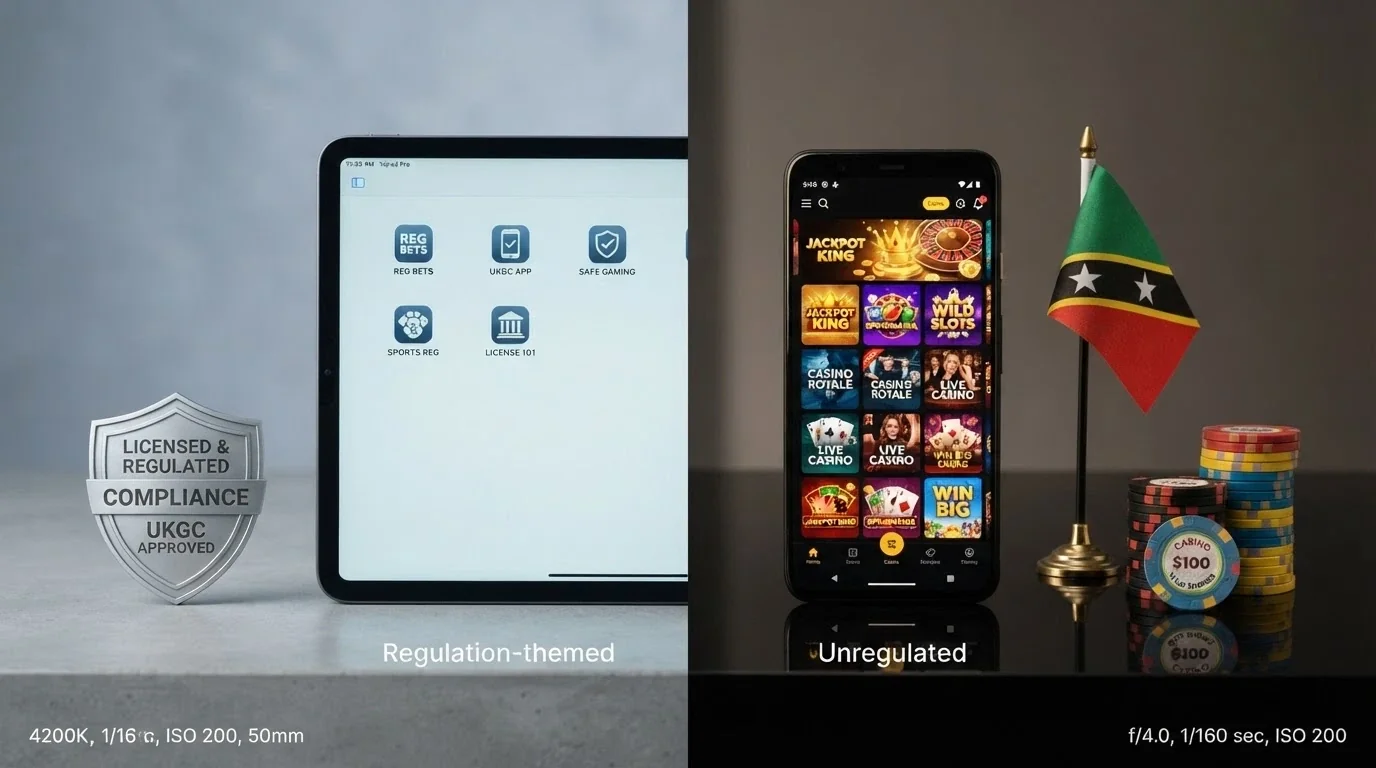
For the player, the most visible consequences are these: licensed bookmakers cannot advertise welcome bonuses or sign-up free bets. Credit cards, credit-related products and digital currency have been banned as payment methods since 11 June 2024, with penalties up to A$247,500 for non-compliance. There is no online casino on a licensed bookmaker’s product list, because the IGA prohibits the product altogether. Sportsbet cannot offer you a pokie. TAB cannot run a roulette wheel online. The legal wagering market in Australia is sports and racing only.
Offshore casinos operate outside all of that. They hold Curaçao or equivalent licences, accept the payment methods the Australian framework prohibits, and offer the casino games Australian law does not let a licensed bookmaker offer. The 2026 reform tightens the licensed side further: from 1 January 2027, broadcast wagering advertising is capped at three ads per hour between 6:00 am and 8:30 pm, with a blackout from fifteen minutes before any live sporting event until five minutes after. Athletes, celebrities and influencers are barred from promoting wagering products. Wagering advertising is banned inside sports venues and on player uniforms. Direct marketing of inducements is prohibited for fourteen days after sign-up, three months after BetStop deregistration, and indefinitely for at-risk customers. None of these new rules bind offshore operators, because none of these new rules can reach offshore operators.
What you trade away when you play outside the Australian system
The consumer protections a player loses by going offshore are not abstract. They are concrete, named, and they stop at the border.

There is no Australian consumer protection. There is no Australian complaints body. There is no BetStop coverage. There is no recourse if the offshore operator refuses a withdrawal, voids a win on a terms-of-service technicality, or simply stops responding to support emails. The site can be blocked by Australian ISPs at any time, with the player’s balance still sitting on it. ACMA has blocked 1,564 illegal gambling and affiliate websites since the first blocking request in November 2019; more than 225 illegal services have withdrawn from the Australian market since 2017 enforcement was strengthened. A site that is reachable today may not be reachable next month.
The individual player is not prosecuted. The IGA targets the provider. That is a small mercy, and it is the only one on this side of the trade.
The clearest “tell” that a casino is offshore is a payment-method list. Credit cards and crypto are banned for licensed wagering since 11 June 2024. A site that accepts either is not licensed wagering. It is offshore. That is the fastest single check a reader can run.
New casino brands — fresh wrapping, the same offshore licence
A new domain does not change the regulatory reality. New casinos launching into the Australian-facing market in 2026 are rebrandings or new wrappers over the same offshore licences — Curaçao eGaming or, increasingly, the Anjouan licence. The launch date is a marketing artefact, not a regulatory one. A site launched last month sits in exactly the same position with respect to ACMA as a site launched five years ago. New domains are blocked in the same ISP cycle. The same enforcement architecture applies. The same gap with BetStop applies. The same lack of Australian complaints body, deposit protection, and recourse applies.
What is worth checking before depositing at an unfamiliar brand is straightforward. Confirm the licence — and check whether the licence is verifiable against the named regulator’s register. Confirm the payment-method list; offshore brands will accept crypto and credit cards, licensed ones will not. Look at the game providers; a brand running exclusively on one studio is a narrower proposition than a brand running on dozens. Read the bonus terms before any deposit; the headline figure is rarely the real figure.
Mobile play — responsive lobbies, no Australian app store presence
Offshore casinos do not appear in the Australian Apple App Store or Google Play Store for real-money casino games. The Australian app stores do not host them. The practical experience is a mobile-responsive website loaded in the phone’s browser, with the same game lobby, the same KYC (know-your-customer) verification flow at withdrawal, and the same offshore-licence reality as the desktop version. Some brands offer downloadable apps through their own sites, sidestepping the app stores entirely, but those are exceptions rather than the rule.
The KYC verification process for withdrawals is where the mobile experience slows down. Identity documents — a driver’s licence, a passport, a recent utility bill — have to be uploaded and reviewed before the first significant withdrawal. That is true at every legitimate operator; offshore does not mean unverified. It means verified outside Australia, by the offshore operator’s own compliance team, with no Australian complaints body standing behind the decision if the verification is contested.
VPN use at offshore casinos is a separate matter. Some operators block known VPN endpoints. Others do not check. The legal position of the player is unchanged either way: the operator is the party the IGA targets. But a brand that does not enforce geo-restrictions at all is also a brand with weaker player-protection infrastructure than its competitors, and that is information worth having before any deposit.
Your bonus looks massive — until you read the fine print
Welcome packages at offshore casinos are bigger than anything a licensed Australian bookmaker can advertise. That is not a coincidence; the inducement ban under the National Consumer Protection Framework is exactly what stops the licensed side competing on this dimension. Neospin runs a 300% match up to A$11,000 plus 300 free spins spread across four deposits, with 40x wagering on the bonus and 30x wagering on free-spin winnings, a fourteen-day validity window per tier, a A$20 minimum qualifying deposit, and a A$5 maximum bet during bonus play. SkyCrown’s package sits at A$8,000 plus 400 free spins over four deposits, with the same 40x/30x split and the same fourteen-day window. RocketPlay runs 300% up to A$6,000 plus 300 free spins at 30x–40x wagering, with a weekly cashback offer at 5x wagering. Golden Crown offers a 100% match up to A$15,000 plus 300 free spins on first deposit at 40x wagering — the largest single-bonus figure in the featured set, though the match rate is the lowest.

The headline numbers describe the ceiling of what the bonus could be worth, not what it will cost the player. The arithmetic that matters is the wagering. Take Neospin’s top tier: a 300% match up to A$11,000 implies A$440,000 of required turnover at 40x wagering on the bonus amount alone. Pokies contribute 100% toward that turnover; table games and live dealer games contribute only 10–20%. The expected cost of clearing that bonus at a 96.71% return-to-player pokie — Big Bass Bonanza is the natural reference — runs to roughly A$14,476 over the bonus’s life, assuming only the bonus amount is wagered. That is the offer’s real cost before any free-spin winnings, deposit top-ups or the possibility of walking away early. It is a statistical estimate across many spins, not a guaranteed outcome for any single player, and it is the figure the A$11,000 headline does not print.
The gap between the headline and the cost is exactly the inducement an inducement ban is designed to remove. The licensed side does not advertise at this scale because it cannot. The offshore side does, because the rules that stop it do not apply. The number a player should hold against the headline is the wagering multiple — 40x, 30x, 35x — and the contribution table that decides which games count toward clearing it.
Free spins — what 300 or 400 spins actually cost you in wagering
The free-spin total is the eye-catching number, and the wagering on winnings decides the real worth. Neospin’s 300 free spins arrive at 30x wagering on whatever the spins pay out, with a A$5 maximum bet during bonus play. SkyCrown’s 400 free spins carry the same 30x split. RocketPlay’s 300 free spins are listed at 30x–40x wagering on winnings. Across the featured set, free-spin counts run from 50 (Spinsy) to 400 (SkyCrown), with the wagering on winnings almost universally in the 30x–40x band.
What this means in practice: a free spin at A$0.20 stake that returns A$2.00 in winnings has to be wagered 30 times — A$60 of turnover at minimum — before the win is withdrawable. If the win returns zero, the wagering requirement is zero. Free-spin value is therefore bimodal: most spins return nothing, the occasional spin returns a small win, and very rarely a spin returns enough to make the playthrough worth the time. The expected value is set by the game’s RTP, the wagering multiple, and the maximum bet limit during bonus play — all three of which the operator sets. A player reading the offer should treat the spin count as marketing copy and the wagering multiple as the binding constraint.
Game eligibility is the second moving part. Most offshore casinos restrict bonus wagering to a specific pokie or a short list of slots. Big Bass Bonanza, Gates of Olympus, and the Sugar Rush/Sweet Bonanza family are common choices. The contribution rate — 100% for pokies, 10–20% for table games and live dealer — is the third. A player who clears a bonus on roulette rather than pokies has to wager five to ten times as much to contribute the same clearing value.
No-deposit bonuses — the A$10 free chip with a A$50 ceiling
No-deposit bonuses at offshore casinos typically range from an A$10 free chip with 30x–60x wagering and a A$50–A$200 maximum cashout cap, to 10–75 free spins with 30x–50x wagering on winnings. Royal Reels is the operator in this set with a confirmed no-deposit offer: an A$10 free chip at 30x wagering, with the cashout cap displayed at activation rather than fixed in advance. That is the practical shape of no-deposit play in this market: a small stake of the operator’s money, a high wagering multiple relative to the amount, and a hard ceiling on what can be withdrawn.
The economics are unforgiving. An A$10 chip at 30x wagering requires A$300 of qualifying play. At a 96% RTP pokie, the expected loss during clearing runs to roughly A$12 — which is greater than the A$10 bonus itself. A player who walks away with anything is winning against a negative expectation. The maximum cashout cap means a lucky run is not paid out at full value either. No-deposit bonuses exist because they convert sign-ups into depositing players. The player’s task is to read the cap and the wagering before claiming, and to keep the expected-value math in view.
Low-deposit entry — getting in the door for A$15
Minimum deposits across the featured set run from A$15 (Spinsy, via Neosurf, Jeton or Skrill) to A$20 (Neospin). Several offshore casinos have set the floor low enough to test the water without a heavy commitment. The trade-off is direct: a low minimum deposit also signals a brand that is competing hard on player acquisition, which often means aggressive bonus terms and tighter withdrawal conditions. A higher minimum deposit tends to pair with a broader bonus structure and a slower spend per session.
Spinsy’s A$15 minimum via Neosurf, Jeton or Skrill — and up to A$8,000 via crypto — illustrates how the floor moves depending on the rail. Crypto deposits routinely lift the floor (or rather, raise the ceiling) because the operator is willing to take larger positions when the transaction is cheap to process. Card and e-wallet deposits cluster at the lower end. The qualifying deposit for a welcome bonus is almost always higher than the absolute minimum deposit; Spinsy’s A$15 is the floor, the bonus terms run at a different threshold.
For a player with a small bankroll, the relevant comparison is not which minimum is lowest but which bonus the minimum qualifies for, what the wagering looks like at that entry point, and whether the game library is rich enough to make a low-stake session worthwhile. A A$15 deposit at a 6,000-pokie casino is a different proposition to a A$15 deposit at a 1,200-pokie casino.
PayID works in seconds — the catch is whose hands your money lands in
PayID and Osko — the New Payments Platform rails that make instant bank-to-bank transfers possible in Australia — function at offshore casinos exactly as they function at licensed bookmakers. Deposits clear instantly. Withdrawals, once the identity check is complete, can land in fifteen to sixty minutes. Crypto withdrawals (Bitcoin, USDT) are faster still — Neospin processes crypto payouts in under thirty minutes. PayPal sits in the middle at around twenty-four hours. Visa and Mastercard withdrawals take two to five days.
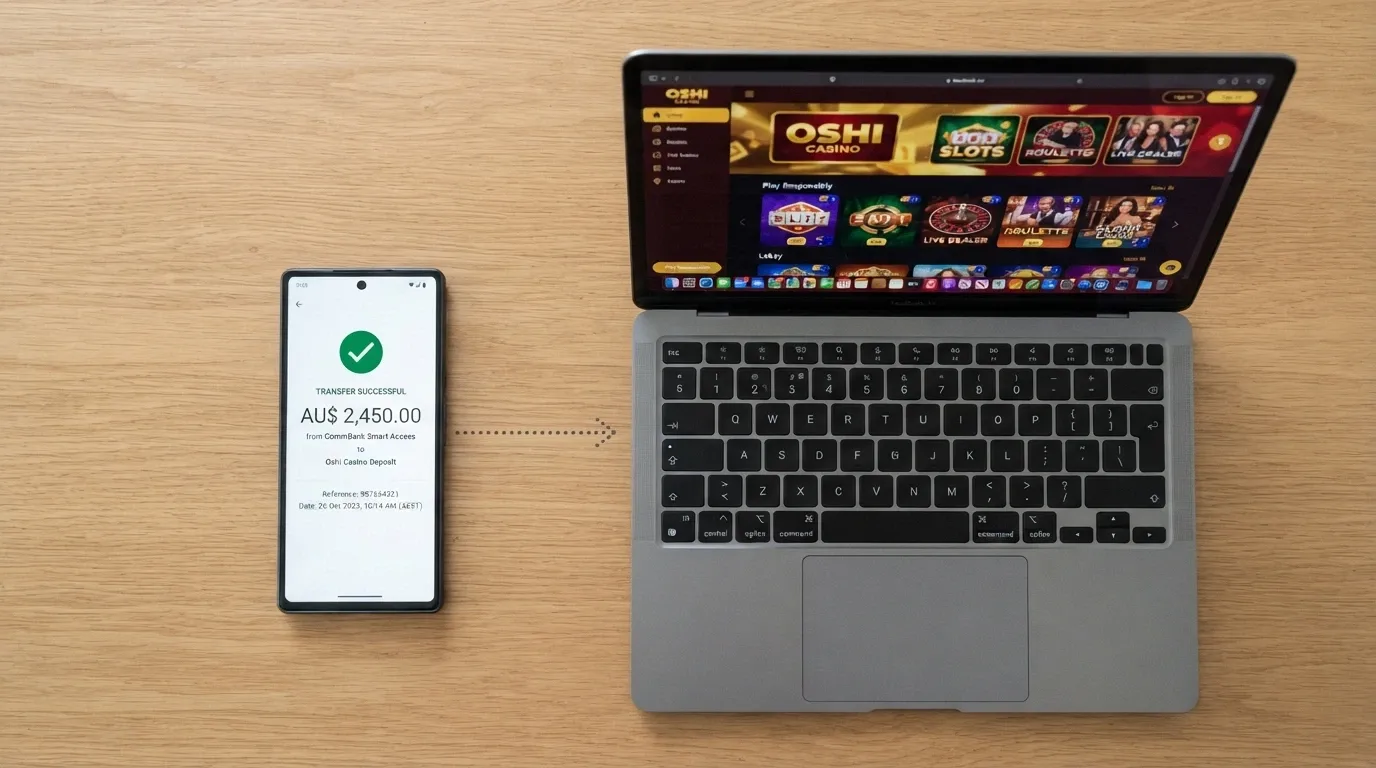
The speed is real. The geography of the money is the same as the speed of the money: it lands in a Curaçao-licensed operator’s account, not in an Australian regulated environment. From 1 January 2027, banks and payment providers gain express authority to block transactions to illegal gambling operators. Until then, the rails run as normal — and a player has no guarantee that the operator on the other end will process the withdrawal at all. PayID’s instant clearance cuts both ways: instant deposit, and instant receipt by an offshore entity whose consumer-protection obligations are set in Curaçao rather than in Canberra.
Card and crypto acceptance at an offshore casino is the cleanest single indicator that the brand is not Australian-licensed. Licensed wagering operators have been barred from accepting either since 11 June 2024, with penalties up to A$247,500 for non-compliance. A site that takes Visa and BTC is, by that test alone, offshore.
Phone-bill and carrier-billing deposits — a niche route with hard limits
Pay-by-phone and carrier-billing deposits exist at some offshore casinos, typically through third-party processors that convert the deposit into a charge on the player’s mobile bill or prepaid balance. The amounts are small — most providers cap a single transaction at A$30 to A$50 and a daily total at well below the welcome bonus’s minimum qualifying deposit. The method is rare among the featured operators in this set. Neosurf and other prepaid vouchers sit in the same niche — a way to deposit without a bank account or card, with hard limits on the size of any single transaction.
For most players, the practical use case is small top-ups after a low-stake session rather than a primary deposit route. A A$15–A$30 top-up on a pay-by-phone deposit cannot fund a welcome package that requires a A$20–A$30 minimum deposit followed by heavy wagering. The economics work best as a secondary option for the player who wants to keep gambling spend off their main bank statement.
The same pokies, the same providers, none of the protections
Offshore casinos run the same Pragmatic Play, NetEnt, Play’n GO and Big Time Gaming titles Australians know from licensed sportsbook-adjacent marketing and from the physical pokie rooms at Crown and the state-licensed venues. The reels are identical. The providers are the same studios. The RTP configurability is the offshore wrinkle: at a Curaçao-licensed operator, a studio like Pragmatic Play can ship a pokie at a configurable RTP, and the operator chooses what to set it to. Gates of Olympus can run at 96.50%, 95.51% or 94.50% on the same reels at the same maths — the difference is the operator’s setting, not the game’s design. Sugar Rush runs the same way. Players who care about RTP should look for the in-game information panel before they deposit, not just the lobby’s marketing copy.

Library depth across the featured set ranges from FairGO’s RealTime Gaming-exclusive catalogue to the multi-thousand-title libraries at the larger operators. SkyCrown runs 7,000+ games with 75+ live dealer tables; Neospin runs 8,000+ titles including 90+ live dealers; Spinsy lists 6,000+ slots from Pragmatic Play, NetEnt, Play’n GO and Microgaming. Wazamba’s 4,000+ figure is a market-context data point from outside the featured set. The relevant comparison for a player is not which library is largest — 6,000 pokies is 6,000 pokies for practical purposes — but which studios are represented, whether live dealer is offered, and whether the RTP settings are visible.
The pokies Australians are playing offshore — RTPs, volatility and max wins
Seven pokies dominate the offshore Australian-facing lobbies. They are the same seven the licensed-side marketing references, the same seven in the physical venues’ promotional material, and the same seven a player will see on the front page of most offshore casino lobbies. The table below sets out the figures that matter — provider, RTP, volatility, max win, and minimum stake — for each.
| Pokie | Provider | RTP | Volatility | Max Win | Min Stake |
|---|---|---|---|---|---|
| Big Bass Bonanza | Pragmatic Play | 96.71% | Low–Medium | 2,100x | A$0.10 |
| Sweet Bonanza | Pragmatic Play | 96.51% | High | 21,100x | A$0.20 |
| Gates of Olympus | Pragmatic Play | 96.50% (configurable to 95.51% / 94.50%) | High | 5,000x | A$0.20 |
| Book of Dead | Play’n GO | 96.21% | High | 5,000x | — |
| Bonanza Megaways | Big Time Gaming | 96.00% | High | 26,000x | A$0.20 |
| Starburst | NetEnt | 96.09% | Low | 500x | A$0.10 |
| Sugar Rush | Pragmatic Play | 96.50% (configurable to 95.50% / 94.00%) | High | 5,000x | — |
Three figures stand out. Sweet Bonanza’s 21,100x max win is unusual among Pragmatic Play’s catalogue. Bonanza Megaways’ 26,000x max win is the highest in the table and explains why the Megaways format remains a fixture in the lobbies. Starburst’s 500x max win is the lowest, paired with the lowest volatility — a pokie that pays small, often, and rarely for more than fifty times the stake. Big Bass Bonanza’s 2,100x max win at Low–Medium volatility is the closest thing in this set to a low-variance session pokie, and that is why it is the default bonus-eligible game at most offshore casinos running Pragmatic Play content.
The “configurable” RTP figures on Gates of Olympus and Sugar Rush are the practical reason a player should check the in-game information panel. The same reels can pay out at materially different rates. A 94% RTP game over A$440,000 of bonus turnover costs roughly A$26,400 in expected loss; a 96.5% game over the same turnover costs roughly A$15,400. The setting is the operator’s choice, not the player’s.
Live dealer tables — real studios, offshore operators
The live dealer floors at the larger offshore casinos run on the same studios that supply regulated markets. Pragmatic Play Live and Evolution are the names to expect — the same providers that supply the Crown Melbourne and The Star Sydney live tables run the offshore streams too. SkyCrown’s 75+ live dealer tables and Neospin’s 90+ live dealers are the two largest floors in the featured set; both are essentially the same Pragmatic Play Live and Evolution catalogue repackaged under an offshore brand. Blackjack, roulette, baccarat, game-show formats like Crazy Time and Monopoly Live — the lot.
What changes at the offshore wrapper is the dispute resolution path. A dispute over a live-dealer outcome at a Curaçao-licensed operator is adjudicated by the operator’s own complaints team, escalating to the Curaçao Gaming Control Board if the operator is unresponsive. There is no Australian complaints body for live-game disputes. A player with a contested hand at a licensed Australian venue can escalate through the state regulator. At an offshore venue, the escalation ends at the offshore licence-issuer. The game is the same. The route to a remedy is not.
How game libraries stack up across the featured ten
Library size is the easiest comparison to make and the least useful for the player. The 6,000-pokie casino and the 8,000-pokie casino carry effectively the same Pragmatic Play, NetEnt and Play’n GO catalogue for any practical session — a player will not exhaust 6,000 pokies in a year. The relevant differences are provider mix, table-game and live-dealer depth, and the presence (or absence) of the studios the player prefers.
FairGO is the outlier in this set. Its catalogue is RealTime Gaming exclusive. RealTime Gaming is a long-established studio with a deep back-catalogue — Achilles, Bubble Bubble, Cash Bandits, the Asian-themed slots — but the catalogue is narrower than the multi-provider offerings at the other nine operators. For a player who prefers the RTG style and wants a casino whose entire proposition is built around it, FairGO is a focused proposition. For a player who wants the full Pragmatic Play / NetEnt / Evolution spread, FairGO is the wrong operator.
Stake’s library runs Pragmatic Play and Hacksaw Gaming prominently, with the wider Pragmatic Play Live catalogue on the live side. Its 1.28% Australian market share reflects a more limited promotional spend on the Australian-facing market than the larger featured operators.
Responsible gambling — the safety net that stays inside Australia’s borders
Approximately 2.1% of Australian adults — roughly 430,000 people — experience problem gambling. The Australian Institute of Health and Welfare put high-risk gambling at 1.8% in 2022. Both figures are population-level estimates; the number that matters for any individual player is whether the gambling has stopped being fun. If it has not, the help that exists is real, free, and does not ask which casino you played at.

The National Gambling Helpline — 1800 858 858 — is staffed 24 hours a day, 7 days a week. It is free. It is confidential. It connects to telephone and online counselling through Gambling Help Online at gamblinghelponline.org.au. The 2026 reform expands specialised financial counselling services for people experiencing gambling-related financial difficulty — a recognition that the harm is often financial before it is anything else. Self-assessment tools at Gambling Help Online let a player take stock before they call. State-based services — Gambling Help NSW, Gambler’s Help Victoria, the equivalents in each state and territory — supplement the national entry points but do not replace them.
The safety net that stops at the border is the part most players do not think about until they need it. There is no Australian complaints body for offshore casino disputes. There is no BetStop coverage. There is no deposit protection if the operator fails. The offshore brands that take problem gambling seriously do offer internal deposit limits, time-outs, and self-exclusion at their own site. None of those tools is portable across the offshore market, and none of them is recognised by an Australian regulator.
The border your self-exclusion cannot cross
Registering with BetStop closes every Australian-licensed wagering account at once — Sportsbet, TAB, Ladbrokes, bet365, the rest of the roughly 150 licensed providers, in a single exclusion. That is the register working as designed. What it does not do is reach the offshore casino. A player who has self-excluded and then deposits at an offshore casino on a phone in the same week has not breached any Australian law — the IGA does not target the player — but they have also not been protected by their BetStop registration. The offshore operator has no notification, no obligation to check, and no exclusion to honour.
The 2026 reform tightens the licensed side of this further. From 1 January 2027, direct marketing of inducements is prohibited for three months after a person deregisters from BetStop — recognising that deregistration is a vulnerable moment, and that the licensed industry’s response should be quiet rather than loud. The 14-day post-signup marketing ban and the indefinite ban on marketing to at-risk customers sit alongside it. None of this binds the offshore operator.
For a player who has self-excluded and is tempted by the offshore option: the trade is not “BetStop on one side, no protection on the other.” It is “no protection anywhere.” The same harm-minimisation tools that worked at the licensed bookmaker simply do not exist at the offshore casino, and the offshore casino has no incentive to develop them.
Where to get help — helplines, counselling and tools that actually work
The single most useful piece of information on this page is this: the National Gambling Helpline on 1800 858 858 is free, confidential, 24/7, and does not ask which casino you played at. Gambling Help Online at gamblinghelponline.org.au provides online chat and email counselling on the same terms. The 2026 reform expands specialised financial counselling for gambling-related financial difficulty — the part of the harm that arrives after the session is over and the bank balance has shifted.
A self-assessment at Gambling Help Online takes a few minutes and gives a private, structured reading of where a player’s gambling sits. The state-based services — Gambling Help NSW, Gambler’s Help Victoria, the Queensland, South Australian, Western Australian, Tasmanian, ACT and Northern Territory equivalents — provide face-to-face and telephone counselling alongside the national entry points. None of these services depends on where the gambling happened. All of them are reachable from a phone in Australia, regardless of which casino the player used.
If the harm is financial, the National Debt Helpline on 1800 007 007 is the parallel entry point. Gambling-related debt is a significant share of the calls financial counsellors handle, and the 2026 reform recognises that the counselling capacity needs to grow with the problem.
Top 10 Casinos Accepting Australians Without BetStop
Every operator below holds a Curaçao eGaming licence or equivalent offshore authorisation. None holds an Australian licence for online casino games, because no such licence exists. Each accepts Australian registrations, processes Australian dollars, and sits outside the consumer-protection framework that follows Australian licensing. The table ranks the featured set; the individual profiles below it set out the offer shape and the wagering in detail.
| Casino | Licence | Welcome Bonus (AUD) | Wagering Requirement | Free Spins | AU Market Share |
|---|---|---|---|---|---|
| Neospin | Curaçao | 300% up to A$11,000 (4 deposits) | 40x bonus / 30x FS winnings | 300 | — |
| SkyCrown | Curaçao | Up to A$8,000 (4 deposits) | 40x bonus / 30x FS winnings | 400 | 8.55% |
| RocketPlay | Curaçao | 300% up to A$6,000 | 30x–40x | 300 | 9.4% |
| Golden Crown | Curaçao | 100% up to A$15,000 | 40x | 300 | — |
| Stake | Curaçao | — | — | — | 1.28% |
| Bizzo Casino | Curaçao | Up to A$450 + 150 FS | — | 150 | 0.57% |
| Royal Reels | Curaçao | A$10 no-deposit bonus | 30x | — | 2.51% |
| FairGO | Curaçao | — | — | — | 0.8% |
| Spinsy | Curaçao | 150% up to A$1,500 (3 tiers) | 35x | 50 | — |
| WinSpirit | Curaçao | Up to A$2,000 + 350 FS | — | 350 | 1.55% |
The market-share figures are from the operators’ Australian traffic share, not from regulatory filings — Curaçao eGaming does not publish per-brand issuance or Australian-traffic data. The blanks where research does not carry a figure are honest gaps, not endorsements. A A$15,000 headline at Golden Crown is not the same value as a 96% RTP pokie session. A “—” in the table is a thing the player should know about, not a thing to assume away.
Neospin — 300% welcome push with an 8,000-title catalogue
Neospin runs the largest headline bonus in the featured set: a 300% match up to A$11,000 plus 300 free spins spread across four deposits, with 40x wagering on bonus funds and 30x on free-spin winnings. Each tier carries a fourteen-day validity window and a A$5 maximum bet during bonus play. The qualifying deposit is A$20. Behind the offer sits an 8,000+ title library and 90+ live dealer tables — the largest game catalogue in the set.
The 300% match rate is the offer’s structural advantage. A A$3,667 deposit captures the full A$11,000 bonus. The cost of clearing it at the 96.71% Big Bass Bonanza benchmark runs to roughly A$14,476 in expected loss over the bonus life, assuming only the bonus is wagered. That is the trade at the headline offer, plainly stated. The 90+ live dealer tables give the brand the deepest live-game proposition among the featured set, and the Pragmatic Play / NetEnt / Play’n GO mix covers the studios most Australian players already have preferences on.
Neospin is an option for players who can maintain the discipline required to clear the bonus — sticking strictly to pokies, keeping to the A$5 max bet, and completing each tier within the fourteen-day window. It provides a large library of 8,000+ titles once the bonus funds are played through.
SkyCrown — 400 free spins and the largest live-dealer floor in the set
SkyCrown runs A$8,000 plus 400 free spins over four deposits, with 40x wagering on bonus funds, 30x on free-spin winnings, fourteen days validity per tier, and a A$5 maximum bet during bonus play. The 7,000+ game library and 75+ live dealer tables are the second-largest in the featured set. SkyCrown holds 8.55% of the Australian-facing offshore casino market — the fourth-largest share in this ranking.
The 400 free spins are the headline’s centre of gravity. Spread across four deposits, that is 100 free spins per tier — a credible volume if the wagering on winnings stays at the 30x floor. The A$8,000 cash match is smaller than Neospin’s A$11,000 ceiling, but the free-spin volume is higher and the live-dealer proposition is broader.
For players prioritising live dealer game volume and free-spin quantity over a high total cash match, SkyCrown offers a compelling alternative. The package structure is designed for those who intend to utilise all four deposit tiers rather than just making a single one-off deposit.
RocketPlay — 300% match with weekly cashback at 5x
RocketPlay runs a 300% match up to A$6,000 plus 300 free spins, with wagering in the 30x–40x range across the package. The weekly cashback offer runs at 5x wagering — meaningfully lower than the welcome bonus’s 30x–40x. RocketPlay holds 9.4% of the Australian-facing offshore market, the third-largest share in this ranking.
The 300% match rate matches Neospin’s structure, but the A$6,000 ceiling is lower. The cashback offer is the differentiator. A 5x wagering requirement on cashback returns is light against a 30x–40x welcome bonus — if a player treats the cashback as the primary value rather than the welcome package, the effective wagering burden drops substantially. Weekly cashback is also a recurring offer, where a welcome package is a one-time proposition.
RocketPlay distinguishes itself with a weekly cashback offer that features a low 5x wagering requirement. It is better suited to players who intend to remain active long after the initial welcome package has been exhausted.
Golden Crown — A$15,000 headline on a single-deposit 100% match
Golden Crown runs a 100% match up to A$15,000 plus 300 free spins on first deposit, with 40x wagering on the bonus. The headline figure is the largest in the featured set. The 100% match rate is the lowest — meaning a player has to deposit A$15,000 of their own money to capture the full bonus.
The trade is direct: the largest single-bonus ceiling in the ranking, paired with the most capital-intensive qualifying deposit. A player with a high bankroll who plans a single large deposit rather than a four-tier grind captures more total bonus value here than at any other operator. A player with a smaller bankroll cannot reach the ceiling at all. Golden Crown’s free-spin count matches Neospin’s and SkyCrown’s at 300.
Golden Crown suits a high-bankroll player making a single large first deposit and clearing a substantial bonus over the validity window.
Stake — the crypto-first operator with 1.28% of the Australian market
Stake runs on a Curaçao licence with a crypto-native payment model. Bitcoin, Ethereum, USDT and other cryptocurrencies are the primary deposit and withdrawal rails; fiat options exist but are secondary. The provider mix centres on Pragmatic Play and Hacksaw Gaming, with the broader Pragmatic Play Live catalogue on the live side. Stake holds 1.28% of the Australian-facing offshore market — a smaller share than the larger featured operators, reflecting a more limited Australian promotional spend.
The structural difference at Stake is the absence of a standard welcome bonus. Promotions vary by region and run as time-limited events, races, and ongoing challenges rather than a fixed four-tier welcome package. For a player who values a predictable bonus structure, Stake is the wrong fit. For a player who values crypto-native banking, fast payouts, and a brand whose identity is not built around a welcome deposit match, Stake is exactly the right fit.
Stake suits a crypto-comfortable player who plans to keep playing past a single welcome offer and is comfortable evaluating promotions on a per-event basis.
Bizzo Casino — a compact welcome package with 150 free spins
Bizzo Casino runs up to A$450 plus 150 free spins, with a Curaçao licence. Its Australian-facing market share is 0.57%, the nineteenth-largest in this market. The multi-provider catalogue covers the studios most players expect.
The compact welcome package is the proposition. A$450 is a small ceiling against the A$11,000 / A$15,000 figures elsewhere in the ranking. The 150 free spins are the volume centre, and the qualifying deposit is correspondingly lower. A player with a small bankroll who wants to enter the offshore market at the lowest material commitment captures more proportional value at Bizzo than at the high-ceiling operators.
Bizzo suits a low-bankroll player who values the free-spin volume over the cash-match ceiling and is comfortable with a smaller brand’s market position.
Royal Reels — the A$10 no-deposit bonus that actually exists
Royal Reels runs a Curaçao licence with a confirmed no-deposit bonus: an A$10 free chip at 30x wagering, with the maximum cashout cap displayed at activation rather than fixed in advance. The 2.51% Australian-facing market share is the ninth-largest in the ranking — a meaningful share for a brand offering an entry point at no cost.
The no-deposit bonus is the proposition. A player who wants to test the offshore waters without depositing their own money has one operator in this ranking that lets them do it. The expected-value math is negative — an A$10 chip at 30x wagering has an expected clearing cost that exceeds the chip’s face value at typical pokie RTPs — but the cap on winnings means the player’s downside is bounded. The actual question is whether the brand’s post-no-deposit deposit offer is competitive, since the no-deposit chip exists to convert sign-ups into depositing players.
Royal Reels is an entry point for players wanting to explore an offshore site without an immediate financial commitment. Always review the maximum cashout cap displayed at activation before you begin playing with the no-deposit chip.
FairGO — the RTG-only casino with an Australian-focused catalogue
FairGO runs on a Curaçao licence with an exclusive RealTime Gaming catalogue. Its 0.8% Australian-facing market share is the sixteenth-largest in this market. RealTime Gaming — Achilles, Bubble Bubble, Cash Bandits, the Asian-themed slots — has a long history in the Australian-facing market, and FairGO’s proposition is built around it.
The catalogue shape is the trade. A player who likes the RTG style and prefers a focused brand over a multi-provider library has a clean fit. A player who wants Pragmatic Play, NetEnt, and the broader multi-provider spread will not find it here. Bonus terms were not surfaced in this round of research; a player considering FairGO should check the operator’s terms page directly before depositing.
FairGO is designed for enthusiasts of the RealTime Gaming catalogue who prefer a curated, single-studio experience. It is a specialised alternative to the broader, multi-provider platforms that dominate the rest of this ranking.
Spinsy — 6,000-plus slots and a 150% three-tier welcome
Spinsy runs on a Curaçao eGaming licence with a 150% match up to A$1,500 plus 50 free spins spread across three tiers, with 35x wagering. The library lists 6,000+ slots from Pragmatic Play, NetEnt, Play’n GO and Microgaming. The minimum deposit is A$15 via Neosurf, Jeton or Skrill — the lowest in the featured set — and up to A$8,000 via crypto.
The combination is the offer’s structure. A 150% match across three tiers and a 50-free-spin package is a smaller headline than the 300% four-tier offers elsewhere, but the entry threshold is lower and the library is broad. Pragmatic Play, NetEnt, Play’n GO and Microgaming cover the studios most Australian players already play, and the 6,000+ slot count is competitive with the larger featured operators.
Spinsy suits a low-bankroll player who wants the full multi-provider catalogue and a low entry threshold, and who values a tiered structure they can pace over three deposits.
WinSpirit — A$2,000 welcome with 350 free spins
WinSpirit runs up to A$2,000 plus 350 free spins on a Curaçao licence, with 1.55% of the Australian-facing market — the eleventh-largest share in the ranking. The multi-provider catalogue covers the studios most players expect.
The 350 free spins are the proposition’s centre of gravity. Second-highest in the featured set after SkyCrown’s 400, paired with a moderate A$2,000 cash match. Wagering terms were not surfaced in this round of research; a player considering WinSpirit should check the operator’s terms page directly.
WinSpirit suits a player who values free-spin volume over cash-match ceiling and is comfortable verifying the wagering terms at the operator’s own pages.
How we picked and ranked these casinos
The operators listed on this page were selected based on their Australian-facing traffic and market reputation. Each brand was checked against the ACMA register of blocked sites to confirm it is not on the active blocking list as of 2026. Each brand’s licence claim was verified against the named regulator’s public register where the register carries per-brand details — Curaçao eGaming’s public-facing register does not carry per-brand issuance dates for all operators, so licence date confirmation is partial across the set. Bonus data was collected from operator bonus tables and monitoring pages current to mid-2026.
The ranking criteria, in order: licence jurisdiction and ACMA blocking status; bonus structure and wagering burden; game-library depth and provider mix; payment-method coverage including PayID and crypto; and Australian-facing market share where available. No single criterion dominates; a brand with a larger bonus and tighter wagering ranks above one with a smaller bonus and lighter wagering only when the total clearing cost favours it. Brands that have entered the Australian-facing market recently and have no trackable market-share figure are ranked on the structural criteria above.
The ranking is editorial. A reader who weights free-spin count over cash-match ceiling, or crypto-native banking over fiat, will reach a different ordering. The intent is to set out the trade each operator makes — large bonus and heavy wagering, or small bonus and lighter terms, or no standard welcome offer at all — and let the player pick from a known shape.
Two exclusions are worth noting. The licensed Australian wagering operators — Sportsbet, TAB, Ladbrokes, bet365, Neds, PointsBet — are not in this ranking, because they do not offer casino games and the page is about online casinos. They are the only legally licensed online gambling operators in Australia. A player who wants the consumer-protection framework a licence brings should look at them first. A page that does not make this clear is misleading.
What this actually means before you deposit a dollar
Every figure on this page points to the same verdict: know what you are trading before you deposit.

The trade is bigger bonuses, faster sign-ups, and unrestricted game libraries on one side. Zero Australian consumer protection, no BetStop coverage, no Australian complaints body, no recourse for refused withdrawals, and a site that can be blocked at any time with a balance on it on the other. The licensed Australian bookmakers cannot offer the casino games the offshore casinos offer — that is the regulatory gap the offshore market exists in. They also cannot match the bonus sizes. Both halves of the comparison are structural, and neither will change without legislative action.
The practical test a player can apply before depositing: confirm the licence against the named regulator’s register. Read the wagering terms and the maximum-bet rule during bonus play. Check the payment-method list — credit cards and crypto acceptance is the cleanest offshore indicator. Look at the RTP settings on the pokies the bonus is restricted to. Read the maximum cashout cap on any no-deposit offer. None of these checks takes long, and each one is information an Australian-licensed operator would be required to publish.
If the gambling has stopped being fun, the National Gambling Helpline on 1800 858 858 is free, confidential, 24/7, and does not ask which casino you played at. Gambling Help Online at gamblinghelponline.org.au provides online chat and email counselling on the same terms. The 2026 reform expands specialised financial counselling for gambling-related financial difficulty. The help is real, it is Australian, and it works regardless of where the gambling happened.
From 1 January 2027 the licensed side tightens further — banks gain authority to block transactions to illegal operators, advertising is capped to three ads per hour with a live-sport blackout, athletes and influencers are barred from wagering promotion, and BetStop deregistration triggers a three-month marketing quiet period. None of these measures reaches the offshore operator. The page you are reading will still describe the same trade a year from now, unless the enforcement architecture shifts to follow the payment rails rather than the ISP blocks. That is a horizon worth watching, but it is not a horizon that resolves the trade today.
Frequently asked questions
What happens to my BetStop self-exclusion if I play at an offshore casino?
Registering with BetStop excludes you from all licensed Australian wagering services, but it does not reach offshore casinos. An offshore operator is not connected to the register and has no obligation to check it. If you have self-excluded, an offshore account remains open, and your activity is not monitored or protected by Australian regulation.
“Not on BetStop” describes every online casino that accepts Australian players, because no online casino has ever been on BetStop. The register covers the roughly 150 wagering providers licensed in Australia — sports and racing — and online casino games cannot be licensed in this country at all. The Interactive Gambling Act 2001 prohibits online casinos, online pokies and in-play betting. The individual player is not prosecuted under the IGA; the Act targets the operator offering the games.
Are online casinos not on BetStop safe to use if they are not licensed in Australia?
They are not Australian-licensed, so they do not have access to Australian consumer protection, Australian dispute resolution, or BetStop coverage. They hold offshore licences (Curaçao in most cases) and operate under those licences’ own complaint and compliance frameworks. A player has no recourse through any Australian body if a withdrawal is refused or a win is voided. The site itself can be blocked by Australian ISPs at any time, with the player’s balance still on it.
What bonuses and free spins can I get at casinos not on BetStop?
Welcome packages at the featured operators run from a A$10 no-deposit bonus (Royal Reels) up to a 100% match to A$15,000 plus 300 free spins (Golden Crown), with most brands clustering in the A$1,500–A$11,000 range with 50–400 free spins. Wagering requirements typically sit at 30x–40x on bonus funds and 30x on free-spin winnings, with fourteen-day validity windows per deposit tier and A$5 maximum bets during bonus play. Pokies contribute 100% to wagering; table games and live dealer contribute 10–20%.
What are the most popular pokies available at non-BetStop casinos and what are their RTPs?
The seven most-played pokies at Australian-facing offshore casinos are Big Bass Bonanza (96.71%), Sweet Bonanza (96.51%), Gates of Olympus (96.50%, configurable to 95.51% or 94.50%), Book of Dead (96.21%), Bonanza Megaways (96.00%), Starburst (96.09%) and Sugar Rush (96.50%, configurable to 95.50% or 94.00%). Several of these titles — notably Gates of Olympus and Sugar Rush — ship from the studio with configurable RTP ranges, and the offshore operator chooses the setting. The in-game information panel shows the live RTP for the version in play.
Why are credit cards and cryptocurrency banned at licensed Australian gambling sites?
Credit cards, credit-related products and digital currency were banned as payment for online wagering from 11 June 2024 under the Interactive Gambling Amendment (Credit and Other Measures) Act 2023. The intent is to reduce harm by removing payment methods that let a player overspend beyond their available funds, and to limit the use of unregulated payment rails in the wagering market. Penalties for non-compliance run up to A$247,500. A casino that accepts credit cards or crypto is, by definition, offshore rather than licensed.
Will the 2026 gambling reforms affect casinos not on BetStop?
The 2026 reform measures — passed in August 2026 and commencing 1 January 2027 — target Australian-licensed operators and Australian-based advertising. They cap broadcast wagering advertising, ban live-sport-period wagering ads, bar athletes and influencers from promoting wagering products, and prohibit direct marketing of inducements for three months after BetStop deregistration. They also give banks authority to block transactions to illegal gambling operators. None of these rules binds an offshore operator directly, but the bank-blocking authority is the lever most likely to change the practical experience of depositing at an offshore casino from an Australian bank account.
Published by the Casino Payment Methods AU team.