
$10 No-Deposit PayID Casino Offers in Australia: What the Bonus Headline Leaves Out
 Available in AU
A A$10 no-deposit bonus at an Australian-facing casino reads like the gentlest on-ramp gambling has ever offered — sign up, take the free money, play a few pokies, see what happens. The marketing leans into that softness: free chip, free spins, no deposit required. The fine print underneath it rewrites the deal. Three numbers decide whether the bonus is worth claiming, and none of them is the A$10 headline. The wagering multiple runs from 30x to 60x. The maximum cashout caps at somewhere between A$50 and A$200. The expiry window can be as tight as three days. And every operator on this page is offshore, because no online casino holds an Australian licence — the product they sell is prohibited under the Interactive Gambling Act 2001.

That is the shape of the page below: not a list of coupons to clip, but a comparison of what the A$10 buys, what it costs to clear, and what sits behind the offshore wrapper that delivers it.
Current as of 18 October 2026. Licence and bonus terms cross-checked against the ACMA enforcement register and each operator’s published terms and conditions.
- The $10 Casino Landscape in Australia — More Complicated Than It Looks
- Your $10 No-Deposit Bonus — What It Costs to Claim
- Top $10 No-Deposit Operators Compared
- PayID at Offshore Casinos — Fast In, Slow Out
- Why Every Casino on This Page Is Offshore
- Safer Play at $10 — Tools That Actually Work in Australia
- How We Evaluated These $10 No-Deposit Operators
- Your $10, Your Call — What the Numbers Say
- Frequently Asked Questions
The $10 Casino Landscape in Australia — More Complicated Than It Looks
The A$10 entry stake sits at the bottom of an offshore market that the Interactive Gambling Act 2001 has tried to push out of Australia for nearly a quarter-century. The Act makes it an offence to provide an online casino, online pokies or in-play sports betting to a person physically in Australia. There is no licence for any of it — not federally, not in any state, not in any territory. The Act targets the provider, not the player, which is why the offers keep appearing. Individual Australians are not prosecuted for placing a bet at an offshore casino; the operator is the one on the hook, and ACMA’s enforcement record shows what that pressure looks like in practice.
The headline figure behind that pressure: ACMA has had 1,564 illegal gambling and affiliate websites blocked by Australian ISPs since November 2019, and more than 225 illegal services have withdrawn from the Australian market since enforcement was strengthened in 2017. In the last quarter of 2025 alone, ACMA completed 23 investigations, found 69 breaches, issued 10 formal warnings and referred 133 websites to ISPs for blocking. The pace is not slowing. It is accelerating.
The market responds in two ways. The first is to keep going — 36% of Australian online gambling still happens on offshore sites that the ACMA cannot fully reach. The second is to dress the product in local clothing. PayID deposits make an offshore casino feel like a licensed Australian bookmaker. A “.com.au” domain and AUD denomination make the cashier look familiar. None of that changes the legal position. A local payment method is not a local licence. PayID to an offshore operator is a person-to-person transfer to a payment intermediary whose name typically does not match the casino brand, and once the funds clear, reversing them is hard.
That is the structural backdrop for everything that follows. The A$10 bonus is real, and the wagering terms that come with it are real, and the offshore status of every operator in this comparison is real. The reader is the one who has to weigh those against each other.
The $10 Entry Stake — What It Buys at an AU-Targeted Casino
The A$10 no-deposit bonus is the floor of the offshore market targeting Australians. It is also the marketing bait that leads to a deposit-gated welcome package with substantially higher numbers behind it — a 100% match up to A$500 plus 50 free spins, a package worth A$5,500 plus 125 free spins, a welcome bonus that runs into four-figure totals. The A$10 chip is the conversation starter. The match deposit is the sale.
On its own terms, a A$10 no-deposit offer buys a small slice of pokies play with strict limits on what comes out the other side. Typical terms across the segment: wagering multiple between 30x and 60x, which means turning the bonus over 30 to 60 times before any withdrawal is permitted; maximum cashout between A$50 and A$200, which caps the upside regardless of what the pokies actually return; bonus expiry 7 to 14 days for cash chips and as short as 3 to 7 days for free spins, with some operators compressing the window to 48–72 hours; and a maximum bet during wagering that typically sits at A$5 to A$8 per spin. Each of those numbers is a guardrail, and together they convert a “free” A$10 into a tightly constrained bet on the house’s terms.
The entry price on the deposit side is similarly modest — PayID minimums at most AU-facing casinos land at A$10 to A$20, though several operators set the first-deposit floor at A$30 to qualify for the welcome package. The A$10 free chip and the A$10 minimum deposit are not the same product, but they share an audience: a punter who wants to feel the casino out before committing real money.
Online Casino vs Retail Framing — Why the Words Matter
Australia runs a two-track gambling market that the offshore industry exploits every day of the week. On one track: licensed wagering on races and pre-event sport through operators approved by a state or territory — Sportsbet, bet365, Ladbrokes, the TAB network. The Northern Territory Racing and Wagering Commission, administered through Licensing NT, is the de facto national licensor for online wagering, with licence terms running up to 20 years. On the other track: online casino games and online pokies, which no Australian regulator can license because the IGA prohibits the activity outright. A licensed Australian bookmaker cannot legally offer you a A$10 free chip to play pokies, no matter how much it might want to compete with the offshore sites doing exactly that.
The offshore product dresses itself to look like the licensed one. AUD balances, PayID cashier buttons, “.com.au” domains, customer support teams who know the Australian banking system. Some even use the word “pokies” instead of “slots” to signal familiarity. None of that grants Australian legitimacy. The test is not the wrapper; it is the licence jurisdiction and the regulatory body behind it. Curaçao, the Tobique Gaming Commission in a small Canadian province, Costa Rica incorporation — these are the addresses behind the offers on this page. None of them gives an Australian punter a BetStop entry, an Australian consumer law remedy, or a route through the ACMA complaints process.
The credit card and crypto ban that took effect on 11 June 2024 sharpened the difference. From that date, no licensed Australian operator can accept a credit card or cryptocurrency for wagering, with penalties of up to A$247,500 for non-compliance. An offshore casino that still accepts both is advertising, by its payment options, that it sits outside the Australian framework.
The $10 Signal in Australian Bonus Marketing
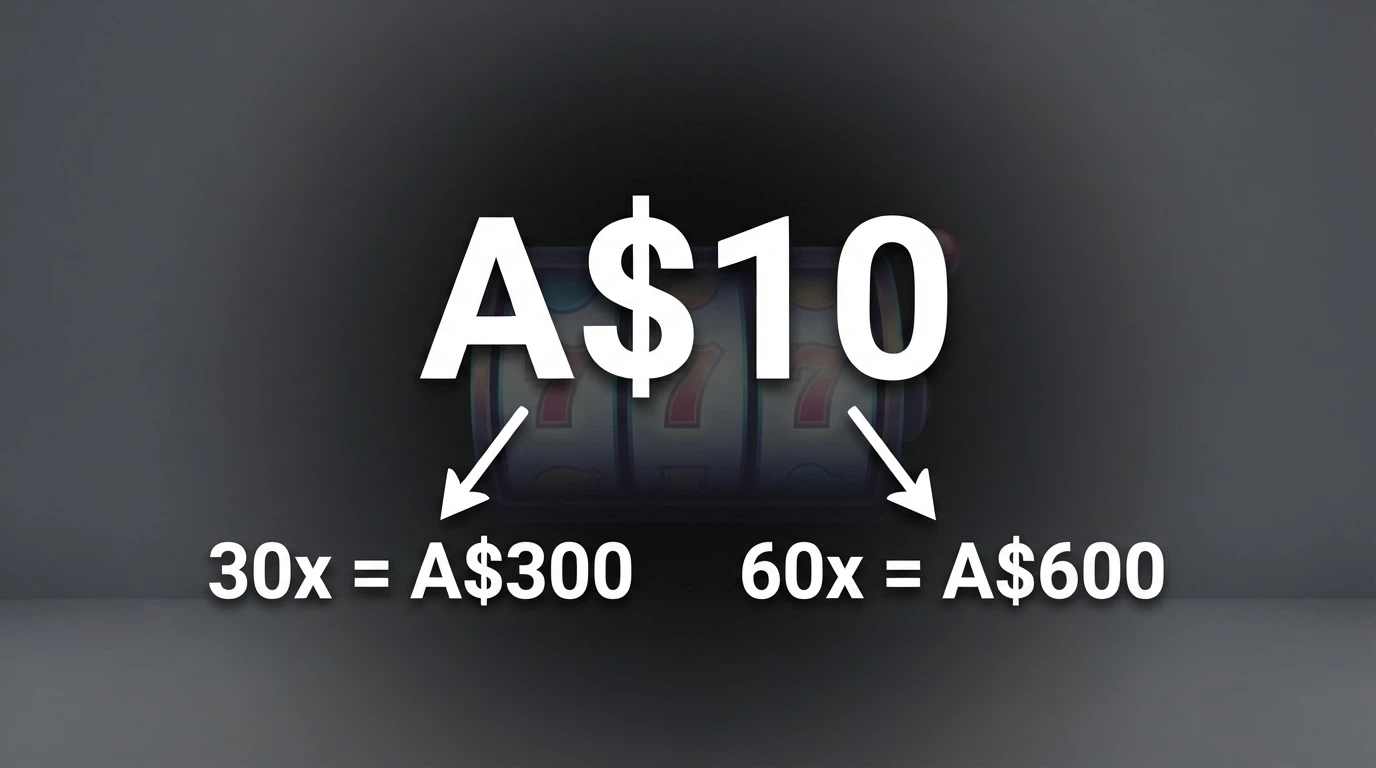
The A$10 entry stake is the segment’s psychological anchor. It is small enough to feel accessible and large enough to make clearing the wagering feel achievable — at 30x, a A$10 bonus needs A$300 of turnover, which sounds modest if you have not run the numbers on a six-second deposit cycle. The marketing message lands because it relies on a punt that most readers will not make: that “free” means free, that a 30x multiple is achievable, that the maximum cashout will not bind because surely the bonus will not pay out that much.
The market data tells a different story. GamblingInsider’s typical-terms read: cash-chip wagering 40x–60x, free-spin wagering 30x–60x on winnings, free-chip max cashout A$50–A$200, free-spin max cashout A$20–A$100, free-chip expiry 7–14 days, free-spin expiry 3–7 days. The numbers cluster tight enough that any operator deviating meaningfully in either direction is making a deliberate choice about the customer they want.
And the A$10 chip is rarely the destination. It is the doorway. Royal Reels’ A$10 no-deposit offer leads to a 100% match up to A$500 plus 50 free spins after verification. Wolf Winner’s welcome package runs up to A$5,500 plus 125 free spins. PlayAmo’s two-tier welcome — 100% up to A$500 plus 100 spins on the first deposit, then 50% up to A$1,000 plus 50 on the second — is a designed funnel from a small chip into four-figure bonus turnover. Read the A$10 as a marketing line item, not a product.
Your $10 No-Deposit Bonus — What It Costs to Claim
The cost of a no-deposit bonus is not the A$10. It is the turnover required to clear the wagering, the maximum cashout cap that bounds the upside, and the expiry window that decides whether you can complete the playthrough before the bonus is voided. The arithmetic behind those three numbers is where the offer either earns its keep or quietly bleeds value.
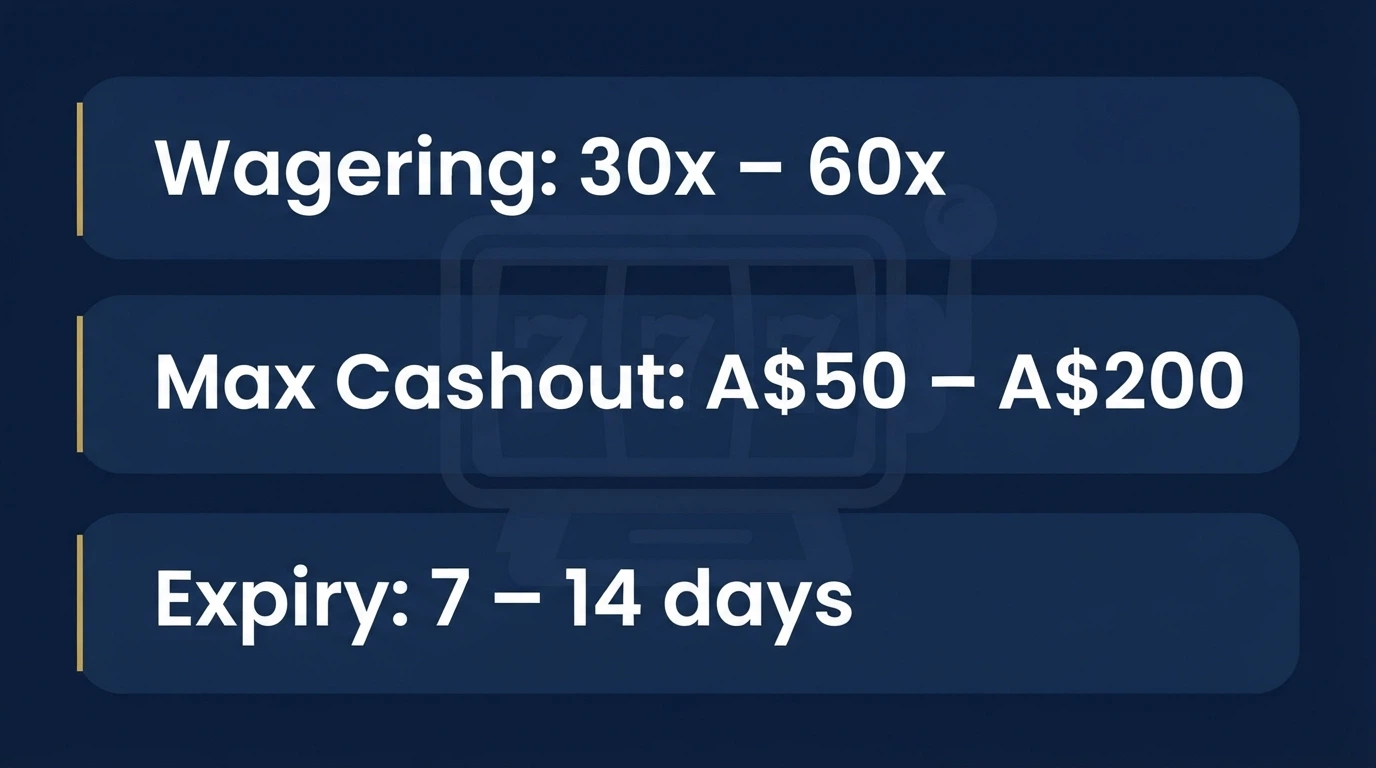
The expected-loss calculation that matters here: a A$10 bonus with 30x wagering means A$300 of required turnover through eligible pokies. At a representative RTP of 96.5%, the house edge on that turnover is 3.5%, and the expected loss across the wagering is A$10.50. The punter is, on average, paying A$10.50 to chase a A$100 maximum cashout. That is the actual price of the offer, before considering whether the cap will bind, whether the expiry will run out, or whether the eligible games will let the wagering be completed at all.
That expected-loss figure assumes only the bonus amount is wagered. It is a statistical estimate averaged across many spins under the stated conditions, not a prediction for any individual session.
What a $10 No-Deposit Bonus Actually Is
A no-deposit bonus comes in two flavours, and they are not interchangeable. The first is a cash credit — a A$10 balance added to a new account, playable on specified games, withdrawable only after the wagering requirement is cleared. The second is a free-spin bundle — a set number of spins at a fixed per-spin value (typically A$0.10 to A$0.50), with the winnings from those spins treated as bonus money that must itself be wagered before withdrawal. A cash credit is more flexible because the punter chooses the stake; a free-spin bundle is more constrained because the operator sets both the stake and the eligible slot.
Cash credits tend to carry higher wagering multiples and higher cashout caps. Free spins tend to carry lower caps but tighter expiry. Typical free-spin caps are 5x to 10x the bonus value: a A$10 free-spin bundle often caps withdrawals at A$50 to A$100, and the spin count itself ranges from as few as 10 (HellSpin, on PWA app download) to as many as 120 (Rocket Play, gamified registration missions). The bonus type shapes the risk profile before the wagering math even starts.
A no-deposit bonus also carries an implicit KYC step. Even without a deposit, the operator will verify identity before allowing a withdrawal — email confirmation at the low end, full document verification at the high end. That verification is the moment at which the operator’s “no deposit required” promise meets its compliance obligations, and it is also the moment at which refused withdrawals become possible.
Bonus Types at a Glance
| Bonus Type | Typical Wagering | Typical Max Cashout | Typical Validity |
|---|---|---|---|
| No-deposit cash chip | 40x–60x | A$50–A$200 | 7–14 days |
| No-deposit free spins | 30x–60x on winnings | A$20–A$100 | 3–7 days (sometimes 48–72 hours) |
| Deposit-match welcome | 50x (range varies) | No maximum cashout (common on first-deposit match) | 14 days |
The three structures are not equivalent value. A no-deposit cash chip looks generous on the surface but pairs a high wagering multiple with a low cashout cap. No-deposit free spins look like the safest trial because the stake is set, but the winnings cap is often lower and the expiry tighter. A deposit-match welcome usually removes the cashout cap entirely but raises the wagering multiple and gates the bonus behind a minimum deposit the no-deposit offer does not require. Each structure rewards a different kind of punter.
Wagering Requirements — The 30x–60x Trap
A 30x wagering multiple on a A$10 bonus requires A$300 of eligible-game turnover before any withdrawal is permitted. A 60x multiple requires A$600. The multiple is the single number that determines how much pokies play the bonus buys, and the segment’s typical range — 30x to 60x — is wide enough that an operator’s position in it is a clear signal of how much friction it intends to impose.
There is a second distinction that the marketing rarely surfaces: wagering on bonus-only versus wagering on bonus-plus-deposit. A no-deposit bonus by definition wagers on the bonus amount alone, since there is no deposit to add. A deposit-match bonus often wagers on the combined balance, which means the punter is grinding through their own real money as well as the bonus. At 50x on a A$500 deposit plus A$500 bonus, the required turnover is A$50,000 — a number that recasts “50x” from a multiplier into a workload.
The max-bet rule during wagering is the third guardrail. Most operators cap eligible bets at A$5 to A$8 per spin while the bonus is active. The cap exists to stop a punter from burning through the wagering in a handful of high-variance spins, and it works in both directions: it prevents the bonus from being cleared in minutes, and it prevents the maximum cashout from being reached in a single lucky hit. Rocket Play, for instance, sets its max bet during bonus play at A$7.50 — specific enough to be enforceable.
Maximum Cashout — What You Actually Keep
The maximum cashout is the ceiling that converts a potentially large pokies payout into a fixed bonus value. A A$10 bonus with a A$100 cashout cap cannot return more than A$100 regardless of how the wagering plays out. The cap binds more often than the marketing implies, because the wagering required to clear the bonus is itself the mechanism that gives the punter enough spins to potentially hit a feature round or a multiplier — and those are exactly the moments when a cap is most likely to bite.
The segment’s range is A$20 to A$200, with most operators clustering at A$75 to A$100. PlayCroco’s A$180 cap is the high-water mark in the featured set; Ripper Casino’s A$50 cap is the floor. SkyCrown’s A$100 cap is the median. The cap is a function of bonus type as much as operator generosity — no-deposit free spins cap lower than no-deposit cash chips, and deposit-match bonuses frequently carry no cap at all, a structural difference that makes the welcome package a different product from the trial chip.
What happens to winnings above the cap varies. Some operators forfeit the excess at withdrawal; others strip it from the bonus balance at the moment the cap is reached. Either way, the cap is a hard ceiling, and it is the line a reader should find before signing up.
Bonus Codes vs Auto-Credited Offers
Delivery mechanism is the part of the bonus mechanics the marketing pages skip over. Some A$10 no-deposit bonuses land automatically — SkyCrown’s credit is auto-credited on email verification, no code required. HellSpin’s 10 free spins land after the punter downloads the casino’s progressive web app. PlayAmo’s 25 free spins require an affiliate-exclusive code. Rocket Play’s 120 free spins come through gamified registration missions.
The distinction matters because it determines what triggers the bonus and what failure modes are possible. An auto-credited offer fails only at verification; a code-gated offer fails if the punter enters the wrong code, the code has expired, or the affiliate channel is no longer active. A PWA-gated offer adds a download step that itself introduces a friction point — the punter is committing to install a web app before seeing whether the bonus even lands. None of these is a deal-breaker, but each is a step where the punter can lose the bonus to a clerical error rather than a wagering outcome.
Slots-Linked Bonuses and the Games That Qualify
A no-deposit bonus frequently ties to a specific slot or a restricted eligible-game list, and the RTP of those games is what determines the expected cost of clearing the wagering. A higher RTP means less expected loss per dollar turned over; a lower RTP means more. The arithmetic is straightforward — expected loss equals turnover multiplied by one minus RTP — but the implication is that the same A$10 bonus carries a different real cost depending on which slot the operator assigns it to.
The eligible-game list is itself a filter. Pragmatic Play’s Gates of Olympus runs at 96.50% RTP with a 5,000x max win and a A$0.20 minimum bet. Sweet Bonanza sits at 96.48% with a 21,100x max-win ceiling. Big Bass Bonanza runs at 96.71% with high variance. NetEnt’s Starburst is at 96.09%. Thunderkick’s 1429 Uncharted Seas is the high-RTP outlier in any list at 98.5%. Play’n GO’s Book of Dead carries the lowest figure in the typical-eligible set at 94.25% with high volatility, which means the wagering grinds harder for less return. A bonus restricted to Book of Dead is, in expected-loss terms, worth less than the same bonus restricted to 1429 Uncharted Seas — and the difference is measurable in dollars, not vibes.
Top $10 No-Deposit Operators Compared
The table below ranks the ten offshore operators that target Australian players with a A$10-class no-deposit offer, on the terms that decide whether the bonus pays out. Cells draw on operator terms pages and affiliate audits current to 2026.
| Operator | Licence | No-Deposit Bonus | Wagering | Max Cashout | Game Providers |
|---|---|---|---|---|---|
| SkyCrown | Curaçao | A$10 cash credit (auto-credited on email verification) | 30x | A$100 | Pragmatic Play, BGaming, others |
| NeoSpin | Tobique Gaming Commission (no. 0000064), Metlait SRL, Costa Rica | A$10 no-deposit credit | 35x | A$80 | 7,000+ pokies (Pragmatic Play, NetEnt, BGaming) |
| Royal Reels | Offshore (not specified) | A$10 no-deposit bonus | 30x | Shown on activation | — |
| Rocket Play | Offshore (not specified) | Up to 120 FS on Doragon’s Gems (missions, first deposit required) + 20 FS on Book of Pyramids (verified review) | 45x | A$75 | Pragmatic Play, BGaming, others |
| PlayAmo | Curaçao eGaming | 25 free spins (affiliate exclusive) | 50x | — | Pragmatic Play, NetEnt, BGaming |
| PlayCroco | Offshore (not specified) | A$10 free chip | 60x | A$180 | RTG (RealTime Gaming) only |
| Wolf Winner | Curaçao eGaming | Not confirmed | 50x (welcome package average) | — | 20+ providers, 1,800+ games |
| Ricky Casino | Tobique Gaming Commission (no. 0000002), Novatrix SRL, Costa Rica | Not confirmed | 50x (deposit bonuses) | — | Visa/Mastercard, Paysafe, e-wallets, bank transfers |
| HellSpin | Curaçao | 10 free spins (PWA app download, A$0.10 each) | 40x | A$75 | Pragmatic Play, NetEnt, Hacksaw |
| BitStarz | Curaçao Gaming Authority (OGL/2024/165/0185), Gareton B.V. | AU restricted — no no-deposit bonus | 50x (deposit bonuses) | A$75 (no-deposit, if available) | Pragmatic Play, NetEnt, BGaming |
The spread on wagering across these ten is 30x to 60x — exactly a 2x range. The spread on cashout caps is A$75 to A$180 for the operators that publish one — a range where the floor matters more than the ceiling, because a A$75 cap on a A$10 bonus is the difference between a trial run and a session that cannot pay out enough to feel worthwhile. Three operators (Wolf Winner, Ricky Casino, BitStarz) do not confirm a no-deposit bonus for Australian players this run, which is itself useful information: the A$10 chip is not universal even within the segment that markets it.
SkyCrown — A$10 Cash Credit, 30x Wagering
SkyCrown sits at the low end of the wagering range and the median of the cashout caps. The A$10 cash credit is auto-credited on email verification — no bonus code, no affiliate channel, no download step. The 30x wagering means A$300 of turnover before withdrawal, the lowest multiple in the featured set. The A$100 maximum cashout is a hard ceiling, and all pokies in the SkyCrown library are eligible, which means the punter chooses the slot rather than having it assigned. A PayID withdrawal was clocked at 11 minutes in independent testing. Curaçao is the licence jurisdiction; no Australian regulator has approved the product.
For the punter who values speed and simplicity over cap height, SkyCrown is the cleanest of the ten. The wagering is light enough to clear, the cashout is high enough to make clearing worth the effort, and the delivery mechanism removes the clerical failure modes that code-gated offers introduce. The cap will bind for any extended lucky run, but at A$100 it is the median of the segment rather than the floor.
NeoSpin — A$10 No-Deposit Credit Across 7,000+ Pokies
NeoSpin’s A$10 no-deposit credit runs at 35x wagering (A$350 to clear) and caps at A$80 cashout. The headline differentiator is the game library: 7,000+ pokies from Pragmatic Play, NetEnt, BGaming and others, which is a wider eligible-game pool than any competitor in the featured set. The operator is Metlait SRL, registered in Costa Rica, licensed by the Tobique Gaming Commission under licence no. 0000064. Minimum deposit is A$30 (fiat); minimum withdrawal is A$45.
The trade-off is tighter than SkyCrown’s: 35x instead of 30x adds A$50 of required turnover, and the A$80 cap is A$20 lower. In return, the punter gets the largest slot library in the comparison and the ability to spread the wagering across high-RTP titles that materially reduce expected loss. That library provides the main edge for the deliberate grinder.
Royal Reels — A$10 No-Deposit, 30x Wagering
Royal Reels matches SkyCrown’s 30x wagering on the A$10 no-deposit bonus, with a cashout cap shown at activation. After verification, a 100% welcome package up to A$500 plus 50 free spins opens up. PayID deposits are instant; withdrawals process in 5 to 24 hours with limits up to A$9,000. The licence jurisdiction is offshore and not specified in the operator’s published terms.
The 30x + 100%-up-to-A$500 structure is the textbook “A$10 chip as door-opener” model. The punter who claims the chip is the punter the operator wants converting to a deposit, and the welcome package is the conversion mechanism. For a punter who intends to deposit anyway, the no-deposit chip is a small bonus on a planned spend. The trial chip is a small appetizer for that larger deposit funnel.
Rocket Play — 120 Free Spins on Registration
Rocket Play’s no-deposit offer is structured as gamified missions rather than a single credited bonus: 120 free spins on Doragon’s Gems at registration, plus 20 free spins on Book of Pyramids for verified reviews. Wagering runs 45x; bonus validity is 14 days; max cashout is A$75 on no-deposit bonuses; max bet during bonus play is A$7.50. The deposit-gated welcome package runs up to A$2,000 at 40x wagering with a A$5,000 max win and a 5-day expiry.
The mission structure spreads the bonus across multiple claim events rather than front-loading it, which means the punter is engaging with the platform repeatedly to collect each tranche. The A$7.50 max bet is specific enough to enforce, and the 5-day expiry on the welcome bonus is tight enough that a punter who delays loses value. The licence jurisdiction is offshore and not specified.
PlayAmo — Affiliate No-Deposit Spins, 50x Wagering
PlayAmo’s no-deposit offer — 25 free spins — sits behind an affiliate-exclusive channel rather than a standard sign-up. The deposit welcome is the main event: 100% up to A$500 plus 100 free spins on first deposit (minimum A$25), then 50% up to A$1,000 plus 50 free spins on second deposit, both at 50x wagering with a 14-day validity and no maximum cashout limit on the deposit bonuses. Curaçao eGaming is the licence.
The 50x multiple is heavier than SkyCrown’s 30x or NeoSpin’s 35x, but the no-max-cashout rule on the deposit welcome makes the math different. A punter who claims the welcome is not bound by the A$75–A$100 ceiling that constrains the no-deposit bonus, which is why the deposit package is where PlayAmo’s actual offer lives. The 25 free spins no-deposit is a brand-introduction tool rather than the headline product.
PlayCroco — A$10 Free Chip, 60x Wagering
PlayCroco carries the heaviest wagering multiple in the featured set at 60x — A$600 of turnover to clear a A$10 bonus. The A$180 maximum cashout is the highest cap among the operators that publish one. The game library is RTG-only, which narrows the eligible-game list to a single provider’s catalogue. The licence is offshore and unspecified.
The trade-off is at the edges: the highest cap in exchange for the heaviest playthrough, on a restricted library. For a punter who plans to grind a high-volume, low-variance RTG slot until the wagering clears, the A$180 ceiling is the reason to choose PlayCroco over a 30x operator with an A$100 cap. Those terms favour the patient grinder over the quick-turn player.
Wolf Winner — Welcome Package, No No-Deposit Confirmed
Wolf Winner’s profile is the welcome package rather than the no-deposit bonus: up to A$5,500 plus 125 free spins across the deposit tiers, with 1,800+ games from 20+ providers, PayID and AUD support, and an average 50x wagering across the bonuses. Curaçao eGaming is the licence. No no-deposit bonus is confirmed for Australian players this run, which is itself information — the A$5,500 figure is the entry point, not a trial chip.
The critical caveat sits at the network level: Wolf Winner is blocked by most major Australian ISPs under Section 313 of the Telecommunications Act. A punter who reaches the site is reaching it through a workaround, and the site can be added to ACMA’s blocking list at any time. The welcome package is large in headline terms, but the access path is unstable in a way the marketing does not surface.
Ricky Casino — Tobique-Licensed, Deposit Bonuses
Ricky Casino is operated by Novatrix SRL, registered in Costa Rica, licensed by the Tobique Gaming Commission under licence no. 0000002. Deposits must be wagered 3x before withdrawal — a rule that applies to the real-money balance, not the bonus, and that is rarer than the standard 1x turnover check. PayID deposits are instant; withdrawals process in 0 to 24 hours. No no-deposit bonus is confirmed for Australian players this run.
The 3x deposit turnover is the structural differentiator. A punter who plans to deposit and withdraw without claiming a bonus still has to turn the deposit over three times. That rule is enough to make the casino unattractive for low-volume play and is a signal of where the operator’s margin sits. For a punter who intends to claim the deposit bonus and grind the wagering, the 3x rule is absorbed into the bonus playthrough. For a punter who wants to deposit, play briefly and withdraw, the rule is a friction point with no upside.
HellSpin — 10 Free Spins Via App Download
HellSpin’s no-deposit offer is the smallest in the featured set: 10 free spins at A$0.10 each, for a total face value of A$1. Wagering is 40x on the winnings, expiry is 7 days, and maximum winnings are capped at A$75. The bonus requires a PWA app download, which is the delivery mechanism and the friction point. The deposit welcome package runs up to A$5,200 plus 150 free spins. Curaçao is the licence; Pragmatic Play, NetEnt and Hacksaw are the providers.
The A$1 face value means the bonus is, in expected-value terms, small — a 40x playthrough on A$1 of bonus equivalent yields less playable turnover than even a modest cash chip. The PWA download requirement is the real ask: the operator wants the app installed on the punter’s device before the bonus credits. For a punter who wants a true no-strings trial, HellSpin’s offer is the least generous in the comparison.
BitStarz — Curaçao-Licensed, AU Restricted From No-Deposit
BitStarz is the only operator in the featured set whose Curaçao licence number is published: OGL/2024/165/0185, held by Gareton B.V. Australian players are explicitly restricted from no-deposit bonuses — only deposit bonuses apply, and the welcome package is 100% up to A$500 plus 100 free spins at 50x wagering. Pragmatic Play, NetEnt and BGaming are among the providers.
BitStarz’s relevance to this comparison is the contrast it provides. The licence is the most verifiable in the set, and the no-deposit restriction is the most clearly stated. For a punter who values licence transparency above all other factors, BitStarz is the operator whose paperwork is easiest to check — and the one that will not give them a A$10 chip. BitStarz is included here to provide a complete picture of the market, even though its no-deposit offer is not available to Australian players.
PayID at Offshore Casinos — Fast In, Slow Out
PayID is the payment rail that makes an offshore casino feel local. It is also the rail that exposes how un-local the operator actually is. The deposit leg is instant. The withdrawal leg runs through intermediaries whose names do not match the brand. That asymmetry is the operational shape of every PayID casino an Australian punter reaches.
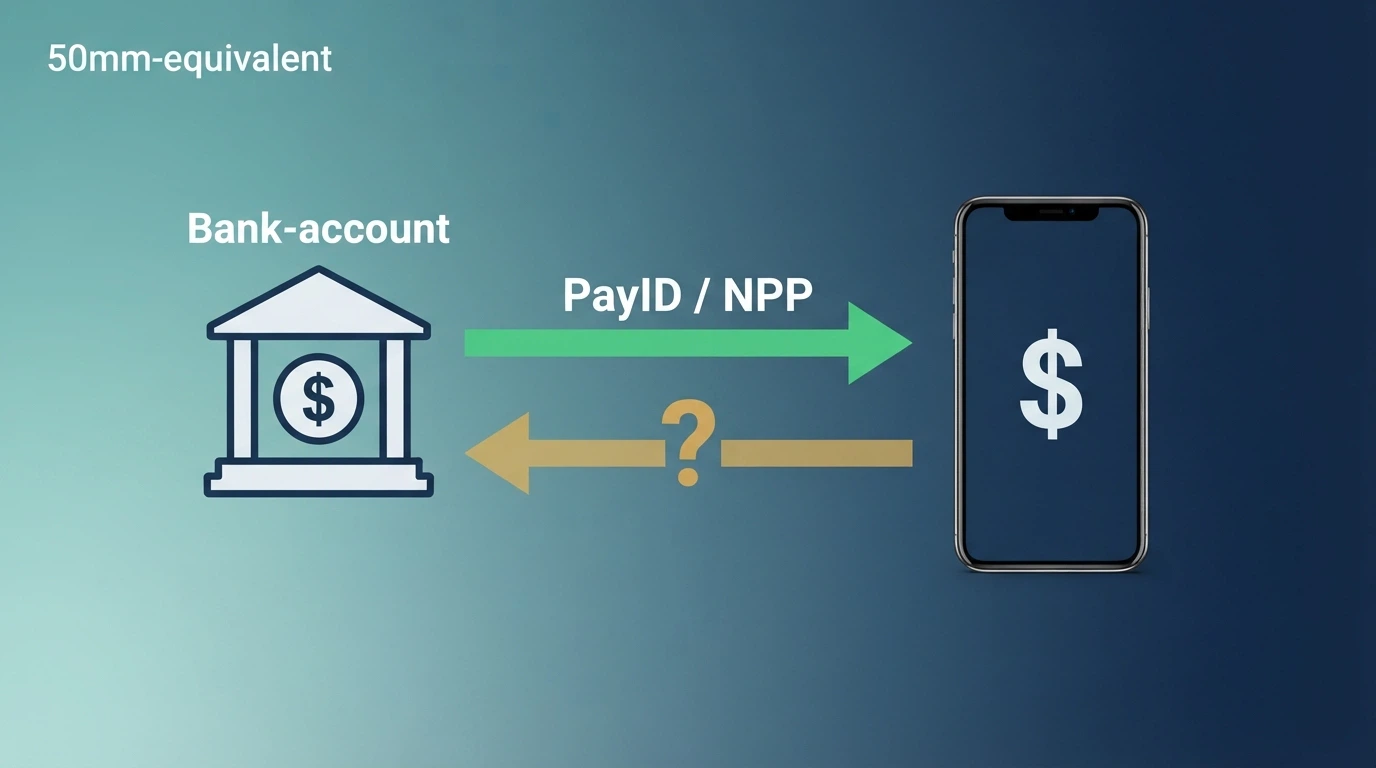
The underlying system is the New Payments Platform, the real-time payments infrastructure operated by Australian Payments Plus and connected to more than 110 banks, mutuals and credit unions. PayID is an addressing layer on top of NPP — a phone number, email address or ABN linked to a bank account, routing near-instant transfers without BSB-and-account-number entry. Over 25 million PayID identifiers are registered in Australia as of April 2025, and NPP clears more than 155 million transactions every month. The scale is domestic. The receiving end is what varies.
How PayID Works — NPP, Osko and the Six-Second Deposit
A PayID transfer is an Osko payment — the real-time settlement service that runs on the NPP rail. At a licensed Australian bookmaker, the deposit lands in approximately six seconds, because the bookmaker is receiving directly into an Australian business account under Australian regulation. At an offshore casino, the deposit also lands in roughly six seconds, because the rail is the same. The difference is what happens after the transfer settles. The licensed bookmaker credits the betting account against a regulated internal ledger. The offshore casino credits the account against a ledger operated by a Curaçao or Tobique-licensed entity, and the PayID payee name on the punter’s bank statement typically shows a third-party intermediary — a payment processor, a corporate vehicle, or a name that does not match the casino brand on the punter’s screen.
That intermediary name is the operational signal. Once funds are sent to a person-to-person transfer via PayID, reversing them is hard. Banks treat PayID transfers as authorised by the sender, and disputes through Australian bank channels are limited once the receiving account has accepted the funds. The speed that makes PayID attractive for deposits is the same speed that makes it unrecoverable when the destination is wrong.
The $10 Minimum Deposit — What PayID Casinos Actually Require
The A$10 offer is the headline, and most PayID casinos deliver a A$10 minimum deposit. Some push higher. Typical minimums in the segment are A$10 to A$20 across all payment methods, but the first-deposit welcome bonus frequently carries its own floor — A$25 at PlayAmo, A$30 at NeoSpin, A$30 at several operators that gate the welcome behind a higher threshold than the cashier. The A$10 PayID deposit gets the punter into the casino; the A$25 or A$30 deposit is what activates the welcome package.
The no-deposit bonus sidesteps the minimum entirely. A A$10 cash credit or a free-spin bundle does not require a PayID transfer at all — it lands on verification. That is the structural advantage of the no-deposit offer and the reason it exists: the punter is in the cashier without having crossed the minimum-deposit threshold, and from inside the cashier the deposit-gated welcome is the next step up.
PayID-Linked Pokies Play
Once a PayID deposit clears, the funds are playable on the casino’s pokies catalogue within seconds. The transfer speed is the same as at a licensed bookmaker, and the gameplay experience is indistinguishable from the punter’s side. What differs is the legal wrapper around the experience. A bet placed at a licensed Australian bookmaker is wagering under Australian regulation. A bet placed at an offshore casino is wagering under Curaçao or Tobique regulation, with no Australian consumer protection framework applying.
That distinction does not change the spin. It changes what happens if the spin goes wrong — a refused withdrawal, a bonus term dispute, a closed account with a balance still on it. The BetStop register, the ACMA complaints process, the Australian Financial Complaints Authority — none of these reach an offshore operator. A punter whose account is frozen at a Curaçao-licensed casino has the casino’s internal dispute process and, depending on the licence, the Curaçao Gaming Authority’s complaint channel. Neither is an Australian remedy.
First-Deposit and Match-Deposit Bonuses via PayID
Beyond the no-deposit chip, the welcome packages are where the marketing spend lives. Royal Reels pairs its A$10 chip with a 100% match up to A$500 plus 50 free spins after verification, and PayID deposits are instant. PlayAmo’s two-tier welcome — 100% up to A$500 plus 100 free spins on first deposit, then 50% up to A$1,000 plus 50 on the second — requires a minimum A$25 deposit to activate. RocketPlay’s welcome runs up to A$2,000 at 40x wagering.
The PayID deposit speed does not change the bonus activation logic. The bonus credits once the deposit clears, and the wagering clock starts. The instant settlement means the punter can begin the playthrough immediately, which is an operational advantage for a punter who wants to grind the bonus in one session rather than spread it across days. It does not change the math.
Why Every Casino on This Page Is Offshore
The Interactive Gambling Act 2001 prohibits the provision of online casino games, online pokies and in-play sports betting to a person in Australia. There is no licence for any of it. The Northern Territory Racing and Wagering Commission licenses online wagering on races and pre-event sport — Sportsbet, bet365, Ladbrokes, the TAB network — but the casino product is not within the NTRWC’s remit because the IGA does not allow it to be. Every operator on this page is an offshore entity. The product they sell is prohibited in Australia. The punter who engages with them is engaging with a market the Australian regulatory framework explicitly does not authorise.
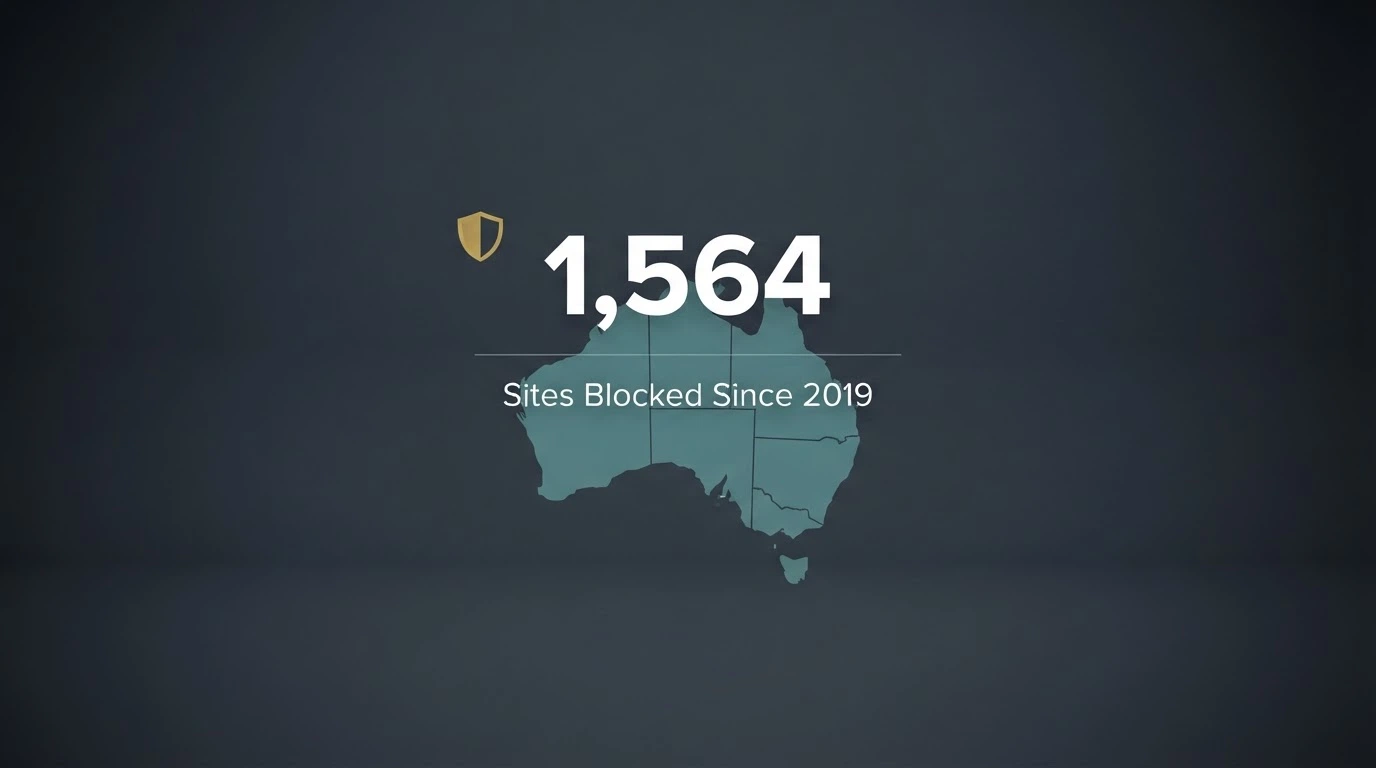
ACMA Enforcement — 1,564 Sites Blocked and Counting
The Australian Communications and Media Authority is the federal regulator enforcing the online prohibition. ACMA investigates complaints, issues formal warnings, refers operators for civil penalty proceedings and directs ISPs to block illegal sites under Section 313 of the Telecommunications Act. The cumulative count since November 2019: 1,564 illegal gambling and affiliate websites blocked, more than 225 illegal services withdrawn from the Australian market. The most recent quarter, Q4 2025, contributed 23 investigations, 69 breach findings (38 for providing a prohibited interactive gambling service, 26 for providing an unlicensed regulated service, 5 for advertising), 10 formal warnings and 133 websites referred to ISPs for blocking.
The pace is not slowing. Q4 2025 alone referred more sites for blocking than several full calendar years before 2023. The enforcement record is the operational backdrop for any offshore casino an Australian reaches — the site is one formal warning or one investigation away from being added to the blocking list, and a punter with an open account and a balance on it has no recourse if the site disappears overnight.
The Legal-vs-Offshore Split — What It Means for Your Money
What is legal in Australia: wagering on races and sport placed before the event begins, lotteries, keno through state-licensed operators. What is not legal: the products on this page. The credit card and crypto ban that took effect on 11 June 2024 capped the legal payment routes for licensed wagering to debit card, bank transfer, PayID/Osko and BPAY, and the same ban does not apply offshore — which is why an offshore casino can still offer credit card deposits, and why the payment method itself is a tell about which side of the regulatory line the operator sits on.
The individual player is not prosecuted under the IGA. The Act targets the provider, not the punter. But the protections the Act creates — consumer guarantees, dispute resolution through Australian channels, BetStop coverage — do not extend to offshore play. There is no Australian complaints body that can compel an offshore operator to pay a disputed withdrawal. There is no Australian regulator that can investigate a bonus term dispute. There is no Australian bank that will reverse a PayID transfer to an offshore casino’s intermediary on the grounds that the destination was an illegal gambling site. The punter’s only remedies are the operator’s internal process and, where it exists, the licensing body’s complaint channel in Curaçao or Tobique.
Protection and Recourse — What the Licensed Market Gives That Offshore Does Not
BetStop — the National Self-Exclusion Register — binds approximately 150 licensed wagering providers in a single registration. An offshore casino is not on the register and cannot be, because the register is Australian and the operator is not. A punter who has self-excluded through BetStop cannot place a bet at Sportsbet or bet365 or any TAB outlet, but can still deposit at an offshore casino and play. The register does not reach the products on this page.
From 1 January 2027, banks and payment providers gain express authority to block transactions to illegal gambling operators. The Interactive Gambling Amendment (Gambling Reform) Bill 2026 passed Parliament on 19 August 2026; its measures commence at the start of 2026+1. From that date, a PayID transfer to a known illegal operator can be refused at the bank level rather than disputed after the fact. That change narrows the operational gap between the licensed market and the offshore market — but it does not eliminate it, because the offshore operator can route through new intermediaries, and the bank can only block what its transaction-monitoring systems recognise.
The tax position is the one piece of good news: betting and gambling winnings are not assessable income under section 6-5 of the ITAA 1997, and losses are not deductible under section 8-1, unless the person is carrying on a business of betting or gambling. A punter who wins A$500 at an offshore casino does not owe tax on it; a punter who loses A$5,000 cannot claim the loss against other income. The ATO does not enter this calculation either way.
Safer Play at $10 — Tools That Actually Work in Australia
Responsible-gambling infrastructure exists in Australia, and it works — inside the licensed system. BetStop, the National Gambling Helpline, Gambling Help Online, Lifeline, state-level counselling services. Each of these is reachable and effective for a punter who plays within the Australian-licensed market. None of them reaches an offshore casino, and that is the operational limit a punter needs to understand before signing up at any operator on this page.

BetStop — The National Self-Exclusion Register
BetStop launched on 21 August 2023. By 31 March 2026, 59,830 people had registered, with 37,247 active exclusions. By 31 July 2026, the cumulative figure was 67,480, of which 41,290 were still active — more than 60% of everyone who ever registered. The minimum exclusion period is three months; the maximum is lifetime. 78% of registrants are under 40, and 38% chose lifetime exclusion. The register binds approximately 150 licensed wagering providers in a single step.
The critical gap: offshore casinos are not connected to BetStop. The register is Australian, the operators are not. A self-excluded person can still deposit at an offshore casino, claim a no-deposit bonus, and play pokies without the exclusion registering. The register does what it was designed to do — it blocks the licensed market — and the unlicensed market is the place a self-excluded person goes when the licensed market is closed.
Deposit and Spend Limits at the $10 Level
The licensed Australian market has mandatory deposit-limit tools and enforceable session-time reminders. The offshore market has whatever the operator chooses to offer. There is no Australian regulatory requirement for an offshore casino to implement deposit limits, time-outs or activity statements, because the casino is not subject to Australian regulation. The marketing pages may describe “responsible gambling tools” — and some operators do implement them voluntarily — but the enforcement mechanism is the operator’s own, not an Australian regulator’s.
The credit card and crypto ban is the closest Australia has to a de facto spending brake for offshore play, because it removes the two payment methods most associated with uncontrolled spend. e61 research after the 11 June 2024 ban found that fortnightly spend among affected users dropped by around A$50 and a third stopped betting entirely. The ban operates on the licensed market’s payment rails; it does not stop a punter from sending a PayID transfer to an offshore operator’s intermediary, but it removes the credit-card-and-crypto pathway that bypassed deposit limits at the bank level.
Responsible-Play Tools at PayID Casinos
The responsible-gambling help infrastructure a punter can reach from Australia is the licensed-market infrastructure, regardless of where the punter actually plays. The National Gambling Helpline is 1800 858 858 — free, confidential, staffed 24 hours a day, 7 days a week. Gambling Help Online (gamblinghelponline.org.au) provides live chat, email counselling and self-help resources. Lifeline (13 11 14) is the crisis line. BetStop (betstop.gov.au) is the self-exclusion register, applicable to licensed operators only.
Approximately 2.1% of Australian adults — roughly 430,000 people — experience problem gambling, with the Australian Institute of Health and Welfare putting high-risk gambling at 1.8% in 2022. The numbers are large enough that the help infrastructure is not theoretical. A punter who feels their play is drifting past the A$10 trial into a pattern has a free, confidential phone line to call at any hour. What the line cannot do is reach the offshore casino and stop the next PayID transfer. That is the punter’s call.
How We Evaluated These $10 No-Deposit Operators
The comparison above is built from operator terms pages, independent affiliate audits and ACMA enforcement data current to 2026. Each operator was checked against the ACMA register for blocking status and against its own licence jurisdiction’s published register where one exists. The ranking reflects the terms research carries: wagering multiple, maximum cashout cap, expiry window, eligible-game breadth, licence transparency, and PayID deposit and withdrawal performance where measured.
The legal-context check is not separable from the comparison. Every operator on this page is offshore, and the comparison is honest only if that fact is named in each entry. A punter reading the table and treating it as a ranking of licensed Australian products would be misled; a punter reading it as a ranking of offshore products that Australians in fact reach has the information needed to weigh the offer against the regulatory gap. The evaluation does not invent weightings or fabricate scoring; the ordering reflects the spread on the terms, not an editorial score.
What the evaluation does not measure: real-money payout reliability beyond what operator terms and independent tests disclose, dispute resolution outcomes beyond the licensing body’s published complaint channel, or the actual experience of any individual punter. Those are outcomes the table cannot carry, and they are the reason this page pairs the comparison with the legal context — the table is a snapshot of the offer, and the surrounding sections are the conditions under which the offer operates.
Your $10, Your Call — What the Numbers Say
The page above describes a market that exists in a structural contradiction. The A$10 no-deposit offer is real — the bonuses credit, the pokies play, the wagering can be cleared. The terms are heavy — a 30x to 60x playthrough, a A$50 to A$200 cashout ceiling, an expiry window measured in days. The operators are offshore, by force of Australian law. The expected-loss math, using a representative 30x wagering on A$10 at a 96.5% RTP, is A$10.50 of expected loss against a A$100 cashout ceiling — a ratio that puts most bonus sessions net-negative before considering the cap binding or the expiry running out. The consumer-protection gap is the largest hidden cost: no BetStop coverage, no Australian complaints body, no recourse if the operator refuses the withdrawal.

Two paths from here. The first: stay inside the licensed market, where the product range is narrower (wagering on races and pre-event sport, lotteries, keno) but the protections are real — BetStop binds, the ACMA enforces, the bank can reverse a disputed transaction through Australian channels. The second: engage with the offshore market knowing the legal position, knowing the expected-loss math, knowing that a A$10 chip is a small slice of pokies play with strict limits on what comes out the other side. The decision is the punter’s, and the comparison above is what the decision is made from.
Frequently Asked Questions
Are $10 no deposit bonus offers at Australian casinos real or a scam?
The offers are real — SkyCrown’s A$10 cash credit, NeoSpin’s A$10 no-deposit credit, Royal Reels’ A$10 chip and others credit on verification, and the wagering can be cleared. The terms are heavy: 30x to 60x playthrough, A$50 to A$200 cashout caps, 7-to-14-day expiry on cash chips. Every operator is offshore, because Australia does not license online casino. The offer is a real product; it is not a product the Australian regulatory framework authorises.
How long does a PayID casino withdrawal take in Australia?
PayID deposits land in approximately six seconds at both licensed and offshore operators. Withdrawals are a different story: licensed Australian bookmakers process PayID withdrawals in minutes to hours; offshore casinos typically process withdrawals through the same PayID rail in 0 to 24 hours (Ricky Casino, Royal Reels) when PayID is supported at all. SkyCrown’s PayID withdrawal was clocked at 11 minutes in independent testing. Many offshore casinos offer PayID for deposits only and route withdrawals through bank transfer or cryptocurrency, which can take several business days.
What happens if an offshore casino blocks my account with money in it?
The operator’s internal dispute process is the first route. Beyond that, the licensing body’s complaint channel — the Curaçao Gaming Authority or the Tobique Gaming Commission, depending on the licence — is the formal path. Neither is an Australian remedy. ACMA does not have jurisdiction over offshore operators’ internal account decisions. The Australian Financial Complaints Authority cannot hear a dispute about a Curacao-licensed casino. A punter whose account is frozen with a balance on it has the operator’s terms and conditions as the binding contract, and the licensing body’s complaint process as the only external review.
Is it legal to play at a $10 no deposit bonus casino in Australia?
Providing online casino to a person in Australia is illegal under the Interactive Gambling Act 2001. The Act targets the provider, not the individual player — Australian residents are not prosecuted for placing a bet at an offshore casino. But the product is prohibited, and every operator offering it is operating outside the Australian framework. There is no Australian licence for online casino, no Australian consumer protection that applies, and no Australian regulator that can compel a payout. The legal position for the player is “not prosecuted”; the legal position for the product is “prohibited.”
Which pokies can I play with a $10 no deposit bonus in Australia?
Eligibility depends on the operator. SkyCrown’s A$10 credit is playable across all pokies in the library. PlayCroco’s A$10 chip is RTG-only, restricting the punter to RealTime Gaming’s catalogue. Rocket Play’s 120 free spins are locked to Doragon’s Gems; the 20 verified-review spins are locked to Book of Pyramids. NeoSpin’s A$10 credit is playable across 7,000+ pokies from Pragmatic Play, NetEnt and BGaming. The eligible-game list is part of the bonus terms and is worth reading before claiming, because it determines both the RTP the punter is grinding against and the volatility profile of the wagering session.
Prepared by the Casino Payment Methods AU editorial staff.