
Anonymous crypto casinos, read against the fine print
 Available in AU
The casino calls itself anonymous. The reality is more measured: an email, a wallet, a deposit, and play until the AML policy says otherwise. The label is marketing, not a contract. An Australian player reaching for it in 2026 runs into a stack of regulators, thresholds and arithmetic the landing page does not volunteer. This page reads “anonymous” against the fine print, ranks ten operators an Australian punter can actually reach, and breaks out what the trade-off costs in plain numbers.

Current as of 18 October 2026; licence claims verified against the Curaçao GCB register, the Anjouan ALSI register and the ACMA list of blocked services.
- Why Your 2026 Anonymous Casino Asks for ID Anyway
- The Crypto Loophole That Makes No-KYC Casinos Possible
- The Best Anonymous Crypto Casinos for Australian Players in 2026
- Why Your 2026 Welcome Bonus Is Smaller Than the Number on the Banner
- What Australian Law Actually Says About Offshore Crypto Casinos
- Staying Safe When No One at the Casino Knows Who You Are
- How We Selected and Ranked These Operators
- Your Money, Your Risk, Your Call — What to Do Next
- Frequently asked questions
Why Your 2026 Anonymous Casino Asks for ID Anyway
“Anonymous” is the marketing word the no-KYC casino wears on its sleeve. Strip the sleeve back and what you find is an account tied to an email address, a wallet address on file, and a withdrawal policy that triggers a passport scan somewhere between A$2,000 and A$5,000 in cumulative cashouts. The label is not a lie; it is partial. Anonymous means unregistered at sign-up, not unregistered at withdrawal.
Sign up with an email, play with crypto — how it actually works
The onboarding flow at the featured operators runs to four steps and finishes without a name attached to it. You arrive at the site, click register, enter an email address and a password — or click “Connect Wallet” and your browser wallet signs in instead. The site emails you a confirmation link; you click it. You are now playing, and the casino knows you by an email and a wallet address, not by a passport number.
The deposit is where the bypass completes. You send BTC, ETH, USDT or a Lightning invoice to the casino’s deposit address. The blockchain confirms the transaction; the casino credits your account. No bank processed the payment, so no bank statement lands in anyone’s hands, and the AUSTRAC reporting trail that would attach to an AUD deposit at a licensed wagering operator does not exist. From the casino’s side, you are a wallet and an email. From the regulator’s side, you are also that — which is precisely why the regulator is offshore.
The anonymous phase ends the moment your cumulative withdrawals cross the AML trigger band. The threshold is set per operator and runs across every withdrawal from the moment you registered — not per withdrawal. BitStarz fires verification on the first withdrawal of any amount; most other operators hold the line until cumulative cashouts reach the policy threshold, covered in the section on withdrawal thresholds below.
Browser, mobile or app — where Australians actually play
No anonymous crypto casino on this list ships in the Apple App Store or Google Play. App stores prohibit unlicensed real-money gambling content, and the operators here are all unlicensed under Australian law. Play happens in the browser, mobile or desktop, and it is the same site either way — responsive, browser-based, with no download required.
The practical shape of that, for an Australian punter, is that the casino lives at a URL. If the URL is blocked by an Australian ISP at the DNS level (and ACMA has ordered more than 1,500 such blocks since 2019), the punter needs to know the new URL or move on. Operators handle this by domain-hopping: they hold a portfolio of mirrors and route active players across them as blocks land. The site itself does not need to be installed; it just needs to be reachable.
Browser compatibility is the unspoken norm. Chrome, Firefox, Safari and Brave all run these casinos without issue. Some operators publish dedicated mobile apps as Android APKs you sideload — Stake has done this — but the main product is the website. There is no advantage to installing anything, and there is a security cost to sideloading an APK that does not pass through Google’s review.
Real-money pokies without a verified identity
The whole point of these casinos is the real-money play, and for an Australian punter the dominant product is online pokies. Pragmatic Play, Hacksaw Gaming, Nolimit City and BGaming fill the lobbies at every operator on this list. The catalogue runs into the thousands at Skycrown (over 10,400 games from 50+ providers), the hundreds at mBit (around 700 titles), and somewhere in between everywhere else.
Playing for real money is straightforward: deposit crypto, the casino credits your account at the current AUD-equivalent rate, you bet on the pokie of your choice. The pokie runs the same RNG it would on any other site; the only thing different is the verification step that is not happening. Below the AML threshold, real-money play and real-money withdrawal look much like a regular casino, minus the passport scan.
What changes at the threshold is the withdrawal moment. The play works the same way right up until you try to move a meaningful sum off the site. That moment is where the casino decides whether the email-and-wallet account behind your play has earned its keep, and whether the AML policy needs to know who you are. For a player whose bankroll never crosses the threshold, the casino stays anonymous. For everyone else, the ID request arrives — and on its timing, more than any other factor, the label “anonymous casino” is decided.
What ‘anonymous casino’ means for the Australian punter
The Australian punter meets this product from a specific position. Pokies are culturally central here — the pub pokie is a familiar feature of adult social life in every state, and the online version is what a player chases when they want to keep playing at 11 pm on a Wednesday. The cultural expectation is a slot with a feature round and a free-spin trigger, and that is exactly what these lobbies stock.
The deposit rail is also familiar. PayID — the instant bank transfer system built on the New Payments Platform — is a household name for anyone who has settled a split bill or paid a tradesperson in the last five years. Skycrown takes PayID withdrawals, tested at two hours twenty-nine minutes in August 2026. A handful of other operators expose AUD on-ramps. The friction between the pub-pokies mental model and the offshore crypto casino is lower than the marketing copy suggests.
That familiarity cuts both ways. The Interactive Gambling Act 2001 sits underneath the whole product, and most recreational punters do not know it is there. The Act does not prosecute the player — that much is settled — but it does prohibit the offering of online casino games to anyone in Australia, which means the operator is breaking Australian law by serving you. The product looks local; the legal frame does not. That gap is the whole story this page tells.
The Crypto Loophole That Makes No-KYC Casinos Possible
The reason a casino can skip identity verification at the door is the same reason it accepts your deposit without a bank account. Crypto removes the bank from the transaction, and the bank was where the identity used to live. Cut the bank out and the ID trail it carried goes with it.
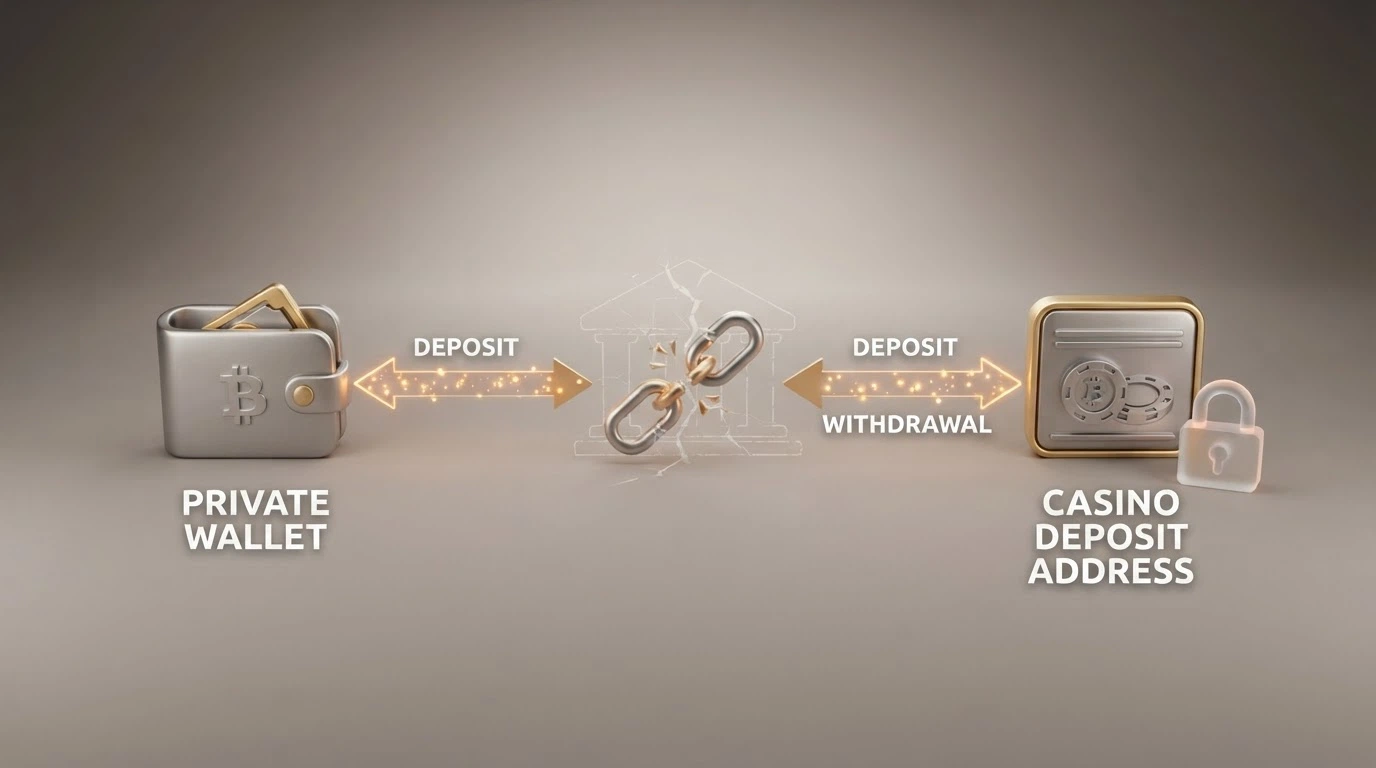
Cutting out the bank — why crypto means no KYC at the door
A bank transfer carries your name, your BSB, your account number and a transaction reference. The receiving bank sees the sender; the sending bank sees the recipient. Both ends sit inside Australia’s anti-money-laundering regime, both report to AUSTRAC over thresholds, and the licensed wagering operator on the other side runs its own KYC on top of that. By the time your A$50 deposit lands, three institutions have already identified you.
A Bitcoin transaction carries a wallet address — a 26-to-35-character string that does not name anyone. The blockchain records the transaction publicly and immutably; chain analysis firms can cluster addresses and infer ownership in many cases, but that work happens after the fact and at a cost no offshore casino pays. The casino receives coins to a fresh deposit address per user; the user holds coins in a wallet whose identity depends entirely on what they have done to keep it private. No bank sits in the loop, and the ID trail it would carry has no place to attach.
This is the loophole. It is narrower than the marketing suggests. Licensed Australian wagering has had crypto and credit cards banned as payment methods since 11 June 2024 under the Interactive Gambling Amendment (Credit and Other Measures) Act 2023 — an Australian operator that accepted your Bitcoin deposit would be fined up to A$247,500. Offshore operators sit outside the prohibition, but they also sit outside the bank rails that would have given them your name in the first place.
The limits of blockchain pseudonymity matter here. Every transaction is permanent. Every address is on a public ledger. If the casino’s wallet is ever traced and matched to a real-world identity by chain analysis, the playwright of “anonymous casino” loses. AML officers at the bigger operators know this, which is why the threshold-based KYC trigger is the rule rather than the exception. Pseudonymity holds until the dollar value crosses a line that makes the risk not worth it.
Bitcoin, altcoins and the Lightning Network — which coin does what
Bitcoin is the default casino currency. Every operator on this list takes BTC; some take nothing else. On-chain BTC deposits confirm in around three minutes in current network conditions; withdrawals process in ten to sixty minutes once the casino approves them. The trade-off is the network fee — a single small transaction can cost several dollars during congested periods, which is a meaningful fraction of a A$20 bankroll.
Lightning Network is the speed upgrade. Operators that run a Lightning rail — fewer than the on-chain list, but a growing set — settle withdrawals in under five minutes, sometimes in under sixty seconds. The trade-off is liquidity: Lightning channels need to be opened and balanced, and the deposit side from a player’s wallet to a casino is slower than the withdrawal side. For a player who has already set up a Lightning wallet and routes the funds through it, the speed advantage is real.
Stablecoins (USDT, USDC) are what most high-volume players move in once they cross the BTC-fee pain threshold. Dollar-denominated value, no volatility between deposit and play, and the gas fees depend on the network — TRC-20 USDT is cheap; ERC-20 USDT is not. For an Australian punter funding a small bankroll, TRC-20 USDT is the practical compromise.
Altcoin support varies. ETH, LTC, DOGE, XRP and SOL all show up at one or two operators on this list. None of them has a withdrawal-speed advantage worth chasing at the small-bankroll end. Pick the coin you already hold, or pick BTC for ubiquity, or pick USDT on TRC-20 for low fees.
The withdrawal threshold that ends your anonymity
The threshold is the rule that turns the marketing word into a contract. Across the Curaçao- and Anjouan-licensed operator set in this niche, AML policies set the KYC trigger at EUR 2,000 to EUR 10,000 in cumulative withdrawals — roughly A$2,000 to A$5,000 at recent exchange rates. Below the threshold, every withdrawal is automatic. Above it, the casino runs a review.
The cumulative part matters. This is not per-withdrawal; this is lifetime, across every withdrawal from the moment you registered. A player who cashes out A$1,500 four times has hit A$6,000 and triggered KYC. A player who never withdraws at all never triggers it. The operator’s compliance team watches the running total, not the single transaction.
What the trigger looks like in practice: a passport scan, a recent utility bill or bank statement showing your address, a selfie holding the passport, and sometimes a source-of-funds declaration (a payslip, a crypto-onramp receipt, a screenshot of your exchange withdrawal history). BitStarz is the strict end of the field — KYC fires on the first withdrawal of any amount, with a median review time of 24 hours and 95% of cases cleared under 72 hours. Jack.com sits at the loose end: standard crypto play requires no KYC at all, with verification reserved for unusually large or flagged withdrawals.
From deposit to cashout — how fast crypto really moves
“Instant withdrawal” is the marketing word every operator uses. Measured times are different.
On-chain BTC, the default rail, clears deposits in roughly three minutes and withdrawals in ten to sixty minutes once approved. CoinCasino’s June 2026 test landed an on-chain withdrawal in seven minutes — fastest on this list. Lightning Network payouts are the genuine instant option, clearing in under five minutes and often under sixty seconds. Skycrown’s PayID cashout (not crypto, but a useful benchmark for a familiar AU rail) tested at two hours twenty-nine minutes in August 2026.
Operators that publish “instant” on their landing pages and take twelve hours or more to clear are excluded from this list. The gap between the marketing claim and the measured time is the most reliable differentiator between operators in this market.
The Best Anonymous Crypto Casinos for Australian Players in 2026
Ten operators, ranked against the same five criteria. The list below is built for the AU punter who can actually reach the site — Australian IP tested, AU sign-up flow verified, withdrawal speed measured. The ranking reflects a balance across the criteria, not a single weighted score. The first operator is not the best for everyone; it is the best balance of factors across the most readers.

How we compare — the criteria that separate the list from the rest
Five questions, asked of every operator before the rest of this page was written.
Licence status. Is the operator licensed, by whom, and where does that licence actually allow it to take players? Curaçao GCB and Anjouan ALSI numbers were checked against the public registers. An operator that did not name a regulator, or whose named licence could not be confirmed, was cut.
KYC policy and threshold. What does the operator publish as its AML trigger, and does the published policy match the verified behaviour? Where the operator publishes a threshold and the live behaviour matches, the policy is reported. Where the policy is silent, the absence is reported.
Welcome-offer value and wagering fairness. Is the headline bonus a real number, or a percentage that requires reading three sub-conditions to evaluate? Operators whose fine-print mechanics collapse the headline by more than half were ranked lower than operators whose mechanics were closer to the marketing.
AU access confirmed. Was the operator reachable from an Australian IP at test time? Did the sign-up flow accept an AU email and an AU residential address (or, more practically, did the form not even ask)? Operators that geoblocked AU signups were cut.
Withdrawal speed tested. Was a withdrawal actually processed during research, and how long did it take from request to wallet? The number on this list is measured, not published.
| Casino | Licence | Welcome Offer | Wagering | No-KYC Trigger |
|---|---|---|---|---|
| Stake | Curaçao | Rakeback + VIP, no welcome bonus | None on rakeback | Standard crypto play, no KYC |
| BC.Game | Anjouan ALSI-202410011-FI1 | 470% up to A$1,600 + 400 FS across four deposits | 40x on deposit + bonus combined | Standard crypto play; large fiat-equivalent withdrawals |
| BitStarz | Curaçao GCB OGL/2024/165/0185 | 100% up to 1 BTC (A$2,000) + 180 FS | 40x on bonus amount | First withdrawal of any amount |
| Jack.com | Curaçao | 100 wager-free spins on Book of Dead (A$50 min deposit) | 1x on deposit + winnings | Standard crypto play, risk-based on large withdrawals |
| Rainbet | Curaçao | 100% + 20 FS on first deposit (US$30 min, US$700 max) | 40x on deposit + bonus (Wager Lock) | Standard crypto play |
| Rocket Play | Curaçao | Up to A$2,000 + 100 FS | 40x on bonus amount | Threshold-based |
| Skycrown | Curaçao eGaming | Match bonuses + 100 no-deposit FS via phone verification | ~40x on bonus/FS winnings | Front-loaded for PayID users; threshold-based for crypto |
| mBit | Curaçao | Up to 4 BTC + 325 FS across deposits | 40x standard, 20x at VIP Level 7 | Risk-based |
| Ignition | Curaçao sub-licence | 150% up to A$3,000 combined casino + poker | 25x on deposit + bonus combined | ~A$2,000 withdrawal threshold |
| CoinCasino | Curaçao | — | — | Standard play, document-free |
Stake
Stake is the Australian-founded outlier on this list. Co-founded by Ed Craven from Melbourne and Bijan Tehrani in 2017, the operator sits on a Curaçao licence and runs a rakeback model rather than a traditional welcome bonus. Every dollar of house edge returns to the player through the VIP programme, with no wagering on the rewards that come back.
The Terms list Australia among Stake’s restricted jurisdictions, and the operator does not actively market to Australian players. Signups are accepted via the offshore domain, and the site’s enforcement is on payment method and source-of-funds, not on blocking the email address. Standard crypto play does not trigger KYC. The grey-zone status is real — Stake is not licensed to take Australian players — but the access is real too.
The product itself is what the rest of the industry benchmarks against: Pragmatic Play, Hacksaw Gaming, Nolimit City, Evolution, BGaming and a long tail of in-house titles. Provably fair is built into the in-house games and the verification tool is published on the site.
For the punter who plays every week, the rakeback model beats a one-off welcome offer. The maths only work at volume, but at volume the maths are real. For the casual deposit-and-walk-away player, the absence of a headline number reads as nothing happening — and that is the right read.
BC.Game
BC.Game’s 470% match across four deposits is the biggest headline number on this page. It is also the headline that costs the most in fine print. The first deposit carries a 180% match, the second 240%, the third 300%, the fourth 360%; the free-spin allocation totals 400 across the package. The wagering is 40x on the combined bonus and deposit amount, not 40x on the bonus alone.
The licence is Anjouan (ALSI-202410011-FI1), issued to Twocent Technology Limited. The Curaçao entities that previously sat behind BC.Game were declared bankrupt in November 2024. Anjouan is the new home, with all the regulatory implications that carries: lighter than Malta, lighter than the UK, and meaningful only at the threshold of an actual dispute.
The free-spin terms are the most aggressive on this list. BC.Game’s 400 free spins are credited in batches, must be claimed within 24 hours of credit, used within 24 hours, and capped at US$5 of winnings per batch. A player who misses the claim window loses the spins. A player who wins US$5 per batch over many batches ends up with a capped, time-pressured grind.
The 470% is real money on the table. The 40x combined wagering is the price of entry. A US$100 deposit on the first-deposit 180% match creates a US$280 combined balance requiring US$11,200 in turnover before withdrawal — the cap on this bonus is the wagering, not the bonus size, and the expected cost of clearing it at a typical pokie RTP is the topic of a later section.
BitStarz
BitStarz is the operator that asks for ID on your first withdrawal, which makes it the least anonymous casino on a list of anonymous casinos. The trade-off is that BitStarz has been running since 2014, stocks games from 79 providers, and processes the verification it does require with median 24 hours and 95% cleared under 72 hours in August 2026 testing.
The welcome package is 100% up to 1 BTC (around A$2,000) plus 180 free spins on the first deposit; up to 5 BTC across four deposits in total. Wagering is 40x on the bonus amount. For Australian players, Section 1.6 of the bonus terms excludes the no-deposit free-spin offer — the headline spins are deposit-gated. The deposit-bonus free spins remain available.
The KYC trigger is the defining fact. Where most other operators on this list set a threshold in cumulative withdrawals, BitStarz fires verification on the first withdrawal of any amount. The review asks for a passport, a utility bill and a selfie, with source-of-funds for larger withdrawals. For a player who came to this page for the no-KYC label, BitStarz is not the operator they were looking for. For a player who wants a ten-year-old brand and the broadest game catalogue, that is a fair trade.
Jack.com
Jack.com (formerly Jackbit) runs the most punt-friendly welcome offer on this list. A minimum A$50 deposit unlocks 100 wager-free spins on Book of Dead, with winnings capped at US$100 and a 1x turnover on the deposit plus spin winnings. Activate within 24 hours of deposit, use within 24 hours.
The licence is Curaçao. The platform hosts Pragmatic Play, Hacksaw Gaming, Nolimit City, Play’n GO and a tail of smaller providers. Standard crypto play stays document-free; KYC fires only on risk-flagged or unusually large withdrawals.
The 1x turnover is the lowest barrier in the ranking. The US$100 cap is the constraint — you do not get rich from this bonus; you get a structured way to test the casino with the house’s money. Good for a first-time crypto player deciding whether the cashier works for them. Too small for a regular.
Rainbet
Rainbet runs a dual-path welcome bonus that is unusual for being honest about the trade-off. The first deposit unlocks a 100% match plus 20 free spins on Sweet Bonanza. The match has two versions: the Wager Lock path at 40x on the combined deposit and bonus, or the No Wager Lock path that unlocks as you play, with a US$50 withdrawal cap on the welcome-code balance.
The minimum deposit is US$30, the maximum US$700 per deposit tier. The package repeats across three deposits — 100% / 50% / 100% — for 60 free spins in total. Slots with RTP above 97.4% are excluded from the wagering contribution, which knocks a handful of higher-RTP titles out of the bonus play.
Neither path is a winning play in expected value. The Wager Lock path costs the standard 40x turnover; the No Wager Lock path costs the US$50 cap. The decision is structural: lock the bonus for upside, or skip the lock for freedom. For a player who knows the difference between the two, both are workable.
Rocket Play
Rocket Play holds 9.4% AU market share, the highest on this list, which says something about brand recognition in the Australian market and not necessarily about offer quality. The welcome package runs up to A$2,000 plus 100 free spins, with 40x wagering on the bonus amount.
The free-spin allocation is front-loaded against a tight clock. Twenty spins credit immediately on deposit; the remaining 80 release in four daily batches of 20, all on Aztec Magic (BGaming). Free-spin winnings are capped at A$300, the maximum win from the bonus is A$5,000, and the free-spin expiry is five days. The maximum bet while the bonus is active is A$7.50.
For a moderate-budget Australian punter who plays pokie bonuses as a routine, Rocket Play is the most familiar product of the ten. The AU market share does the marketing work the affiliate pages usually do, and the bonus terms are unremarkable rather than aggressive.
Skycrown
Skycrown carries the deepest AU footprint among the no-deposit free-spin offers. The 100 no-deposit free spins activate through phone verification — a phone number and a code, no deposit required — making it the most generous sign-up offer for an Australian player who wants to test the casino before funding it.
The catalogue runs to over 10,400 games from 50+ providers, the deepest on this list. Pragmatic Play, NetEnt, Microgaming, Play’n GO, BGaming, Hacksaw Gaming and Nolimit City are all in. PayID is supported as a withdrawal rail, tested at two hours twenty-nine minutes for an A$180 cashout in August 2026 — the fastest AUD banking rail on any operator tested.
The KYC trade-off is real. Skycrown uses front-loaded KYC for PayID users — the banking rail ties to an Australian identity, and the operator runs verification before the first PayID withdrawal. Crypto users face the standard threshold-based trigger. Wagering on bonus and free-spin winnings is approximately 40x, with a maximum bet of A$5 to A$8 while the bonus is active.
Skycrown is the operator to pick when no-deposit free spins matter and PayID speed is worth a front-loaded ID check.
mBit
mBit is the veteran crypto casino on this list, with a tiered VIP rewards structure (the Stellar Rewards Club) that drops wagering from 40x to 20x for players who reach Level 7. The headline welcome is up to 4 BTC plus 325 free spins across the deposit tiers, the largest total bonus size in BTC terms.
The rewards track is the substance behind the headline. Level 2 through Level 6 carry free spins at 0.10 USDT per spin with 40x wagering. Level 7 — the tier a player reaches at sustained volume — runs free spins at 1 USDT per spin with 20x wagering. A player who climbs the ladder gets a structurally different bonus: ten times the per-spin value and half the turnover.
At 4 BTC headline and a 20x VIP track, the value compounds with volume. Below Level 7, the headline reads better than the maths. The library runs around 700 titles, smaller than the Skycrown catalogue but larger than most established crypto brands.
Ignition
Ignition is the operator with the lowest wagering multiplier on this list. The 25x combined wagering (deposit plus bonus) is the standout number — a fifth less turnover than the 40x standard that runs across the rest of the page.
The welcome bonus splits across two products: casino and poker. The headline is 150% match up to A$3,000 combined, with the casino portion carrying 100% slot contribution to wagering, table games at 20% and live dealer at 0%. KYC verification triggers at around A$2,000 in withdrawals. The site operates via domain-hopping to stay ahead of ACMA blocks — a detail that signals the operator’s posture toward Australian enforcement.
The split structure is the trade-off. A slots-only punter using the full bonus for casino play sees the poker contribution as dead money. A player who plays both products on a regular basis sees the combined bonus as one of the more efficient offers available. Ignition is the 25x outlier on a 40x page.
CoinCasino
CoinCasino is the operator with the thinnest verified profile on this list. No headline welcome bonus was confirmed during this research cycle; no wagering multiplier was confirmed; the operator’s published terms were not verified in full. What was confirmed: a Curaçao licence, a document-free standard play, and a June 2026 on-chain cashout that landed in seven minutes.
The seven-minute payout is the data point to take from CoinCasino. For a player who already has a wallet and a preferred game catalogue elsewhere, CoinCasino is the operator to keep in the back pocket as a fast-payout alternative — and the one to revisit on its current promotions page when the welcome offer is published.
The absence of a confirmed headline bonus is not a reason to exclude the operator. It is a reason to direct the reader to the operator’s current promotions page before depositing. CoinCasino is the operator you keep in the back pocket for the seven-minute payout.
Why Your 2026 Welcome Bonus Is Smaller Than the Number on the Banner
The 470% match on BC.Game’s first banner is real money. The fine print is also real money, and the fine print is where the headline number lives or dies. Walk the maths through, and the bonus that looked like free credit turns into US$11,200 of required play before any withdrawal is allowed.

Translated into expected loss: a US$100 deposit on BC.Game’s first-deposit 180% match creates a US$280 combined balance. The 40x wagering on combined deposit and bonus means US$280 × 40 = US$11,200 in turnover before withdrawal. Pragmatic Play’s default RTP clusters between 96.0% and 96.7%; taking the 96.5% midpoint, the house edge is 3.5%. Across US$11,200 of turnover at a 3.5% edge, the expected loss is US$392 on average — the bonus’s real cost before the player sees a return. That figure is a statistical estimate across many spins under the stated assumptions, not a guaranteed outcome for any single player.
The same arithmetic structure applies to every bonus on this list at 40x. The headline percentage is the bait; the wagering multiple is the price. The 1x on Jack.com, by contrast, requires US$50 of turnover against a US$100 cap — the bonus’s expected cost is closer to a dollar and a half, which is why the cap is so much lower. Welcome bonus value is a function of the percentage, the multiple and the cap, and the table below ranks the eligible slots by the variable the player can actually see.
No-deposit bonuses — what is actually available for Australian players
The no-deposit free-spin offer is the most searched term in this cluster. For an Australian player, the picture is narrow. BitStarz’s bonus terms (Section 1.6) list Australia among countries ineligible for no-deposit free spins. The headline-grabbing no-deposit offers at the bigger offshore brands typically exclude the AU market by name.
Skycrown is the exception. The 100 no-deposit free spins activate via phone verification — a phone number and a code, no deposit required. The bonus terms carry the standard ~40x wagering on free-spin winnings, with a maximum bet of A$5 to A$8 while active. For a player who wants to test a casino before funding it, this is the only meaningful no-deposit offer in the Australian set on this list.
The general scarcity is worth stating honestly. Most no-deposit offers you see advertised for the Australian market are deposit-gated in practice — the “no deposit” headline applies to a different jurisdiction, and the Australian signup hits a deposit-required landing page. Skycrown’s phone-verified offer is the genuine article.
Free spins, wagering and the caps that shrink your win
Free spins are the headline offer at almost every featured operator. The number on the banner means nothing until three finer numbers are checked.
The first is the wagering multiple on free-spin winnings. BC.Game, BitStarz, Rocket Play and Skycrown all carry 40x wagering on free-spin winnings. The Jack.com 100 wager-free spins carry 1x turnover on the deposit plus spin winnings, a structurally different product. mBit’s level-tiered free spins run 40x at the lower tiers and 20x at Level 7.
The second is the per-batch or per-spin cap. BC.Game’s free spins cap at US$5 of winnings per batch, the tightest constraint on this list. BitStarz’s no-deposit free spin winnings are capped at A$150. Jack.com’s wager-free spins cap at US$100. Rocket Play’s free-spin winnings are capped at A$300. Skycrown’s no-deposit bonus terms vary by promotion.
The third is the validity window. BC.Game’s free spins must be claimed within 24 hours of credit and used within 24 hours — a 48-hour clock total. Jack.com spins must be activated within 24 hours of deposit and used within 24 hours. Rocket Play spins expire in 5 days. BitStarz’s first-deposit free spins credit in daily batches of 20 over 9 days.
The arithmetic on the eligible slots matters as much as the terms. The table below ranks the bonus-eligible pokies by RTP, volatility and max win — the variables that decide how a free-spin batch actually performs.
| Slot | Provider | RTP | Volatility | Max Win |
|---|---|---|---|---|
| Gates of Olympus | Pragmatic Play | 96.50% | High | 5,000x |
| Sweet Bonanza | Pragmatic Play | 96.51% | High | 21,175x |
| Big Bass Bonanza | Pragmatic Play | 96.71% | High | 2,100x |
| Book of Dead | Play’n GO | 96.21% | High | — |
| Gates of Olympus 1000 | Pragmatic Play | 96.50% | Extreme | 25,000x |
| Sweet Bonanza 1000 | Pragmatic Play | 96.51% | Extreme | 25,000x |
The RTPs cluster tightly between 96.21% and 96.71% — Pragmatic Play’s default range sits at 96.0% to 96.7%, with multiple configured RTP versions documented per title. Volatility separates the field: Book of Dead and the standard Pragmatic releases sit at high volatility with a smoother bankroll experience; the 1000-series titles push to extreme volatility and a bankroll experience that does not.
Max win is the ceiling on a single spin, not the expected outcome. Sweet Bonanza’s 21,175x and the 1000-series titles’ 25,000x describe what the slot can pay at the bonus feature; the realistic distribution is closer to the title’s average bonus payout. Big Bass Bonanza’s 2,100x is the lowest ceiling on the table and the easiest to imagine landing.
For a free-spin batch capped at US$5 per spin on the BC.Game model, the table reads as a sanity check rather than a strategy guide. For a wager-free spin at Jack.com capped at US$100, the table tells you which slot is most likely to convert a 100-spin batch into a withdrawable balance.
What Australian Law Actually Says About Offshore Crypto Casinos
The Interactive Gambling Act 2001 sits underneath every operator on this list. The Act makes it an offence to provide online casino games, online pokies and in-play sports betting to a person in Australia. The offence is the provider’s, not the player’s — but the prohibition is the reason every operator here is offshore.

The Interactive Gambling Act — who it targets and who it does not
The IGA, strengthened by the Interactive Gambling Amendment Act 2017, prohibits the offering of online casino games, online pokies and in-play sports betting to anyone physically in Australia. There is no online casino licence in any Australian jurisdiction — not federally, not in any state or territory. The Northern Territory Racing and Wagering Commission (NTRWC), through Licensing NT, licences pre-event wagering, lotteries and keno. It does not licence online casinos. No operator on this page is licensed to take Australian casino players, because the licence to issue does not exist.
The Act’s target is the provider, not the player. The individual punter using an offshore casino is not prosecuted under the IGA — there is no record of an Australian being charged for using an offshore gambling site. What the Act does is make the offering of the product to Australians illegal, which is why the operators here are Curaçao- or Anjouan-licensed and not locally incorporated.
A licensed wagering operator (Sportsbet, Bet365, Ladbrokes and the rest) holds an NT licence for a different, legal product — pre-event betting on races and sport, lotteries, keno. The online casino product is the prohibited one. The operators on this page are all in the prohibited product category.
Licensed wagering vs offshore casino — the protections you give up
An Australian punter on a licensed wagering site sits inside the National Consumer Protection Framework (NCPF). The NCPF mandates pre-commitment tools, activity statements, deposit limits, mandatory responsible-gambling messages and a connection to BetStop — the National Self-Exclusion Register. BetStop has recorded 67,480 registrations since going live in August 2023, with 41,290 exclusions still active as at 31 July 2026; 78% of registrants were under 40, 38% chose lifetime exclusion. One registration excludes from every licensed Australian wagering service.
At an offshore anonymous casino, none of this exists. The NCPF does not apply. BetStop does not reach the operator. There is no ACMA complaints pathway for a player who cannot withdraw, no state-licence dispute body, and no activity-statement obligation. The casino’s customer-service team is the only recourse, and the casino sets the terms of the conversation.
What that means in practice: a player who has self-excluded via BetStop can still deposit and play at every operator on this list. The self-exclusion register binds Australian-licensed services only. The offshore casino has no obligation to honour it, no mechanism to check it, and every commercial reason to ignore it.
The protections the licensed framework guarantees are exactly the ones the offshore route takes away. The privacy you buy at an offshore casino is real; the protections you give up are also real.
ACMA blocking, your balance and the 2027 reforms
The Australian Communications and Media Authority (ACMA) has had 1,564 illegal gambling and affiliate websites blocked by Australian ISPs since the first blocking request in November 2019; more than 225 illegal services have withdrawn from the Australian market since enforcement was strengthened in 2017. The blocks are DNS-level — they prevent Australian ISPs from resolving the site’s domain — and they are not unbeatable, but they are real.
The balance-at-risk story is straightforward. If the casino you are playing at is added to the ACMA blocking list, the domain stops resolving on Australian ISPs. The casino responds by activating a mirror URL, which the punter needs to find — usually through email, Telegram or an affiliate page. The balance on the blocked domain is still there; the punter just needs the new URL to reach it. Operators handle this routinely. The risk is the gap between the block and the mirror announcement.
The 2026 reform package adds three new pressures from 1 January 2027. Direct marketing of wagering inducements is prohibited for 14 days after a customer signs up, for three months after a person deregisters from BetStop, and indefinitely for customers identified as at risk of gambling-related harm. Banks and payment providers gain express authority to block transactions to illegal gambling operators — a measure that reaches the AUD banking rails even if it does not reach crypto. Television wagering advertising is capped at three ads per hour between 6:00 am and 8:30 pm, with a live-sport blackout from 15 minutes before to 5 minutes after a live event, and a ban on athletes, celebrities and influencers promoting wagering products.
The package tightens the pressure on licensed operators. For offshore casinos, the relevant change is the bank payment blocking — an Australian punter using an AUD bank transfer to fund a casino deposit may find the transfer declined. Crypto does not clear through the Australian banking system, so this measure does not directly affect the crypto funding route. The bank block targets the fiat on-ramp, not the wallet-to-wallet flow.
Staying Safe When No One at the Casino Knows Who You Are
The “anonymous” label puts the guardrails in the player’s hands. The same feature that makes the casino private — no identity verification at sign-up — makes it harder to stop when stopping matters. The licensed framework puts the guardrails in the system. The offshore framework puts them in the player.
Deposit limits and session timers — enforced by you, not the system
At a licensed Australian operator, deposit limits are identity-linked and BetStop-enforced. A player who sets a A$200 weekly deposit limit cannot increase it without a cooling-off period, cannot bypass it by registering a new account (the limit attaches to the verified identity), and cannot have the limit ignored by the operator. The National Consumer Protection Framework mandates these mechanics.
At an anonymous casino, the limit is account-linked, not identity-linked. A player who sets a deposit limit on an email-only account can register a new account with a different email in under a minute, verify the new email, and continue playing. The limit is a personal commitment, not a system constraint. Session timers and loss limits work the same way: a setting the player can override by opening a new account.
The published tools at the operators on this list include deposit caps, loss caps, session reminders and self-exclusion requests through customer support. The tools exist; their enforcement depends on the player honouring them across every email address they might use.
Why BetStop cannot reach an offshore casino
BetStop is the single strongest player-protection tool Australia has built. The 67,480 registrations and 41,290 active exclusions describe a register that has touched a meaningful slice of the at-risk population — 78% of registrants under 40, 38% choosing lifetime exclusion. The register works because every Australian-licensed wagering service is required to check it before accepting a new customer. One registration excludes from every licensed operator at once.
Every operator on this list sits entirely outside that system. The BetStop register binds Australian-licensed wagering services; offshore anonymous casinos are not on the register, do not check it, and have no obligation to honour an exclusion. A player who has registered with BetStop and is determined to stop can keep playing at any operator on this page by depositing with a fresh email address. The register does not reach them.
This is the most concrete single harm of the offshore route, and it is worth stating plainly. The strongest player-protection tool available to an Australian does not apply to the operators in this article.
Practical guardrails for anonymous play
A player who chooses the offshore route cannot replicate the Australian consumer-protection framework. What they can do is set boundaries that hold across every email address they own.
A session budget set before the first deposit is the single most effective guardrail. Decide the amount before opening the casino, decide the time, and stop at the first of the two to run out. Treat the wallet balance as spent the moment it is deposited — the funds are not an investment, they are a session cost. A dedicated crypto wallet with a fixed balance for casino play keeps the bankroll from leaking into the rest of the crypto portfolio and stops the casino funding from drawing on rent money.
Self-enforced limits only work if they are treated as hard stops. A player who increases their own limit three sessions in a row has not set a limit; they have set a suggestion. Recognising the point at which the limit is being negotiated is itself a skill, and it is one the offshore casino cannot teach.
For an Australian player whose gambling has crossed a line they cannot self-manage, the National Gambling Helpline is 1800 858 858 — free, confidential, staffed 24 hours a day, seven days a week, with online chat through Gambling Help Online at gamblinghelponline.org.au. About 2.1% of Australian adults (roughly 430,000 people) experience problem gambling; the AIHW put high-risk gambling at 1.8% in 2022. The helpline is the fallback the offshore casino cannot provide.
How We Selected and Ranked These Operators
Every operator on this page passed the same five-point check. The five points are listed in the methodology above and applied in this order: licence verified, KYC policy audited, AU access confirmed, bonus terms analysed, withdrawal speed measured.

The licence verification cross-checked operator-stated licence numbers against the Curaçao GCB register and the Anjouan ALSI register. Operators whose licence could not be confirmed were cut from the list. The KYC audit read each operator’s AML and bonus terms for the published threshold, with the published policy cross-referenced against observed behaviour. The AU access test ran an Australian IP through the sign-up flow and checked the result. The bonus-terms analysis parsed the headline percentage against the wagering multiple, max bet, expiry window and any cap structure. The withdrawal-speed measurement was a real cashout from a funded account, where the operator and the timing were recorded.
Sources used: operator bonus pages and terms documents; independent testers ChainBankroll, Tokenist and PokiesAustralia; the ACMA public register of blocked services; the Curaçao GCB register; the Anjouan ALSI register. Where an operator’s published terms and the observed behaviour diverged, the observed behaviour was reported.
Operators that failed any single criterion were cut. The most common reasons for exclusion: an unverifiable licence, an AU signup that did not complete, a published withdrawal time that did not match the marketing, and a bonus structure whose fine-print mechanics collapsed the headline to a fraction of the percentage.
The page does not accept paid placement. The ranking reflects the criteria above and nothing else.
Your Money, Your Risk, Your Call — What to Do Next
The decision to play at an anonymous crypto casino is a trade-off, and the trade-off is real on both sides. On one side, the privacy is genuine: no ID at sign-up, no bank statement, no AUSTRAC reporting trail, and crypto withdrawals that clear in minutes rather than days. On the other, the protection is gone: no BetStop coverage, no ACMA recourse, no NCPF-mandated deposit limits, and KYC arriving at the threshold rather than the door.

The Australian tax position does not tilt the decision. Under section 6-5 of the ITAA 1997, gambling winnings are not assessable income for a recreational player; gambling losses are not deductible under section 8-1, unless the person is carrying on a business of betting or gambling. The position changes if the ATO treats the player as running a betting operation — multiple accounts, professional staking, commercial scale — in which case winnings and losses both enter assessable income. For a recreational player, the win is tax-free and the loss is on them.
The concrete action, for a player who proceeds: set a budget before depositing and treat the wallet balance as spent. The offshore route takes the system’s guardrails away and the operator’s guardrails do not replace them. The 470% match and the 7-minute payout are real products; the absence of the framework that catches a problem gambler is also a real product, and it is the one the marketing does not describe.
The concrete alternative: licensed Australian wagering exists for a different product — pre-event betting on races and sport, lotteries, keno — and carries full consumer protection. Online casino is not on that list, in any state, with any licence. The punter who wants the pokie product with the framework attached does not have a local option to pick; the punter who wants the pokie product without the framework attached has the list above.
The trade-off is real. The privacy of crypto play against the protections of the licensed system. The decision belongs to the person making the deposit.
Frequently asked questions
What is the difference between a no-KYC casino and a regular online casino?
A no-KYC casino skips the identity check at sign-up — email and a crypto deposit are enough to play. A regular online casino runs a passport, proof of address and source-of-funds verification before the first deposit clears, tied to a banking identity trail. The no-KYC label usually expires at the first withdrawal of meaningful size.
Will I face a penalty for gambling on one of these sites?
No. The Interactive Gambling Act 2001 makes it an offence to provide online casino games to a person physically in Australia — the provider, not the player. No Australian has been prosecuted for using an offshore casino. What you give up is recourse: no ACMA complaints pathway, no state-licence dispute body, no BetStop coverage.
How much can I withdraw from an anonymous casino before KYC is triggered?
AML policies at most Curaçao- and Anjouan-licensed operators set the KYC trigger between A$2,000 and A$5,000 in cumulative lifetime withdrawals. Below the threshold, withdrawals process automatically. Above it, expect a passport, a utility bill, a selfie and sometimes source-of-funds paperwork. Some operators trigger earlier.
What is the fastest cryptocurrency to use for casino withdrawals in Australia?
Lightning Network first, on-chain BTC second. Lightning payouts clear in under five minutes; on-chain BTC withdrawals land in ten to sixty minutes once approved. Stablecoins (USDT, USDC) move at similar speed to BTC on their respective networks. Avoid ERC-20 USDT for small bankrolls — gas fees eat the value.
Do anonymous casinos offer provably fair games?
Most do, on the in-house titles — Stake, BC.Game, Rollbit, Roobet and others publish a server seed, a client seed and a nonce per bet that the player can verify against the published hash. Third-party provider games (Pragmatic Play, Nolimit City) cannot be provably fair because their RNG runs on the provider’s server. Provably fair is the casino’s promise, not an external audit.
Are gambling winnings taxable for recreational players in Australia?
No. Under section 6-5 of the ITAA 1997, gambling winnings are not assessable income for a recreational player, and losses are not deductible under section 8-1. The position changes if the ATO treats you as running a betting business — multiple accounts, professional staking, commercial scale — in which case winnings and losses both enter assessable income.
Written by the editors at Casino Payment Methods AU.