
Bitcoin Pokies Australia: The Reels, the Wagering, and the Law That Prohibits Them
 Available in AU
Data current as of 18 October 2026. Verified against the ACMA register and operator terms pages.
Bitcoin pokies play the same as any other online pokie. The reels spin, the RNG decides, the bonus round triggers on its own schedule. What changes when you switch from a debit card to a Bitcoin wallet is everything around the reels: how the money gets there, how fast it comes back, and which country’s law applies when something goes wrong. In Australia, that last question has a hard answer. No online casino licence exists. Every operator an Australian can reach is offshore. The protections Australians rely on for domestic wagering do not follow the deposit across the border.
This page is a working analysis of that route. It walks through what a bitcoin pokie actually is, how the crypto deposit and withdrawal rail works in practice, which ten offshore sites Australians use in 2026 and what their welcome offers cost once the wagering is applied, the seven high-RTP pokies those sites run, the legal ground underneath the offshore casino industry, and the responsible gambling resources that still work when BetStop cannot reach the site.
- What Are Bitcoin Pokies? And Why They Run on Crypto, Not Dollars
- How the Bitcoin Payment Rail Works — Deposit, Play and Cash Out Without a Bank
- The Bitcoin Pokies Sites Australians Actually Use in 2026
- The Pokies Worth Your Bitcoin — RTP, Volatility and What the Numbers Reveal
- Why Every Bitcoin Pokies Site Is Offshore — And What That Means for You
- Playing Safely When the Safety Net Can’t Reach You
- How We Picked and Ranked These Bitcoin Pokies Sites
- Offshore Bitcoin Pokies — What You Should Actually Do
- Frequently Asked Questions
What Are Bitcoin Pokies? And Why They Run on Crypto, Not Dollars
A bitcoin pokie is a standard online slot machine that accepts cryptocurrency at the cashier instead of, or alongside, a bank card. The word “pokies” is Australian shorthand for slot machines, short for “poker machines,” and it covers the same three-reel classics, five-reel video slots, Megaways engines and bonus-buy games that run at any other online casino. The reels, the random number generator, the paylines and the bonus features are not different because the deposit is in BTC. They are the same games, made by the same studios, running on the same maths.
The basics: what a bitcoin pokie actually is
The product is identical to a dollar pokie in every respect except the payment rail. A player opens an account, deposits cryptocurrency, picks a stake in the casino’s displayed currency (typically USDT, BTC or the operator’s own internal credit), and spins. The game treats the stake as a number. Whether that number was funded from a CommBank debit card or a USDT transfer from an AUSTRAC-registered exchange is invisible to the slot software. The Return to Player percentage, the volatility, the hit frequency and the maximum win are all set by the studio, and they do not change when the deposit currency changes.
What does change is everything around the transaction. A crypto deposit clears in seconds rather than days. A crypto withdrawal does not pass through a bank that can decline a gambling credit. The casino, in turn, often runs without an Australian licence, because accepting crypto from an Australian player is one of the clearest signals that it is operating outside the Australian regulatory perimeter. The credit and crypto payment ban for licensed wagering, in force since 11 June 2024, makes that line explicit. A gambling site that takes your Bitcoin is one that has already stepped outside the rules that govern Australian-licensed bookmakers.
How a crypto slot spin works — from wallet to reels
The mechanics of one spin are unchanged by the currency. What is different is the journey the money takes before it lands in the session balance. For most Australians, that path runs: Australian bank account, AUD deposit to a domestic crypto exchange registered with AUSTRAC (CoinSpot and Independent Reserve are the most commonly named), swap AUD for USDT on the TRC-20 network, copy the casino’s TRC-20 deposit address, send USDT, confirm the transaction on-chain, the casino credits the account, usually within a minute. The same flow runs in reverse on cashout: request a withdrawal, casino processes it, USDT returns to the exchange wallet, sold for AUD, withdrawn back to an Australian bank account.
Crypto only touches the edges of the spin. The actual round is the same Random Number Generator call any online slot runs, the same multiplier animation, the same free-spin trigger. Crypto replaces the bank in the deposit and withdrawal leg, and it does not appear anywhere else. That separation is what makes a bitcoin pokie possible. The casino does not need to rebuild its games to take crypto. It just needs to add a wallet address and an on-chain confirmation check to its cashier.
Why players choose crypto pokies over dollar slots
Three reasons drive the choice, and the third is the one nobody says out loud.
The first is speed. A USDT withdrawal on TRC-20 typically lands in under five minutes. A BTC withdrawal takes fifteen minutes to an hour. A bank transfer from an offshore casino to an Australian account, where it is even offered, runs two to five business days. For a player who just hit a five-thousand-times line on a high-volatility slot and wants the money, the difference is not convenience. It is whether the money is theirs yet.
The second is privacy. A crypto deposit does not print “CASINO XYZ PTY LTD” on a bank statement. Players who do not want their partner, their accountant or their bank to see gambling transactions find that appealing. Whether it is wise is a separate question. Crypto on-chain transactions are publicly visible to anyone with the wallet address, and the exchange on-ramp and off-ramp is exactly where AUSTRAC’s reporting obligations live.
The third is access. Australia does not licence online casinos. There is no Australian-regulated site at which a player can deposit dollars and spin pokies online. The Interactive Gambling Act 2001 prohibits it. Crypto offshore casinos are the de facto access route for Australians who want to play online pokies at all. Without the offshore crypto option, the legal Australian online pokie does not exist.
How the Bitcoin Payment Rail Works — Deposit, Play and Cash Out Without a Bank
The deposit and withdrawal path is the part that matters most for an Australian player, because it is where the practical differences between offshore crypto casinos and any domestic service show up. The mechanics are not complicated. The risks are concentrated at the network-selection step, where a single mistake can make the money vanish permanently.
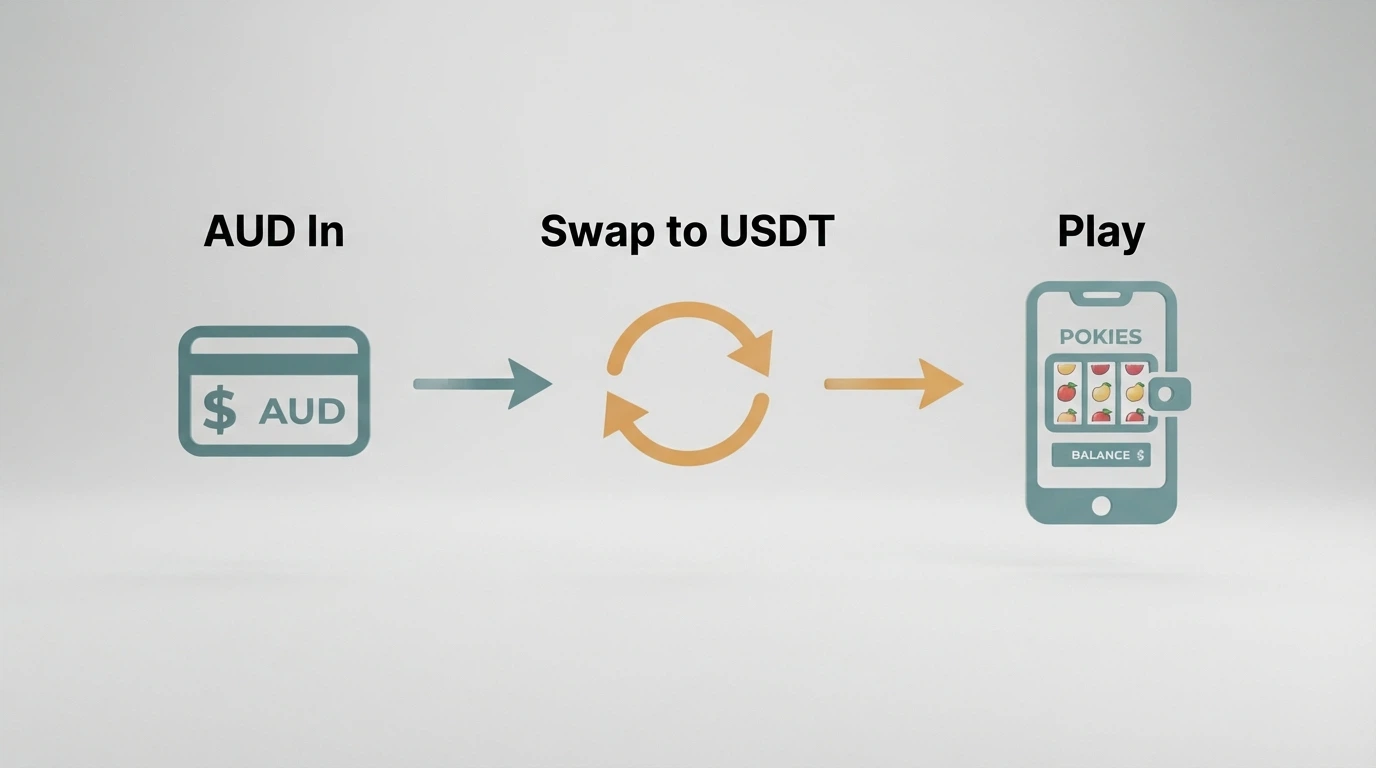
Depositing bitcoin at an online pokies site — step by step
The cleanest on-ramp in 2026 for an Australian player runs through an AUSTRAC-registered exchange. The flow: log in to CoinSpot or Independent Reserve, deposit AUD from an Australian bank account, swap AUD for USDT on the TRC-20 network, then send the USDT to the casino’s deposit address. The whole leg from AUD landing in the exchange to USDT arriving at the casino typically completes inside an hour, with most of that time spent on the bank deposit rather than the blockchain.
Not every Australian bank treats outbound transfers to crypto exchanges the same way. CommBank and Westpac restrict large outbound transfers to known exchanges. ANZ and NAB flag them without fully blocking. ING and Macquarie sit at the most permissive end. None of these banks block outbound transfers to offshore casinos, because the casinos do not ask for the bank account. They ask for the wallet. The bank’s only role is funding the exchange on the way in.
The single most expensive mistake a player can make in this process is selecting the wrong network. If a casino’s deposit page says “USDT TRC-20” and the player sends USDT on ERC-20 instead, the funds arrive at an address the casino does not control. Crypto transactions are irreversible. There is no chargeback, no bank dispute, no ACMA complaint that recovers them. The wrong-network error is the one that costs Australians money in this market, and it costs them permanently.
Cashing out: how crypto withdrawals actually work
The reverse path is faster. A player requests a withdrawal in the casino cashier, the casino processes it (often within minutes for crypto — Rainbet publishes five to fifteen minutes), the funds arrive at the player’s exchange wallet, the player sells USDT back to AUD, and the AUD withdraws to the player’s Australian bank account. The total time from “withdraw” click to “AUD in my bank” is usually under an hour, dominated by the on-chain confirmation and the exchange’s processing time.
The AUSTRAC Travel Rule applies at A$10,000 for crypto transactions. Australian-registered exchanges enforce this on the way in and the way out. A transfer above the threshold triggers identity verification and reporting. For most pokies players, the per-transaction figure sits well below that ceiling, but a player cashing out a large progressive or a high-multiplier bonus win should expect additional verification steps at the exchange.
Minimum withdrawals differ sharply by operator. WinSpirit allows withdrawals from A$10 with no fee. Fair Go matches that floor. Bizzo sits at A$20. Rainbet is set at $15 equivalent. Rocket Casino is A$30. These minimums are not the same as deposit minimums. Fair Go’s Lightning Bitcoin deposit floor is A$5, the lowest in the featured set, but its withdrawal minimum is A$10. Read both before funding the account, because depositing A$10 in Lightning Bitcoin and finding the withdrawal floor is A$30 means a player has to play through the difference before cashing out.
BTC, USDT or Litecoin — which token suits your play
| Cryptocurrency | Deposit Speed | Withdrawal Speed | Network Fee | Price Volatility |
|---|---|---|---|---|
| USDT (TRC-20) | Under 60 seconds | Under 5 minutes | Under A$0.50 | None (stablecoin) |
| Bitcoin (BTC) | 10–60 minutes | 15–60 minutes | A$5 to A$20 | High |
| Litecoin | 2–5 minutes | Under 10 minutes | Under A$0.20 | Medium |
| Solana | Under 30 seconds | Under 2 minutes | Around A$0.10 | High |
The choice of token trades off speed, cost and stability. USDT on TRC-20 is the default for players who want the funds to behave like dollars without behaving like an Australian bank transfer. It clears in under a minute, costs almost nothing in fees, and the value does not move between deposit and withdrawal. A player who wins and cashes out the same day does not have to wonder whether Bitcoin’s price fell twelve percent while they were playing. The trade-off is that the casino, the exchange and the off-ramp all need to support TRC-20, and a wrong-network send to an ERC-20 address is permanent loss.
Bitcoin is the coin most players arrive knowing, and it is the coin most players should think twice about using for pokies. The network fees on Bitcoin have ranged from A$5 to A$20 in recent traffic — painful for small withdrawals and a rounding error for large ones. The confirmation time runs ten to sixty minutes for deposits, fifteen to sixty minutes for withdrawals. And the price can move meaningfully during a long session. A player who deposits 0.01 BTC on a Tuesday and withdraws 0.011 BTC on a Thursday has gained eleven percent on paper, but the dollar value depends on the BTC/AUD rate that Thursday. For a pokies player whose bankroll is denominated in dollars, that volatility is a cost.
Litecoin sits in the cheap-and-fast middle. Sub-A$0.20 fees, two-to-five-minute deposits, sub-ten-minute withdrawals. The price moves less than Bitcoin but more than USDT. Solana is the fastest network on the list, with sub-thirty-second deposits and sub-two-minute withdrawals, but its price volatility rivals Bitcoin’s, and the casino and exchange have to support it specifically. For most Australians, USDT on TRC-20 is the right answer unless the casino does not accept it.
How fast your money moves — crypto vs bank payout speeds
Crypto withdrawal times run from a few minutes to an hour, depending on the coin and the network. Bank transfers, where an offshore casino offers them at all, take days rather than minutes. The speed gap is the single most visible advantage crypto holds over the bank rail for an Australian player, and it is real. A player who hits a bonus round at midnight does not have to wait until Wednesday to see the money.
The speed has a price the marketing does not advertise. A crypto transaction has no chargeback. If the casino sends the wrong amount, sends to the wrong address, or simply refuses to send, the player has no bank to call, no card network to dispute the charge with, and no Australian regulator with jurisdiction over the operator. The same irreversibility that makes crypto fast also makes it unforgiving. A player who picks crypto for speed should pick it with that trade-off in mind, not in spite of it.
The one-way street: why a wrong address means lost funds forever
Crypto transactions are irreversible. That is the underlying design of every blockchain the pokies industry uses, and it is what makes the crypto casino possible. The operator does not have to worry about a chargeback six months later. It is also what makes the casino dangerous to play at. There is no recourse mechanism. A wrong wallet address is permanent loss. A wrong network is permanent loss. A casino that accepts a deposit and refuses to credit the account is not subject to a card dispute.
The payment method is itself a tell. Credit cards and crypto have been banned as payment for licensed interactive wagering in Australia since 11 June 2024, with penalties of up to A$247,500 for operators that fail to enforce the ban. The ban applies to Australian-licensed wagering only, and a gambling site that asks an Australian for a crypto deposit is one that has already stepped outside the Australian rules. The same irreversibility that makes crypto attractive also means the player has no Australian authority to appeal to if the casino disappears, blocks the account, or simply stops answering support emails. That asymmetry is the structural reason the offshore crypto market carries more risk than a domestic debit-card deposit to a licensed Australian bookmaker.
The Bitcoin Pokies Sites Australians Actually Use in 2026
Every operator on this page is offshore. None holds an Australian licence, because no licence for online casino or online pokies exists in Australia, not federally, not in any state or territory. The ACMA has blocked 1,788 illegal gambling and affiliate websites since November 2019, and over 230 illegal services have withdrawn from the Australian market since 2017. The ten operators ranked below are the ones Australians reach anyway, via direct navigation, affiliate links, or the gaps between block orders. The table ranks them on three things that could be verified from public sources: the wagering requirement, the cryptocurrencies accepted, and the minimum withdrawal.
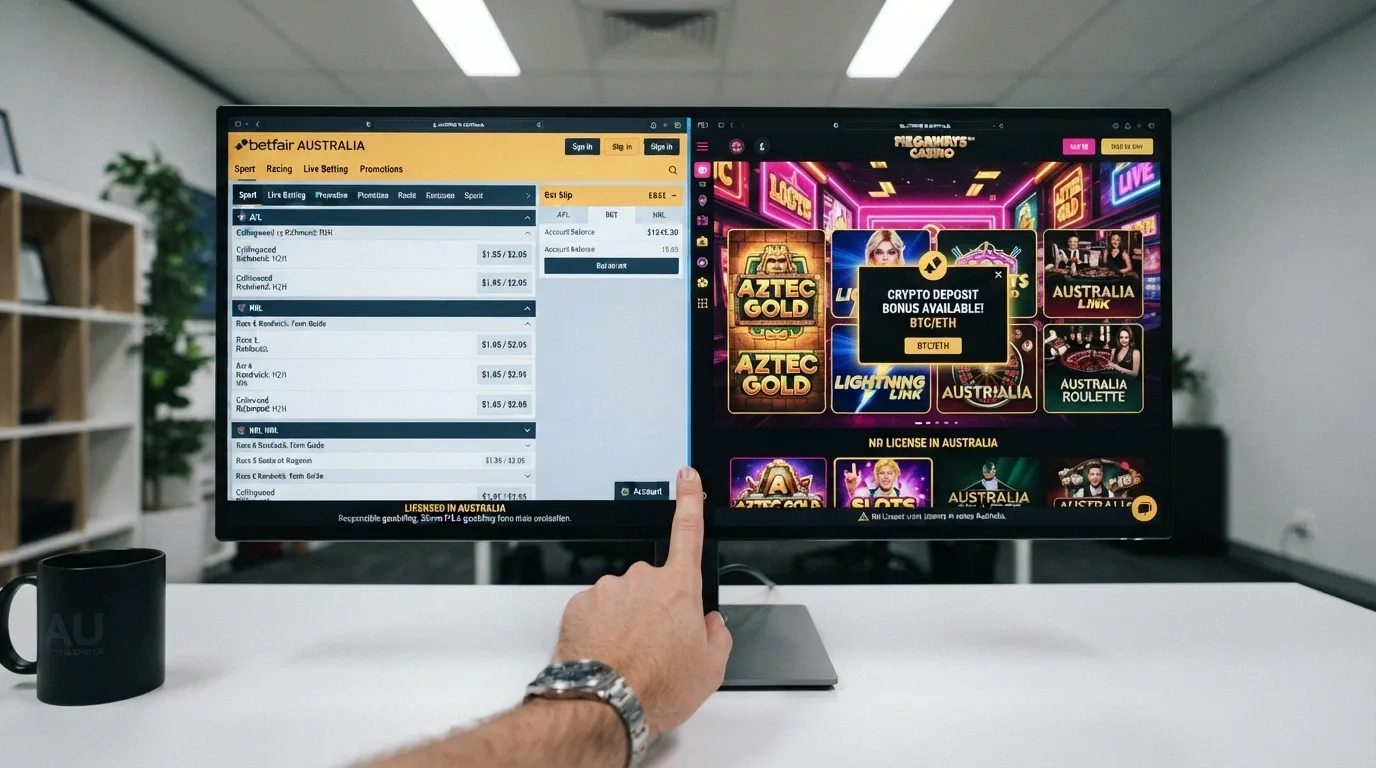
| Operator | Wagering Requirement | Accepted Cryptocurrencies | Minimum Withdrawal |
|---|---|---|---|
| Rocket Play | 40x | BTC, ETH | — |
| SkyCrown | 40x | BTC, ETH | — |
| Royal Reels | — | BTC, ETH | — |
| WinSpirit | 40x | BTC, ETH | A$10 |
| Stake | n/a (rakeback model) | BTC, ETH | — |
| Rainbet | 40x | BTC, ETH | $15 equivalent |
| Scream Casino | — | BTC, ETH | — |
| Fair Go | 30x | BTC, LTC, BCH, Lightning BTC | A$10 |
| Bizzo Casino | 35x–40x | BTC, ETH | A$20 |
| Rocket Casino | 50x | BTC, ETH | A$30 |
The cells left blank are not editorial gaps. They reflect what could be confirmed from publicly available sources this round. Royal Reels and Scream Casino appear in the Australian offshore market but no bonus terms, provider list or licence detail could be verified; readers should check current terms on the operator’s own site before depositing. Three operators did not publish a minimum withdrawal figure that could be confirmed. Where the column is empty, the data was not found.
The variation across the wagering column is the more important story. Fair Go’s 30x is the lightest burden on this list. Rocket Casino’s 50x is the heaviest, and was raised from 45x in September 2026. A higher wagering requirement means more turnover through the pokies before the bonus converts to withdrawable cash, and every dollar of turnover carries the house edge. The wagering column is where the bonus cost lives.
Rocket Play — 9,000+ Pokies and a Welcome Package Worth €1,000
Rocket Play is the volume play on the list. The casino advertises 9,000+ real money pokies, of which 1,248+ are explicitly BTC-eligible, from providers that include Playson, IGT, Wazdan, BGaming and NETGAME alongside the usual Pragmatic Play and Play’n GO catalogues. For a player who wants one account to cover most pokies released in the last few years, the breadth is the selling point.
The welcome offer is 100% up to €1,000 plus 100 free spins on Aztec Magic by BGaming, drip-fed at 20 spins per day for five days. Wagering is 40x on the deposit bonus and 40x separately on the free spin winnings. The maximum cashout from free spins is capped at A$300, the figure that quietly reduces the headline value of the spin package. Bonus validity is seven days from activation, with 24 hours to use each batch of free spins once released.
The combination that matters: a player who maxes out the deposit and works through the wagering on the highest-RTP pokies in the catalogue has a real chance of clearing a positive balance, but the free-spin value is hard-capped well below what 100 spins at the slot’s hit rate would mathematically produce. Treat the free spins as a small bonus on top of the matched deposit, not as a parallel offer.
SkyCrown — The 450% Match That Looks Bigger Than It Is
SkyCrown markets a 450% deposit match up to A$8,000 plus 400 free spins across four deposits. The first deposit alone is 120% up to A$1,200 plus 125 free spins. The free spins spread across four titles: Wolf Treasure by IGTech, Coin Volcano by Booongo, 15 Dragon Pearls: Hold and Win by Booongo, and Mighty Wild: Panther Grand Diamond Edition by Voltent. The headline is one of the largest on the Australian offshore market.
The arithmetic tells a different story. Take the maximum A$8,000 match at 40x wagering on the bonus amount. The required turnover is A$320,000 before the bonus converts to withdrawable cash. Bonus validity is 14 days. The maximum bonus-to-real conversion is A$5,000 per welcome bonus, a hard ceiling on what the player can walk away with regardless of how far the balance runs during wagering.
Assuming only the bonus amount is wagered at the average 96.47% RTP across the Pragmatic Play portfolio, the expected house take on that turnover is roughly A$11,300. That is more than the bonus value the player is clearing. The wagering requirement, on average, costs the player more than the headline value of the offer. For a player who intends to deposit anyway, SkyCrown’s bonus is a discount on the session rather than free money, and a player who would not otherwise deposit A$8,000 should not let the 450% match persuade them to.
The free-spin allocation softens that picture slightly. Four hundred spins at the configured RTP of the four named titles produces some return, but the bonus structure’s centre of gravity is the matched-deposit turnover, and that centre of gravity costs the player money on average.
Royal Reels — A Known Name With Almost Nothing Confirmed
Royal Reels is a recognised brand in the Australian offshore market and appears consistently in affiliate rankings for Australian players. The public record, however, contains no confirmed bonus terms, no confirmed game provider list, no confirmed wagering requirement and no confirmed licence detail. The brand exists and Australians use it; the specifics of what they get when they do are not on the public record that could be verified.
For a player considering Royal Reels, the absence is itself information. A site that markets to Australians without publishing auditable terms is one to test with the smallest possible deposit, read the bonus terms before claiming anything, and verify the withdrawal terms before the balance grows. The offshore market is not short of operators with published terms. Royal Reels being thin on disclosed specifics is a reason to compare rather than commit.
WinSpirit — 200% Bonus and the Lowest Withdrawal Minimum on This List
WinSpirit’s welcome package is a 200% match plus 25 free spins, with 40x wagering on the bonus and the free spin winnings. The bonus shape is straightforward, with no multi-deposit structure and no allocation across four games, and the minimum withdrawal is A$10 with no fee. That floor is the lowest on this list, tied with Fair Go. Payment methods include Visa, crypto and PayID.
The package suits a smaller bankroll. A player depositing A$50 receives A$150 in bonus funds, with 40x turnover on the bonus (A$150 × 40 = A$6,000) before it converts. That is a meaningful session requirement on a small balance but not an unmanageable one. The A$10 withdrawal floor means a player does not have to accumulate a large balance before they can cash out a small win, and the no-fee structure means a small cashout does not get eaten by transaction costs. For players who want to test an offshore casino without committing a large deposit, WinSpirit’s combination of modest match, standard wagering and accessible withdrawal floor is the most player-friendly entry point on this list.
Stake — The Rakeback Model That Skips the Welcome Bonus Entirely
Stake does not offer a traditional welcome bonus. The casino runs a rakeback and cashback model instead, returning a percentage of the house edge to active players over time rather than front-loading a matched deposit on sign-up. The provider mix includes Pragmatic Play, BGaming, Hacksaw Gaming and Evolution, which covers the bulk of the high-RTP pokies an Australian player would look for.
The trade-off is structural. A matched-deposit bonus gives a player more session time upfront and a clear wagering target to clear. Rakeback gives a player a longer-term return that compounds with volume. The more they wager, the more comes back. For a player who plans to play regularly on one site, rakeback can outweigh a one-off welcome bonus across a year of sessions. For a player who wants to deposit once, play through a welcome package and move on, Stake is the wrong operator. There is no welcome package to clear, just a steady return on whatever the player chooses to wager. Read the rakeback terms carefully, because the percentage and the qualifying games vary.
Rainbet — The Only Operator on This List With a Confirmed Licence
Rainbet carries an Anjouan licence under permit number ALSI-152406029-FI2, making it the only operator in the featured set with a verifiable offshore licence. The licence is not an Australian licence and does not confer Australian consumer protections; it is a regulatory registration in a small island jurisdiction. But it is a licence number a player can look up, and that is more than most of the featured set offers. Withdrawal processing is published at five to fifteen minutes. The minimum withdrawal is the $15 equivalent in the chosen cryptocurrency. Crypto deposits are subject to a 1x wager lock, meaning the deposit must be wagered once before it can be withdrawn.
Rainbet also runs its own “Originals” games with provably fair verification. Each bet’s outcome can be checked against a cryptographic seed after the round. For a player who cares about game fairness at a level beyond the studio’s published RTP, the provably fair check is a different kind of reassurance than a licence number alone. The combination of disclosed licence, fast withdrawals and verifiable game fairness is the reason Rainbet sits above the operators with no confirmed data, but the player should still read the Anjouan licence scope. The regulator’s dispute resolution process does not match what an Australian player is used to from an ASIC-regulated service.
Scream Casino — A Brand With More Questions Than Answers
Scream Casino appears in the Australian offshore market but, like Royal Reels, almost nothing could be confirmed. No bonus terms, no provider list, no wagering requirement, no licence. The brand has presence; the disclosure does not.
The same caution applies as for Royal Reels. A player attracted to Scream Casino should verify the bonus terms, the withdrawal conditions and the licence status on the operator’s own site before depositing any amount they would not be comfortable losing to an absence of disclosure. The offshore market has enough operators with published terms that a brand with none is best approached as a research project, not as a place to send a deposit.
Fair Go — RTG-Only, Low Crypto Minimums, and a 30x Wagering Rate
Fair Go runs on RealTime Gaming as a single provider, with a library of around 280 games. That is a smaller catalogue than Rocket Play’s 9,000+ or any of the multi-provider casinos on the list, but RTG has a long Australian history and the games are familiar to players who have used RTG-powered casinos in the past. The welcome package is 100% up to A$200 on each of the first five deposits, a total of A$1,000 in matched deposits across the first five top-ups.
The wagering requirement is 30x, the lightest on this list by a clear margin. A player who maxes out the first deposit at A$200 and works through the bonus faces A$6,000 in turnover, against the A$30,000 to A$32,000 that a similar bonus at 40x would require. Over the full five-deposit package, the 30x rate saves meaningful turnover against the 40x pack.
The crypto deposit minimums are the lowest on the list: Bitcoin A$25, Litecoin A$10, Bitcoin Cash A$10, Lightning Bitcoin A$5. For a player who wants to test an offshore casino with the smallest possible crypto commitment, Fair Go’s Lightning Bitcoin floor is the lowest documented entry point. The trade-off is the single-provider library. A player who wants Pragmatic Play’s Gates of Olympus or Play’n GO’s Book of Dead will not find them here.
Bizzo Casino — No-Fee Withdrawals From A$20
Bizzo’s standout term is the no-fee A$20 minimum withdrawal, with payment methods covering Visa, Mastercard and crypto. The wagering requirement sits in the 35x to 40x range across sources. Bizzo’s published terms do not give a single consistent figure, so a player should check the current bonus terms page before claiming. The casino’s position in the middle of the wagering range and the middle of the withdrawal range makes it a representative option rather than a standout.
For a player who wants a familiar multi-payment setup, with Visa for those who prefer the bank rail and crypto for those who do not, and a mid-pack wagering burden, Bizzo sits in the reasonable middle. It does not have the lowest wagering (Fair Go), the largest library (Rocket Play) or the verifiable licence (Rainbet), but it combines enough of each to function as a default offshore option.
Rocket Casino — 50x Wagering, the Highest on This List
Rocket Casino raised its wagering requirement to 50x on all deposits over A$100 as of September 2026, up from the previous 45x with a A$5 maximum bet. The minimum withdrawal is A$30 with no fees, the highest withdrawal floor on this list. The combination of high wagering and a high withdrawal minimum is the most expensive on this list to cash out a small balance.
A player who deposits A$100 and claims a bonus is committing to A$5,000 in turnover at 50x. At the same 96.47% average RTP, the expected house take on that turnover is roughly A$177, versus A$141 at 40x and A$106 at 30x. For a high-roller depositing A$1,000 and clearing a A$500 bonus, the turnover is A$25,000 and the expected house take is A$883. The 50x rate does not change the bonus value. It changes the cost of clearing it. Rocket Casino is the operator to compare against when a welcome offer looks generous elsewhere. The difference between 40x and 50x is the difference between a recoverable session and a margin the bonus does not cover.
How we compared these sites — the criteria that mattered
The ranking in the table above weighs three things that could be verified across all or most operators: the wagering requirement, the cryptocurrencies accepted, and the minimum withdrawal. Beyond those, the operator profiles note game range, provider breadth, licence status and any unusual bonus structure. The full methodology lives in the section below on how these sites were picked and ranked, including the fact that every operator is offshore, that none holds an Australian licence, and that the comparison is among offshore sites because no licensed Australian online casino exists to compare against.
The criteria that mattered most, in order: how much of the bonus a player actually gets to keep after the wagering is done (the wagering column), how accessible the cashout is for a small balance (the minimum withdrawal column), and how broad the cryptocurrency support is for a player who wants to use a particular coin (the accepted cryptocurrencies column). Game count and provider quality mattered but did not differentiate as sharply. Most multi-provider casinos on this list carry Pragmatic Play and a Play’n GO subset. The licensing column matters precisely because so few of the operators publish a verifiable licence number.
The Pokies Worth Your Bitcoin — RTP, Volatility and What the Numbers Reveal
Return to Player, expressed as a percentage, is the share of wagered money a slot returns to players over a very large number of spins. A 96% RTP slot returns, on average, A$96 of every A$100 wagered. The house keeps A$4. Over thousands of spins, the percentage converges. Over a single session of two hundred spins, anything can happen, and the house edge does not feel like a percentage. It feels like the balance going down.
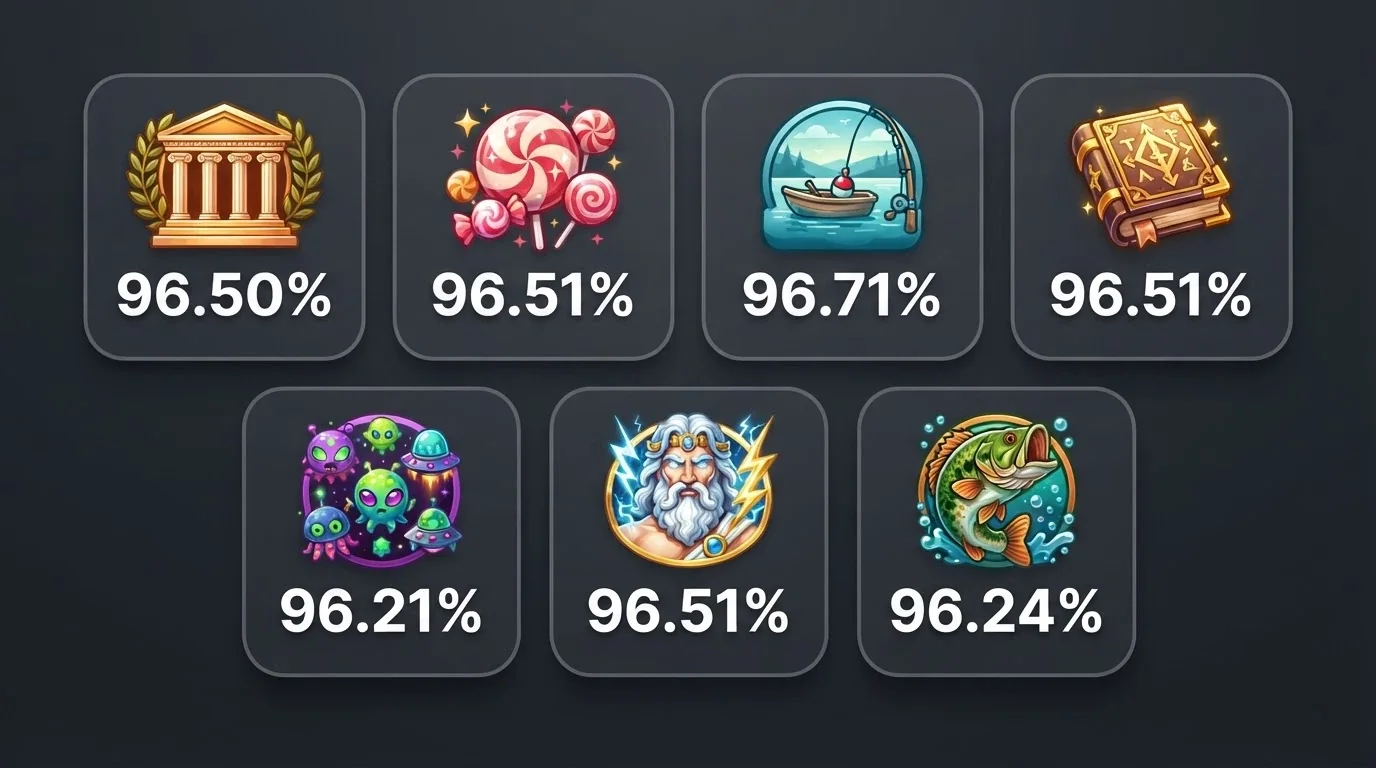
The Pragmatic Play portfolio averages around 96.47% RTP, above the industry average of approximately 95.5% at traditional fiat casinos. That difference is meaningful over thousands of spins. It is not meaningful over a Tuesday night session on Gates of Olympus. Volatility, the spread between common small wins and rare large wins, matters more for the session experience than the RTP does. A high-volatility slot with a 5,000x max win can drain a balance in two hundred spins and still pay out exactly what its RTP says it should, because the maths plays out across millions of rounds, not across one player’s evening.
The seven titles below are the ones with specific RTP figures that could be verified. The table is not a list of “the best pokies.” It is a list of the pokies where the numbers are known and where an Australian player is likely to encounter them on the offshore sites above.
| Slot Title | Provider | RTP | Volatility | Max Win |
|---|---|---|---|---|
| Gates of Olympus | Pragmatic Play | 96.50% / 96.58% bonus buy | High | 5,000x |
| Sweet Bonanza | Pragmatic Play | 96.51% / 96.58% bonus buy | High | 21,175x |
| Big Bass Bonanza | Pragmatic Play | 96.71% | High | 2,100x |
| Big Bass Bonanza 1000 | Pragmatic Play | 96.51% | High | 20,000x |
| Book of Dead | Play’n GO | 96.21% (configurable down to 84.18%) | High | 5,000x |
| Reactoonz | Play’n GO | 96.51% | High | 4,570x |
| Rise of Olympus 1000 | Play’n GO | 96.24% (configurable down to 84.24%) | High | 60,000x |
Three things stand out in this table. First, the volatility column is uniformly High. None of these titles are low-volatility games that pay out small amounts regularly. Every one of them is built around a less-frequent, larger-payout profile. A player who picks one of these slots for a session should expect long dry stretches punctuated by either nothing or a significant hit. Second, the max win figures vary by an order of magnitude. Big Bass Bonanza caps at 2,100x. Rise of Olympus 1000 reaches 60,000x. The higher the max win, the rarer it hits. Third, the Play’n GO titles carry a configurable-RTP warning: Book of Dead, for example, can run at 96.21% at one operator and 84.18% at another, a difference of more than twelve percentage points. The RTP a player sees in the game’s information panel is the configured version the operator has selected, not necessarily the version the studio publishes as the headline.
That last point matters for the player choosing between two offshore casinos running the same Play’n GO title. The RTP published on the studio’s site is not a guarantee. It is the upper bound. The actual return depends on which configuration the operator has paid for. Pragmatic Play titles are generally published at a single RTP and do not have the same range, though bonus-buy versions sometimes run slightly higher than the standard spin RTP.
Why Every Bitcoin Pokies Site Is Offshore — And What That Means for You
The legal position in Australia is unambiguous. The Interactive Gambling Act 2001 prohibits the provision of online casino games, online pokies and in-play sports betting to a person in Australia. There is no licence for online casino anywhere in the country. The ACMA enforces the prohibition. The 2026 reform tightens it further from 1 January 2027. The player is not prosecuted, but the player is also not protected.
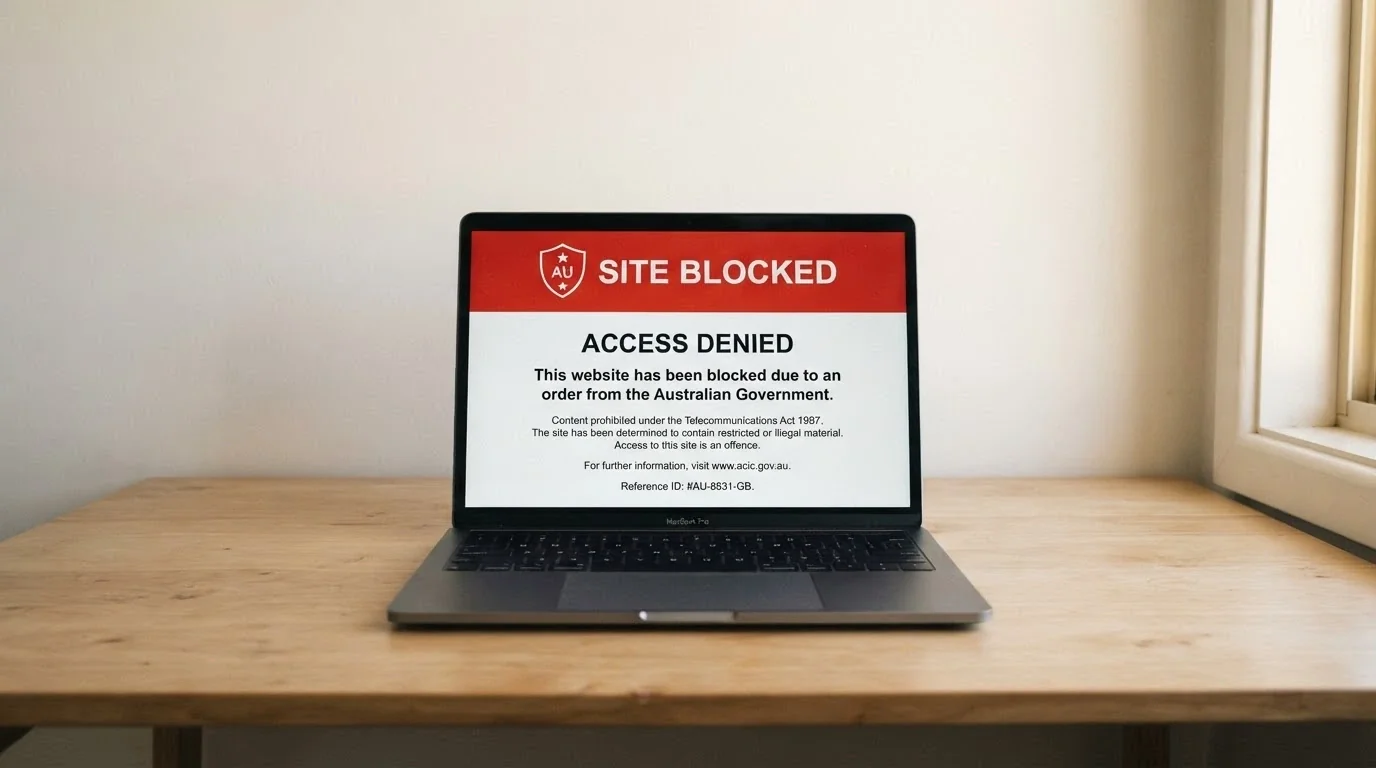
The law that says no — the Interactive Gambling Act explained
The Interactive Gambling Act 2001 makes it an offence for an operator to provide online casino games, online pokies or in-play sports betting to a person physically in Australia. There is no licence for online casino at the federal level, and there is no licence at the state or territory level either. The act targets the provider, not the player. An Australian who plays at an offshore casino is not committing an offence. The provider is.
What IS licensed in Australia is wagering on races and sport placed before the event begins, lotteries, and keno, through operators licensed by state and territory regulators. The Northern Territory Racing and Wagering Commission is the most common of those. The minimum age is 18. Online casino sits outside that licensed market entirely, which is why “best licensed online casinos in Australia” is describing something that does not exist.
The payment ban that gives the game away — crypto and credit cards
Since 11 June 2024, credit cards, credit-related products and digital currency (crypto) have been banned as payment methods for licensed interactive wagering services in Australia. The Interactive Gambling Amendment (Credit and Other Measures) Act 2023 passed Parliament on 6 December 2023 and commenced in full on 11 June 2024. Penalties for operators that fail to enforce the ban reach A$247,500.
The practical consequence is the clearest tell in the offshore market. A gambling site that asks an Australian for a credit card deposit or a crypto deposit is one that is already operating outside the Australian rules. Licensed Australian wagering takes debit cards, bank transfers, PayID/Osko and BPAY, not credit and not crypto. The payment method reveals the operator’s status before the bonus terms do. A government review of the ban is scheduled after June 2026. Until then, the prohibition holds.
ACMA enforcement — blocking, warnings and the numbers
The ACMA has had 1,788 illegal gambling and affiliate websites blocked by Australian ISPs since the first blocking request in November 2019, as of August 2026. Over 230 illegal services have pulled out of the Australian market entirely since the ACMA strengthened enforcement in 2017. The numbers are accelerating, not slowing.
In Q4 2025, the ACMA completed 23 investigations into 45 gambling sites, found 69 breaches of the IGA, issued 10 formal warnings and referred 133 websites for ISP blocking. In Q1 2026, the authority reviewed 422 gambling enquiries and complaints, completed 25 investigations into 60 gambling sites, found 44 IGA breaches and referred 109 websites for ISP blocking. The blocking is DNS-level. Australian ISPs refuse to resolve the domain. It is not presented as unbeatable. The trajectory is what matters. The block list grows faster than the operators can replace themselves.
The 2026 reform — what changes in January 2026
The Interactive Gambling Amendment (Gambling Reform) Bill 2026 passed Parliament on 19 August 2026 and its measures commence on 1 January 2027. The reform restructures the advertising and inducement environment around licensed wagering, and it gives banks new powers to block transactions to illegal operators.
For advertising: wagering ads are capped at three per hour between 6:00 am and 8:30 pm, with a live-sport blackout from fifteen minutes before an event until five minutes after. Radio wagering ads are banned during school hours; broadcasting odds is banned outright. Online wagering ads can only target logged-in, age-verified users who have not opted out. Inside sports venues and on player and official uniforms, wagering advertising is banned. Athletes, celebrities and influencers cannot promote wagering products.
For inducements: direct marketing of inducements is banned for fourteen days after a customer signs up with a licensed operator and for three months after a person deregisters from BetStop. For at-risk customers, the ban is open-ended. The window for the “free bet, deposit match, bonus spin” marketing cycle on licensed Australian platforms narrows sharply from 1 January 2027.
For payments: banks and payment providers gain express authority to block transactions to illegal gambling operators. The mechanism is not yet fully specified, but the direction is clear. Australian banks will be able to refuse transactions to offshore gambling sites in a way the current legal framework does not allow. For an Australian player funding an offshore casino through an AUSTRAC-registered exchange, this is the change most likely to affect the practical mechanics of the offshore route.
What you give up playing offshore — no BetStop, no ACMA, no recourse
The price of the offshore route is not in the bonus terms. It is in what disappears when the player steps outside the Australian licensing perimeter.
BetStop, the National Self-Exclusion Register, binds Australian-licensed wagering services only. One registration excludes a person from every Australian-licensed online and phone wagering service. As at 31 July 2026, the register held 67,480 registrations, of which 41,290 exclusions were still active. Seventy-eight percent of registrants were under 40, and thirty-eight percent chose lifetime exclusion. None of this matters at an offshore crypto casino. The register is not connected to the site. The site will accept the deposit from a self-excluded person without question, and the player keeps the entire burden of self-exclusion on themselves.
The ACMA complaint path is gone. The Australian Financial Complaints Authority does not cover offshore operators. State and territory fair-trading tribunals have no practical jurisdiction over an entity incorporated in Curaçao or Anjouan. An Australian court order against an offshore casino is enforceable only if the operator holds assets in Australia, which most do not.
Crypto deposits add a second layer: irreversibility. If the casino refuses a withdrawal, the player cannot dispute the original transaction through a card network. The transaction cleared when the funds arrived at the casino’s wallet, and that is the end of the bank’s involvement.
The site can be blocked at any time. The ACMA can refer a domain for ISP blocking, and the Australian ISP will stop resolving it. A player with a balance on the blocked site has no Australian authority to appeal to for the funds. The casino may continue operating from its offshore jurisdiction and may eventually release the balance. It may not. The risk is structural and cannot be diversified across operators.
Playing Safely When the Safety Net Can’t Reach You
BetStop does not reach offshore crypto casinos. ACMA cannot recover funds from them. The Australian Consumer Law does not apply to them. A player who decides to use the offshore route is the only safety net that touches their own play. That changes how harm reduction has to work.

Where BetStop can’t follow — the offshore self-exclusion gap
BetStop went live in August 2023 as Australia’s national self-exclusion register. One registration excludes a person from every Australian-licensed online and phone wagering service. There is no opt-out period for the minimum six-month exclusion and a lifetime option for those who want it. As at 31 July 2026, 67,480 Australians had registered. Forty-one thousand two hundred and ninety exclusions were still active. Seventy-eight percent of registrants were under forty. Thirty-eight percent chose lifetime exclusion.
None of this applies offshore. An offshore casino does not query the BetStop register before accepting a deposit. It does not see a player’s exclusion status. It does not block sign-ups from self-excluded Australians. The most concrete harm of the offshore route is that the country’s primary self-exclusion mechanism does not follow the player across the border. A person struggling with gambling and registered with BetStop is fully protected at a licensed Australian bookmaker. At an offshore crypto casino, they are not protected at all.
How big the problem is — gambling harm in Australia by the numbers
Approximately 3.29 million Australians aged five and over are affected annually by their own or another person’s gambling. The breakdown: 1.97 million adults with at-risk or problem gambling, plus 1.38 million affected others. The Roy Morgan Gambling Harm Index (March 2026) found 15.1% of the Australian adult population, 3.32 million people, experiencing some level of gambling harm: 13.0% from their own gambling, 5.4% from someone else’s.
Problem gambling incidence has been climbing. On the Roy Morgan PGSI, problem gambling moved from 1.9% in 2022–23 to 2.4% in 2023–24 and 2.9% in 2024–25. Risky gambling among those who gamble rose from 13.7% in 2024 to 19.4% in 2025, almost doubling since the COVID-19 lockdowns. Of those who gamble, 56.1% participate mainly online.
In the twelve months to March 2026, Australians lost A$36.0 billion to gambling. The per-capita figure is the highest of any country measured. The annual health loss associated with that harm is estimated at over 400,000 Years Lived with Disability. These numbers sit behind every spin on an offshore pokie, and they are the reason offshore play deserves the caution this page keeps returning to.
Getting help — numbers to call and tools that work
The National Gambling Helpline is 1800 858 858, free, confidential, and staffed 24 hours a day. Online chat and professional counselling are available through Gambling Help Online. The helpline is the single resource that works regardless of where a person plays, because it is not tied to a particular operator or jurisdiction.
For offshore players, the practical harm-reduction tactics shift to the parts of the system a player does control. Set deposit limits on the exchange side, not just at the casino. If the casino’s deposit cap is bypassed, the exchange-level cap remains. Use session timers and stick to them. Offshore sites do not impose them. Self-exclude from the crypto exchanges themselves if necessary. Closing the on-ramp is a circuit-breaker that does not depend on the casino’s cooperation. Never chase a crypto loss with another deposit. The irreversibility that makes crypto fast also makes chasing expensive.
A player who recognises the signs — playing longer than intended, depositing more than they planned, hiding play from family, borrowing to fund sessions — should call 1800 858 858. The line is free. The conversation is confidential. It works regardless of whether the person’s account is with a licensed Australian bookmaker or an offshore crypto casino.
How We Picked and Ranked These Bitcoin Pokies Sites
Every operator in this ranking was checked against the ACMA register, which lists licensed Australian wagering services. None of the ten operators appear there, because no Australian licence for online casino exists. The operators were then checked against publicly available offshore licence registers (Curaçao, Anjouan) where those registers are accessible, and against the operators’ own published terms pages.
The ranking weighs three verified criteria: wagering requirement (the multiplier applied to the bonus before it converts to withdrawable cash), cryptocurrency support breadth (which coins the operator accepts for deposit and withdrawal), and minimum withdrawal (the smallest amount a player can cash out without incurring fees). Beyond those three, the operator profiles note game range, provider quality, licence transparency and any structural bonus features that differentiate the offer.
No invented weightings or composite scores sit behind the table. The criteria are visible in the columns; the ranking follows from them. Where a cell could not be confirmed, the cell is empty, because an empty cell is more useful than an invented one. The full set of operators is presented, including Royal Reels and Scream Casino, where the published record is thin. Naming them without inventing terms for them is more honest than leaving them out.
Every operator on this page is offshore, and every operator is unranked on Australian-consumer-protection grounds because that ranking cannot be performed. No Australian regulator oversees any of them, and the protections Australian players are accustomed to do not apply at any of them. A player using this page to choose an operator should read the responsible gambling section above as carefully as the operator profiles.
Offshore Bitcoin Pokies — What You Should Actually Do
The trade-off the offshore route offers is real. Crypto deposits clear in minutes, withdrawals land the same day, and a player can access online pokies at all, which is not possible through any Australian-licensed service because no such service exists. The cost of that access is the absence of every protection Australians rely on for domestic wagering. No BetStop. No ACMA complaint path. No AFCA. No state fair-trading tribunal. No chargeback on crypto. No guarantee the site will not be blocked tomorrow with a balance on it.

For a player who decides to proceed, four practical rules follow from the numbers on this page. First, use USDT on TRC-20 unless the operator does not accept it. The speed, the low fee and the absence of price volatility make it the right default for a dollar-denominated bankroll. Second, pick the lowest wagering operator that fits the rest of the criteria. Fair Go at 30x costs meaningfully less than Rocket Casino at 50x across the same turnover, and the bonus value is the same headline. Third, withdraw gains frequently rather than letting a balance accumulate. The offshore site can be blocked at any time, and a smaller balance is a smaller exposure to that risk. Fourth, never deposit funds needed for living expenses, and never chase a loss with another deposit. The irreversibility that makes crypto fast also makes recovery impossible.
This page has not named a recommended operator, because recommending one to a reader as a place to play is a service to the operator and not to the reader. The operator profiles describe what each one offers and what it costs. The choice is the reader’s, made with the legal ground underneath the choice understood. The offshore route is fast, private and outside every Australian protection. The reader should weigh those three things before they deposit, not after.
Frequently Asked Questions
Can I self-exclude from a bitcoin casino using BetStop?
No. BetStop binds Australian-licensed wagering services only. An offshore bitcoin casino is not connected to the register and keeps accepting deposits from self-excluded players. A player registered with BetStop who is still playing offshore should treat the coverage gap as a direct harm-reduction problem and contact the National Gambling Helpline on 1800 858 858.
Do I have to pay tax on bitcoin pokies winnings in Australia?
For an ordinary punter, no. Gambling winnings are not assessable income under section 6-5 of the ITAA 1997, and losses are not deductible. The exception is a person carrying on a business of betting, judged against the ATO criteria in IT 2655. The crypto layer adds a CGT event when swapping crypto back to AUD.
What happens if a crypto casino refuses to pay my withdrawal?
Crypto transactions are irreversible, so there is no card dispute to file. The casino is offshore, so the ACMA cannot compel a payout and the Australian Financial Complaints Authority does not cover these operators. The practical options are the casino’s own dispute process and any verifiable offshore licence’s complaint channel. The structural lesson is to use small deposits and withdraw gains frequently.
What is the ACMA and what does it do about illegal online casinos?
The Australian Communications and Media Authority is the regulator that enforces the Interactive Gambling Act 2001. Its tools include formal warnings, civil penalty proceedings, and referring domains to ISPs for blocking. Since November 2019, 1,788 illegal gambling websites have been blocked, and over 230 illegal services have withdrawn from the Australian market entirely.
Does the A$10,000 AUSTRAC Travel Rule apply to my bitcoin casino deposits?
The Travel Rule applies at A$10,000 for crypto transactions and is enforced by AUSTRAC-registered exchanges, not by the casino. It triggers identity verification on AUD-to-crypto and crypto-to-AUD conversions above A$10,000. Most pokies players operate below the threshold, but a large win can push a single cashout above it.
How can I check if an online casino is licensed in Australia?
There is no licence to check. The ACMA register lists licensed Australian wagering services, and no online casino appears on it because no Australian licence for online casino exists. Any site claiming to be a licensed Australian online casino is not consistent with the Interactive Gambling Act 2001. Offshore licences are verifiable through the relevant offshore regulator’s register.
Published by the Casino Payment Methods AU team.