
Australian Keno in 2026: What Every Online Casino Ranking Leaves Out
 Available in AU
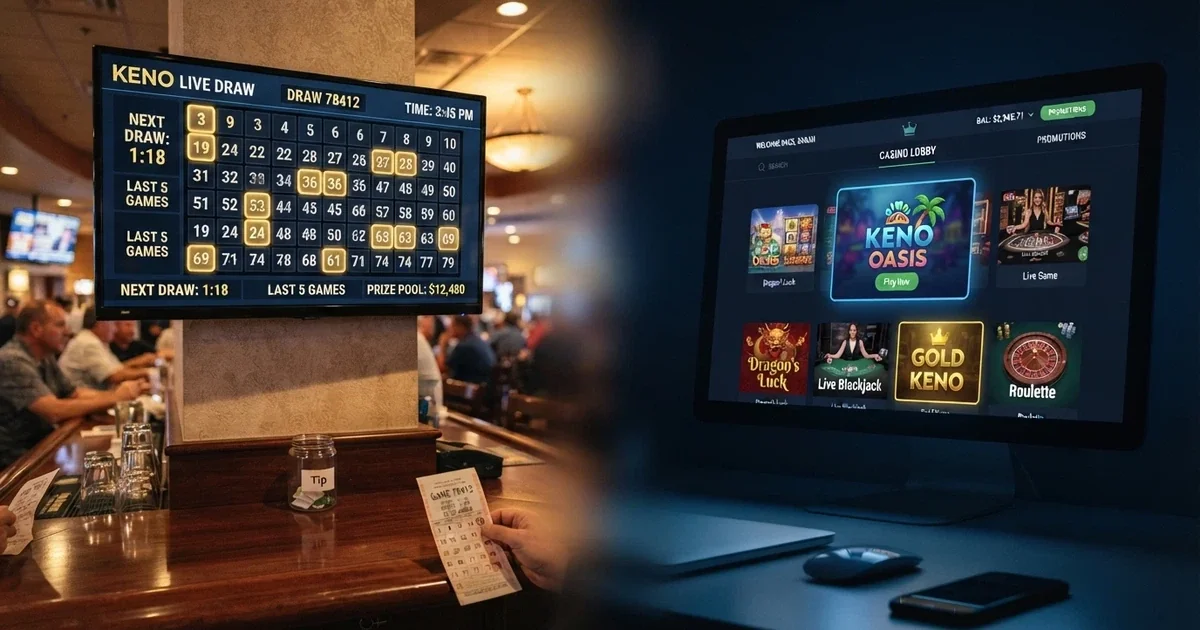
The term “online keno casino Australia” brings up two products that share a name and almost nothing else. One is the licensed lottery draw, run every few minutes at a pub TAB or on a regulated app. The other is an offshore casino game, hosted by a Curaçao-registered operator, paid in Bitcoin, and sitting outside Australian law. Both appear when you look for the same topic, and most rankings do not bother drawing the line. This one does.
Data current as of 18 October 2026 · licence and product claims verified against ACMA, the Victorian Gambling and Casino Control Commission, and The Lott’s published game rules.
- What Online Keno Actually Delivers in 2026 — and What It Doesn’t
- How Keno Works — and Why the House Edge Is Sharper Than It Looks
- Offshore Keno Casinos Australians Actually Use: The 2026 Ranking
- Free Keno: Practise Without Risk Before You Bet a Dollar
- Real-Money Keno Payments: What Works for Australian Players Right Now
- Crypto Keno Casinos: The Offshore Route, Explained
- Is Online Keno Legal in Australia? The Two-World Reality
- Staying in Control: BetStop, Limits and Real Help
- How We Selected and Ranked These Keno Casinos
- What an Australian Keno Player Should Actually Do in 2026
- Frequently Asked Questions
What Online Keno Actually Delivers in 2026 — and What It Doesn’t
The reason a player searches for “best keno online casino australia” is that the licensed product does not feel like an online casino. The pub TAB screen, the KenoGO app, the in-venue monitor at the RSL — these are regulated lottery products with state-issued licences, a set RTP, and a 25% house edge the operator cannot quietly rewrite. The offshore casino keno Australians find when they click an affiliate link is a different thing in almost every respect: an RNG-driven instant game, a higher stated RTP, a welcome bonus that pays out in matched deposit, and a Curaçao licence that no Australian regulator recognises.
The legal split is the spine of this page. Most competitor reviews treat the two products as the same category with different RTPs. They are not the same category. They sit on opposite sides of the Interactive Gambling Act, and what an Australian can do at each is shaped by that difference.
The Two Keno Worlds: Licensed Australian Draws vs Offshore Casino Games
Australian keno, as a licensed product, runs through Tabcorp in NSW, the ACT Jockey Club, Tatts in Victoria and KenoGO across the country — all licensed under state regimes, with the Victorian Gambling and Casino Control Commission the most visible regulator for the online KenoGO app. The draw is fixed. Twenty numbers come out of eighty every three to three-and-a-half minutes in NSW, QLD, VIC and the ACT, and roughly every ten minutes in South Australia. Tickets start at A$1. Jackpots climb to A$40 million every three minutes on the marketing copy. The player is buying a chance at a lottery draw that has been running, in much the same form, since the 1990s.
Offshore casino keno is the other category, and the one a search for “online casino keno” actually surfaces. It is run by studios like Pragmatic Play, Evoplay, Spribe, Turbo Games and Shadow Studios, hosted by Curaçao-licensed casinos like Neospin, Golden Crown and SkyCrown, and funded with crypto on most of them. The draw is not a draw. It is an RNG call, settled instantly, and the player can re-spin in seconds. The stated RTP runs from 94% to 97% across the main titles. Welcome bonuses are the main event: 300% here, 450% there, with free-spin counts in the hundreds.
What the player does not get from the offshore product is the licensed-side scaffolding: no BetStop self-exclusion, no deposit-limit regime enforced by an Australian regulator, no recourse to an ombudsman if a withdrawal stalls. The product is accessible from Australia. It is not legal for an Australian-licensed operator to offer it, and the offshore operator carries the legal exposure, not the punter who placed the bet.
How Casino-Style Keno Differs From the Pub TAB Screen
The two products even feel different to play. A licensed draw is a fixed-event lottery: the player marks their numbers, the screen goes quiet, the draw happens on a schedule, and the result is final. A casino-style keno bet is closer to a slot spin in feel. The player picks spots, places the bet, the RNG fires, the result resolves in under a second, and the next bet can be on the table before the screen finishes animating the win.
That pace change is not cosmetic. The licensed draw forces a pause between decisions, which is part of why its RTP sits around 75%. The offshore RNG version compresses that pause to nothing, and the maths shifts accordingly: the operator takes less per spin, the player loses less per spin, but the player can play more spins per minute. The marketing word for this is “instant.” The arithmetic word for it is that a player’s hourly exposure depends as much on how often they tap the button as on what each tap costs.
Bet sizing is the other divergence. The licensed product draws most of its audience at A$1 to A$5 a ticket. The offshore casino typically sets a higher minimum and offers far wider maximums, with per-bet caps and bonus rules layered on top. A KenoGO bank transfer starts at A$1. A Neospin deposit starts materially higher and comes with a 300% match if the player takes the bonus, which carries its own turnover requirement (research did not surface the wagering multiple for Neospin).
Why the Search Results for “Keno Online Casino Australia” Don’t Tell the Full Story
A search for these terms returns a near-uniform list of affiliate review pages. They list five to fifteen offshore casinos, attach bonus caps, name payment methods, and tack on a generic responsible-gambling paragraph at the bottom. Most do not state that no online casino licence exists in Australia. Many slide between licensed lottery keno and offshore casino keno as if the two were variants of the same game. A small number name BetStop and the credit card ban; fewer still give specific RTP numbers and cite where they came from.
What this means for a reader is that any individual ranking is a monetised funnel, not a neutral assessment. The casino at position one has paid for that placement, and the welcome bonus numbers reflect what the affiliate negotiated, not what the casino will pay out to the player. The honest question to ask of any list is not which casino is best but what the list leaves out. On this page, the thing it leaves out is the licensed product — the 75% RTP draw that runs on an Australian-issued licence and binds itself to BetStop. That draw is not in the affiliate funnel. That is precisely why it belongs in any honest comparison.
How Keno Works — and Why the House Edge Is Sharper Than It Looks
Keno’s rules are simple enough to learn in a minute and unforgiving enough to bleed a bankroll in an evening. Twenty numbers are drawn from a possible eighty. The player picks between one and ten numbers, called Spots, and wins according to how many of their picks the draw matches. The game runs on the same fundamental maths in both the licensed and offshore formats, but the configuration is where the player loses.
The Basic Keno Card: Spots, Draws and How Payouts Scale
A keno card is an 80-number grid from which the player marks their Spots — between one and ten numbers, depending on the format and what the operator allows. The draw selects twenty numbers at random, and the payout is a function of how many of the player’s Spots match against the twenty drawn. The minimum entry is A$1 per draw on the licensed product, or A$2 for Keno Mega Millions on the same platform. Offshore casinos tend to set their own minimums, typically higher than a dollar.
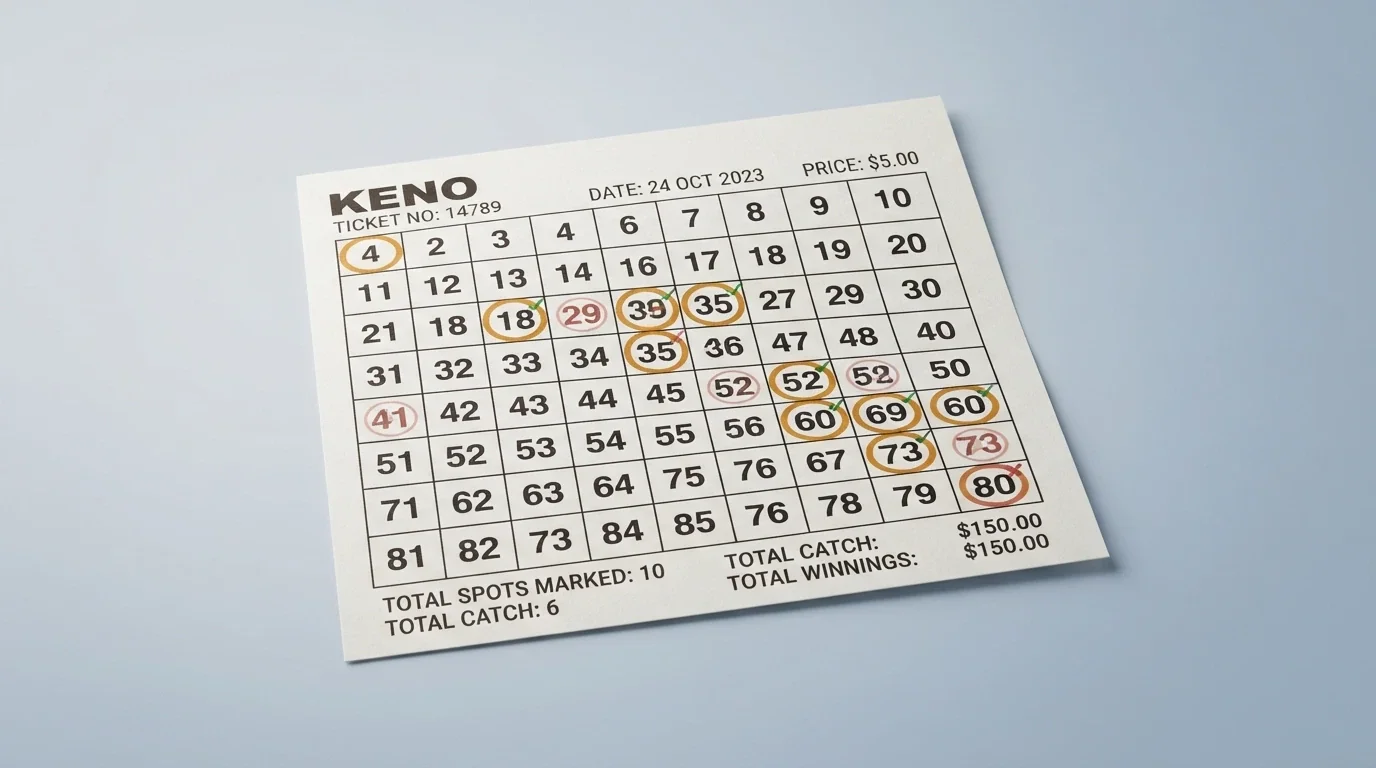
A few features define the card across both worlds:
- 20 of 80 numbers are drawn per round on licensed Australian keno; offshore titles may run on the same 80-ball configuration or use a different ball count.
- Players pick 1 to 10 Spots per ticket on the licensed product; the offshore RNG format typically allows the same range.
- Payouts scale with the number of Spots chosen and the number matched, but the table is set by the operator — and on the licensed side the curves produce a roughly 75% return across most configurations.
- The minimum draw entry is A$1 (A$2 for Mega Millions on The Lott), which is the cheapest real-money keno a player can buy in Australia.
Keno RTP by the Numbers: Licensed Draws vs Online Casino Titles
The RTP gap is the single biggest number on this page. Licensed Australian keno returns roughly 75 cents per dollar across Spots 1 through 10, 15, 20 and 40 — a 25% house edge that does not vary with strategy. Some side formats on the same licensed product — keno racing, heads-or-tails, keno roulette — return closer to 80% RTP, but those are the exception. Online casino-style keno is a different proposition: named titles carry stated RTPs between 94% and 97%, with the variance coming from how the studio configures the game rather than from any game-side decision the player makes.
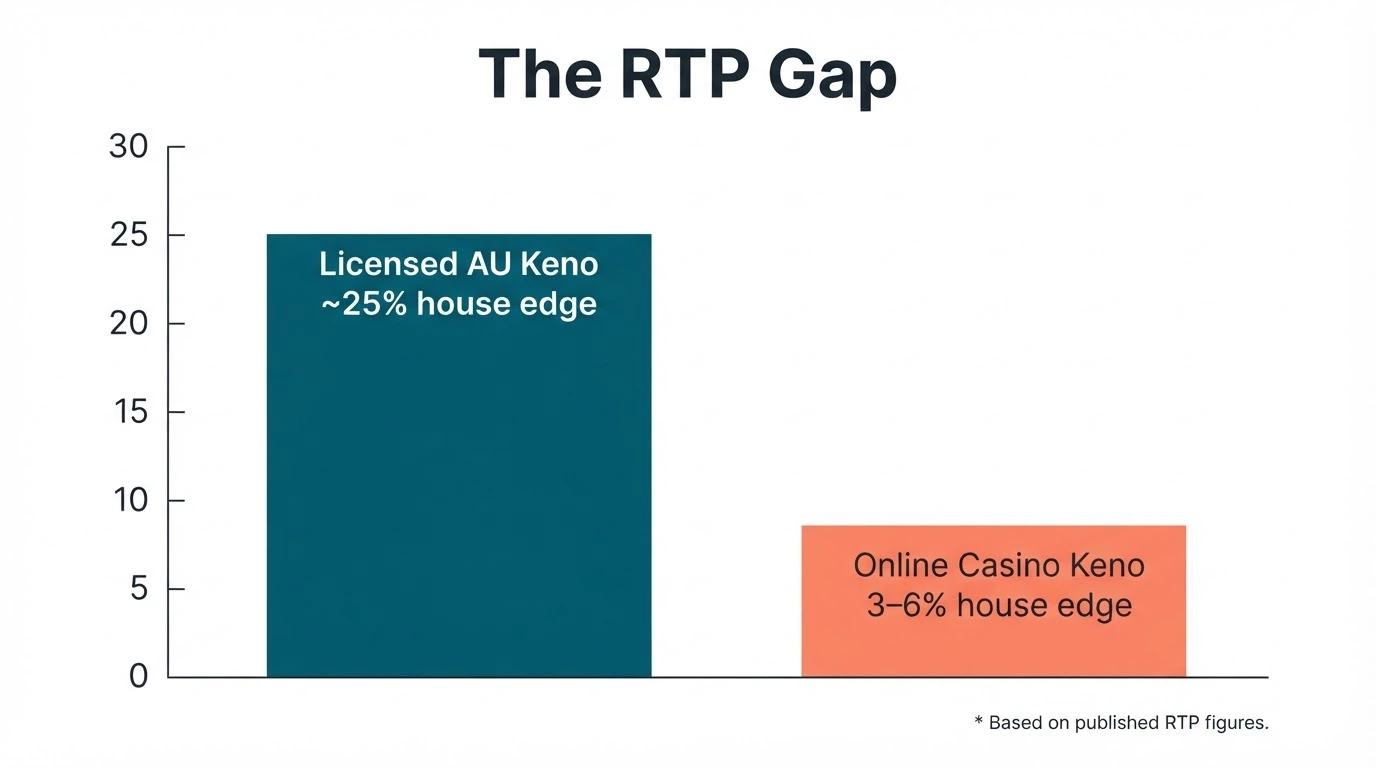
The two clearest comparisons are below. The licensed figure is for the standard Australian keno product; the online casino titles are individual games with documented RTP figures from third-party testing or the operator’s own listing.
| Title | Provider | RTP | Max Win |
|---|---|---|---|
| Keno+ | Pragmatic Play | 97.02% | x5,000 |
| Keno 2X | Shadow Studios | 96% | x2,000 |
| Turbo Keno | Turbo Games | 96.02% | x6,000 |
| Keno 80 | Spribe | 94.48% | x63,500 |
| Book of Keno | Evoplay | 96.11% | €7,500 |
| Galaxsys Keno 10 | Galaxsys | n/a | x10,000 |
| BC.Game Keno | BC.Game | n/a | x1,000 |
| Duel Keno | (provider not confirmed) | not confirmed | x50,000 (with A$1,000 bet cap) |
The spread is wider than it looks. Book of Keno is a good case: Evoplay lists a max win around €7,500 and Wizard of Odds carries a 96.11% RTP figure, but independent slot aggregators show RTP up to 97.01% and max wins of x10,000. The disagreement is not a single canonical answer — it is a disagreement between sources, and the player choosing a game should know that even the published RTP is a published figure, not a guarantee.
What this RTP gap costs a session is the more useful number. At A$1 per draw and 75% RTP, a 50-draw session is set up to cost the player A$12.50 in expected loss — 25 cents on every dollar wagered, regardless of how often the player wins along the way. The same 50 draws on an online casino title at 96% RTP come in at A$2.00 of expected loss. The difference is roughly A$10.50 per fifty draws, and it scales linearly: 100 draws, A$21 difference; 500 draws, A$105. None of these are guarantees. They are averages over many sessions, and any individual session can come in well above or below the figure. But the average is the number a player plans against, and it is the number the licensed product’s marketing does not volunteer.
Keno Strategy: What You Can Control and What the Maths Decides
There is no system for picking keno numbers, and the player who buys one is buying something that does not work. The draw is independent each round on the licensed product and generated by an RNG on the offshore product. The probability of hitting all 10 Spots on a standard licensed draw is roughly one in 8.9 million. No frequency analysis, no “hot number” pattern, no Mark-or-QuickPick distinction moves that figure.
What the player can do is manage the Spot count and the bankroll. Fewer Spots mean a higher chance of hitting some of them, but the payout per hit drops faster than the hit rate climbs. Ten Spots is the long-shot configuration with the 1-in-8.9-million payout ceiling. One Spot is essentially a coin flip at near-even odds, with the operator’s edge baked in. The maths across the Spot range is calibrated to return about 75% regardless of what the player chooses — the operator has already balanced the payouts so the strategy is which configuration feels closest to even-handed, not which one wins more often.
Bankroll management is the real strategy. The 25% house edge at licensed keno is severe: a player with a A$100 bankroll is set up to lose it in roughly A$400 of total draws, and that is on average. The player who treats keno as an entertainment spend rather than an investment has already absorbed the most important rule.
Keno Variants That Change the Odds: 4-Card, Multi-Card and Live Dealer
Not every keno product on the offshore side plays the same way. Neospin’s catalogue spans 14 keno formats across Classic, Super, Turbo and Video groupings, with Book of Keno among the more visible titles. Wild Tokyo lists 23 keno styles on its menu, the deepest catalogue among the operators on this page. The format names cluster around three mechanical changes: more cards per round (4-card keno is the common version), faster draw cycles (turbo and speed keno), and a live dealer running the draw in real time rather than an RNG.
The mechanic change is what matters, not the label. A 4-card keno round increases the player’s total action per round — four separate Spots, four chances to hit — but each card carries its own house edge, and the combined edge across the four cards is roughly four times the per-card figure. The player feels like they are getting more action per round. The maths is unchanged.
Live dealer keno is the closest the offshore product comes to the licensed experience: a real draw, a real-time result, no RNG shortcut. It runs slower than the instant version, and the RTP on the live dealer format varies by provider and configuration. The player’s experience is closer to a pub TAB draw than to a slot, and that is the point of the product.
Turbo and speed keno cut in the other direction. The draw happens in under a second, the bets resolve instantly, and the session pace is closer to a high-volatility slot than a lottery draw. That is why these formats get labelled “pocket pokies” in government commentary on the reform package — they are engineered to compress wagering into a small screen and a short cycle.
Keno Slots and Pokies: When the Reels Replace the Draw
Many of the titles marketed as keno in offshore casinos are not keno at all in the lottery sense. They are slot machines with a keno-skinned interface — RNG-driven, symbol-based, and operating on the same reel logic as any other video slot. The 80-number grid is a graphical device; the actual outcome is a random number picked from a software-defined distribution that pays out a configured percentage of wagers.
This is the category that includes Pragmatic Play’s Keno+ (97.02% RTP, volatility 2/5, max win x5,000), Spribe’s Keno 80 (94.48% RTP, very high volatility, max win x63,500), and Evoplay’s Book of Keno (96.11% RTP on Wizard of Odds’ listing, max win €7,500 on Evoplay’s own page). The player picking between them is picking between slot configurations, not between keno variants. The “keno” label tells the player the interface. The RTP and volatility tell the player the maths.
The volatility tag is what changes the session feel most. Keno+ runs at low volatility — smaller wins, more frequent hits, a smoother ride. Keno 80 runs at very high volatility — longer dry spells, larger top-end payouts, and the kind of bankroll curve that produces the headline x63,500 win at the cost of long stretches of nothing. Both can be the right game for a given bankroll, but they are different games, and the player should pick on the volatility profile rather than the surface theme.
The Studios Behind the Titles: Pragmatic Play, Evoplay, Spribe and More
The studio matters because it sets the maths. Pragmatic Play’s keno portfolio is built around the Keno+ design — high RTP, low volatility, broad bet range — and the player who knows the studio knows what to expect on a new release. Evoplay’s Book of Keno has two RTP figures circulating: 96.11% on Wizard of Odds and up to 97.01% on some aggregator listings, with a max win that varies between €7,500 (Evoplay) and x10,000 (third parties). Spribe’s Keno 80 is the high-volatility outlier, with the largest single payout ceiling (x63,500) on the table here and an RTP at the lower end of the range.
Turbo Games and Shadow Studios fill out the middle of the distribution: Turbo Keno at 96.02% RTP with a max win of x6,000, Keno 2X at 96% RTP with a max win of x2,000. Both sit in the average band of the offshore market and are what most players will find in a default lobby. The choice between them is rarely about the RTP — the maths is close — and more about the visual design, the bet range, and whether the operator offers a bonus on that specific title.
Offshore Keno Casinos Australians Actually Use: The 2026 Ranking
Every operator on this ranking is offshore and unlicensed under Australian law. None holds an Australian online casino licence, because no such licence exists. The Interactive Gambling Act 2001 prohibits the offering of online casino games — including online keno — to people in Australia, and ACMA enforces that prohibition by directing Australian ISPs to block non-compliant services. As of March 2026, ACMA had directed the blocking of 1,564 illegal gambling and affiliate websites since November 2019, and more than 225 illegal services had withdrawn from the Australian market since the 2017 amendments took effect.

What follows is a ranking of the offshore casinos that consistently appear in Australian-facing search results and traffic-share data for keno, ranked on the depth of their keno catalogue, the confirmed welcome-offer terms, and any third-party-tested deposit or withdrawal data. Legal status is identical across the set in spirit: all nine are offshore, not Australian-licensed, and rely on Curaçao or similar jurisdictions where a licence is verified. The ranking does not assert legality — it ranks on what is accessible.
| Operator | Legal Status in Australia | Welcome Offer |
|---|---|---|
| Neospin | Offshore, Curaçao licence (per competitor testing) | 300% up to AU$11,000 + 300 free spins |
| Golden Crown | Offshore, Curaçao licence (per competitor testing) | 100% up to AU$15,000 + 300 free spins |
| SkyCrown | Offshore, Curaçao licence (per competitor testing) | 450% up to AU$8,000 + 400 free spins (30x wagering) |
| Wild Tokyo | Offshore, licence not confirmed from regulator | 260% up to AU$5,300 + 620 free spins |
| VIPLuck | Offshore, licence not confirmed this run | 300% up to AU$10,000 + 300 free spins |
| Rocket Play | Offshore, AU traffic-share presence | Bonus not confirmed from non-affiliate source |
| Royal Reels | Offshore, AU-facing branding | Bonus not confirmed from non-affiliate source |
| Stake | Offshore, AU market-share presence | Bonus not confirmed from non-affiliate source |
| FairGO | Offshore, AU market-share presence | Bonus not confirmed from non-affiliate source |
“Bonus not confirmed” means the figure was not verified from a non-affiliate primary source — the operator’s own terms page or a tested review with documented methodology. Affiliate pages list terms for all nine; those figures should be treated as marketing copy until the operator’s own terms confirm them. The wagering multiples for VIPLuck, Wild Tokyo, Rocket Play, Royal Reels, Stake and FairGO are not confirmed by this page and a player should check the operator’s own bonus terms before depositing.
Neospin — 14 Keno Formats and a 300% Welcome Package
Neospin’s pitch is catalogue breadth. The operator lists 14 keno formats across Classic, Super, Turbo and Video groupings, with Book of Keno (Evoplay, 96.11% RTP per Wizard of Odds) among the tested titles. The welcome offer is a 300% deposit match up to AU$11,000 plus 300 free spins — the larger bonus percentage of the set, with the higher cap that comes with it.
Tested third-party data gives Neospin a confirmed BTC deposit time of roughly 10 minutes for an AU$50 deposit, which is fast for an offshore casino and puts it at the quicker end of the set. The bonus is the kind of “matched deposit” structure where the player’s deposit is multiplied by 3, with the matched amount subject to turnover requirements that research did not surface for this operator. The free spins are likely tied to specific slot titles rather than keno; the operator’s bonus terms are the place to confirm which games contribute, and at what rate.
The honest verdict: Neospin is the operator with the broadest documented keno offering on this list, paired with a bonus large enough that the turnover requirement — whatever it turns out to be — is the number the player should identify before depositing. The catalogue is the real draw. The 300% match is the marketing layer.
Golden Crown — 100% Match and Bitcoin-Tested Withdrawals
Golden Crown’s distinguishing data point is a tested Bitcoin withdrawal time of roughly 32 minutes for an AU$20 cashout — one of the few confirmed withdrawal figures across the offshore set and a useful counterweight to the marketing copy about “instant payouts.” The welcome offer is a 100% match up to AU$15,000 plus 300 free spins, which is the lowest bonus percentage in this ranking but the largest absolute cap, and that combination tells the player something about the operator’s positioning: it is competing on maximum potential value rather than on matching aggressiveness.
The wagering requirement on the welcome bonus is not confirmed by this page. The licence, per competitor testing, is Curaçao. What the player gets from Golden Crown is the tested BTC withdrawal figure — the kind of data point that is rare for an offshore casino and worth weighting against a more heavily marketed bonus at a competitor.
The verdict: for a player whose priority is getting funds out quickly once they have decided to leave, that figure is more useful than any percentage match on the way in. Golden Crown is the operator whose payout timing has been measured rather than promised.
SkyCrown — 450% Bonus, 30x Wagering and a 7,000-Game Library
SkyCrown carries the highest bonus percentage in the set: 450% up to AU$8,000 plus 400 free spins, with a stated 30x wagering requirement on the matched bonus. That 30x figure is the only confirmed wagering multiplier across the nine operators on this ranking, and it matters because it makes the bonus cost more visible than its competitors. At 30x, a player taking the full AU$8,000 matched bonus is committing AU$240,000 of wagering playthrough before any winnings from the bonus convert to withdrawable cash.
The library is the operator’s other headline number: 7,000+ games, positioning SkyCrown as broad-market access rather than a keno specialist. Keno is one title in that catalogue. For a player whose interest is keno specifically, that 7,000-game count is not the relevant figure — the relevant question is how many of those 7,000 are keno variants and which ones, and the operator’s lobby is the place to find that out.
The 450% match is the marketing line. The 30x wagering is the operative one. For a player depositing the minimum to claim the offer and play a small number of draws, the wagering requirement is the difference between a convertible bonus and one that never converts. SkyCrown is the only operator on this list where that number is published, and the player who ignores it is the player who discovers it on the way out.
Wild Tokyo — 23 Keno Styles and 620 Free Spins
Wild Tokyo’s catalogue is the deepest documented on this ranking: 23 keno styles, more than any other featured operator. The welcome offer is a 260% match up to AU$5,300 plus 620 free spins, with the largest free-spin count in the set. The bonus percentage is mid-range, the cap is mid-range, and the free-spin number is the most generous — and that combination tells the player the operator is competing on volume of bonus value rather than percentage depth.
The 620 free spins, at minimum stake, are worth something concrete — but how much depends on the slot they are tied to and the conversion rate from spin winnings to cash. Slots commonly carry RTPs between 94% and 97%, and a typical minimum-stake spin returns something close to the bet amount on average over a long session. The player should treat the free-spin count as a volume figure and check the conversion terms before valuing it.
Wild Tokyo’s licence is not confirmed by this page — it is offshore, not Australian-licensed, and the licensing jurisdiction was not surfaced in non-affiliate testing for this ranking. The catalogue depth is the operator’s strongest feature; the licence position is the standard offshore position.
VIPLuck — 300% Match With a Loyalty-Tier Name
VIPLuck’s welcome offer sits at the upper end of the set: 300% up to AU$10,000 plus 300 free spins. The “VIP” in the name signals the operator’s positioning — a loyalty-tier focus that suggests the welcome package is the first move in a longer retention structure, and that the player’s value is measured over time rather than in the first deposit.
The bonus structure is the same matched-deposit model as Neospin, with the same gap that runs through this entire ranking: research did not surface a confirmed wagering multiple. That means the player taking the 300% match does not know from this page alone how much wagering the bonus carries, and that is the single most important term to verify before depositing. A 300% match at 20x is a different offer from the same headline number at 40x.
The honest verdict: VIPLuck is positioned for the player who values a tier structure over a one-shot bonus, with a welcome offer that matches Neospin’s percentage but carries a smaller cap. The terms behind the headline are the figure to find.
Rocket Play — High AU Traffic Share, Limited Confirmed Data
Rocket Play appears prominently in Australian traffic-share data, which is the only verified signal this page can offer. The operator does surface in AU search results and affiliate rankings, but the welcome offer, wagering requirement, and game-providers list were not confirmed from a non-affiliate primary source.
That gap is itself information. A reader who can find the operator’s own terms page should treat those terms as authoritative and disregard anything an affiliate page is publishing about a “Rocket Play welcome bonus” until the two sources agree. The licence is offshore; the operator is accessible from Australia; the data set on this page is too thin to rank it on anything other than its presence in Australian search traffic.
Royal Reels — AU Traffic Presence With an Australian-Facing Brand Name
Royal Reels carries an Australian-facing brand name and a corresponding presence in Australian traffic-share data. Beyond that, the confirmed detail runs thin: no welcome offer from a non-affiliate primary source, no confirmed wagering multiple, no documented keno-specific catalogue. The brand signals are aimed at an Australian audience; the underlying terms are not.
For a player whose familiarity with a name is the deciding factor, that name is here. For a player who ranks on confirmed terms and tested payouts, Royal Reels does not have the data this page requires to place it higher.
Stake — Major Global Brand With AU Market-Share Data
Stake is the largest global brand in this ranking by recognition, and it appears in Australian market-share data alongside the other operators. Its strength is platform scale and brand recognition; its weakness on this page is the keno-specific gap. Research did not confirm a keno-focused welcome offer, a keno-specific catalogue, or a tested payout figure for keno play.
A player coming to Stake for its name and liquidity is making a brand decision. A player coming for keno depth is making a catalogue decision, and on catalogue depth the Australian-facing operators with confirmed keno formats outscore Stake on this page.
FairGO — Australian-Themed Branding, Unconfirmed Keno Depth
FairGO’s brand identity is pitched directly at the Australian market. The name, the visual identity, the AU-facing promotion all signal that the operator knows its audience. What research did not surface is a confirmed welcome offer or keno catalogue from a non-affiliate primary source — the same gap that affects Royal Reels and the other traffic-share operators on this list.
The Australian branding does not change the underlying position: the operator is offshore, not Australian-licensed, and the gap between a familiar-feeling name and verified terms is the same gap a player should close before depositing anywhere.
Free Keno: Practise Without Risk Before You Bet a Dollar
Demo mode is the cheapest education available. Most offshore casinos on this ranking offer demo access to their keno titles, and the player who spends an hour with Keno+, Book of Keno or Keno 80 in free play will understand the game’s rhythm, the bet sizing, and the volatility feel before they risk a dollar.
Free Keno Slots and Demo Titles: Where to Find Them
Demo keno is generally available on the offshore casino lobby without registration, with play-money balance preloaded. The titles to test first are the ones with documented RTP — Keno+ from Pragmatic Play (97.02% RTP, low volatility), Book of Keno from Evoplay (96.11% on Wizard of Odds), and Keno 80 from Spribe (94.48% RTP, very high volatility). Each demonstrates a different point on the volatility spectrum, and a few dozen demo draws will tell the player which one matches their bankroll tolerance.
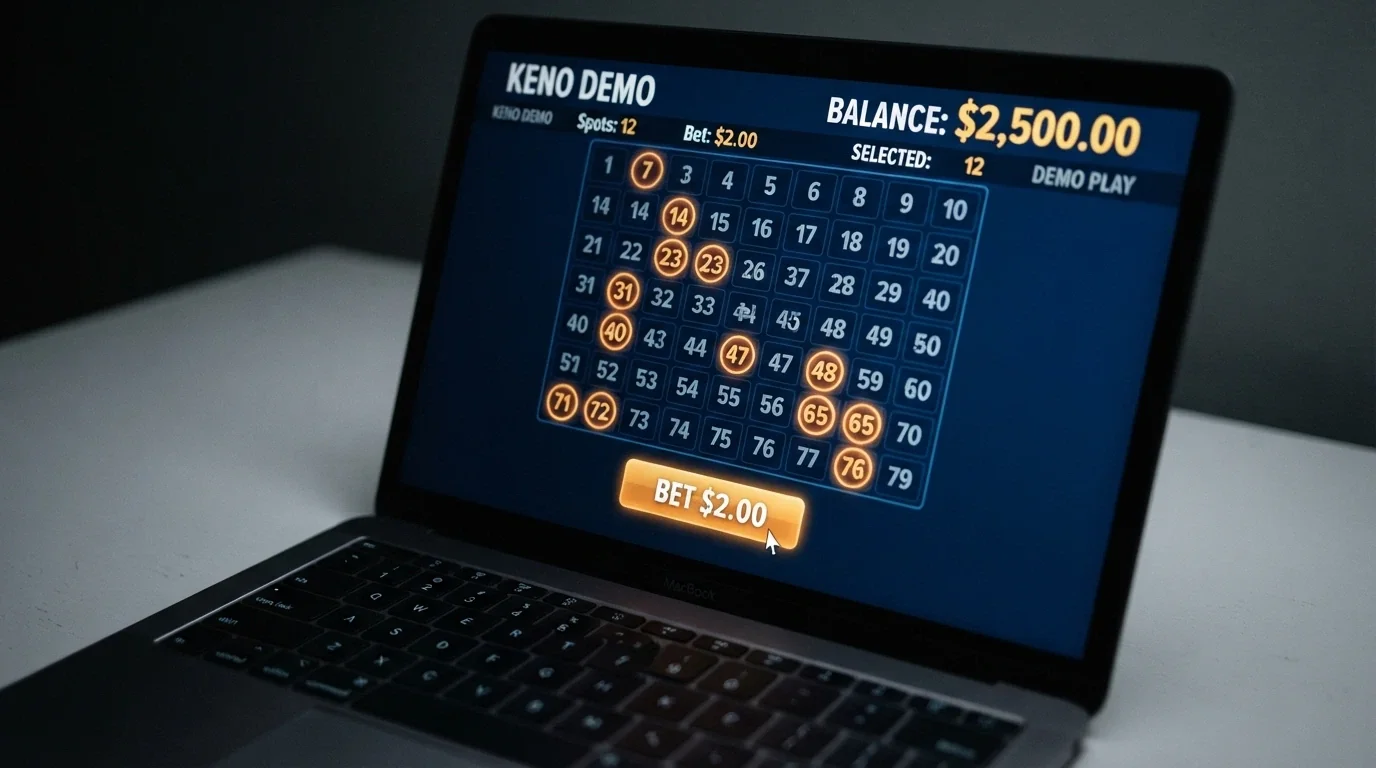
The licensed Australian product does not offer a demo mode in the same sense. The game rules, payout tables, and RTP figures are publicly published on The Lott’s game guide and on KenoGO’s app store listings, and the player can study them without playing. But there is no practice mode — the licensed product is a paid lottery draw, and the draw does not run on demand.
What Demo Mode Teaches You — and What It Hides
Free play shows the game’s surface; it hides the part that costs the player money:
- Draw speed and animation rhythm: how long between the bet and the result, and how fast the next bet can be placed.
- Bet sizing and bankroll feel: how the A$1, A$2 and A$5 stake levels compare against a play-money balance when run at typical session lengths.
- Volatility curve: how often wins land, how large they tend to be, and how long the dry stretches run between payouts.
- Bonus-game mechanics on keno slots: free-spin triggers, scatter symbols, and the side features that change the session profile on slot-skinned titles.
What demo mode does not show is the part that hurts. The wagering-requirement trap on a welcome bonus. The withdrawal friction when the player tries to cash out. The credit-card processing and the documentation requests for KYC verification. None of that exists in free play, and the player who treats a winning demo session as evidence of how the real-money product will perform has already made the mistake the audit is designed to catch. The house edge operates the same in demo and real — but the player’s psychology under each is different by a wide margin.
Real-Money Keno Payments: What Works for Australian Players Right Now
The payment side of Australian online wagering has been redrawn twice in recent years: once in June 2024, when credit cards and crypto were banned as payment methods for online wagering, and once in the 2026 reform bill, which adds bank and payment-provider authority to block transactions to illegal operators from 1 January 2027. For an Australian player on the licensed product, the payment map is narrower than it was a decade ago. For an Australian player on an offshore product, the map is in flux.
PayID, Osko and Bank Transfer: The Routes That Work
For an Australian funding a licensed keno account, the standard routes are PayID, Osko and direct bank transfer. The KenoGO app supports bank transfer with a minimum deposit of A$1, but credits to the player account can take up to three business days. PayID and Osko are the instant-payment rails operated by Australian banks through the New Payments Platform — transfers clear in seconds to a linked account, and most licensed operators integrate them as the default deposit method.
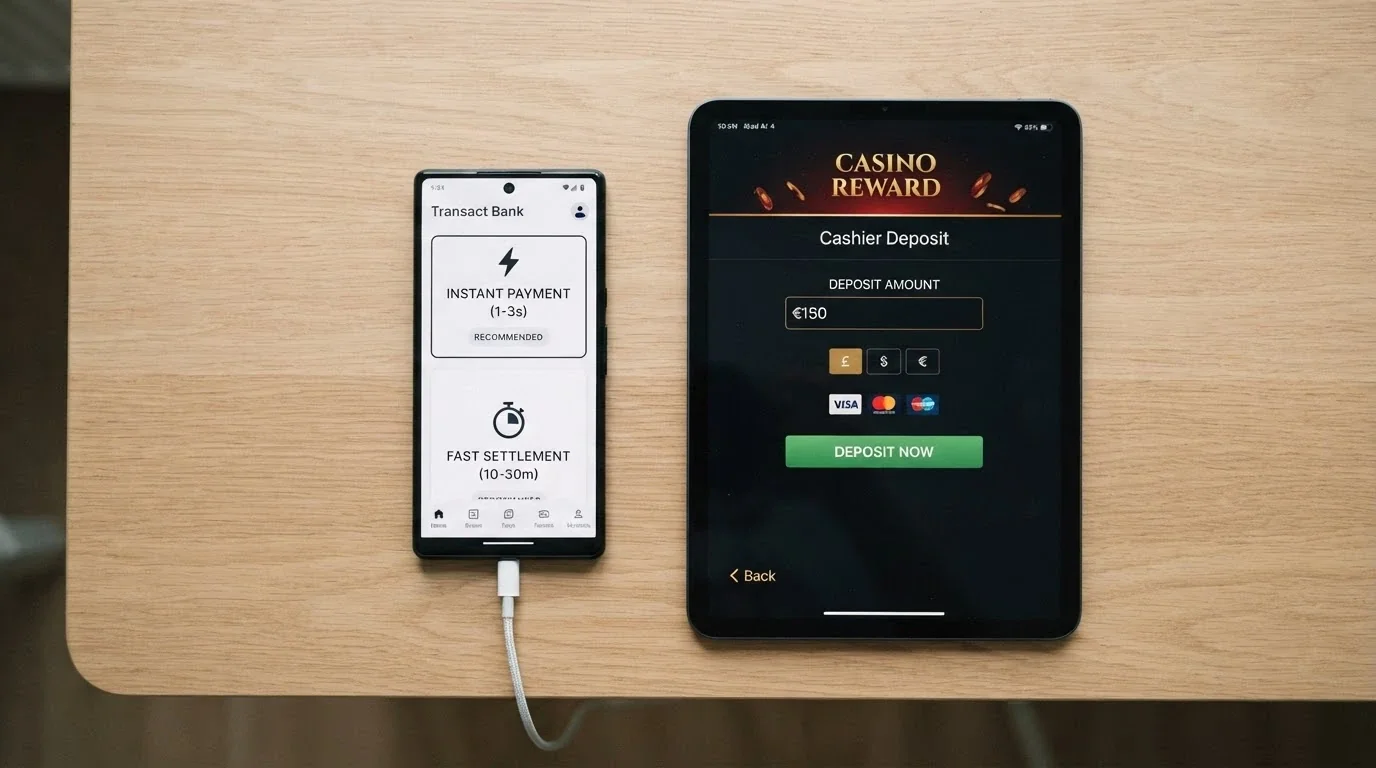
For an Australian funding an offshore casino, the picture is less settled. Most offshore operators do not accept PayID or Osko directly. Some accept bank transfer, but the transaction may attract a gambling merchant block at the bank level. The credit-card-and-crypto ban introduced in June 2024 has pushed several offshore operators toward vouchers, e-wallets and other indirect routes, but the practical answer is that the licensed product is the easier one to fund for an Australian, and the offshore product is the easier one to fund with crypto.
Why Credit Cards and Crypto Are Off the Table for Australian-Regulated Play
From 11 June 2024, the Interactive Gambling Amendment (Credit and Other Measures) Act 2023 prohibited the use of credit cards, credit-related products and cryptocurrency for online wagering in Australia. Penalties for non-compliant operators run up to A$247,500. The intent is to break the credit-funded gambling cycle and to prevent the unregulated offshore flow of funds through crypto.
For a player on the licensed product, that is the end of the discussion: credit cards and crypto are not available. For a player on an offshore product, the ban does not bind the operator — the offshore casino accepts whatever it accepts — but the Australian bank will not process a credit-card payment to a merchant it has classified as an unlicensed wagering provider, and most Australian banks will not send AUD to a crypto exchange for the explicit purpose of funding an offshore gambling account. The player who is asked for a credit card or a Bitcoin deposit on an offshore casino site is being shown, by that request, that the operator is outside the Australian rules.
KenoGO’s own terms warn that some banks may treat credit-card deposits as a cash advance, with the cash-advance fee and interest rate applying from the day of the transaction. That is a residual risk on the licensed product and a structural risk on the offshore one.
Crypto Keno Casinos: The Offshore Route, Explained
Crypto is the offshore default. Bitcoin deposits on the featured operators clear in minutes rather than days, and the fees are lower than the wire-transfer equivalents. The trade is the trade that crypto always carries: no chargeback protection, no consumer-recourse mechanism at the receiving end, and no participation in the Australian financial system if something goes wrong.
Bitcoin Deposits for Keno: Speed, Limits and the Anonymity Trade-Off
Tested data on the featured set gives the player a sense of the practical timing. Neospin was tested at approximately 10 minutes for an AU$50 BTC deposit. Golden Crown was tested at approximately 32 minutes for an AU$20 BTC withdrawal. Those are quick figures by traditional-finance standards — minutes rather than the three business days a licensed bank transfer can take — and they are part of why offshore keno operators default to crypto.
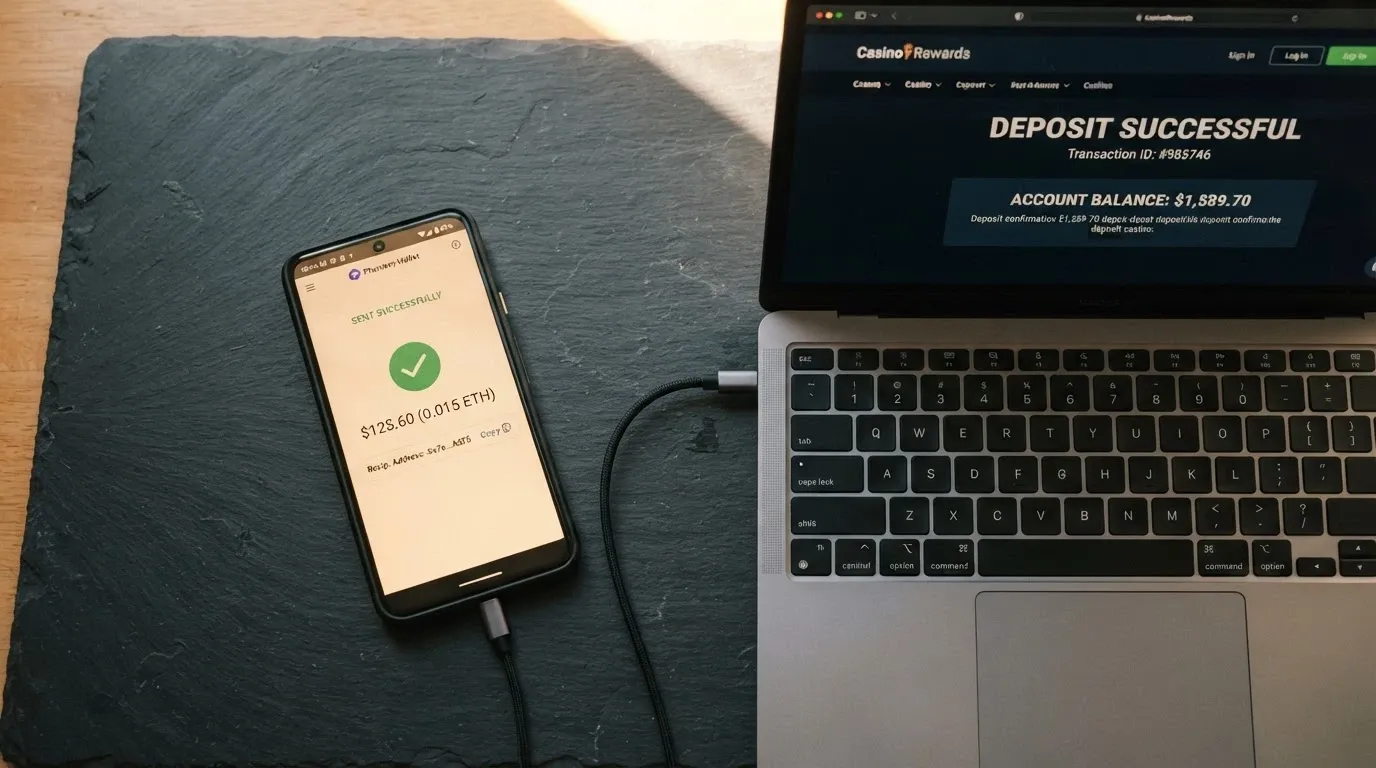
What the speed costs is the protection layer. A Bitcoin transaction is irreversible once confirmed. There is no chargeback mechanism on the network. There is no bank to call if the operator stops responding. There is no Australian regulator with a complaints process for an Australian player. The player is trusting the operator with the funds at the moment of transfer, and the only recourse if something goes wrong is whatever dispute-resolution process the operator itself publishes — which on a Curaçao-licensed site is governed by Curaçao law, not Australian law.
The minimum deposit on a BTC deposit varies by operator. The tested AU$50 figure for Neospin is at the lower end of typical offshore minimums. The tested AU$20 BTC withdrawal for Golden Crown is also at the lower end of typical minimums. The player should treat both as confirmed figures, not as the floor across the whole set.
The final point on crypto and Australian players: a gambling site that asks for a credit card or a Bitcoin deposit from an Australian is operating outside the Australian rules, and the player should understand that before the first transaction clears. The crypto route is fast. It is also outside the regulatory perimeter.
Is Online Keno Legal in Australia? The Two-World Reality
The legal picture is split, and the 2026 reform redraws it further. The short version is that licensed Australian keno is permitted and online casino-style keno is prohibited for providers; the player is not the target of IGA enforcement. The longer version is that the prohibition is being strengthened, and the offshore product is in a closing window.
What the Interactive Gambling Act Actually Prohibits
The Interactive Gambling Act 2001 prohibits providers from offering online casino games to people in Australia. ACMA’s own description of the Act names online casinos among the banned services. The 2017 amendments strengthened the framework, gave ACMA its enforcement powers, and laid the groundwork for civil penalties and ISP blocking. The 2024 amendments extended the prohibition to payment methods.
What is permitted is the licensed lottery and keno product — the carve-out that lets Tabcorp, Tatts, the ACT Jockey Club and KenoGO run keno draws under state and territory licences. The Victorian Gambling and Casino Control Commission regulates KenoGO, and the operator carries a Victorian Government licence. That is the licence framework that licensed Australian keno runs on.
The enforcement action targets the provider, not the player. ACMA’s blocking powers apply to ISPs, not to individual punters. There has been no prosecution of an Australian player for using an offshore casino under the IGA. The legal exposure sits on the operator offering the service.
The Looming January 2027 Deadline: What the Reform Bill Changes
The Interactive Gambling Amendment (Gambling Reform) Bill 2026 was introduced into Parliament on 2 July 2026 and most of its schedules commence on 1 January 2027. The headline change is that online keno — the offshore product this page describes — is prohibited outright, alongside foreign-matched lotteries. Government commentary on the bill has characterised online keno as “pocket pokies,” pointing to rapid-play mechanics and wagering thresholds that allow consumers to stake up to A$1,000 every three minutes in some configurations.
The 2027 commencement is paired with new payment-blocking powers for banks and payment providers, who gain express authority to block transactions to illegal gambling operators from the same date. That is the second leg of the prohibition: the offshore product is restricted on the offer side and on the payment side, leaving the player fewer ways to fund it.
For a player considering an offshore keno deposit in 2026, the 1 January 2027 commencement is the operative date. The product is accessible now. The legal and financial routes around it close at the start of 2027, and the deposit terms the player reads now should be read with that window in mind.
ACMA Enforcement, ISP Blocks and What They Mean for Players
ACMA’s enforcement record is real and quantified. Since November 2019, ACMA has directed Australian ISPs to block 1,564 illegal gambling and affiliate websites, and more than 225 illegal services have withdrawn from the Australian market since the 2017 reforms. The blocking mechanism works by ordering ISPs to prevent Australian IP addresses from resolving the offending domains.
For an Australian player, the practical effect is that some offshore casino sites will not load without a VPN, and the number of unreachable sites grows each month as ACMA adds new blocking orders. The legal exposure does not extend to the player — the IGA targets the provider — but the operational friction is real: access can be intermittent, and the operator’s compliance with Australian consumer-protection law is not something an Australian regulator is enforcing.
The cleaner answer for an Australian who wants keno without the legal grey area is the licensed product — the 75% RTP draw, the state-licensed operator, the BetStop binding, the regulator with a complaints process. The cost is a lower RTP and a slower payout. The trade is real, and the next section describes the protection layer behind the licensed side.
Staying in Control: BetStop, Limits and Real Help
Problem gambling affects roughly 2.1% of Australian adults, and the support infrastructure exists on the licensed side of the market. The tools and the limits described in this section apply to Australian-licensed operators. They do not bind offshore casinos, and that is the gap a player on the offshore side should understand.

BetStop by the Numbers: Who Uses It and What It Covers
BetStop, the National Self-Exclusion Register, went live in August 2023 and had recorded 67,480 registrations by 31 July 2026, with 41,290 of those exclusions still active. The age profile skews young: 78% of registrants are under 40. The exclusion duration chosen by registrants is meaningful — 38% have opted for lifetime exclusion rather than a fixed-period block, the strongest commitment the register accepts.
What BetStop actually does is direct every Australian-licensed online wagering operator to refuse service to the registered individual for the duration of the exclusion. KenoGO, the licensed online keno product, is bound. Tabcorp, Tatts and the state-licensed land-based wagering operators are bound. The offshore casinos on this page are not.
For a player using both the licensed and offshore products, the protection runs only on the licensed side. A BetStop registration will block access to KenoGO and the other licensed operators. It will not affect an offshore casino account, and the player who has registered with BetStop and continues to use an offshore operator is relying on their own willpower for the offshore side. That is the limit of the register.
The National Gambling Helpline is 1800 858 858 — free, confidential, staffed 24 hours. Gambling Help Online is the federal online support service, available at any time. Both services are funded at the federal level and available to anyone in Australia, regardless of which side of the licensed/offshore line they are on.
How We Selected and Ranked These Keno Casinos
The operator set on this ranking is built from the Australian-facing offshore keno casino market as it appears in 2026 search results and traffic-share data. The selection process ran through three filters. First, a competitor-research pass identified the operators that consistently appear in Australian-facing “keno online casino” rankings. Second, third-party testing data — payment timing, catalogue depth, bonus terms — was assembled where available. Third, the operator’s own terms page was checked for licence status and bonus specifics, with affiliate-page bonus figures used only as a starting point.
The ranking weights three criteria, in this order: keno-specific catalogue depth (the number and variety of keno formats the operator offers), confirmed welcome-offer terms (a figure backed by the operator’s own terms page or by documented third-party testing), and tested payment timing (a measured deposit or withdrawal speed rather than a marketing claim). Where the catalogue depth and bonus terms are both confirmed, the operator ranks higher. Where one is confirmed and the other is not, the operator ranks lower. Where neither is confirmed, the operator appears at the bottom of the ranking on traffic-share presence alone.
What the ranking is not is a legal recommendation. Every operator on this list is offshore and not Australian-licensed. The ranking orders them on what they offer, not on whether they are legal for an Australian player to use. The legal status is described under each operator and is identical across the set in the substantive sense: offshore, prohibited under the IGA for the provider, accessible to the player, and entering a closing window under the 2026 reform bill.
What the ranking does not cover is the licensed product itself — the 75% RTP draw that runs through KenoGO and the state lottery operators. The licensed product is the comparison case, not a ranked option, because it is not an offshore casino and the page’s subject does not refer to it. Where it appears in the body, it appears as the legal alternative and the lower-RTP-but-regulated counterweight to the offshore set.
What an Australian Keno Player Should Actually Do in 2026
The numbers give a clear answer, and it is not the answer the affiliate rankings offer. Licensed Australian keno returns roughly 75 cents per dollar — a 25% house edge that does not move with strategy. Offshore casino keno returns 94 to 97 cents per dollar, but the operator is unlicensed under Australian law, the bonus carries a wagering requirement the player must clear, and the offshore side of the market closes on 1 January 2027. The cheapest way to play real-money keno legally in Australia is the licensed product, at the cost of a quarter of every dollar wagered on average.
For a player who has decided to play on the offshore side regardless, the checklist is short. Read the operator’s own bonus terms — not the affiliate copy — and identify the wagering multiple on the welcome offer. Test the withdrawal route with a small cashout before making a large deposit. Verify that the operator’s licence jurisdiction is one you can name (Curaçao is the most common here, and it is the operator’s own licence, not an Australian one). Treat the 75% RTP on the licensed product as the floor of the cost equation, and treat any offshore title at 96% RTP as an estimate of expected cost over many sessions rather than a guarantee of any individual outcome.
The one concrete step a keno player should take before depositing anywhere: open the operator’s terms page, find the wagering requirement on the welcome bonus, and do the maths on how many keno draws that requirement costs at the player’s normal stake. A 300% match at an unstated multiplier is a marketing line. The same offer with a 30x multiple and a clear game-contribution percentage is a figure the player can plan against. The bonus is worth what the requirement leaves after conversion, not what the percentage promises on the way in.
The 1 January 2027 deadline is the operative date for the offshore product. A deposit made in 2026 is on a product that is scheduled for prohibition from that date, and the payment-blocking powers that come in on the same date reduce the available funding routes. The player who wants offshore keno today has it. The player who wants it in twelve months may not, and the deposit terms the player reads now should be read with that window in mind.
For a player who wants the licensed product instead: KenoGO, The Lott’s keno pages, and the state-licensed venue keno screens are the access points. The 75% RTP is real, the BetStop registration is real, the helpline at 1800 858 858 is real, and the regulatory perimeter is the one most players in this market are not told they have.
Frequently Asked Questions
Can I play keno online for real money in Australia using PayID or Osko?
For licensed Australian keno (KenoGO), PayID and Osko credit player accounts typically within minutes; bank transfer is the slower fallback at up to three business days. Offshore casinos generally do not accept PayID or Osko, and credit cards and crypto are blocked under the June 2024 ban. Bank transfer may attract a gambling merchant block.
What is the RTP of keno in Australia, and how does lottery keno compare with online casino-style keno?
Licensed Australian keno returns about 75% across spot types 1 to 10 — a 25% house edge strategy does not change. Online casino-style keno runs higher: Keno+ at 97.02%, Keno 80 at 94.48%, Book of Keno at 96.11%. The licensed product is the lower-RTP, regulated option; offshore titles are higher-RTP but legally exposed.
Do Australian-licensed keno apps connect to BetStop, and what protections do they offer?
Yes — Australian-licensed wagering services including KenoGO are bound by BetStop. By 31 July 2026, BetStop had 67,480 registrations with 41,290 still active, and 38% of registrants chose lifetime exclusion. BetStop does not extend to offshore casinos; a registration blocks access to Australian-licensed operators but does not block offshore accounts.
Which keno variants are available online in Australia, and how do rules differ by spot count?
The licensed Australian product uses a 20-of-80 draw with 1 to 10 numbers per Spot; minimum entry is A$1 per draw (A$2 for Keno Mega Millions). Payout curves are calibrated to return roughly 75%. Offshore casino keno uses the same spot configuration but RTPs run 94% to 97%, with volatility varying more by title than spot count.
How often are keno draws held in Australia, and what can I win on a $1 or $2 keno ticket?
Licensed Australian keno draws run every 3 to 3.5 minutes in NSW, QLD, VIC and the ACT, and roughly every 10 minutes in South Australia. The minimum ticket is A$1 per draw, or A$2 for Keno Mega Millions. KenoGO’s advertised top-end jackpot reaches A$40 million every three minutes, though actual jackpot size varies by configuration.
What happens to online keno after the Interactive Gambling Amendment (Gambling Reform) Bill 2026?
The bill was introduced 2 July 2026 with most schedules commencing 1 January 2027. Online keno is prohibited outright from that date alongside foreign-matched lotteries. Banks gain authority to block transactions to illegal gambling operators from the same date. Government commentary has called online keno “pocket pokies” for its rapid-play mechanics and A$1,000-per-three-minutes wagering thresholds.
Written by the editors at Casino Payment Methods AU.