Ten Solana Casinos Open to Australians — and What the Blockchain Edge Buys You
Solana casinos pitch themselves on three things: deposits that clear in seconds, fees that round to zero, and withdrawals that reach the wallet before the browser tab closes. For Australian players, all three claims hold up. They arrive, however, on top of a regulatory floor that does not exist for online casino games anywhere in the country. This page compares ten offshore casinos accepting Australian traffic, ranks them on the figures a player can actually verify, and lays out what the local consumer protections cost the moment the SOL leaves the on-ramp.
Data current as of 30 October 2026, checked against the ACMA’s public register and the Interactive Gambling Act 2001 as in force on that date.
- What a Solana Casino Actually Is — and Why Australians Are Using Them
- What Solana Brings to Online Betting That Other Blockchains Don’t
- The Top 10 Solana Casinos for Australian Players in 2026
- Stake
- BC.Game
- RocketPlay
- Skycrown
- Rainbet
- Royal Reels
- WinSpirit
- FairGO
- Bizzo Casino
- Scream Casino
- The Games You’ll Actually Play at a Solana Casino
- Where the Law Really Stands on Solana Casinos in Australia
- Staying in Control When the Aussie Safety Net Isn’t There
- How We Reviewed and Ranked These Solana Casinos
- Your Move: What to Actually Do About Solana Casinos in Australia
- Frequently Asked Questions
What a Solana Casino Actually Is — and Why Australians Are Using Them
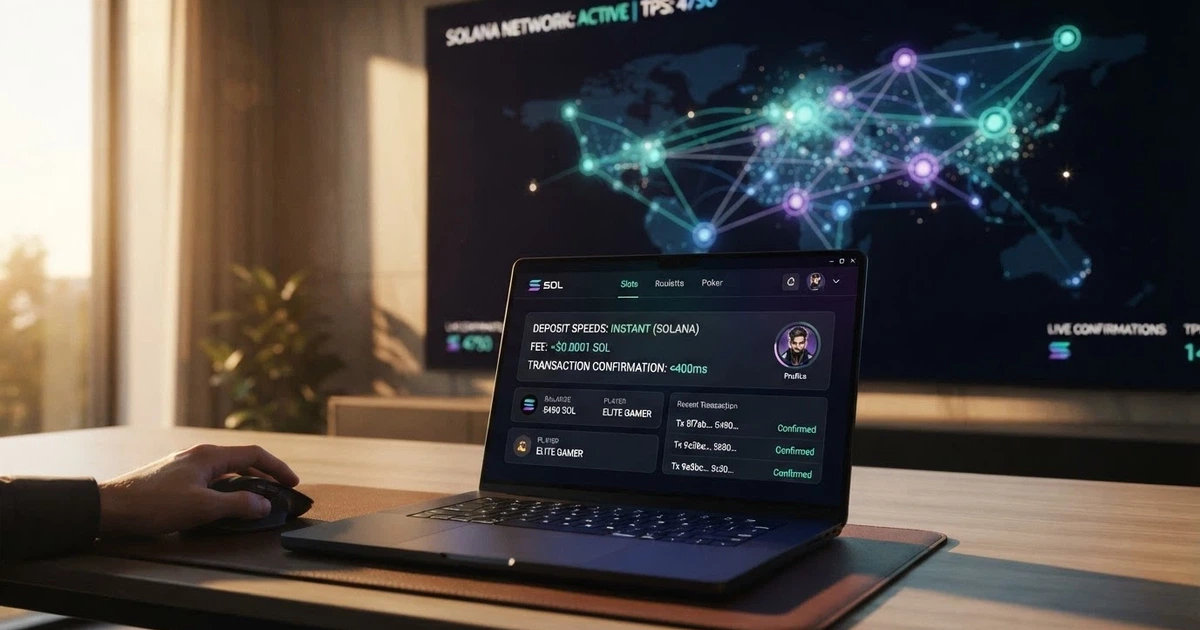
A Solana casino is an online casino that accepts SOL — the native token of the Solana blockchain — at the cashier. Behind the brand, that means the deposit, the in-platform balance, and the withdrawal all run over the same network that settles a Solana transaction in roughly 400 milliseconds for fees under one US cent. For the cashier, the trade looks like a faster, cheaper version of what an Ethereum or Bitcoin casino has been running for years. SOL deposits confirm in two to five seconds at roughly US$0.00025 per transaction, quicker than any other crypto deposit option competitors have tested in 2026.
Australian players end up at these sites for reasons the licensed market does not address. Online casino games, online pokies and in-play betting are prohibited under the Interactive Gambling Act 2001 as amended by the Interactive Gambling Amendment Act 2017. There is no licence for online casino games anywhere in Australia — not federally, not in any state or territory. Australians who want to play a slot or a hand of blackjack online are not choosing between a regulated local product and an offshore one. They are choosing between no play and offshore play.
That constraint sets the rest of this page. The ten casinos ranked below are all offshore. None is regulated by an Australian authority, and none is connected to BetStop, the National Self-Exclusion Register. A player using one is not prosecuted under the IGA — the Act targets the provider, not the customer — but they are also outside every local protection the licensed wagering market offers. The bonuses, the game libraries and the SOL withdrawal speeds are real. The safety net is not.
How a Solana Casino Actually Works
The cycle starts with an AUD-to-SOL conversion and ends with the reverse. In between, the SOL sits in a casino balance the player may or may not actually see, depending on how the cashier handles the deposit. The path looks the same for every operator: open an account, copy the casino’s SOL wallet address, send the SOL from a Phantom or Solflare wallet, wait for confirmations, play, then request a withdrawal to the same wallet. The blockchain does not see the casino. It settles a transfer from one wallet to another and back again.
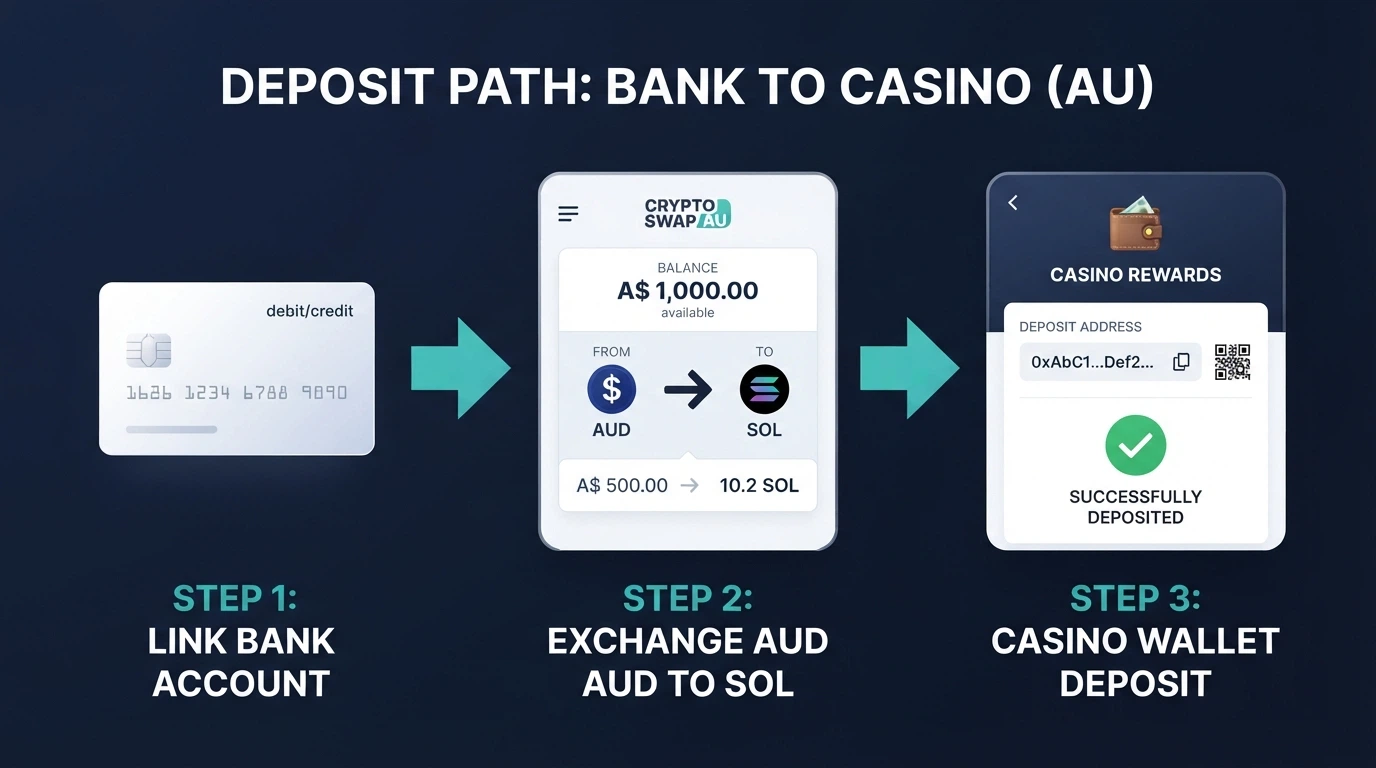
What the player does see is the in-platform balance. Some casinos credit the deposit as SOL and let it stay SOL until withdrawal; others convert the SOL on the way in to a house token or stablecoin and reconvert on the way out. The distinction matters because the support type changes both bonus eligibility and payout speed. A native SOL balance typically withdraws faster and tends not to trigger additional conversion steps on the cashier side. A house-token balance may carry a conversion fee on the way out that the player did not see on the way in. The promotion page will not tell you which model a casino uses; the cashier will.
SOL network fees are under A$0.01 per transaction against A$5 to A$20 for BTC during network congestion. That is the figure that, over a year of regular play, adds up to a real saving for the player who deposits and withdraws often. The fee advantage is one of the genuinely defensible parts of the marketing. The speed advantage is the other.
Native SOL vs SPL Token Deposits: What the Difference Means for Your Play
SPL is the token standard on Solana, the equivalent of ERC-20 on Ethereum. A casino that supports SPL tokens can credit a USDC or USDT deposit over the Solana network, and the transaction settles in seconds rather than minutes. A casino that supports native SOL holds the player’s actual SOL tokens in a custodial wallet on the platform; a casino that converts to a house token or stablecoin holds a credit on its own ledger backed by a token pool it controls. BC.Game processed a test SOL withdrawal of 8.2 SOL in exactly 28 seconds, with the average across tests at 31 seconds, and supports native SPL token play end to end. Rollbit averaged 52-second SOL withdrawals and supports SPL token wagering alongside an NFT marketplace.
The player-facing difference shows up in three places. First, withdrawal time: native SOL settles fastest, then SPL stablecoins, then any casino that runs a conversion step. Second, bonus eligibility: some promotions are denominated in the house token only, and a player who deposited in SOL may not be able to opt in cleanly. Third, the on-platform exposure: a player holding native SOL on the casino side is taking price risk on SOL between deposit and withdrawal; a player holding USDC has held their dollar value through the play. Neither is “right” — they are different bets on what SOL does over the play window.
What Australians Can Actually Access Right Now
Credit cards and digital currency are banned as payment for online wagering in Australia since 11 June 2024. An operator that fails to enforce the ban faces penalties of up to A$247,500. The crypto payment ban was designed for the licensed wagering market — Sportsbet, the TABs, Ladbrokes and the rest — but it has had a clarifying effect on what the Australian customer is actually looking at when an offshore site asks for SOL. “An Australian who is asked for a credit card or a crypto deposit by a gambling site is being served by someone outside the Australian rules. The payment method is itself a tell.”
The operators serving Australian traffic in 2026 fall into three groups by licence: Curaçao (Stake, WinSpirit and Skycrown as best as can be confirmed), Anjouan in the Comoros (BC.Game), and a third group whose licence was not confirmed in the sources available at review time (RocketPlay, Rainbet, Royal Reels, FairGO, Bizzo, Scream). The first two groups are offshore regulators; the third is unconfirmed, which is a different kind of risk from either of them. Two of the ten — Bizzo and Scream — had no public welcome offer available at the time of review, and one — Royal Reels — supports Bitcoin, Ethereum, USDT and USDC but had SOL support unconfirmed in the snippets available.
What every operator in this list has in common is that none of them is authorised to take a bet from a customer physically present in Australia. The site is reachable, the cashier works, the SOL lands — and the operator is in breach of section 15(2A) of the IGA for the duration of every deposit and every spin.
What Solana Brings to Online Betting That Other Blockchains Don’t
The blockchain choice at the cashier is not a marketing detail. It changes the cost of every transaction a player runs and the latency of every withdrawal. Solana confirms transactions in roughly 400 milliseconds for fees under one cent — the fastest and cheapest mainstream blockchain at the casino cashier in 2026. Bitcoin takes minutes in quiet periods and longer in congested ones, with fees that have run from a few dollars to A$5–20 during periods of network stress. Ethereum is faster than Bitcoin on the base layer in 2026 but the gas economics still price a small-deposit player out of routine transfers.
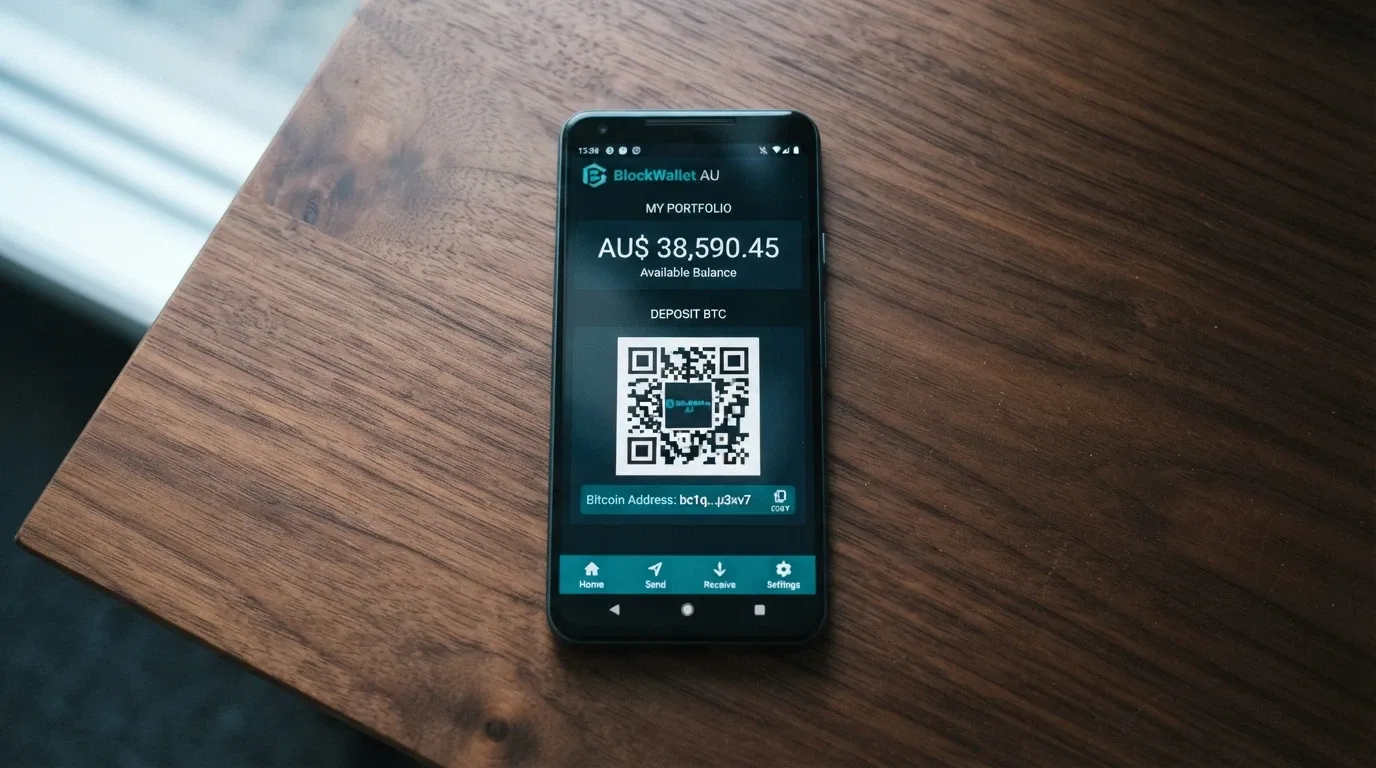
For a player who deposits A$100, plays through it, and withdraws the residue, the SOL fee is a rounding error. The BTC fee in a congested week can be 10% of the deposit. That asymmetry does not just change the cost; it changes the strategy. A Bitcoin player does not want to withdraw small balances because the fee eats the play. A Solana player can withdraw at any time without that penalty, which is the structural reason crypto-native casinos have moved to faster chains.
Casino Tokens, Coins and SPL Assets on Solana
A casino token is a token the casino itself issues, usually on the chain the casino runs on, and usually tradeable on the open market against SOL or USDC. A casino coin is the same idea with a longer history — older operators issued coins on Ethereum or on their own sidechain. The Solana-native set leans on SPL tokens: USDC and USDT for stablecoin play, plus a long tail of casino-branded tokens that the player can usually buy on a Solana DEX and then deposit at the cashier.
The cashier determines what the player actually holds. A native SOL balance means the SOL sits in a wallet the casino controls and the player can withdraw back to SOL. A USDC balance means the same thing for USDC. A house token balance means the player holds a token whose price the casino partially controls through treasury and emission policy. Some casinos offer staking rewards on their own token; some let the player swap into the token through the cashier at a spread. The economic exposure is real and the spreads are not always disclosed in the bonus terms.
NFT Casinos and Wagering on Solana
NFT casinos let the player use non-fungible tokens as casino chips, as collateral, or as status markers that unlock higher withdrawal limits. Rollbit runs an NFT marketplace alongside its sportsbook and casino; BC.Game runs NFT rewards programmes. The mechanics vary; the risk is the same. The player is taking two positions at once — the bet on the game and the bet on the NFT’s floor price. If the slot returns 95% and the NFT loses 30% of its value in the same week, the casino experience was a net loser regardless of how the spins went.
NFT gambling on Solana also inherits the price-volatility risk of the underlying token. A player who deposited SOL, swapped to a casino token, then received NFT rewards has stacked three price bets on top of the gambling bet. The promotional material calls this a “reward”. The arithmetic calls it exposure.
Provably Fair Gaming: How the Solana Blockchain Verifies Every Bet
Provably fair is the term for a system that lets the player verify, after the fact, that the bet was not altered by the casino. The casino publishes a hashed server seed before play; the player provides a client seed; each bet’s outcome is derived from both plus a nonce. The hash commits the casino to its seed before the bet runs, and the player can check the math after. Some Solana casinos publish their seeds on-chain; others publish them on the casino’s own fairness page.
The on-chain verification is real, and it is meaningfully better than no verification at all. It is not, however, the same as the operator running the game at the RTP the studio published. Two operators tested showed Pragmatic Play slots running at 92.3% and 90.8% actual RTP over 700 spins each, well below the 96.5% studio-published variant, with in-game RTP info confirming a 94% deployed version. The blockchain can prove the spin was fair; the blockchain cannot prove the slot was running the version of the game the studio said it was. That is a casino-side setting, not a chain-side guarantee, and it is the part a provably fair certificate does not cover.
The Top 10 Solana Casinos for Australian Players in 2026
The ten operators below are ordered by a combination of game library depth, bonus size, SOL-specific speed (deposit confirmation, withdrawal confirmation, SPL token support) and licence clarity. They are not ranked by the player experience alone — every entry on this list is offshore, unlicensed in Australia, and outside the local consumer protection framework. The comparison table sets out the welcome package and the wagering multiple side by side. The write-ups below the table go through what each one actually delivers.
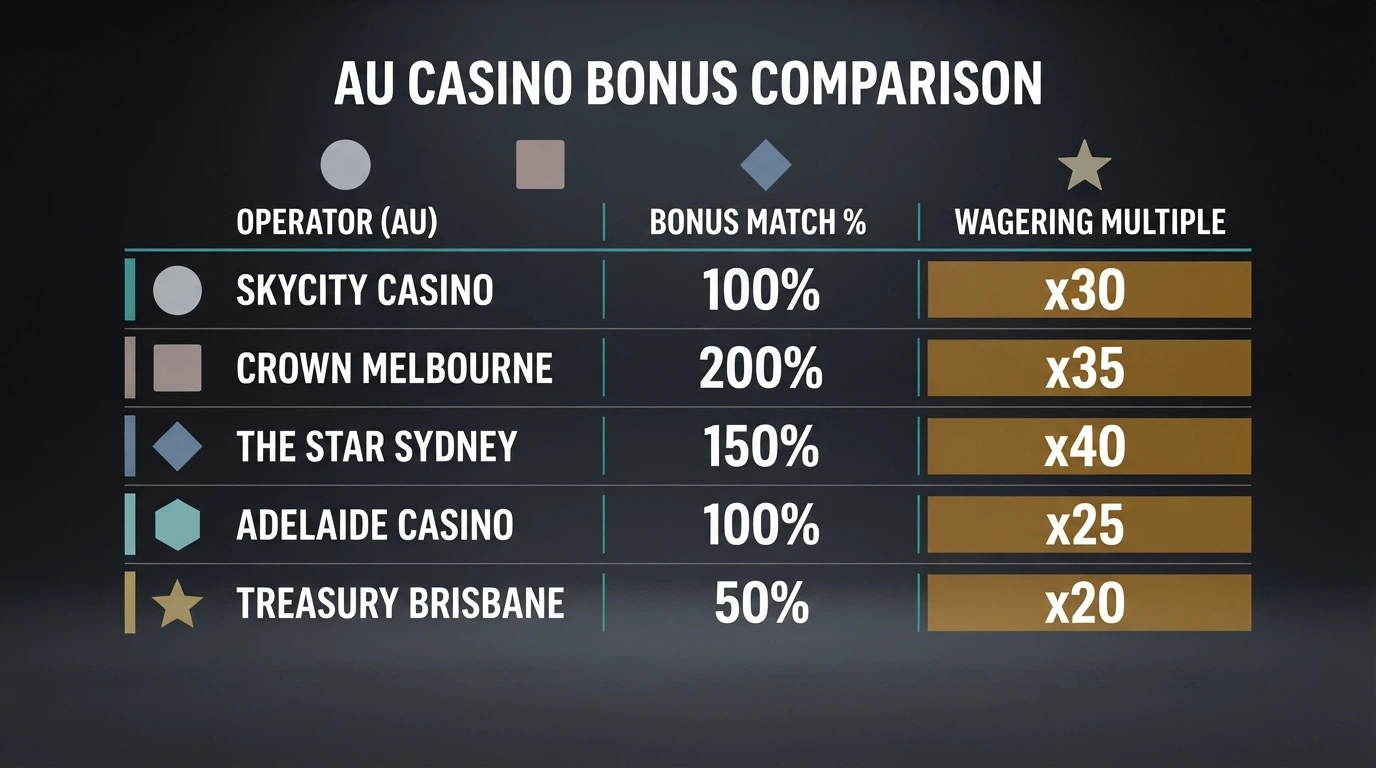
| Casino | Welcome Bonus | Wagering Multiple | Free Spins |
|---|---|---|---|
| Stake | 200% up to US$2,000 | 40x (D+B) | — |
| BC.Game | 380% up to US$4,000 | 40x (D+B) | 400 |
| RocketPlay | 100% up to €1,000 | 40x (D+B) | 100 |
| Skycrown | Up to C$7,500 | 40x | 400 |
| Rainbet | 250% up to US$2,100 | 40x (D+B) | 60 |
| Royal Reels | A$10 no deposit + 100% up to A$500 | — | — |
| WinSpirit | 100% up to AU$500 | 30x | 50 |
| FairGO | 100% up to A$200 × 5 (A$1,000 total) | 30x–60x | — |
| Bizzo Casino | — | — | — |
| Scream Casino | — | — | — |
The em-dash cells are not gaps in the data. They are gaps in what the operators made public at the time of review. Where a bonus, a wagering multiple or a free-spin count was not published in the available sources, the cell carries the no-data marker rather than a number we did not have. A reader who sees a dash in this table can act on it: the operator did not publish the term, which is itself a signal.
A few things to read off the table before the individual write-ups. WinSpirit is among the operators on this list with a wagering multiple below 40x; the rest sit on the 40x line or, in FairGO’s case, report a range that has been cited as high as 60x. BC.Game runs the highest match percentage and the largest free-spin count. Stake runs the deepest game library. Royal Reels is the only operator whose welcome offer is denominated in Australian dollars and the only one with a no-deposit bonus. The two empty rows at the bottom — Bizzo and Scream — are operators whose public profile at review was too thin for a comparison.
How Long It Takes to Clear a 200% Bonus
The wagering multiple is the number that turns a headline bonus into a workload. Take Stake’s 200% match up to US$2,000 at 40x on deposit plus bonus. A player depositing the maximum US$1,000 to claim the maximum US$2,000 bonus is committing to US$120,000 in required turnover — the total balance (deposit plus bonus) multiplied by the wagering factor. At A$1 per spin, that is 120,000 spins. At five seconds per spin, that is 167 hours of continuous play.
A player with a smaller bankroll sees a proportional workload. Deposit A$100 to claim the A$200 bonus, and the same 40x figure produces A$12,000 in required turnover, or 12,000 one-dollar spins, or about 17 hours of play. The number that matters is the wagering multiple, not the match percentage. A 200% match at 40x is four times the bonus amount in required turnover. A 100% match at 30x is three times the deposit. The match sets the headline; the multiple sets the cost.
This is a statistical estimate — an average over many spins under the stated assumptions, not a guaranteed outcome for any single player. It promises no win, no payout, and no return. What it does promise is the time budget the wagering requirement actually demands, and that is the figure the marketing page does not show.
Stake
Stake is the biggest name in crypto gambling, and the depth of the game library is the immediate draw. The site runs more than 6,000 games from Pragmatic Play, Evolution, Hacksaw, Nolimit City and Push Gaming, with the studio count still climbing. SOL sits alongside fifteen-plus cryptocurrencies at the cashier, and the Curaçao Gaming Authority licence is published in the footer. Welcome bonus is 200% up to US$2,000 with 40x wagering on deposit plus bonus, a 30-day bonus validity window, and no free spins as part of the standard package. The match is large; the multiple is the same 40x every other operator in the top half of this list carries.
The game library is the verdict. A player who wants the deepest single-brand selection in the offshore market and is comfortable with Curaçao is getting more games per dollar of turnover here than at any other operator in the comparison. The 30-day window is the constraint: a player who cannot commit to clearing the wagering in a month is paying a different kind of cost on the unmatched portion of the bonus.
BC.Game
BC.Game runs the highest match percentage in the set. The 380% match up to US$4,000 plus 400 free spins is spread across four deposits, and the wagering is 40x on the bonus. SOL withdrawals were tested at an average of 31 seconds, with a single 8.2 SOL withdrawal processed in exactly 28 seconds, and the site supports native SPL token play end to end. The Anjouan Gaming Board in the Comoros is the licence on file. Game count runs past 10,000 titles from more than 100 providers.
The match is the verdict: 380% is the largest headline figure on this list, the 28-second withdrawal is the fastest, and the SPL token support is the most thorough. The Anjouan licence is the corresponding cost — it is a real regulator, but it is a less established one than Curaçao, and the player is taking the operator’s compliance on thinner authority. A player who values the bonus and the speed over the licence jurisdiction has found the right operator in BC.Game.
RocketPlay
RocketPlay’s headline is the 100% match up to €1,000 plus 100 free spins with 40x wagering on bonus plus deposit, on a €20 minimum deposit. The match is mid-market; the free spins are mid-market; the wagering is the standard. The number that breaks the offer is the 7-day bonus validity. Seven days to clear €40,000 in required turnover at the maximum bonus is the tightest window in the set by a wide margin. Free spins winnings are capped at €50 with a separate 40x playthrough on those winnings, which adds another constraint the headline does not mention.
The verdict is the constraint. A player with a calendar week and a daily schedule that can absorb 5,700 spins a day at €1 per spin can clear the bonus. A player who needs the rollover to run across weekends and weekday evenings will not. The 7-day window turns the offer into a short sprint; a long-distance player should pass.
Skycrown
The headline at Skycrown is the largest bonus figure on the list: C$7,500 plus 400 free spins, with 40x wagering and a C$30 minimum deposit. The catch sits in the cashier, not the promotion page. The daily withdrawal limit at Skycrown is C$7,500, meaning a player who lands a session-winning result that exceeds the daily cap is paid out across multiple days. The cap does not reduce the bonus; it changes how fast the player can move the residue off the site after the wagering clears.
The cap is the verdict. The promotion is genuinely large for the players who play through it in normal volumes. A player who needs the full balance back inside 24 hours is hitting a wall the bonus terms did not telegraph. Skycrown is a strong fit for the steady-volume punter and a poor fit for the player who wants the residue gone the same day.
Rainbet
Rainbet splits the welcome into two paths. Path A is the Wager Lock: no bonus credit, no cap on winnings, but the player must still satisfy a wagering condition before any withdrawal clears. Path B is the matched deposit: 250% up to US$2,100 plus 60 free spins across three deposits (100% up to $700 + 20 free spins on the first, 50% up to $700 + 20 free spins on the second, 100% up to $700 + 20 free spins on the third), with 40x wagering on deposit plus bonus, winnings capped at US$50 above the bonus balance, and Hacksaw Gaming and Nolimit City titles excluded from bonus clearing. The free spins run on Sweet Bonanza by Pragmatic Play.
The two paths serve two players. Path B is the bonus hunter: larger headline number, capped upside, slower playthrough. Path A is the variance-averse: no bonus, no cap, smaller required turnover, no free spins. The decision is structural rather than promotional, and it is the cleanest fork on this list.
Royal Reels
Royal Reels is the only featured operator with a no-deposit bonus denominated in Australian dollars — A$10 credited on signup, no deposit required, plus a 100% match up to A$500 on the first deposit. The cashier takes seven payment methods, including Bitcoin, Ethereum, USDT and USDC. SOL support was not confirmed in the available sources, which is a real gap for a page that ranks operators on their Solana compatibility. The daily withdrawal limit is A$9,000, and there is no win limit. Licence status was not confirmed in the available snippets at review time.
The verdict is the no-deposit. A player who wants to test a casino with their own wallet untouched gets A$10 of house money to do it at Royal Reels, and nobody else in the top ten offers that. The unconfirmed SOL support is the trade: a player who has SOL in a Phantom wallet and wants to deposit it directly should check the cashier before signing up, because the comparison cannot confirm it does.
WinSpirit
WinSpirit runs the lowest wagering multiple in the set. The 100% match up to AU$500 plus 50 free spins carries 30x wagering on the first deposit, with a 200% up to AU$300 follow-up on the second deposit. The Curaçao Antillephone N.V. licence is on file: No. 8048/JAZ2014-053, operated by Complete Technologies N.V. The wagering contribution table is restrictive — only slots contribute the full 100% toward clearing, with table games weighted much lower or excluded — and the maximum bet during the wagering period sits at roughly A$7.50.
The 30x multiple is the verdict. Every other operator in the top half of the table asks the player to turn over forty times the bonus. WinSpirit asks for thirty. On a AU$500 bonus, that is a A$15,000 turnover difference at the maximum, or roughly 4,200 fewer spins at A$1 per spin. The slots-only contribution is the trade: a table-game player is not getting the full benefit of the 30x headline.
FairGO
FairGO runs the welcome offer across the first five deposits: 100% up to A$200 on each, for A$1,000 in matched bonus in total. The wagering requirement has been reported in different ranges — one source cites a 60x playthrough on deposit plus bonus, another places it in the 30x to 40x band that is the RTG-casino standard. The library is RealTime Gaming, around 280 titles, with a comp-point system that pays 1 point per A$5 wagered, redeemable at 100 points per A$1. A 24-hour cool-off is available with one click.
The verdict is the range. FairGO is a long-running RTG operator with a comp system that returns a real slice of the play back to the player over time, but the wagering multiple is uncertain at review. A player considering FairGO should confirm the playthrough figure on the casino’s own terms page before depositing, because the spread between 30x and 60x is the difference between a 15,000-spin clear and a 30,000-spin clear on the same A$200 bonus.
Bizzo Casino
Bizzo’s public profile at review was thin on the welcome offer and on SOL support. The cashier takes Visa, Mastercard and crypto, with a minimum withdrawal of A$20 and no withdrawal fee — those are the published facts. The welcome bonus terms, the wagering multiple and the licensing information were not available in the sources consulted for this comparison. A player who already has a Bizzo account and is comparing the rest of the market against it will know more than this page does.
The verdict is the data gap. A comparison page cannot recommend what it cannot verify, and the welcome offer at Bizzo Casino was not verifiable in the sources used to build this ranking. The published payment and withdrawal terms are competitive; the bonus is unknown. A player should check the operator’s own terms page before signing up.
Scream Casino
Scream Casino has the thinnest public profile in the set. The game lobby is the only confirmed draw, and even the licensing information was not available in the snippets consulted for this review. The casino is in operation and accessible from Australia; the comparison cannot say much more than that with the data on hand.
The verdict is the data gap, again. A player who can verify the licence, the bonus terms and the SOL support directly on the operator’s own site has more information than this page does. A player who cannot find those terms on the site itself is being asked to deposit into a profile the comparison cannot describe. The page leaves Scream Casino on the list because the operator is in the Australian-facing offshore market, and a comparison that drops every operator with thin public data would drop most of the market. It does not pretend to know more than it does.
The Games You’ll Actually Play at a Solana Casino
The game lobby at a Solana casino is, on the inside, the same lobby you would find at any other modern online casino. Slots dominate. Live dealer tables sit alongside them. A long tail of crypto-native games — dice, crash, plinko, mines, hilo — fills the gap between the slots and the tables. Provider counts at the bigger operators run from a few dozen to over a hundred. SolCasino.io, the example with the most public detail, runs 3,000+ games from Pragmatic Play, Evolution, NetEnt, Hacksaw and Nolimit City across more than forty studios, with an operator filter that surfaces Bgaming, Endorphina, Platipus, Pragmatic, Play’n GO, Push Gaming and Red Tiger among others.
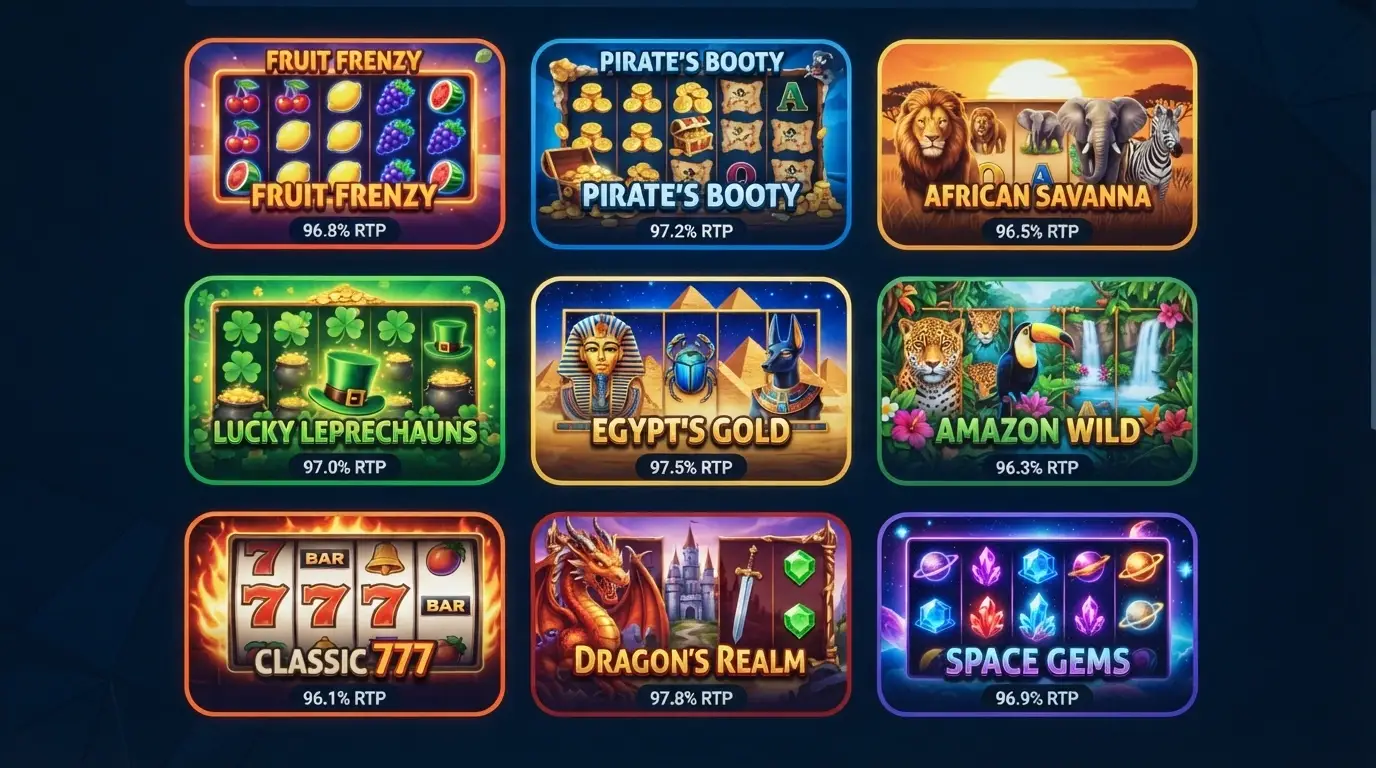
The volume is real. The marketing line about “thousands of games” is the one part of the pitch the operators do not have to inflate. What the marketing does inflate is the return the player can expect from those games, which is where the slot-by-slot RTP matters.
Slots and Slot Machines: The RTP Numbers That Matter
The SlotRandomizer dataset across 13 studios puts NetEnt at the top of the provider average at 96.39%, followed by Big Time Gaming at 96.25% and Push Gaming at 96.15%, against an all-provider average of 95.62% across 4,267 verified games from 339 studios. Those are the studio averages. The per-title figures vary, and a few specific titles have published RTPs high enough to deserve a row of their own.
| Slot Title | Provider | RTP | Volatility |
|---|---|---|---|
| Blood Suckers | NetEnt | 98.0% | Low |
| 1429 Uncharted Seas | Thunderkick | 98.6% | Medium |
| Dead or Alive 2 | NetEnt | 96.8% | Extreme |
These three are the verifiable high-RTP titles. They are not the only high-RTP games available — most studios publish the figure in the in-game help screen — but they are the ones the available research carries a confirmed number for. The volatility column changes what “high RTP” means in practice: a low-volatility slot like Blood Suckers pays out in many small wins, while Dead or Alive 2’s extreme volatility means long dry spells punctuated by the rare large hit. The published RTP averages out over the long run, but the player’s actual session looks different at the two extremes.
The published RTP is also not the RTP a player necessarily sees. The same Pragmatic Play title, deployed at two different offshore operators, ran at 92.3% and 90.8% actual over 700 spins each, against the 96.5% studio-published variant. The in-game help screen on the 92.3% deployment confirmed a 94% version of the game was running. The casino had configured a lower-return version and was still promoting the slot as if it were the studio default. A player who treats the published RTP as a guarantee is making a bet the operator’s cashier settings will not undo.
Dice, Crash and Other Crypto-Native Games
Dice is the simplest crypto-native game. The player picks a number, the casino rolls, the closer the player gets the bigger the payout, and the house edge is published on the game page — usually between 1% and 3% on the roll, adjustable by the player within the rules. Crash is a multiplier that rises in real time; the player cashes out before the multiplier busts. The bust is provably determined at the start of the round, the player can verify the seed, and the longer the player waits the larger the multiplier — and the higher the chance the round is already over.
Plinko, mines, hilo and the other formats are variations on the same theme: simple rules, transparent house edge, fast rounds, low minimum stakes. The games exist because they are cheap to operate and quick to play, and because they pair naturally with the provably fair infrastructure that crypto-native players expect. They are not the draw for a player who wants the experience of a NetEnt slot or a Pragmatic live-dealer table. They are the draw for a player who wants to verify the bet on-chain, and they are the part of the lobby that the blockchain makes possible.
Where the Law Really Stands on Solana Casinos in Australia
The Interactive Gambling Act 2001, as amended by the Interactive Gambling Amendment Act 2017, prohibits the provision of online casino games, online pokies and in-play betting to a person in Australia. The offence is at section 15(2A) of the Act, and the ACMA is the federal regulator that pursues it. The individual player is not prosecuted under the IGA — the Act targets the provider, not the customer. There is no licence for online casino games anywhere in Australia: not federally, not in any state or territory. The licensed wagering market covers racing, sport and lotteries, and the operators in that market cannot offer an online casino game or a single online pokie without breaking the law.
That is the whole picture on legality. The rest of this section is the texture around it.
Offshore Casinos and the IGA: What’s Actually Illegal
What is illegal is the provision of a “prohibited interactive gambling service” to a customer with an “Australian-customer link” — section 5 of the IGA defines the service, section 8 defines the link, section 15(2A) sets the offence. What is not illegal is the Australian player placing the bet. The ACMA’s own framing is plain: “Even if a service looks legitimate, it’s unlikely to have important customer protections. Australians who use illegal gambling services risk losing their money.” The regulator is telling the player the consequence is the loss of the protection, not the loss of the freedom.
The offshore casino keeps operating because the offshore jurisdiction is not the Australian jurisdiction. A Curaçao licence binds the operator to Curaçao’s rules. An Anjouan licence binds the operator to Anjouan’s rules. The Australian player sitting in Sydney is subject to the IGA, but the casino is not, and the casino’s regulator has no reach into Australian consumer protection law. The legal position of the operator is breach. The legal position of the player is, in practice, unregulated.
No-KYC Play: What It Means and What You Give Up
Many Solana casinos accept players without verifying their identity on deposit or on the first withdrawal. KYC tends to trigger at withdrawal thresholds, at bonus abuse flags, or at the operator’s discretion. The trade is structural. A player who skips KYC gets faster onboarding and no identity document on file. A player who skips KYC also has no formal dispute mechanism with the operator and no account-recovery path if the casino locks the profile.
That is the no-KYC trade in full. The marketing line is “play without sharing your ID.” The honest version is “play without the ability to file a complaint and recover a closed account.” For a player depositing small amounts and withdrawing the same day, the trade can be acceptable. For a player building a balance on the platform, the absence of a KYC trail removes the only evidence the player would have in a dispute.
The ACMA Blocking Regime, the 2026 Reform and What They Mean for Your Funds
The ACMA has had 1,788 illegal gambling and affiliate websites blocked by Australian ISPs since the first blocking request in November 2019. Over 230 illegal services have pulled out of the Australian market since the ACMA started enforcing the new illegal online gambling rules in 2017. The blocking is at the DNS level: the site’s domain stops resolving on Australian internet connections. A player with a balance on a blocked site can still reach the site through a non-Australian DNS or a VPN, but the cashier is in the operator’s hands, and the operator’s hands are no longer being watched by an Australian authority.
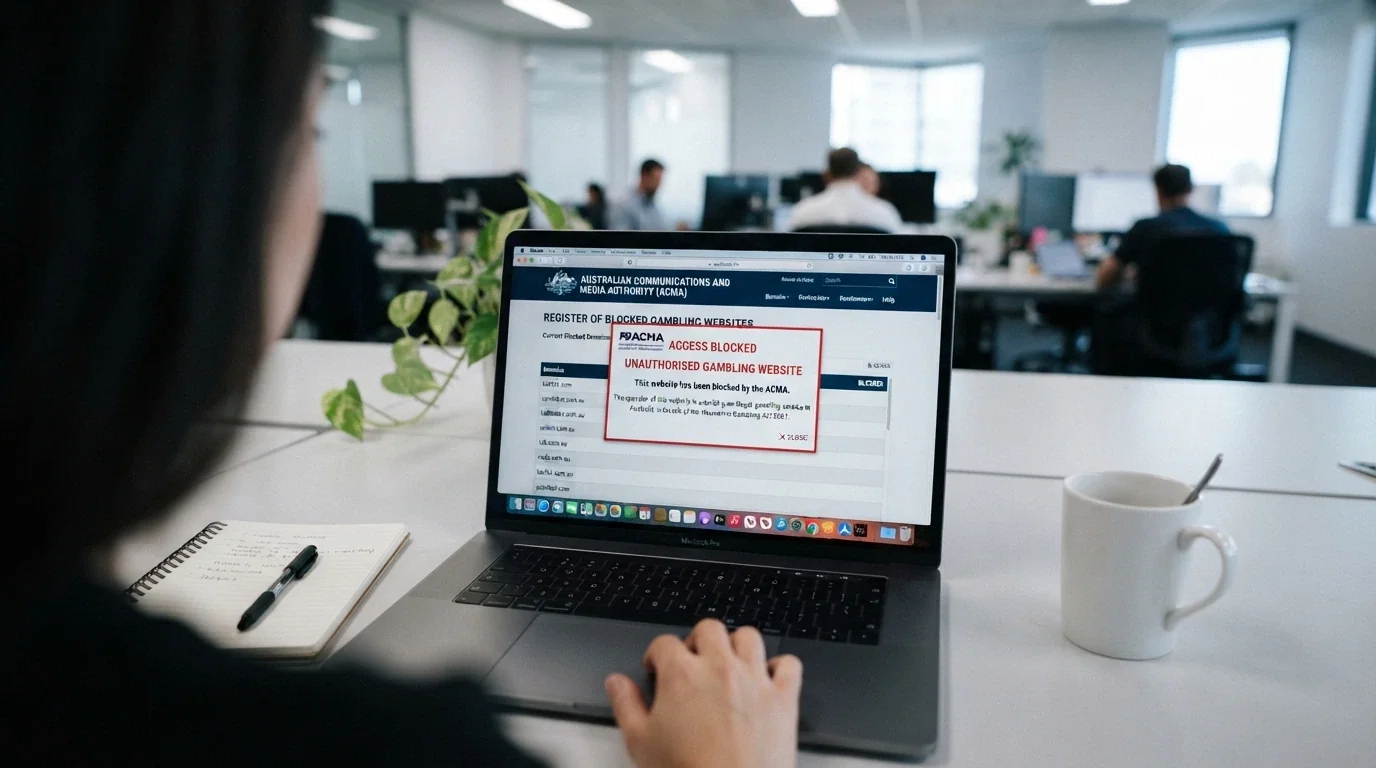
The Interactive Gambling Amendment (Gambling Reform) Bill 2026 passed Parliament on 19 August 2026, with the measures commencing on 1 January 2027. From that date, banks and payment providers gain express authority to block transactions to illegal gambling operators. Direct marketing of inducements is prohibited for 14 days after a customer signs up, for three months after a person deregisters from BetStop, and indefinitely for customers identified as at risk of gambling-related harm. Advertising is capped at three wagering ads per hour between 6am and 8:30pm, with a live-sport advertising blackout from 15 minutes before to 5 minutes after a live event. Athletes, celebrities and influencers are barred from promoting wagering.
The bank-blocking provision is the one that touches the player most directly. A player funding an offshore SOL casino through an Australian bank may find the transaction refused at the bank’s discretion from January 2027 onwards, with no recourse to the bank and no recourse to the ACMA. The blockchain leg of the deposit is still open. The fiat leg closes.
What You Get vs What You Lose: Licensed Wagering vs Offshore Solana Casinos
| Protection | Australian-Licensed Wagering | Offshore Solana Casino |
|---|---|---|
| Regulator oversight | State/territory regulator plus ACMA | Offshore (Curaçao, Anjouan, or unconfirmed) |
| Self-exclusion | BetStop covers every Australian-licensed service | Not connected |
| Crypto payment | Banned since 11 June 2024 | Accepted |
| Credit-card payment | Banned since 11 June 2024 | Not relevant — crypto only |
| Customer-set deposit limits | Required under state conditions | None mandated |
| Activity statements | Required under state conditions | Not required |
| Formal dispute resolution | Available through state regulator | None — operator’s own terms |
| DNS blocking exposure | Not applicable | ACMA has blocked 1,788 sites since November 2019 |
| Bank transaction blocking | Not applicable | From 1 January 2027 |
| Section 15(2A) IGA | Compliant | Operator in breach |
| ACMA recourse on disputed withdrawal | Available | Not available |
| Consumer protection framing | “Protected” | “Risk losing their money” — ACMA |
The licensed column is mostly empty for casino products because the licensed market does not offer online casino games at all. A licensed sportsbook covers racing and sport. The crypto column is empty in the licensed row because the crypto payment ban closed that route in June 2024. A player who wants both consumer protection and online casino games cannot get both in Australia in 2026.
Your Tax Position: CGT on Crypto, Tax-Free on Winnings
Betting and gambling winnings are not assessable income under section 6-5 of the ITAA 1997, and gambling losses are not deductible under section 8-1 unless the person is carrying on a business of betting. The winnings side is clean: an Australian punter who lands a session-winning result on a Solana casino does not pay income tax on the win. The conversion side is not. Converting AUD to SOL and back to AUD may trigger capital gains tax events even though the gambling winnings themselves remain tax-free. A player who deposits A$1,000, plays through it, and withdraws A$1,500 has had a tax-free gambling result. A player who deposited at a SOL price of A$200 and withdrew at A$250 has also had a capital gain on the SOL position that the ATO is not obliged to ignore.
The CGT exposure sits on the conversion, not on the spin. The cleanest tax position for an Australian punter using a Solana casino is to fund the wallet in SOL they already hold, leave any residue in SOL, and only convert back to AUD when the gambling result is settled. The least clean position is to round-trip AUD to SOL and back on every session, because the CGT events are layered on top of the gambling result with no offsetting deduction available.
Staying in Control When the Aussie Safety Net Isn’t There
The Australian safety net for gambling harm is built on four pillars: a national self-exclusion register, a national helpline, an online counselling service, and the customer-set deposit limits and activity statements that licensed operators are required to offer. Three of those four reach an Australian-licensed wagering customer. None of them reaches an offshore Solana casino customer.
BetStop launched on 21 August 2023 and covers every Australian-licensed online and phone wagering service. As at 31 July 2026, the register held 67,480 registrations, of which 41,290 exclusions were still active. Seventy-eight per cent of registrants were under 40, and thirty-eight per cent chose lifetime exclusion. The register works because it sits between the player and every licensed product they could reach. The register does not sit between the player and a Curaçao-licensed Solana casino. An offshore operator has no integration with BetStop and no obligation to honour an Australian self-exclusion list.
The Tools You Won’t Find at an Offshore Solana Casino
The customer-set deposit limit is required under the state or territory conditions that bind an Australian-licensed wagering operator. Activity statements — a regular statement of deposits, withdrawals, net position and time on site — sit alongside the deposit limit in the same conditions framework. Both are mandatory for the licensed market. Neither is mandatory offshore. An offshore casino may offer both as a feature, and many do, but the player is taking them at the operator’s discretion. The operator can change the policy, raise the limit, or remove the statement feature with the next terms update.
The practical effect is that the player is the only limit in the system. There is no regulator-mandated ceiling. There is no BetStop reach. There is no mandatory activity statement to look back on. The Australian-licensed operator is required to surface the tools; the offshore operator is required to do nothing.
Where to Get Help If Gambling Stops Being Fun
The National Gambling Helpline — 1800 858 858 — is free, confidential, and staffed 24 hours a day, every day. The accompanying service, Gambling Help Online, runs at gamblinghelponline.org.au with online chat and counselling. Both are run through the Australian Government and reach a player regardless of where they gamble. The helpline is the right number to call when a session has gone past the budget, and the counselling service is the right place to start when the pattern is repeating.
Self-exclusion, self-assessment and financial counselling are all available through the same channel. A player who has been gambling offshore and wants to stop does not need to come clean about which operator or which chain they were using. The service is the same.
How Big the Problem Actually Is in Australia
About 2.1% of Australian adults — roughly 430,000 people — experience problem gambling. The Australian Institute of Health and Welfare put high-risk gambling at 1.8% in 2022. Seventy-eight per cent of BetStop registrants are under 40. Thirty-eight per cent chose lifetime exclusion. The demographic skew is not a coincidence: the licensed market is the more visible one, and the visible market is where the heaviest users register. The offshore market draws a different demographic in part because the offshore market does not surface the same protective prompts.
The figure that matters for a page about offshore Solana casinos is the 2.1%. The estimate is for the adult population, the offshore market is part of that population, and the offshore market is the part of the market with the fewest mandatory controls. The closer the player is to problem gambling, the more the missing controls cost.
How We Reviewed and Ranked These Solana Casinos
The ranking on this page is built on five sources of evidence. The first is competitor testing, primarily from the published guides at Casipto, CryptoSlate, Tokenist and VIP-Grinders, which run timed SOL deposits and withdrawals and report the results in seconds rather than estimates. The second is the ACMA’s own public register, the official framework for what is and is not legal in Australia. The third is the Interactive Gambling Act 2001 and the Interactive Gambling Amendment (Gambling Reform) Bill 2026, which together set the regulatory ceiling the comparison works under. The fourth is the operator-skill sweep, which surfaced the ten operators named here as the live Australian-facing offshore market in 2026. The fifth is the figures the operators themselves publish on their own terms pages and cashier pages.
The criteria that ordered the ranking are SOL-specific, not generic. A casino that runs at the standard 40x wagering and a small game library ranks below a casino that runs the same 40x and a deep one, because the turnover per dollar of play is similar and the value per spin is higher. A casino with the fastest tested SOL withdrawal ranks above a casino with a slower one, because the cashier leg is the part of the experience the blockchain is supposed to fix. A casino with a confirmed Curaçao or Anjouan licence ranks above a casino with an unconfirmed one, because a regulator is a regulator even if it is not an Australian one. Where a casino has no public welcome offer — Bizzo and Scream at the time of review — the cell is left empty rather than filled with a guess.
What the ranking does not include is a numerical weighting or a percentage score. The ordering is editorial: the same evidence, weighted differently by a different editor, would produce a different table. The aim is to make the evidence visible and the decision legible, not to substitute a number for the comparison.
Your Move: What to Actually Do About Solana Casinos in Australia
The decision the page is built around is not which operator to pick. The decision is whether the trade is worth it for the player making it. On one side of the ledger: deposits in under five seconds, fees under A$0.01, withdrawals measured in tens of seconds, bonuses measured in hundreds of percent. On the other side: zero Australian consumer protection, zero BetStop coverage, zero ACMA recourse, an active ACMA blocking regime that has put 1,788 sites beyond reach, and a January 2027 reform that hands Australian banks the authority to refuse the fiat leg of the deposit.
A player who decides the trade is worth it can still make the trade more cleanly. The fastest practical first step is to fund the wallet in SOL they already hold, so the AUD-to-SOL conversion that triggers the CGT exposure happens once and at a known cost. The second is to set a personal deposit limit before the first deposit, because the operator is not going to set one. The third is to read the wagering terms on the operator’s own site rather than on a comparison page, because the operator’s terms are the ones the cashier will apply. The fourth is to take the winnings off the platform between sessions, because the platform is the only place the money is at the mercy of the offshore operator’s terms.
A player who decides the trade is not worth it is not choosing nothing. They are choosing the Australian-licensed wagering market for racing and sport, and choosing not to play online casino games. The licensed market does not offer the product the player came to this page for. That gap is the reason this page exists. It is not the reason to fill it.
Frequently Asked Questions
Is it legal to play at Solana casinos from Australia?
Online casino games are prohibited under the Interactive Gambling Act 2001. The player is not prosecuted — section 15(2A) targets the provider, not the customer. Playing at an offshore Solana casino is not a criminal offence for the Australian user. It does mean every local consumer protection is absent.
How fast are Solana deposits and withdrawals at online casinos?
SOL deposits typically confirm in two to five seconds. Withdrawals depend on the operator — BC.Game processed a test withdrawal of 8.2 SOL in 28 seconds, with the average across tests at 31 seconds. The blockchain settles in roughly 400 milliseconds; the operator’s own processing is where the time actually sits.
Do Solana casinos require KYC verification for Australian players?
Many Solana casinos accept players with no identity check on deposit or withdrawal. KYC tends to trigger only at withdrawal thresholds or when the operator flags the account. The trade is real: skipping KYC means no formal dispute mechanism and no account-recovery path if the casino locks the profile.
Can I use BetStop to self-exclude from offshore Solana casinos?
No. BetStop, the National Self-Exclusion Register, covers every Australian-licensed online and phone wagering service. It launched on 21 August 2023 and does not connect to offshore operators. Self-excluding on BetStop does not stop you opening a new account at a Solana casino licensed in Curaçao or Anjouan.
Are Solana casino games provably fair?
Some crypto-native games on Solana use provably fair systems that let the player verify each bet against an on-chain hash. The catch: the operator-configured RTP can differ from the studio-published figure. Two tested operators ran Pragmatic Play slots at 90.8% and 92.3% actual, well below the 96.5% published variant.
Why choose Solana over Bitcoin for online casino deposits?
Solana confirms transactions in roughly 400 milliseconds for under one US cent. Bitcoin fees run from a few dollars in quiet periods to A$5–20 during network congestion. The practical difference shows up at the cashier: a SOL deposit clears while a BTC deposit waits, and the fee is a rounding error either way.
Are gambling winnings from Solana casinos taxable in Australia?
Gambling winnings are not assessable income under section 6-5 of the ITAA 1997, and losses are not deductible. The catch is the conversion: turning AUD into SOL and back can trigger capital gains tax events even though the gambling itself is tax-free. The winnings stay untaxed; the swap may not.