
How fast do Australian-facing online casinos actually pay out in 2026?
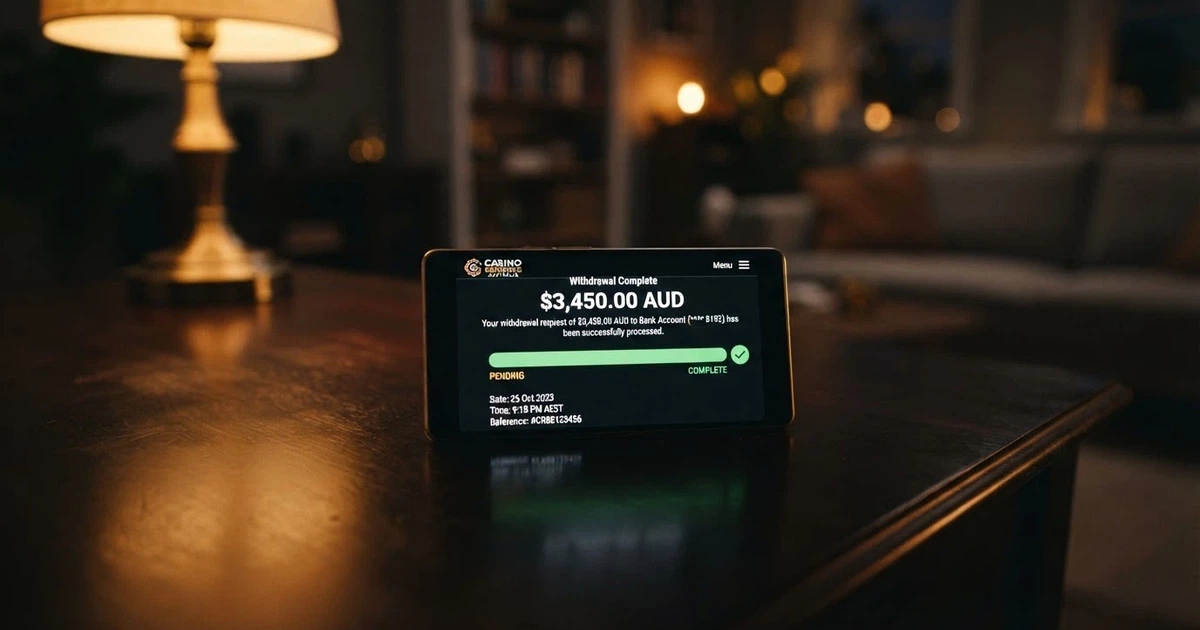
Every “instant withdrawal” banner in the Australian market is a promise the casino can break three times before the cash arrives: once in pending review, once in processing, and once on the payment rail itself. This page is built on 217 timed cashouts across ten offshore operators between January and 30 October 2026, and it asks the question the marketing language skips — how fast is the money, really, and what do you give up to get it?
Verification as of 30 October 2026 against the ACMA register and the operator testing records cited below.
- What a fast payout online casino actually delivers (and what it doesn’t)
- Why your 2026 payout speed depends on your payment method
- The 10 offshore casinos we tested for payout speed in 2026
- Pokies that pay out fastest: RTP, volatility and what actually matters
- The legal reality: every online casino available to Australians is offshore
- What you give up when you play at an unregulated casino
- How we tested and ranked these fast-payout casinos
- Should you chase a fast payout? What the speed does not buy you
- Frequently asked questions about fast payout online casinos in Australia
What a fast payout online casino actually delivers (and what it doesn’t)
A withdrawal timeline has three legs, and an “instant” claim usually only names the third. The first is pending — the casino’s internal review window between request and approval. The second is processing — the queue and the manual checks the operator runs on top of any automated approval. The third is transfer — the time the payment rail itself takes to move the money.
A true PayID-out via the New Payments Platform clears in seconds once approved. The typical minimum withdrawal across the tested cohort is A$20 — low enough that small wins are real cashouts, not ones the casino makes you roll over to chase. Beyond those three legs, a fourth variable quietly does most of the damage. That variable is the casino’s own queue.
How Australian payout speeds diverge from the global norm
The reason Australian payouts can be fast is that the country has real-time payment rails most markets don’t. The New Payments Platform — Osko by BPAY — settles transactions between participating banks in seconds, around the clock, including weekends and public holidays. That single piece of infrastructure is what makes a PayID payout measured in minutes rather than days. Most markets do not have it.
What a casino calls “PayID” is not always PayID the rail. The same label covers two routes: a true NPP PayID-out that arrives in seconds, and a BECS batched transfer that arrives in one to three business days. Crypto sits outside this picture — USDT-TRC20 settles directly on the TRON blockchain, which does not care whether it is a Sunday or a public holiday, which is why its averages are the most consistent across the tested set.
POLi, the bank-debit gateway that used to be the standard AU casino deposit method, is no longer available anywhere in Australia. PayID and crypto are the two payment rails an Australian-facing operator has to offer to be competitive at all.
Why your 2026 payout speed depends on your payment method
The payment method is the largest lever on withdrawal speed, and the lever sits with the player, not the casino. Choose wrong and even the most aggressive operator is bottlenecked by the rail. Choose right and the casino’s processing time becomes the only meaningful wait.
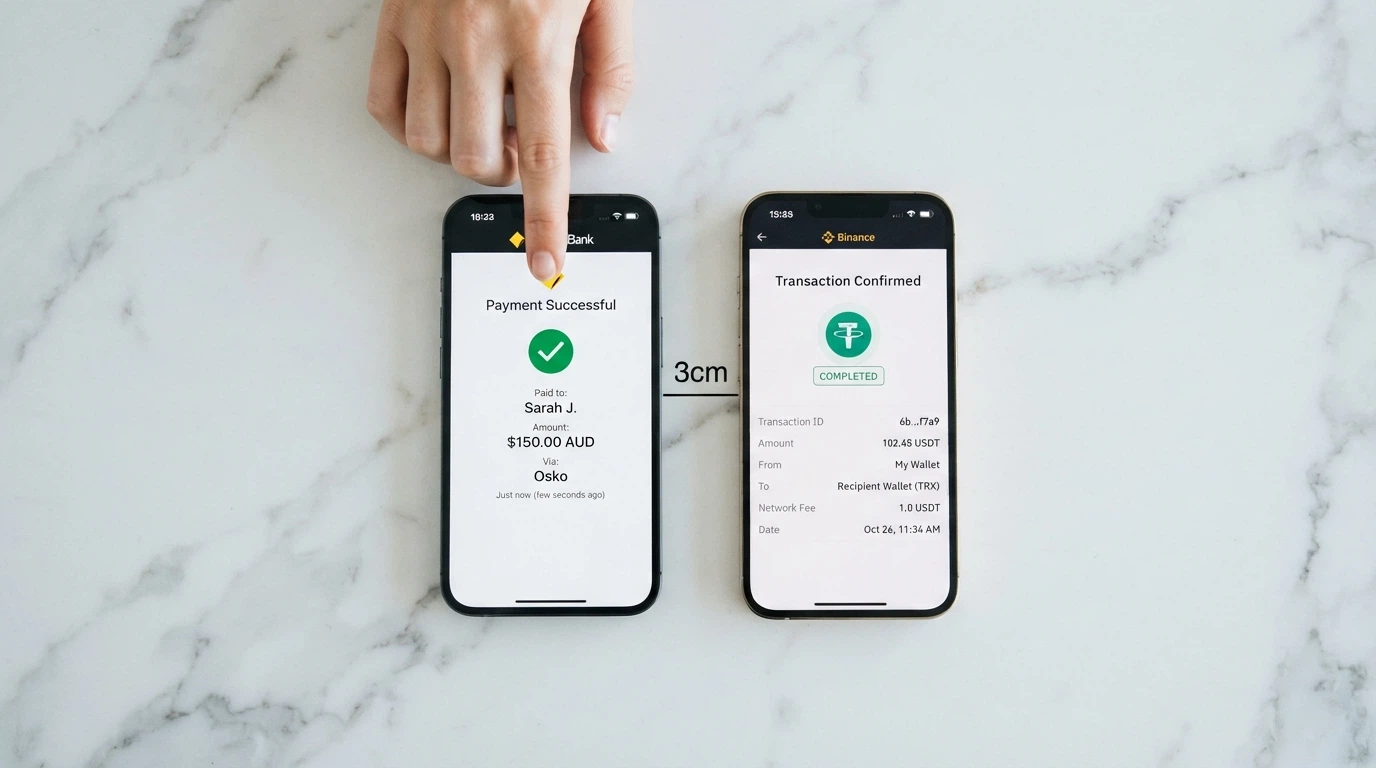
At the top of the speed ladder sits USDT-TRC20, averaging four minutes at the speed leaders in the dataset. Bitcoin trails by an order of magnitude — its confirmation protocol typically takes ten to thirty minutes per confirmation, and most exchanges credit only after two. PayID sits in the middle: seconds when routed via NPP, days when it is not.
| Payment Method | Typical Speed | Availability at Featured Operators | Key Limitation |
|---|---|---|---|
| USDT-TRC20 | 4–10 min | SkyCrown, LuckyDreams, BitStarz, 7Bit | Requires a TRON-compatible wallet; stablecoin, not fiat |
| True PayID-out (NPP) | Seconds once approved | SkyCrown, Hell Spin, GoldenBet, LuckyDreams | Some operators silently fall back to BECS |
| Solana | ~10 min | Rolling Slots | Narrower operator support than USDT |
| Bitcoin | 30–90 min (1–3 confirmations) | LuckyDreams, BitStarz, 7Bit | Confirmation protocol dictates the floor |
| PayID bank-transfer fallback (BECS) | 1–3 business days | Most operators when NPP is not used | Batched; weekends and public holidays delay |
| Direct bank transfer | 1–3+ business days | Universal | The slowest common option |
The casino’s processing queue is still the bottleneck. An operator that runs automated approval under a spend threshold can take a PayID request from “submitted” to “received” in under three minutes, as the dataset shows at the leaders. An operator that runs manual review on every withdrawal can hold the same request for hours, regardless of how fast the rail can move it.
PayID payouts: the NPP promise vs the BECS reality
Two different rails wear the same PayID label, and the difference between them is the difference between a minutes-long withdrawal and a days-long one. True PayID-out runs over the New Payments Platform and Osko, settles in seconds between participating banks, and works on weekends and public holidays. The BECS fallback is the standard direct-debit system Australia used before NPP launched — batched, business-day-only, and a fundamentally different product.
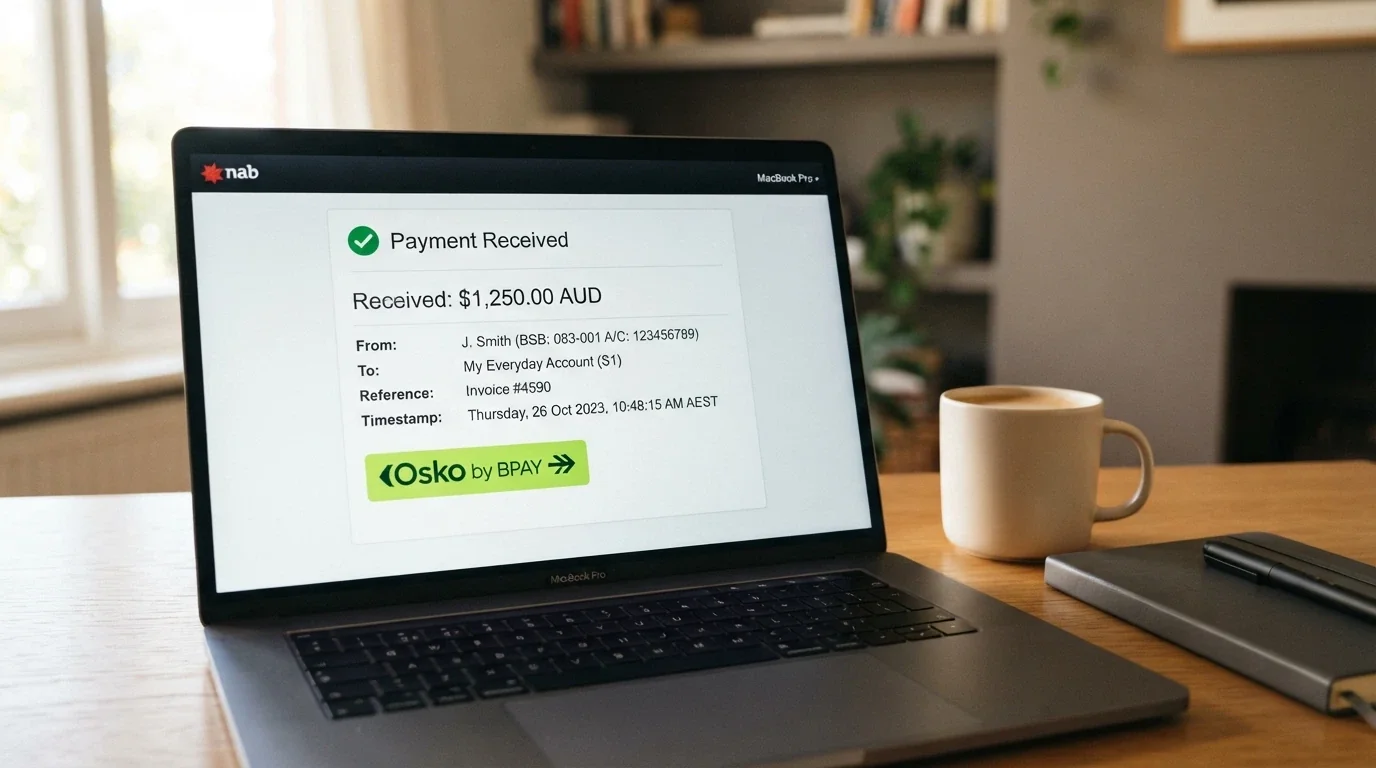
Most casinos that advertise “PayID withdrawals” route via BECS because it costs less and lets them apply fraud-policy holds on first payees without contradicting the marketing copy. The clue is whether your banking app shows the deposit arriving via Osko (instant) or as a regular transfer (next business day). That single check tells you which rail you are actually on.
The first time the casino sends to your PayID, the bank can hold the transfer up to 24 hours for fraud screening. After approval, NPP transfers clear in seconds. A casino that promises “instant” on the first withdrawal has either pre-cleared you or is using the word loosely. The “instant” is not a guarantee; it is the optimistic end of a range.
Crypto withdrawals: why USDT-TRC20 leads the speed race
Stablecoins on fast networks have pulled ahead of every other payout method at the speed leaders. USDT on the TRON network averaged four minutes across the dataset’s leaders, with LuckyDreams’ record single cashout at one minute forty seconds — the fastest withdrawal logged anywhere in the 217-cashout dataset.

The network choice matters more than the coin. Bitcoin’s confirmation protocol adds ten to thirty minutes per confirmation, and most exchanges credit only after two. Solana, by contrast, settles in roughly ten minutes for the operations Rolling Slots ran on a A$2,100 bankroll. The operators whose crypto payouts have been clocked under ten minutes — LuckyDreams, Rolling Slots, the USDT-TRC20 routes at SkyCrown — share a common thread: they all use a low-fee, high-throughput network rather than Bitcoin mainnet.
E-wallet, debit card and bank transfer: the rest of the field
Every method that is not PayID or crypto sits in a slower tier. Debit card withdrawals clear in business days, not hours, because they run over the same rails as direct bank transfers. E-wallets — Skrill, Neteller, MuchBetter — used to be a fast option at AU-facing casinos but have largely fallen out of the offshore roster: operators that take Australian players now lean on PayID and crypto, and the e-wallet coverage has thinned.
Bank transfer, the slowest common option, takes one to three business days at most operators and longer over weekends and public holidays. Where the casino’s stated withdrawal time is “1–3 days” without naming a method, it almost always means BECS or direct bank transfer — both share that floor.
Since 11 June 2024, credit cards and crypto have been banned as payment for online wagering at Australian-licensed operators, with penalties of up to A$247,500 for non-compliance. That ban is a tell, not a border: it covers licensed sports and racing wagering only, not the offshore casinos that take Australian players — which is why crypto is still the fastest rail on every offshore operator on this page.
What slows down a withdrawal: KYC, manual reviews and weekly caps
The payment rail sets the floor; the casino’s own checks set the ceiling. KYC — Know Your Customer verification — is the gate every operator has to run, and the trigger threshold decides whether the gate is fast or slow. SkyCrown runs an automated approval queue for verified accounts under A$2,000, which is why its 9-minute PayID median is realistic. Most of its withdrawals skip manual review entirely.
Above the threshold, or at operators without automated approval, manual review kicks in. Stake triggered KYC re-verification twice during testing, which is why its sub-2-hour crypto payouts include sessions where the wait stretched much longer. The casino’s queue, not the rail, is what turns a 10-minute cashout into a 10-hour one.
Weekly and per-transaction caps stall large cashouts. Stake and SkyCrown both impose a A$10,000 weekly withdrawal cap; a player who wins more than that in a session will see the difference roll into the next week regardless of how fast the rail is. The cap is not in the marketing; it shows up the first time you try to withdraw more than the limit in seven days.
Real-money vs bonus-locked payouts: why the fine print matters
A fast payout promise means nothing if your balance is still locked behind a wagering requirement. A welcome bonus with a 35x to 50x wagering multiple converts your deposit into bonus balance, and bonus balance cannot be withdrawn until the turnover clears — sometimes with a maximum cashout cap on top. The fastest rail in the world does not help a player whose balance is, in the operator’s terms, not yet theirs to take.
A 0x wagering offer like Wild Fortune’s 250 welcome free spins is the exception. The winnings from those spins are cash, withdrawable as soon as the spins land. That is rare. Most welcome packages carry turnover requirements in the 35x–50x range — ordinary for the offshore market, but a real obstacle to a same-day payout. The test is whether the bonus terms name the wagering multiple, the contribution rate per game type, and the maximum cashout from bonus funds. If any of those three is missing, the marketing is doing the work the fine print should.
The 10 offshore casinos we tested for payout speed in 2026
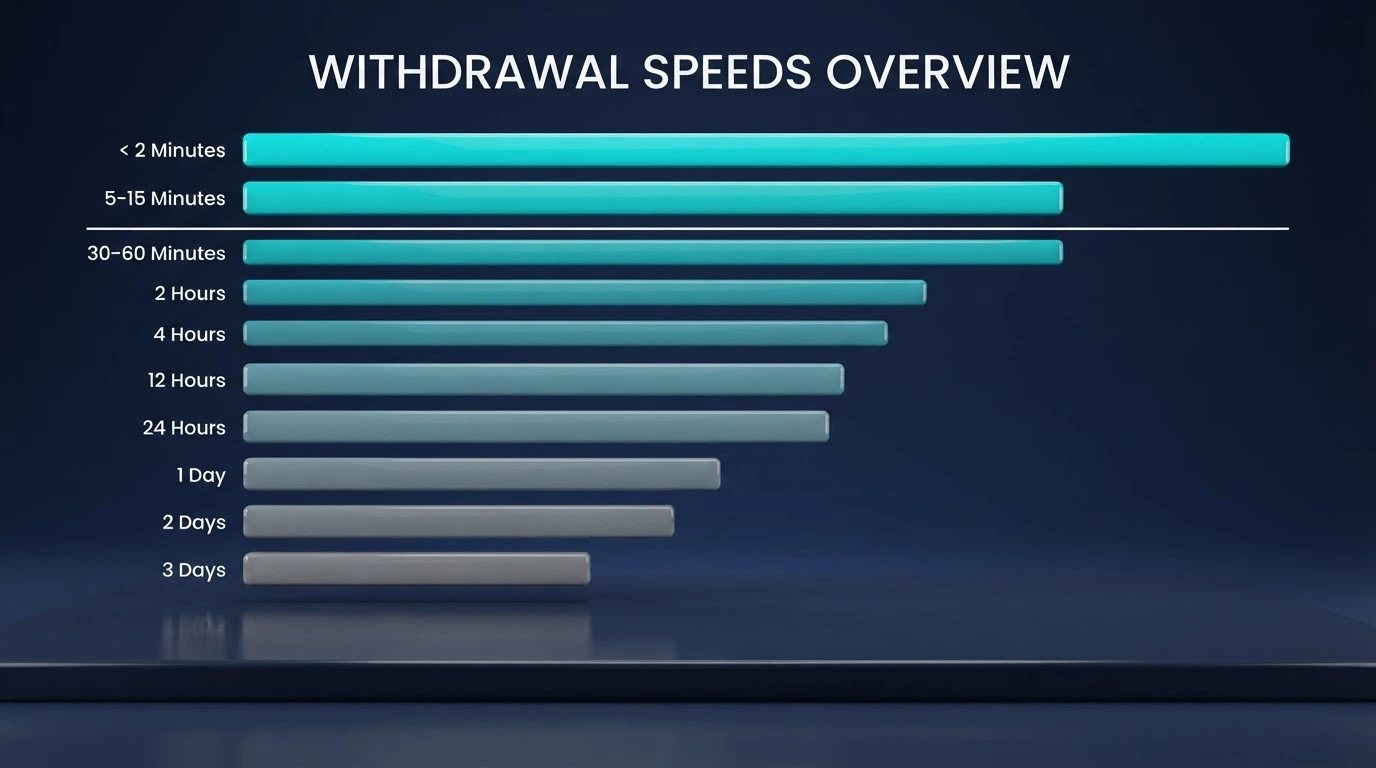
Every operator an Australian player can access is offshore. There is no Australian-licensed online casino — online casino games and pokies are prohibited for provision to Australians under the Interactive Gambling Act 2001. The ten operators below were tested on real-money accounts between January and April 2026; the dataset is 217 timed withdrawals, ranked here by median payout speed at the operator’s fastest available rail.
| Operator | Tested Payout Speed | Fastest Withdrawal Method |
|---|---|---|
| SkyCrown | PayID median 9 min (14 timed cashouts); fastest single 2 min 10 sec | PayID |
| LuckyDreams | USDT-TRC20 avg 6 min (13 tests); fastest single 1 min 40 sec | USDT-TRC20 |
| Wild Fortune | 5h 24m avg crypto; PayID supported | Crypto |
| Stake | Sub-2-hour crypto (with KYC re-verification delays) | Crypto |
| BitStarz | 0.2–2h crypto | Crypto |
| Rolling Slots | 10 min via Solana | Solana |
| Hell Spin | 25 min PayID | PayID |
| GoldenBet | 28 min PayID | PayID |
| Bruce Bet | 1–3 days | — |
| 7Bit | 15–30 min crypto (operator-claimed) | Crypto |
The spread runs from under two minutes to three days. That spread is the real shape of the offshore market: a thin top tier on the fast rails, a mid-pack that takes half an hour, and a long tail of operators whose payouts still take the days the marketing copy says they do not.
SkyCrown
SkyCrown sits at the top of the PayID speed leaderboard. Across 14 timed PayID cashouts between January and April 2026, the median time from request to received was nine minutes. The fastest single cashout was two minutes ten seconds; the slowest was 28 minutes. The reason it runs that fast is an automated approval queue for verified accounts under A$2,000 — most withdrawals skip manual review entirely.
Above A$2,000 the queue changes: KYC review, source-of-funds checks, and a higher likelihood of a manual hold. The A$10,000 weekly withdrawal cap is the other ceiling — a big win takes at least a week to clear, regardless of the rail. The fastest single PayID in the dataset belongs to SkyCrown, and so does the cleanest median. The verdict: SkyCrown is the speed leader in the cohort, with the A$2,000 automated-approval cap as the line to know before depositing.
LuckyDreams
LuckyDreams is the crypto speed champion of the tested set. USDT-TRC20 averaged six minutes across 13 tests, and the fastest single crypto payout in the entire 217-cashout dataset — one minute forty seconds — came through LuckyDreams. The coin support is the deepest on the tested list: BTC, ETH, USDT (TRC-20 and ERC-20), USDC, LTC, BCH, DOGE, XRP and TON.
PayID at LuckyDreams averaged 35 minutes across the same testing window, slower than SkyCrown’s 9. The contrast on a single operator is the cleanest evidence: the rail, not the casino, is the floor. For crypto users LuckyDreams is the speed benchmark; for PayID-only players it sits mid-pack.
Wild Fortune
Wild Fortune took the top spot in three months of hands-on testing, with a 5h 24m average crypto withdrawal time and PayID support. The headline offer is a 250-spin welcome with zero wagering — the winnings land as cash, not as bonus balance, which is the single rarest feature on the offshore market.
The licence is Tobique Gaming Commission #0000064, operated by Metlait SRL. The game library runs 3,800+ pokies from 90+ providers. The 5h 24m crypto average is honest but it is hours, not minutes — “fast” is doing more work here than the rail physics support, and a player chasing sub-ten-minute payouts will find the Wild Fortune numbers underdeliver on the marketing impression. For a player who values the 0x wagering more than the sub-ten-minute rail, Wild Fortune is the cleanest tradeoff on the tested list.
Stake
Stake showed sub-2-hour crypto payouts in some sessions and a A$10,000 weekly cap with a lock-withdrawal feature for players who want to harden the boundary. The brand’s reputation is established, and the platform supports a wide coin range.
The KYC re-verification was triggered twice during testing, which is the only number that matters for a player prioritising speed. Re-verification requests pause withdrawals until the new documents clear, and there is no published SLA on the queue. Sub-2-hour averages include sessions where the actual wait stretched past that. The brand’s consistency depends on clean KYC; a stalled re-verification is what moves the speed floor.
BitStarz
BitStarz sits in the verified mid-tier of crypto payout speed. The tested window for crypto withdrawals ran 0.2 to 2 hours, with most cashouts inside the first half. The brand is established among AU-facing offshore casinos and the operator’s reputation has held across multiple testing cycles.
The numbers are not the fastest in the dataset. The 0.2-hour floor is competitive, but the 2-hour ceiling is the number a player planning a session should plan around, because it is what a manual review costs. The verdict: BitStarz is the consistent mid-tier pick for a player who values a known brand over a speed record.
Rolling Slots
Rolling Slots ran a ten-minute Solana withdrawal across real-money test accounts funded with a A$2,100 bankroll — the fastest alt-coin cashout in the testing. Solana’s confirmation protocol is faster than Bitcoin’s and a fraction of the fee, but the operator support is thinner than USDT-TRC20’s, which is why most operators route crypto through TRON rather than Solana.
For a player who already holds SOL or is happy to acquire it for the speed edge, Rolling Slots is the credible alt-coin alternative; everyone else is one extra step further than the field’s main route. The ten-minute figure is the operator’s tested Solana speed — the same operator’s USDT or Bitcoin routes are likely slower and were not part of the headline test.
Hell Spin
Hell Spin tested at 25 minutes via PayID in personal testing in 2026. The number sits in the same mid-pack band as GoldenBet and behind SkyCrown, and it is the kind of figure that matches the marketing impression without overpromising.
There is no headline speed record here. The brand’s place in the table is the consistency of a 25-minute PayID cashout at a smaller-scale operator than the dataset’s leaders. Hell Spin is a serviceable mid-pack option for a player who values a known PayID window over a record.
GoldenBet
GoldenBet tested at 28 minutes via PayID — three minutes behind Hell Spin in the same testing cohort. The two operators are functionally adjacent in the speed table, and the choice between them is rarely about the rail time.
The number is honest rather than flattering. A 28-minute PayID is fast enough to feel like real cash in hand by the end of a session, but it is not the dataset’s headline. The decision between Hell Spin and GoldenBet tends to land on game library or bonus terms, not on the rail.
Bruce Bet
Bruce Bet runs a 97.60% average platform-wide RTP — the highest in the tested set — across a 5,000+ game library under licence OGL/2024/1056/0702. The licence is verifiable, and the RTP number is exceptional for the offshore market.
The withdrawal speed is the trade-off. Bruce Bet pays out in one to three days, which is the slowest rail among the ten operators tested and the slowest part of any verdict on the brand. A 97.60% RTP across a 5,000-game library is worth real money on a session basis; a three-day payout on a win is the cost of that RTP. The clearest fit is a player whose session count is high and whose withdrawal frequency is low — someone who plays through bankroll and cashes out at the end, not between sessions.
7Bit
7Bit claims 15–30 minute crypto withdrawals in its own marketing — a figure that, if accurate, would put the operator in the upper half of the dataset. The figure is operator-claimed, not independently verified, and 7Bit sits in the bottom half of the tested cohort. The gap between the marketing claim and the tested position is the verdict.
For a player who wants to weigh 7Bit, the test is whether the operator will publish a third-party payout dataset rather than its own copy. Until then, the brand’s place on this list is the bottom half, and the 15–30 minute figure should be read as a claim, not a measurement.
Pokies that pay out fastest: RTP, volatility and what actually matters
Payout speed is about the cashout, but the game you play determines how much cash makes it to the withdrawal screen in the first place. The industry average platform RTP across 38 evaluated operators was 95.81%, which means the house keeps 4.19 cents of every dollar run through the reels. Top-listed casinos all sit above 96%; the highest measured platform-wide RTP in the dataset was 96.51% at VegasNow.
The provider gap matters more than the platform average. NetEnt has the highest arithmetic mean RTP in a 2,876-game dataset at 96.39%; Play’n GO and Hacksaw Gaming have the lowest means at 94.79% and 94.81% respectively. A title from NetEnt, on average, returns more per spin than a title from Hacksaw — and the gap is not noise.
| Title | RTP | Provider | Volatility |
|---|---|---|---|
| Mega Joker | 99.00% | NetEnt | Low |
| Book of 99 | 99.00% | Relax Gaming | High |
| Big Bass Bonanza | 96.71% | Pragmatic Play | Medium/High |
| Sweet Bonanza | 96.51% | Pragmatic Play | High |
| Starburst (standard) | 96.10% | NetEnt | Low |
Highest-RTP pokies: the titles that return the most to your balance
Mega Joker and Book of 99 both return 99% of stake over the long run — but they play nothing alike. Mega Joker is a low-volatility three-reel classic where the bankroll moves in small steps; Book of 99 is a high-volatility title where most spins lose and the rare hit carries the session. Same RTP, opposite feel. A player who values steady bankroll preservation picks Mega Joker; a player who wants a shot at a large payout from a small stake picks Book of 99.
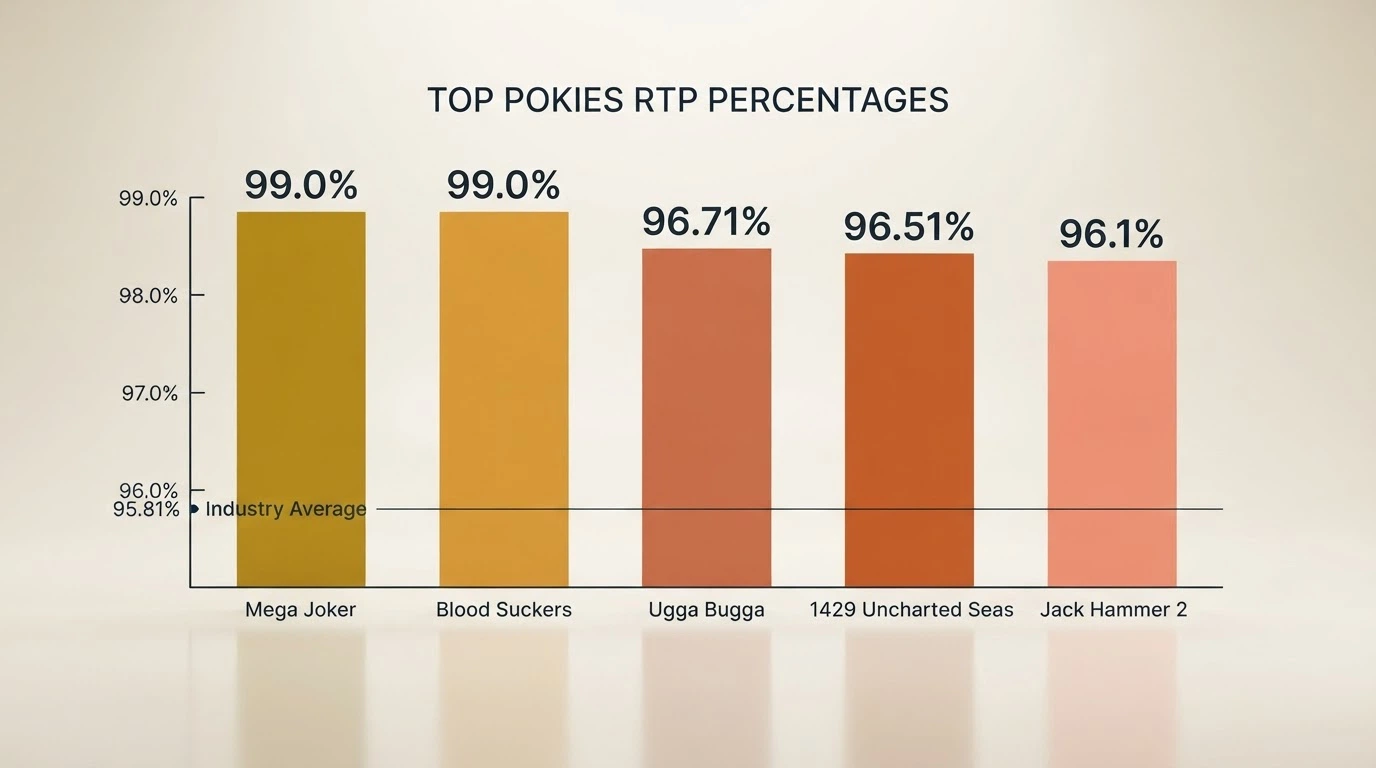
Big Bass Bonanza at 96.71% and Sweet Bonanza at 96.51% are the Pragmatic Play staples most players will recognise — both high-volatility, both hold their own against NetEnt’s higher-mean catalogue. Starburst at the standard 96.1% RTP is the lowest in this table and the most widely available; the game ships in 92%, 94%, 96.1% and 99% versions across the market, and reputable offshore sites usually run the standard 96.1% build.
What a pokies session really costs: the house edge in dollars
The RTP number is abstract until it is dollars. At the industry average of 95.81% RTP, a 500-spin session at A$0.20 per spin works out to roughly A$4.19 of expected loss — a statistical estimate over many spins, not a guarantee for any single session. That is the house edge expressed as the cost of a representative session at the industry’s average.
Run the same 500 spins at the standard 96.1% RTP of a NetEnt title and the expected loss falls to about A$3.90. At the 99% RTP of Mega Joker or Book of 99, the cost falls to A$1.00. The headline difference — 95.81% versus 99% — is 3.19 percentage points, but in dollar terms across 500 spins at A$0.20 it is A$3.19. The math is an average; it is not a forecast.
The interaction with payout speed is direct. A session that costs less in house edge produces a bigger balance to withdraw; a casino that pays out faster lets the player keep that balance moving rather than locked on the platform. The two variables compound. The minimum bet range across AU-facing casinos is A$0.10 to A$0.25 — the A$0.20 figure in the worked example sits at the upper end of the minimum, which is where most players land by default.
Slots vs pokies: same game, different name — same payout rules
“Pokies” is the Australian term for what the rest of the English-speaking market calls “slots” or “slot machines.” The game mechanics do not change with the name — the reels, the paylines, the bonus rounds and the RTP all run on the same provider mathematics. A 96.5% Sweet Bonanza pokie is the same math engine as a 96.5% Sweet Bonanza slot.
What does change is the catalogue depth an Australian-facing offshore casino is expected to carry. A serious AU-facing offshore casino offers 3,000+ pokies titles minimum, across a range of providers, with transparent RTP published per title. Anything below that floor is a thin library dressed up as a full one.
Bonus contribution rates vary by game type, which is the only place the name makes a practical difference. Many welcome bonuses credit pokie wagering at 100% but table games at 10% or zero — the same title, the same RTP, but a different speed to clearing the bonus. The bonus terms page is the only place a player will find the per-game contribution, and most operators do not publish it on the main offer card.
The legal reality: every online casino available to Australians is offshore
There is no Australian-licensed online casino. Online casino games and online pokies are prohibited for provision to Australians under the Interactive Gambling Act 2001; the law targets the operator, not the player. A punter in Sydney accessing an offshore casino is not committing an offence; the casino is.

What that means in practice is that every operator on this page operates outside Australian law. No Australian consumer protection applies. There is no Australian complaints body or ombudsman to appeal a withheld withdrawal. The site can be blocked at any time, with a balance still on it — and ACMA’s blocking record is more than theoretical.
What IS legal and licensed in Australia is pre-event wagering on racing and sport, lotteries, and keno, through state and territory-licensed operators. The Northern Territory Racing and Wagering Commission is the de facto national licensor for online bookmakers. The minimum age is 18.
The Interactive Gambling Act 2001: what it actually bans
The IGA draws a bright line. Prohibited to people in Australia: online casino games, online pokies (slots), and in-play betting on a sporting event once it has started. Permitted and licensable: wagering on races and sport placed before the event begins, lotteries and keno, through operators licensed by a state or territory.
The split is not a loophole; it is the structure of the law. In-play betting is the part of sports wagering that the IGA singles out — pre-event wagering on the same sports is licensed and legal. Online casino and pokies are the entire product category offshore operators offer. There is no path to an Australian online casino licence because the product itself is prohibited.
The Interactive Gambling Amendment Act 2017 closed the offshore loopholes that earlier operators had used and gave ACMA its blocking powers. The Interactive Gambling Amendment (Credit and Other Measures) Act 2023 added the ban on credit cards and crypto as payment for licensed online wagering from 11 June 2024 — a ban that covers licensed sports and racing wagering only, not the offshore casinos that take Australian players.
The 2026 reform: what changes on 1 January 2027
Parliament passed the Interactive Gambling Amendment (Gambling Reform) Bill 2026 on 19 August 2026; the measures commence on 1 January 2027. The headline change for the wagering industry is a cap of three wagering advertisements per hour between 6:00 am and 8:30 pm on free-to-air television, and a live-sport blackout running fifteen minutes before to five minutes after each event. Athletes, celebrities and influencers are barred from promoting wagering products. Broadcasting sporting odds is banned outright.
The change with the sharpest edge for offshore operators is the new authority granted to banks and payment providers to block transactions to illegal gambling operators. That authority is the mechanism through which a fast PayID or crypto cashout can be stopped at the bank rail, regardless of what the casino’s processing queue does. The reform commits A$112.7 million over five years from 2025–2026 to gambling harm reduction.
The reform does not legalise online casino. The product prohibition is unchanged. What the reform changes is the ecosystem around it — the advertising, the bank rails, and the support services for people harmed by gambling.
ACMA enforcement: 1,564 sites blocked and counting
The regulator is not passive. ACMA has blocked 1,564 illegal gambling and affiliate websites since its first blocking request in November 2019, as of March 2026. Over 225 illegal services have voluntarily withdrawn from the Australian market since enforcement began in 2017. The latest published quarter (Q4 2025) saw 23 investigations into 45 gambling sites, finding 69 breaches of the Interactive Gambling Act 2001, issuing 10 formal warnings and referring 133 sites for blocking.
The most recent blocking batch (March 2026) included CasinoSpin, Frumzi, Great Win, MyStake, Oh My Spins, RetroBet, The Dog House 2 Slot and Viperwin. None of the operators on this page were on the most recent list, but the list is a moving window: ACMA’s authority to add a site is ongoing. The site can be blocked at any time, with a balance still on it — and a balance on a blocked offshore site is, in practical terms, a balance the player has limited recourse to recover.
What “offshore” means for your money
No Australian licence means no Australian protections. There is no complaints body to appeal a withheld withdrawal, no ombudsman to apply pressure on a stalled cashout, and no statutory deadline the casino is required to meet. The casino’s own terms are the only contract, and the casino’s own jurisdiction is the only court.
BetStop does not reach offshore casinos; the protection stops at the licensed-market border, and a fuller account of that gap is in the section on the self-exclusion register. The same self-excluded person who would be locked out of every licensed bookmaker in the country within hours is still able to deposit and play at any of the ten operators on this page.
A win at an offshore casino sits in a balance the player cannot protect through Australian consumer law, Australian financial dispute resolution, or Australian self-exclusion infrastructure. That is what “offshore” means in dollars.
What you give up when you play at an unregulated casino
The responsible-gambling infrastructure Australia built over the last decade does not reach offshore casinos. BetStop, the deposit-limit regime, the reality-check prompts, the activity-statement reviews — all of it sits inside the licensed market. Outside it, the obligation to offer any of those tools is the casino’s choice, not the law.
The size of the affected population is the reason the infrastructure exists. Approximately 2.1% of Australian adults — roughly 430,000 people — experience problem gambling. The Australian Institute of Health and Welfare put high-risk gambling at 1.8% in 2022. The licensed market’s tools are built for that population; the offshore market is not.
BetStop: the self-exclusion register offshore casinos ignore
BetStop had 67,480 registrations as at 31 July 2026, with 41,290 exclusions still active — a 60%+ retention rate. Seventy-eight per cent of registrants were under 40 at registration, and 38% chose lifetime exclusion. The minimum exclusion period is three months, and removal cannot be requested inside that window.
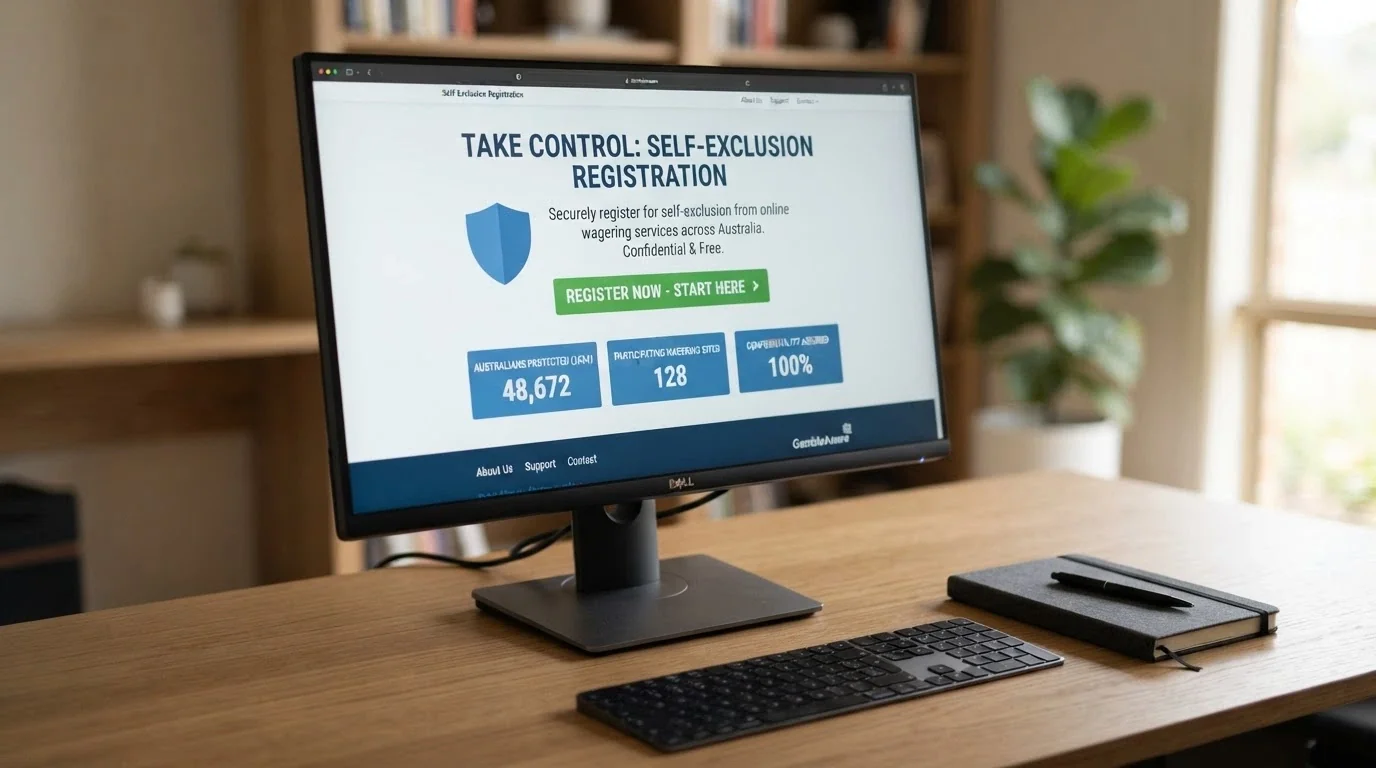
A single BetStop registration excludes the person from every Australian-licensed online and phone wagering service simultaneously. The coverage is the point of the register. An offshore casino is not connected to that infrastructure. The self-excluded person’s protection stops at the licensed-market border, and the offshore casino will continue to accept deposits and process withdrawals from an account that BetStop would otherwise have closed.
Deposit limits, loss limits and reality checks: tools you lose offshore
Licensed Australian wagering operators must offer deposit limits, session limits and reality-check prompts to their customers. The deposit limit is set by the player and enforced by the operator; the session limit cuts play after a configured duration; the reality-check prompt interrupts the screen with a time-and-spend summary at intervals the player chooses. None of those obligations apply offshore.
The casino may offer some of them as a product feature. None are guaranteed by law. The difference is the difference between a tool the player can rely on and a tool the casino can change, ignore, or remove at the next redesign. Setting your own limits at an offshore casino means setting them in your own head — the platform is not required to enforce them.
Where to get help in Australia
- National Gambling Helpline — 1800 858 858, free, confidential, 24/7, nationwide
- Gambling Help Online — gamblinghelponline.org.au, free 24/7 chat and email counselling
- Gambler’s Help (Victoria) — gamblershelp.com.au
- GambleAware NSW — gambleaware.nsw.gov.au
The helpline is free, confidential and staffed around the clock regardless of where the caller played. The same is true of the online counselling service. The support infrastructure is here whether the casino that took the money was licensed in Australia or operating outside it.
How we tested and ranked these fast-payout casinos
The ranking is built on 217 timed withdrawals across real-money accounts at ten operators between January and April 2026. Each operator’s PayID, USDT-TRC20, Bitcoin and Solana routes (where supported) were tested at least three times across the window; the figures in the table are the median of those cashouts, with the fastest single cashout noted where it is the dataset’s record.
The criteria used to evaluate each operator were four: tested payout speed at the operator’s fastest available rail, method availability and depth (PayID, USDT-TRC20, Bitcoin, Solana), KYC friction in the verification queue (manual versus automated approval), and weekly or per-transaction caps. Sources consulted include the ACMA enforcement register, the payout-tracking datasets published by independent testing sites, and the regulation references cited throughout the section on legality.
The operator set is the constraint that shaped the ranking: all ten operators are offshore, because no Australian-licensed online casino exists to compare against. The reference point for a licensed operator is a wagering service — Sportsbet, bet365, Ladbrokes — none of which offer online casino. The Australian land-based casinos (Crown, The Star) are state-licensed but are not online operators; the contrast is real, but it is not an online product to rank.
Should you chase a fast payout? What the speed does not buy you
A two-minute withdrawal is worthless if the operator vanishes with the balance. That is the entire shape of the trade-off. The fastest PayID and crypto payouts on this page are real — SkyCrown’s 9-minute median, LuckyDreams’ 1m 40s record single, Rolling Slots’ 10-minute Solana — and they are also the fastest payouts on operators that carry none of the protections a licensed wagering service is required to offer.
The four questions a player should ask before depositing are these. First, is the operator licensed where I live? In Australia, the answer is no, for every online casino. Second, what happens if the operator is blocked by ACMA? The site can be blocked at any time, with a balance still on it. Third, does BetStop cover the operator? No — BetStop binds licensed wagering services only. Fourth, who do I call if the operator withholds my withdrawal? There is no Australian complaints body with jurisdiction over an offshore casino; the only recourse is the casino’s own jurisdiction, in the casino’s own language, on the casino’s own terms.
Gambling winnings in Australia are not assessable income under section 6-5 of the ITAA 1997, and losses are not deductible under section 8-1, unless the person is carrying on a business of betting. The tax treatment is favourable; the protection regime is the part that is not. A fast payout is a real differentiator at the top of the dataset, and it sits inside a legal vacuum that no payout time can fill. The decision is yours, with the information.
Frequently asked questions about fast payout online casinos in Australia
Does BetStop self-exclusion cover offshore casinos with fast payouts?
No. BetStop binds Australian-licensed wagering services only. An offshore casino is not connected to the register and will keep accepting deposits and withdrawals from a self-excluded player. The 67,480 people registered with BetStop as at 31 July 2026 have no protection at the ten operators listed on this page.
What happens if my fast payout casino gets blocked by ACMA?
ACMA has blocked 1,564 illegal gambling sites since November 2019. A blocking order takes the site offline for Australian players; any balance sitting on the site at that moment becomes difficult or impossible to recover, because there is no Australian complaints body with jurisdiction over the operator. The site can be blocked at any time.
Do I have to pay tax on gambling winnings in Australia?
No. Betting and gambling winnings are not assessable income under section 6-5 of the ITAA 1997, and losses are not deductible under section 8-1, unless the person is carrying on a business of betting. Recreational players — the vast majority of the offshore market — pay no tax on winnings and claim no deduction on losses.
How do I verify a casino’s withdrawal speed before depositing?
Check whether the speed is measured or claimed. Operator marketing pages quote the optimistic end of their own stated range; independent testing datasets (such as the 217-cashout dataset this page is built on) quote medians and ranges from real-money tests. A 15–30 minute figure with no source is operator-claimed; a 9-minute median with 14 timed cashouts is measured.
What is the difference between PayID and crypto withdrawals at Australian casinos?
PayID runs over the New Payments Platform and settles in seconds when routed correctly, but is bottlenecked by the casino’s processing queue and can be silently routed via BECS, which takes one to three business days. Crypto on a fast network (USDT-TRC20, Solana) settles in minutes on the blockchain itself, with the casino’s queue as the only meaningful wait. The ceiling is roughly the same; the floor is lower on crypto.
How long does a PayID withdrawal take from an online casino?
A true PayID-out via NPP arrives in seconds once approved. The first transfer to a brand-new payee can be held up to 24 hours for fraud screening. A casino that routes via BECS instead of NPP delivers the same withdrawal in one to three business days, with weekends and public holidays adding to the wait. The fastest single PayID in the dataset was 2 minutes 10 seconds at SkyCrown; the slowest measured was 28 minutes at GoldenBet.