
Fast Payouts at Offshore Casinos: A Buyer’s Guide for Australian Players
Every “instant payout casino” advertising to Australian players sits offshore. None holds an Australian licence, because no such licence exists for online casino games under the Interactive Gambling Act 2001. The speed claims are real, the rails are real, and so is the unprotected status of every dollar a player deposits. This guide ranks offshore casinos by what could be measured, names where the data is thin, explains what “instant” actually means once verification enters the picture, and lays out the legal and consumer-protection reality that runs underneath the marketing.

30 October 2026 · Verified against the ACMA register and current ACMA-published enforcement figures.
- Why every “instant payout casino” in Australia sits offshore — and what that means for your money
- PayID, crypto or e-wallet: which withdrawal method actually delivers on “instant”
- 10 offshore casinos ranked by real-world payout speed
- The pokies that pay: high-RTP slots compatible with instant cashouts
- The no-deposit trap: why “free” spins at instant payout casinos cost more than they pay
- The legal fine print: what the Interactive Gambling Act 2001 actually says about playing from Australia
- When the speed hurts: problem gambling help that actually works in Australia
- How we selected and ranked the casinos on this page
- Your money, your call: what to actually do about instant payout casinos in 2026
- Frequently asked questions about instant payout online casinos in Australia
Why every “instant payout casino” in Australia sits offshore — and what that means for your money
The AU market reality is blunt: the Interactive Gambling Act 2001 prohibits the provision of online casino games, online pokies and in-play sports betting to a person physically in Australia. No licence exists. State and territory regulators issue licences only for sports and racing wagering, lotteries and keno — not for the slot-and-table product these offshore brands sell. Every casino on this page is therefore an offshore operator, licensed in another jurisdiction (commonly Curaçao or Anjouan), accepting Australian players in a market the Australian regulator cannot reach.
That gap is where the marketing lives. The fastest payout rails on earth sit behind offshore brands that target Australian players precisely because Australia is closed. The ACMA has had 1,564 illegal gambling and affiliate websites blocked by Australian ISPs since November 2019, and more than 225 illegal services have withdrawn from the Australian market since enforcement was strengthened in 2017. None of that stops a new brand from launching, advertising on social media, and accepting an AUD deposit from a player in Sydney. The block happens at the domain level; the player is not prosecuted — the Act targets the provider — but the player is also not protected.
What “instant payout” actually means at an offshore casino — and what it doesn’t
“Instant” describes the second stage of a two-stage process, never the first. Casino-side approval runs from minutes to 24 hours depending on the operator’s queue, the time of day, and whether the account has been verified. Once that approval is granted, the actual transfer time depends on the payment network chosen. The fastest rails clear in seconds (USDT on TRC20, Solana); the slowest run five business days or more (international bank transfer). The marketing claim of “instant” only applies once the casino has already pushed the button.
The biggest cause of a slow payout is your own KYC, not the casino. Every reputable offshore operator runs Know Your Customer verification before releasing a first withdrawal. Submitting ID, proof of address and payment-method ownership at sign-up — not at first withdrawal — is the difference between a minutes-long payout and a 48-hour one. No offshore online casino is truly instant once verification is involved; the question is which ones get closest once it is complete.
Real-money play at offshore casinos: what Australian players are actually risking
Real-money mode means real exposure with no Australian consumer protection standing behind it. Deposits in AUD sit in an account held by an offshore entity under the rules of a jurisdiction the ACMA does not regulate. A balance can be frozen pending a compliance review, a site can be blocked mid-session (ACMA has the power and has used it), and there is no Australian complaints body, no state consumer affairs tribunal and no financial ombudsman with reach over an offshore operator.
The protections Australian players take for granted on a locally licensed product do not travel. There is no equivalent of the National Consumer Protection Framework’s deposit limits and monthly activity statements, no BetStop coverage, no recourse if the operator refuses to pay. The credit-card and crypto payment ban that took effect for licensed wagering on 11 June 2024 exists because the licensed product is the protected one; an offshore casino accepting those payment methods from an Australian player is operating outside Australian rules entirely. Paying in a banned method is itself a signal about which regulatory regime a player is actually in.
How we picked and ranked the casinos on this page
This run returned thin per-operator data where it matters most. Live operator-sweep queries failed and the data that powers this page comes from general-round snippets, competitor test data (Gambling360, PokiesAustralia, PayoutVerdict, CasinoAudit) and operator public-facing sites. Where tested payout speeds exist, they are reported with the source attached. Where they do not, the gap is stated plainly — the ranking favours speed first, method availability second, bonus-term fairness third, and applies the same legal-status disclosure to every row. The criteria and the data-gap disclosure both sit in the methodology section below.
PayID, crypto or e-wallet: which withdrawal method actually delivers on “instant”
The speed hierarchy is real. It is also lopsided: a method that clears deposits in seconds may not even be available for withdrawals, and the speediest crypto rail for a deposit is the speediest one for a withdrawal only because the casino bothers to support it on the way out. The honest picture is a short list of rails ranked by how often offshore casinos actually let a player use them for the direction that matters.
PayID and Osko: Australia’s real-time rails — but only if the casino lets you withdraw
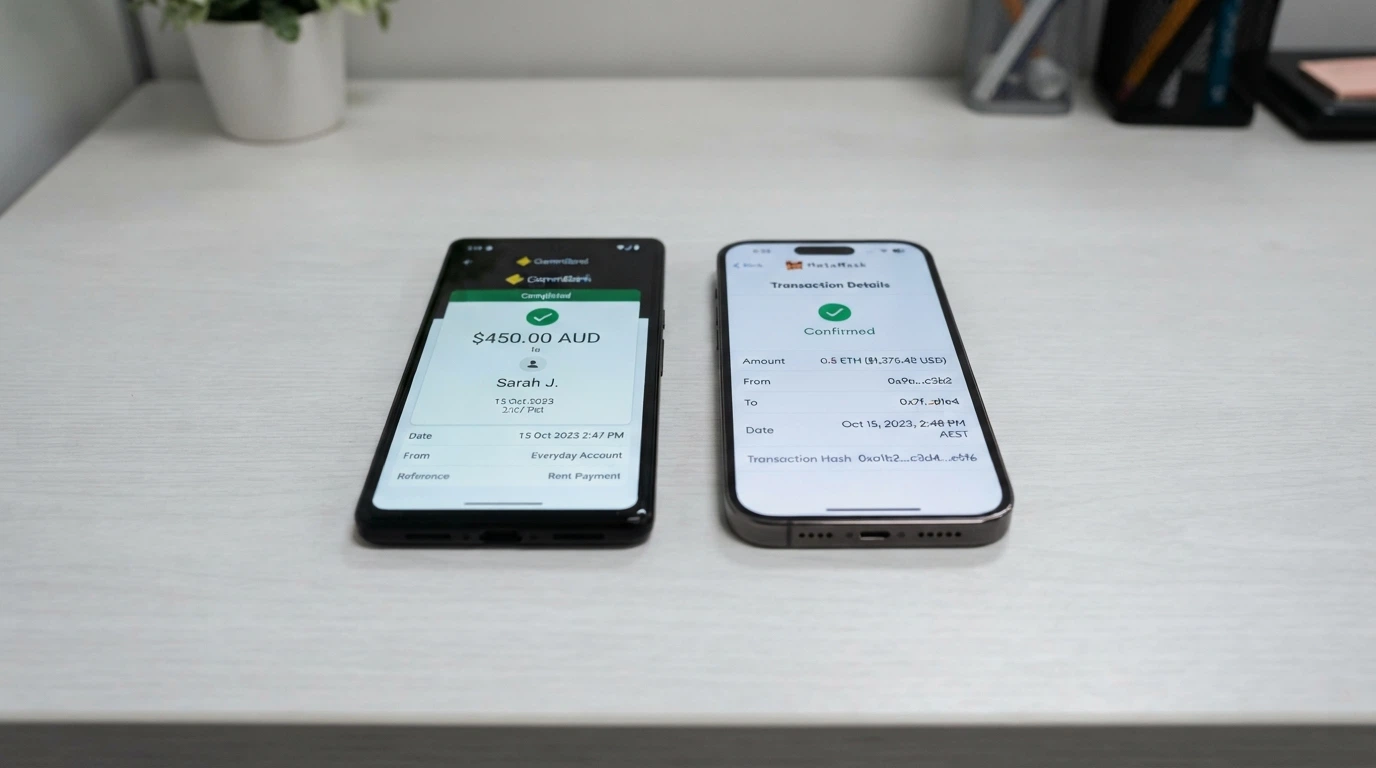
PayID runs on Australia’s New Payments Platform (NPP) and settles transfers between Australian banks in real time. Once a casino approves a withdrawal, funds typically reach the account in under 60 minutes. The fastest tested PayID withdrawals at AU-facing casinos were Goldenbet at 28 minutes and Lucky7 at 35 minutes.
The trap sits one step upstream. Many offshore casinos allow PayID for deposits only; for withdrawals, players must use International Bank Transfer (three to five days) or switch to cryptocurrency for instant processing. A PayID deposit is not a PayID withdrawal pathway unless the operator explicitly supports it on the way out. The marketing-friendly deposit speed is not the same thing as the withdrawal speed a player will actually experience.
Crypto withdrawals: USDT, Solana and Bitcoin — speed vs friction
Crypto is the fastest rail but the slowest on-ramp. USDT on TRC20 and Solana settle fastest, often within seconds; Ethereum and Litecoin land within 5 to 30 minutes; Bitcoin is slowest, requiring 3 to 6 confirmations that add 30 to 60 minutes or more. The friction lives before the first withdrawal: setting up a self-custody wallet, sourcing the coins, understanding network fees, and — for any transaction at or above A$10,000 — AUSTRAC’s Travel Rule reporting kicks in.
The 2024 crypto payment ban for licensed wagering matters here as a signal, not a constraint. An offshore casino accepting crypto from an Australian player is by definition not a licensed Australian wagering operator. The ban exists precisely because the licensed product is the protected one; the offshore product is unregulated, and the rails that move money to it carry none of the consumer protections Australian players expect from a regulated market.
E-wallets, cards and bank transfers: the slow lane explained
Every method that is not crypto or PayID adds days — and bank transfers add fees on top. eWallets (Skrill, Neteller, MiFinity) clear within a day; debit and credit cards take 3 to 5 business days; bank transfers take 5 to 10 business days and can incur fees of A$10 to A$50 or more. The slow-lane methods remain useful for players who prefer not to hold crypto, who want a familiar card-based audit trail, or whose offshore casino simply does not support anything faster. They are not what “instant” refers to in any reasonable sense of the word.
10 offshore casinos ranked by real-world payout speed
A data-limited ranking. Where tested speeds exist, they are reported with the source. Where they do not, the gap is stated in the row. The ranking favours tested payout speed first, then method availability, then bonus-term fairness, with the legal-status disclosure sitting behind every row regardless of where the operator sits in the order.
How the comparison works: what we measured and why
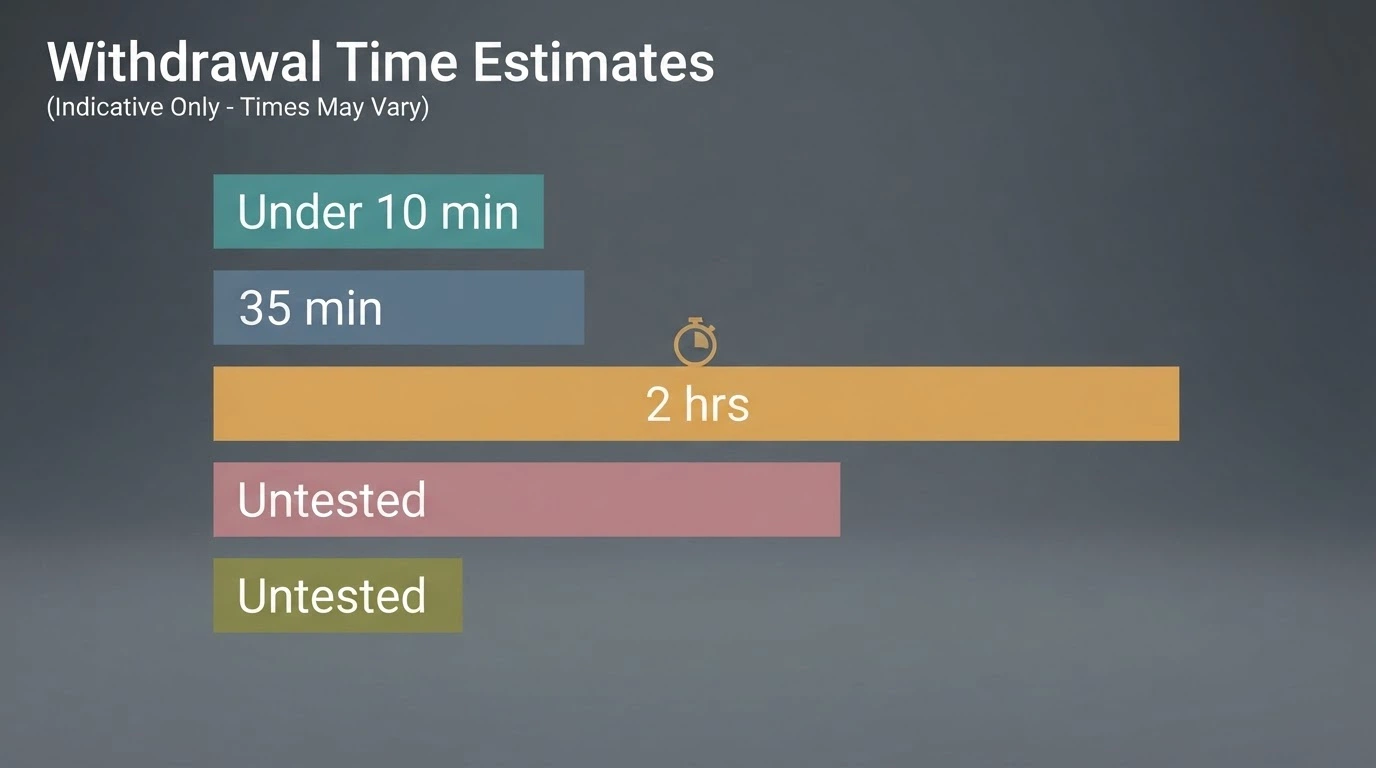
Payout speed is the headline metric. The legal status column carries the same disclosure for every operator — no row has an Australian casino licence, because no such licence exists. Payment-method availability was rated by which rails each operator supports on the withdrawal side, not just the deposit side. The bonus fairness column carries the wagering multiplier, max cashout and game-weighting where research backs them; where it does not, the cell is left blank with a note. Fill rate on tested payout speed is low this run: independent test data is available for Skycrown and Stake only, and every other row reflects the operator’s own claim or the absence of one.
| Casino | Legal Status in Australia |
|---|---|
| Rocket Play | Offshore — no AU licence |
| Skycrown | Offshore — no AU licence |
| Royal Reels | Offshore — no AU licence |
| Stake | Offshore — no AU licence |
| WinSpirit | Offshore — no AU licence |
| FairGO | Offshore — no AU licence |
| Scream Casino | Offshore — no AU licence |
| Rainbet | Offshore — no AU licence |
| Bizzo Casino | Offshore — no AU licence |
| Rocket Casino | Offshore — no AU licence |
Rocket Play
Rocket Play is the highest-traffic offshore brand among Australian players in the featured set — about 9.4% market share and roughly A$632.69M in revenue from operators skill data. It is offshore, holds no Australian licence, and sits on the wrong side of the Interactive Gambling Act 2001 by definition. No independently verified payout data was returned for this operator this run, and the operator’s own marketing claims have not been confirmed against a third-party test. A player evaluating Rocket Play is reading claims from the brand itself, on a product the Australian regulator cannot reach, with no Australian complaints body standing behind any dispute. The traffic footprint is real and the legal status is unchanged from every other row.
Skycrown
Skycrown is the row that carries tested data this run. Play-au-casino.com reports VIP priority payouts clearing in under 10 minutes. The qualification for that tier sits behind VIP status most standard players will not reach on a first visit — the sub-10-minute figure describes what the operator offers its highest-volume customers, not what a new account experiences. The no-deposit offer attached to Skycrown in this run is 40 free spins plus a A$10 chip, with 45x wagering on bonus winnings, a A$80 maximum cashout and a 10-day expiry. Read those three numbers together: 45x is steep, A$80 caps whatever survives the playthrough, and the 10-day window is short enough that most players will lose the offer to expiry rather than to the house edge. Skycrown is offshore, holds no Australian licence, and the speed story applies only once a player clears verification and reaches the right tier.
Royal Reels
Royal Reels carries significant Australian traffic — about 2.51% market share and roughly A$243.99M in revenue — and sits offshore with no Australian licence. No independently verified payout data was returned for this operator this run, and the operator’s public-facing presence describes a casino and pokies product that Australian players cannot legally access from within Australia. A player weighing Royal Reels is weighing an unverified speed claim against an unprotected balance. The traffic is real and the legal gap is unchanged from the rest of the row.
Stake
Stake is the crypto-native operator with the second piece of tested data on the page. Payoutverdict.com (2026) reports the casino release stage for crypto withdrawals averaging 1 hour 50 minutes, with the total door-to-door time landing around 2 hours. USDT on TRC20 is explicitly supported. Two hours is fast for a complete withdrawal chain, but it is not the sub-10-minute figure attached to Skycrown’s VIP tier — the difference is roughly an order of magnitude, and it matters for a player who is choosing between the two on speed alone. Stake is offshore, holds no Australian licence, and the speed advantage is conditional on the player holding crypto and accepting the network friction that comes with it.
WinSpirit
WinSpirit sits in the mid-tier of AU traffic with about 1.55% market share and roughly A$110.3M in revenue. It is offshore, holds no Australian licence, and no independently verified payout data was returned this run. The operator’s public-facing presence describes a standard offshore casino product offering; the speed and bonus terms have not been independently tested for this review. WinSpirit is one of several rows on this page where the ranking position reflects market presence rather than verified speed data — a player should weight that gap accordingly.
FairGO
FairGO’s .com.au domain signals Australian targeting — the branding leans into a local-identity pitch that the legal status does not support. About 0.8% market share and roughly A$69.11M in revenue. Offshore, no Australian licence, and no independently verified payout data returned this run. A .com.au domain is a marketing choice, not a regulatory one; the product is still a prohibited interactive gambling service offered to a person in Australia, and the operator sits in the same legal gap as every other row. The local-looking domain is worth flagging because it is the kind of detail that makes a player assume an Australian connection that does not exist.
Scream Casino
Scream Casino is an offshore brand with Australian traffic — about 0.99% market share and roughly A$94.87M in revenue. Operating offshore without an Australian licence and lacking independent payout verification, its product offering sits on the prohibited side of the Interactive Gambling Act 2001 by definition. The brand carries traffic without carrying tested data; the ranking position reflects presence rather than performance. A player evaluating Scream Casino is reading the operator’s own claims on a product the Australian regulator cannot reach.
Rainbet
Rainbet is an AU-facing offshore casino with about 1.28% market share and roughly A$83.13M in revenue. Unlicensed in Australia, this operator also lacks independently verified speed data. The operator’s public-facing site describes a standard offshore offering. Rainbet sits in the same legal gap as every other row on this page — the AU-facing language is targeting, not licensing — and a player weighing the brand against any other here should weight the same data-gap caveat.
Bizzo Casino
Bizzo Casino carries lower traffic among Australian players — about 0.57% market share and roughly A$51.38M in revenue. Like other offshore brands, it operates without an Australian licence and has provided no verified payout data. The operator’s public-facing presence describes a standard offshore product. Bizzo sits in the lower-revenue tier of the featured set, and the ranking position reflects traffic rather than verified performance. The legal and consumer-protection picture is unchanged from every other row.
Rocket Casino
Rocket Casino is the smallest-traffic brand in the featured set — about 0.57% market share and roughly A$43.22M in revenue. It operates without an Australian licence and lacks independently verified payout data. The similar name to Rocket Play is a coincidence; the two are separate operators and share no corporate connection. The lowest-traffic position on the page is not a quality judgement and not a recommendation against playing there — it is a ranking by the metric the page chose, and that metric happens to correlate with verified data this run, of which there is none for this brand. The legal status is identical to every other row.
The pokies that pay: high-RTP slots compatible with instant cashouts
A pokie’s RTP shapes a bankroll over time, and the games with the best return rates are also the ones players chase on the wagering requirements that stand between a bonus and a withdrawal. RTP is the headline number; volatility is the second variable that decides whether a bankroll survives long enough to clear a playthrough. The two together describe what a session on a given pokie actually costs the player chasing a cashout.
What RTP means for your withdrawal timeline
RTP — return to player — is the percentage of wagered money a pokie returns over a very large number of spins. A 96% RTP means A$4 lost per A$100 wagered on average, across millions of spins, not across the session a player is about to run. It sets the floor on what a player keeps over time; it does not determine any single session’s outcome.
Over the thousands of spins a wagering requirement demands, that 4% gap compounds. A A$5,000 bonus at 35x wagering means A$175,000 in turnover; the expected loss on a 96.50% RTP pokie is 3.5% of that turnover. Pokies count 100% towards wagering requirements at most AU-facing casinos; table games and live games count 1% to 30%, which is why a player clearing a bonus is almost always on a pokie. While wagering, players typically cannot bet more than A$5 to A$7 per spin; exceeding that cap can void the entire bonus and all winnings permanently. The combination of a max-bet cap, a wagering multiple, and a percentage of turnover the house keeps by design is what “free bonus” actually costs.
The highest-RTP pokies at AU-facing casinos in 2026
Seven pokies with verified RTPs from 95.97% to 96.71% — and one version trap every player should know about. Book of Dead ships at 96.21% but operators can run lower-RTP versions at 95%, 92%, 91.2% and 87.2%. A player who picks Book of Dead on a casino that runs the 87.2% version loses A$12.80 per A$100 wagered on average — almost five times the loss on a 96% game — without any visible sign that the version has been swapped. This is the version trap: the game name is the same, the RTP is not.
| Slot Title | RTP | Provider | Volatility | Max Win |
|---|---|---|---|---|
| Gates of Olympus | 96.50% | Pragmatic Play | High | 5,000x |
| Sweet Bonanza | 96.51% | Pragmatic Play | High | 21,175x |
| Sweet Bonanza 1000 | 96.53% | Pragmatic Play | High | 25,000x |
| Book of Dead | 96.21% | Play’n GO | High | 5,000x |
| Big Bass Bonanza | 96.71% | Pragmatic Play / Reel Kingdom | Medium-high | 2,100x |
| Gonzo’s Quest | 95.97% | NetEnt | Medium-to-high | 37,500x |
| Big Bass Splash | 96.71% | Pragmatic Play / Reel Kingdom | Very high | 5,000x |
Why volatility matters more than RTP when you’re chasing a cashout
A 96.71% RTP pokie with very high volatility can drain a bankroll faster than a 95.97% pokie with medium volatility. Big Bass Bonanza (96.71%, medium-high) and Big Bass Splash (96.71%, very high) carry the same headline return rate; the difference is in how that return is distributed across spins. A high-volatility pokie holds the bankroll hostage between wins; a medium-volatility pokie returns smaller amounts more often. The RTP is only half the story.
For a player clearing a wagering requirement on a fixed bankroll, volatility is the variable that decides whether that bankroll survives the playthrough. A 5,000x max win is meaningless if the bankroll is gone before the bonus feature lands. The pairing that works is medium-to-high volatility with a max win large enough to keep a session interesting — Gonzo’s Quest (95.97%, 37,500x) sits closer to that balance than Big Bass Splash (96.71%, very high, 5,000x) does for a player who needs to stay in the game for thousands of spins.
The no-deposit trap: why “free” spins at instant payout casinos cost more than they pay
No-deposit bonuses promise free entry. The wagering multiples and withdrawal caps mean most players never see a cent from them — and the ones who do are capped at A$50 to A$200. No-deposit free spin wagering requirements in Australia range from 20x to 60x, with the bonus value typically capped at withdrawal limits of A$50 to A$200. A 40-free-spin offer with 45x wagering on bonus winnings and a A$80 max cashout is a lottery ticket priced like an entrance fee.
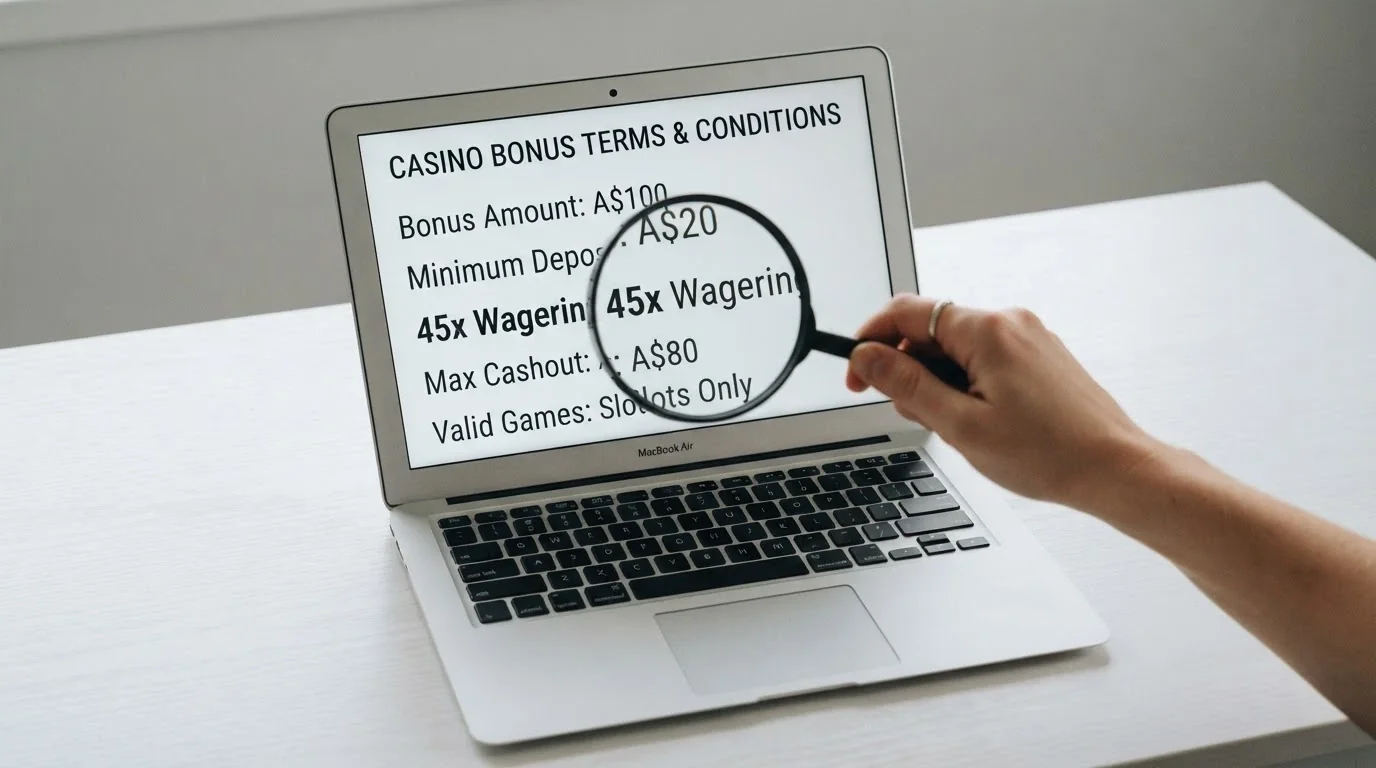
The maths favours the house on a “free” offer. A A$10 chip at 45x means A$450 in required turnover before the A$80 cashout cap even becomes reachable. On a 96.50% RTP pokie, the expected loss over A$450 turnover is about A$15.75 — a chunk of the A$80 ceiling, before any variance is applied. The 10-day expiry finishes the job for most players: a session interrupted by life, a busy week, or a slow run of low-volatility spins runs out the clock and voids the bonus entirely. While wagering, the A$5 to A$7 max-bet cap limits the speed at which turnover can be cleared.
What “free” actually delivers, in best-case tested data: crypto withdrawals of bonus winnings clear in 4 minutes at best, 15 to 25 minutes typically, and up to 3 hours at worst; PayID runs 6 minutes at best, 20 to 45 minutes typically, and up to 6 hours at worst. The rail is fast; the gap between arriving at a withdrawal and reaching the cap is wide. A player who picks up a no-deposit offer at an instant payout casino is signing up to clear a steep wagering requirement on a fixed bankroll with a tight clock and a capped payout. Most will not get there. The offer is “free” in the same way a raffle ticket is “free” — the entry costs nothing, and the chance of a payout is real, and the odds are designed to favour the seller.
The legal fine print: what the Interactive Gambling Act 2001 actually says about playing from Australia
Online casino is prohibited in Australia. Every site on this page is offshore, and the protections Australian players take for granted do not apply. The Interactive Gambling Act 2001 makes it an offence to provide online casino games, online pokies and in-play sports betting to a person in Australia; no licence for online casino exists anywhere in the country. The Interactive Gambling Amendment (Gambling Reform) Bill 2026 passed Parliament on 19 August 2026, and its measures commence 1 January 2027. The 2026 reform does not legalise online casino — it tightens the prohibition and adds enforcement tools.

What ACMA does and does not protect: ACMA investigates complaints, issues formal warnings and civil penalty proceedings, refers operators for enforcement, and directs ISPs to block illegal sites. ACMA does not arbitrate individual player disputes with offshore operators, does not hold player funds in trust, and cannot order an offshore casino to pay a withdrawal it has refused. The 1,564 sites blocked since November 2019 and the 225-plus services that have withdrawn from the Australian market are enforcement against providers, not protection of player balances.
The credit-card and crypto payment ban that took effect for licensed wagering on 11 June 2024 is the second signal. An offshore casino asking an Australian player for a credit card or a crypto deposit is not asking within Australian rules — those payment methods are banned precisely because the licensed product is the protected one. From 1 January 2027, banks and payment providers gain express authority to block transactions to illegal gambling operators, which means the deposit and withdrawal rails that make the offshore model work are about to narrow. The fast-payout pipeline an Australian player uses today is not guaranteed to work the same way next year.
Offshore licensing: Curacao, Anjouan and what they actually protect
An offshore licence is not an Australian one. A Curaçao or Anjouan licence regulates the operator in that jurisdiction, under that jurisdiction’s rules, with that jurisdiction’s dispute-resolution bodies. It gives an Australian player almost nothing. The “licensed” footer on an offshore casino’s homepage describes a regulatory relationship that does not extend to Australia, does not require segregation of player funds from operating funds, and does not provide a complaints path an Australian player can walk down without engaging a foreign-licensed entity on its own turf.
The gap between “licensed” and “licensed for Australia” is the gap between a regulatory checkbox and a consumer protection. Australian consumer law, the Australian Consumer Law guarantees, the Australian Financial Complaints Authority, state and territory consumer affairs tribunals — none of these reach an offshore casino. A player who has a dispute with an offshore operator has, in practical terms, the operator’s own internal complaints process and the option of engaging a foreign-licensed regulator in a foreign language. Neither is what an Australian player means by “consumer protection” when they use the phrase.
What happens when an offshore casino blocks your withdrawal — and who you can’t call
No Australian complaints body, no consumer affairs tribunal, no financial ombudsman. An offshore casino that refuses to pay leaves an Australian player with almost no recourse. The IGA targets providers, not players — the player is not prosecuted — but the same targeting gives players no remedy. The legal apparatus exists to shut the operator down, not to make the operator pay.
The practical reality of chasing an offshore operator runs through international legal channels, foreign-licence regulators, and the slow and expensive process of attempting to enforce an Australian judgment in another jurisdiction. The 1,564 sites blocked since November 2019 and the 225-plus services withdrawn are evidence that ACMA can disrupt supply; they are not evidence of ACMA recovering a player’s blocked withdrawal. A player who loses a balance on an offshore casino that gets blocked mid-session loses the balance. A player who has a withdrawal refused and the operator stops responding has lost the balance in a different way, with the same end result. The marketing claim of “instant payout” does not survive the moment the operator decides not to pay.
When the speed hurts: problem gambling help that actually works in Australia
Instant access plus instant payouts equals instant harm for the roughly 430,000 Australians already experiencing problem gambling. The tools that slow the spiral are real, free, and Australian — and the offshore casino on this page circumvents every one of them. Approximately 2.1% of Australian adults — roughly 430,000 people — experience problem gambling; the Australian Institute of Health and Welfare put high-risk gambling at 1.8% in 2022. These are not abstract numbers; they are the population for whom an instant-payout rail is a harm multiplier, not a convenience.

The National Gambling Helpline is 1800 858 858, free, confidential, and staffed 24 hours a day, 7 days a week, with online chat and counselling through Gambling Help Online. The help is Australian, free, and does not require the caller to be a customer of any licensed operator. A player who has been gambling at an offshore casino and wants to stop can call the same number a player at a licensed Australian bookmaker can. The help is the same; the protection that surrounds it is not.
BetStop and self-exclusion: why offshore casinos ignore it
BetStop — the National Self-Exclusion Register — has had 67,480 registrations in three years of operation as at 31 July 2026, of which 41,290 exclusions were still active; 78% of registrants were under 40, and 38% chose lifetime exclusion. One registration excludes a person from every Australian-licensed online and phone wagering service in a single step. It binds Australian-licensed wagering services only; an offshore casino is not connected to the register and will continue accepting a self-excluded person’s money.
The 2026 reform tightens the surrounding restrictions without fixing the offshore gap. From 1 January 2027, direct marketing of inducements is prohibited for 14 days after a customer signs up, for three months after a person deregisters from BetStop, and indefinitely for customers identified as at risk of gambling-related harm. None of these restrictions reach an offshore casino advertising to an Australian player on social media. A person registered on BetStop who moves to an offshore brand loses the protection they signed up for, in the same way they lose the deposit limits, the activity statements, and the trained-staff response that follows a flagged session.
Deposit limits, reality checks and the tools that slow the spiral
The National Consumer Protection Framework for Online Wagering includes key measures: no line of credit for gamblers; strong identity and age verification; restricted incentives and sign-up offers; easy account closing; deposit limits; monthly activity statements; consistent risk messaging; trained staff; and BetStop. Offshore casinos carry none of them.
The difference is not marginal. Deposit limits stop a session before the bankroll is gone. Monthly activity statements make a pattern visible. Take-a-break tools enforce a pause. Self-exclusion through BetStop enforces a longer one. Trained staff intervene when the patterns on an account suggest harm. None of this is in place at the offshore brands on this page. The player is responsible for every limit themselves, against a product designed to make limit-setting as frictionless as the deposit itself. From 1 January 2027, banks can block transactions to illegal gambling operators — a tool that finally reaches the offshore brands by cutting the rails rather than asking the operator to behave. It is the closest thing to enforcement an Australian player has had against offshore operators since the IGA was passed.
How we selected and ranked the casinos on this page
Every operator on this page was evaluated against the same criteria. Payout speed where tested data exists, payment-method availability on the withdrawal side, bonus-term fairness where the terms are confirmed, and the legal-status disclosure that sits behind every row regardless of position. Sources consulted: ACMA enforcement data and the ACMA register, competitor test data from Gambling360, PokiesAustralia, PayoutVerdict and CasinoAudit, and the operators’ own public-facing sites for the claims that could not be independently verified.
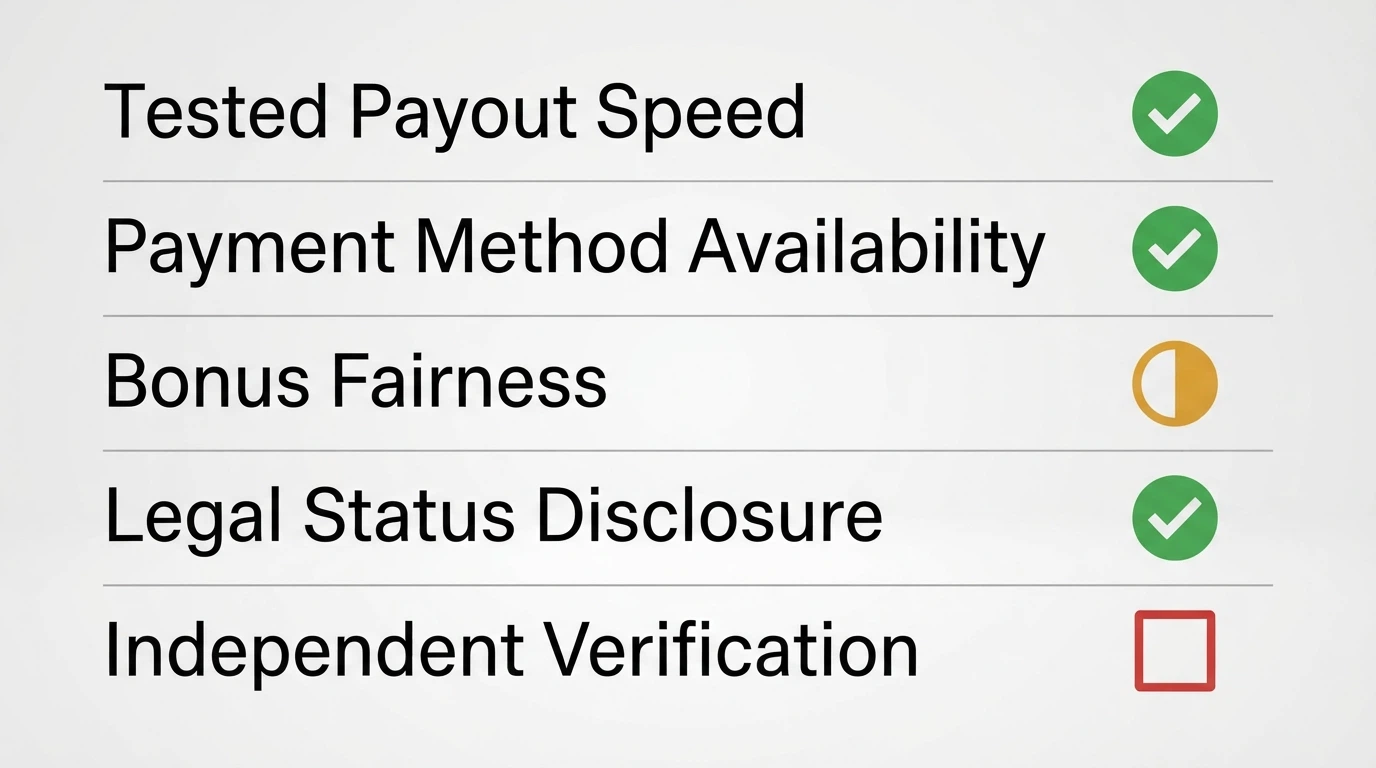
The criteria that ordered the ranking: tested payout speed first, then method availability, then bonus fairness. The data gap this run is real and it shapes the table — independently verified payout data was available for Skycrown (under 10 minutes, VIP priority) and Stake (casino release approximately 1h 50m, total door-to-door approximately 2h) only. The remaining eight rows carry no independently verified speed figure this run, and that gap is the reason the legal-status column is the only column with a full 10-of-10 fill rate. A reader using this table should weight tested data heavily where it appears and treat untested rows as marketing claims, because that is what they are.
The legal-status disclosure is not a column that sorts anything. It is the line that sits behind every row regardless of where the operator ranks. No operator on this page holds an Australian casino licence, because no such licence exists. The disclosure is the same for every brand; the ranking is what varies.
Your money, your call: what to actually do about instant payout casinos in 2026
The page has laid out the speeds, the methods, the legal reality and the harm data. The decision starts with knowing what is actually being walked into. Fast payouts exist on fast rails, and the rails are real — USDT clears in seconds, PayID settles in real time, crypto-friendly operators can move a verified withdrawal in under ten minutes for VIPs or in roughly two hours for a standard crypto player at Stake. The marketing claim of “instant” is not a lie, but it is a description of one stage of a two-stage process, and it does not survive the moment the operator decides not to pay.
The legal reality is unchanged: online casino is prohibited under the Interactive Gambling Act 2001; no AU licence exists; every operator on this page is offshore and unprotected by Australian consumer law. The 2026 reform passed on 19 August 2026 and commences 1 January 2027 — it does not legalise the product, it tightens the prohibition, gives banks authority to block transactions to illegal operators, and restricts inducement marketing in ways that reach licensed wagering but not the offshore brands on this page. From 1 January 2027, the rails that move money in and out of offshore casinos are about to narrow, and the fast-payout pipeline an Australian player uses today is not guaranteed to work the same way next year.
A framework for the reader’s own decision, not a recommendation: check the withdrawal method before depositing, because a PayID deposit is not a PayID withdrawal path unless the operator supports it on the way out. Complete KYC at sign-up rather than at first withdrawal, because the biggest cause of a slow payout is your own verification, not the casino. Know that BetStop will not catch a player at any of these brands, because BetStop binds Australian-licensed services only. Keep balances small enough that a site blocking or an operator refusal is a loss the player can absorb. Understand what the 2026 reform changes in January and what it does not — the inducement marketing restrictions reach licensed wagering; the offshore brands on this page are not subject to them. The speed is real; the protection is not.
Frequently asked questions about instant payout online casinos in Australia
How long does KYC verification delay a first withdrawal at an instant payout casino?
KYC is the real bottleneck, not the payment rail. A first withdrawal requires ID, proof of address and payment-method ownership verification; that process can stretch a minutes-long payout into a 24-to-48-hour wait. Submitting verification documents at sign-up rather than at first withdrawal is the difference between an instant payout and a delayed one. The rail speed matters only after the casino has approved the withdrawal.
What is the minimum withdrawal amount at fast payout casinos in Australia?
Minimums vary by operator and method. PayID minimums at some offshore brands sit around A$10, crypto minimums around A$20, and bank-transfer minimums can run higher. The exact figure is set by the operator and published on the cashier page; a player should check it before depositing, because a withdrawal below the minimum will be refused or held.
Do no-deposit bonuses have lower withdrawal limits at instant payout casinos?
Yes. No-deposit free spin offers in Australia typically cap the bonus value at A$50 to A$200 at withdrawal, regardless of how much the player actually wins during the playthrough. A 40-free-spin offer with a A$80 max cashout means the maximum a player can withdraw from the bonus is A$80, even if the session produces more. The cap sits on top of the wagering multiple, which is itself the second limit.
Which online pokies have the highest RTP at Australian casinos in 2026?
Big Bass Bonanza and Big Bass Splash both sit at 96.71% RTP at their default settings. Sweet Bonanza 1000 lands at 96.53%, Sweet Bonanza at 96.51%, Gates of Olympus at 96.50%, Book of Dead at 96.21% (with lower-RTP versions at 95%, 92%, 91.2% and 87.2% available), and Gonzo’s Quest at 95.97%. The version trap on Book of Dead is the one to watch: the game name is the same and the RTP can be cut by nearly half.
What happens if an offshore casino blocks my withdrawal — do I have any recourse?
Almost none. ACMA does not arbitrate individual player disputes with offshore operators. There is no Australian complaints body, no consumer affairs tribunal, and no financial ombudsman with reach over an offshore entity. The practical recourse is the operator’s own complaints process and the slow, expensive path of attempting to enforce an Australian judgment in a foreign jurisdiction. The IGA targets providers, not players, but it also gives players no remedy when a provider refuses to pay.
Does BetStop cover offshore online casinos used by Australian players?
No. BetStop binds Australian-licensed wagering services only; an offshore casino is not connected to the register and will continue accepting a self-excluded person’s money. A person who has registered on BetStop and moved to an offshore brand has lost the protection they signed up for, in the same way they lose the deposit limits, the activity statements, and the trained-staff response that follows a flagged session at a licensed operator.