
The Offshore Pokies Sites That Deliver the Highest Payouts in 2026
3 November 2026 data, verified against ACMA enforcement records and operator terms.

No licensed online pokie exists in Australia. Every site an Australian can actually play on is offshore, run from Curaçao or another international jurisdiction, and operated by a company that the Australian Communications and Media Authority has tried at some point to block. The page that follows is not a guide to a legal market, because there is no legal market to guide readers through. It is a guide to the market that grew in the gap the Interactive Gambling Act 2001 left behind, and a clear account of what that gap costs the person depositing into it.
The ten operators below are ranked by three things a reader can act on: how many high-RTP pokies the site actually carries, how transparent its bonus terms are, and what its payout record shows in the data we have. Where research carries a bonus figure, a wagering multiple and a licence holder, the operator is in the top half. Where research carries only a market-share figure and a name, the operator sits lower, and the write-up explains what the absence of detail means for anyone thinking of depositing there. The table below maps the same ten operators in two columns that matter most: licence status, and the providers behind the games. Every featured brand is offshore; the column exists to make the uniform prohibition visible at a glance.
| Operator | AU licence status | Game providers |
|---|---|---|
| Skycrown | No AU licence (offshore, Curaçao) | Pragmatic Play, NetEnt, BTG, Play’n GO, Evolution, IGTech, Booongo, Voltent, 7,000+ titles |
| Royal Reels | No AU licence (offshore, Curaçao — Digibrite S.R.L.) | — |
| Rocket Play | No AU licence (offshore) | BGaming, Pragmatic Play |
| WinSpirit | No AU licence (offshore since 2023) | Evolution, Pragmatic Play, 2,500+ games |
| Stake | No AU licence (offshore, Curaçao) | Pragmatic Play, Evolution, Hacksaw, Nolimit City, Push Gaming |
| Rainbet | No AU licence (offshore) | — |
| Scream Casino | No AU licence (offshore) | — |
| FairGO | No AU licence (offshore) | RealTime Gaming (RTG) |
| Bizzo Casino | No AU licence (offshore) | — |
| Rocket Casino | No AU licence (offshore) | — |
The em-dash cells above are not errors of research. They are the research itself. Five of the ten brands carry a confirmed provider line; the other five do not, and that absence is information a reader needs before signing up anywhere. Where a site does not publicly state who builds the games it hosts, the games themselves are unverifiable, and unverifiable games cannot be checked for RTP, volatility, or whether the random number generator behind them has ever been independently audited. The casino that will not name its providers is asking the reader to trust it on the very thing the reader cannot check.
Three of the ten — Skycrown, Royal Reels and Stake — sit at the top because their licence holder, provider list, and bonus terms are independently confirmable. The remaining seven drop down the table in proportion to what their public record actually carries, and the write-up below names, for each one, what the data gap means for a player ranking them against the others.
- Skycrown: 450% Match and the Biggest Bonus Pool on This List
- Royal Reels: The Only Operator Here With a No-Deposit Free Chip
- Rocket Play: Daily Free Spins and a Structured Welcome Path
- WinSpirit: A 200% Second-Deposit Match That Doubles Your Bankroll
- Stake: Crypto-Only Pokies With No Traditional Welcome Bonus
- Rainbet: Limited Public Data but a Growing AU Presence
- Scream Casino: Newer Entrant With Minimal Verified Detail
- FairGO: RTG-Powered Pokies With an Australian Focus
- Bizzo Casino: Modest AU Reach With Sparse Public Terms
- Rocket Casino: Small AU Footprint With Unverified Bonus Terms
- Every High-RTP Pokie Worth Your Time — and the One Stat That Changes Everything
- Pokies vs Slots: What Australian Players Need to Know About the Terminology
- Where Australian Online Pokies Sit in the Global Market
- Online Pokies for Real Money: How the Stakes Change Everything
- No-Deposit Pokies Offers: What They Are and Which Operators Actually Have One
- RTP, Volatility and Why Your Favourite Pokie Keeps Less Than You Think
- How a Slot Machine’s RTP Is Actually Calculated
- Progressive Jackpots and Their Real Odds
- Which Game Providers Build the Highest-Paying Pokies
- What “Real Money” Pokies Actually Cost You
- Free-Play Mode vs Real-Money Spins: What the Demo Does Not Show
- How Fast Offshore Pokies Sites Really Pay: Tested Times and the Payment Methods That Matter
- What Slows Down a Pokies Payout — and How to Speed It Up
- What Australian Players Lose When They Play Offshore
- Payment Methods Under the Microscope: PayID, Crypto and the Credit Card Ban
- Online Pokies and Australian Law: No Grey Zone, No Licence, No Exceptions
- ACMA Enforcement: Blocking, Fines and the 2026 Reform Bill
- Player-Protection: What the Law Does — and Does Not — Cover
- When the Spins Stop: Responsible Gambling Help That Actually Works
- BetStop and the Offshore Blind Spot
- Deposit Limits, Reality Checks and the Tools Offshore Sites Rarely Offer
- How We Picked and Ranked Every Site on This Page
- Your 2026 Pokies Playbook: What to Actually Do With Everything You Just Read
- Frequently Asked Questions
Skycrown: 450% Match and the Biggest Bonus Pool on This List
Skycrown’s welcome package runs 450% up to A$8,000 plus 400 free spins across four deposits, with 40x wagering on the bonus and 30x on free spin winnings, and a 14-day validity on each deposit tier. The headline figure is the largest on this list, and that is the first thing a reader should notice about it, because the wagering number is what determines whether the bonus is worth anything. A$8,000 at 40x means a player must wager A$320,000 before any of it converts to withdrawable cash. Even spread across four deposits, that is a sum the house edge will steadily eat through, and the 14-day window per tier is the second pressure point: the bonus does not wait, and a player who moves slowly loses whatever the wagering has not already converted.

The game library is the genuine counter-weight. Skycrown runs over 7,000 pokie titles across Pragmatic Play, NetEnt, Big Time Gaming, Play’n GO, Evolution, IGTech, Booongo and Voltent, which gives a serious RTP hunter the depth to filter for the titles covered in the table further down. The free spins are split across four games — 125 on Wolf Treasure, 75 on Coin Volcano, 50 on 15 Dragon Pearls, and 150 on Mighty Wild: Panther Grand Diamond Edition — and that spread is more useful than a single big batch on one title, because the player can compare volatility and pacing across games before committing real bankroll.
The no-wagering 10% weekly cashback up to A$500, credited every Monday, is the genuine safety net on the page. Cashback with no wagering attached is rare among offshore operators, and it gives a player who has lost on the welcome package a real second chance without another 40x playthrough. A reader should treat it as a reason to play at Skycrown rather than as a reason to chase losses there.
The licence is Curaçao offshore — not Australian, not enforceable in Australia. A player who disputes a withdrawal or feels the bonus terms have been applied unfairly has no Australian regulator to complain to and no Australian court that can compel payment. The site’s licence holder is overseas, and the recourse that exists is the operator’s own dispute process, then whatever the Curaçao regulator will do, which is slow and inconsistent.
For a player with a large bankroll, a willingness to clear a 40x playthrough, and an interest in RTP hunting across a deep library, Skycrown is the most generous offer on this list. For everyone else, the cashback is the better reason to be there.
Royal Reels: The Only Operator Here With a No-Deposit Free Chip
Royal Reels is the only featured operator that lets a player try the site before depositing. The A$10 no-deposit free chip comes with 30x wagering and a maximum cashout cap shown at activation, which means a player can run a small session on the house, keep whatever survives the playthrough, and decide whether to put real money in afterwards. That is the standard structure for a no-deposit offer, and on this list it is unique.
The welcome package, once a player does deposit, runs A$2,500 plus 50 free spins across three deposits — 100% up to A$500 on the first, 75% up to A$750 on the second, and 100% up to A$1,250 on the third — with 35x wagering on the bonus only. The wagering is lower than Skycrown’s 40x, which makes the welcome package materially easier to clear, and the A$5 per-spin cap during wagering is a workable limit for most titles. The free spins are 50 in total at A$0.20 per spin on a featured pokie, which is a small batch compared to the 400 Skycrown offers but a cleaner one, because the per-spin value is fixed and visible upfront.
The licence is Curaçao, held by Digibrite S.R.L., which is verifiable. That is not the same as trustworthy — no Curaçao licence carries the weight of a UK Gambling Commission licence — but it is the difference between a regulator that has a name attached to it and a regulator the site has not even bothered to disclose. Royal Reels discloses the holder, and the holder is a real company.
The honest read is that Royal Reels is the entry point on this list. The A$10 chip is the cheapest possible way to find out whether a player likes the lobby, and the welcome package is the cleanest mid-tier offer in the featured set. The cap on cashout from the no-deposit chip is a real limit, but no-deposit offers are not free money — they are a way to test a site at no cost, and Royal Reels offers the test.
Rocket Play: Daily Free Spins and a Structured Welcome Path
Rocket Play’s welcome package is up to A$2,000 in matched deposits plus 100 free spins, with the free spins released in a staggered pattern: 20 credited immediately, then 20 each day for four days, totalling 100. The structure is unusual and worth noting, because the four-day drip turns a single big batch into something closer to a small daily session, which is a better match for how most players actually gamble.
The wagering is 40x on the bonus, the maximum win is A$5,000, the maximum bet during bonus is A$7.50, and the expiry is 5 days. That combination is tight. Five days is a short window to clear a 40x playthrough, and the A$7.50 bet cap means a player cannot speed the wagering up by staking more on a single spin. The free spins themselves are on Aztec Magic by BGaming, with winnings capped at A$300 and a 5-day validity — a small enough cap that it materially caps the value of the spin batch.
The game library is led by BGaming and Pragmatic Play, which is a narrower provider line than Skycrown’s eight studios but covers most of the high-RTP titles Australians actually look for. Pragmatic Play alone supplies Big Bass Bonanza, Sweet Bonanza, Gates of Olympus and Wolf Gold from the table below, which is a meaningful share of the high-RTP mid-96% range.
Rocket Play suits a player who wants a clear daily routine during the welcome window and is comfortable with the 5-day pressure. The package is not the largest on this list, but the staggered free spins are a genuine product design choice that the bigger offers do not make.
WinSpirit: A 200% Second-Deposit Match That Doubles Your Bankroll
WinSpirit’s welcome package is split across two deposits: 100% up to A$1,000 on the first, then 200% up to A$1,000 on the second, totalling A$2,000 plus 100 free spins on Elvis Frog in Vegas at A$0.20 per spin. The 200% second-deposit match is the only one of its kind in the featured set, and it is genuinely a doubled bankroll at the moment the second deposit lands. Wagering is 40x on both the bonus and the free spin winnings, the maximum combined win is A$3,000, the maximum bet during bonus is A$7.50, and the validity is 5 days.
The 5-day window is the binding constraint. 40x on a A$1,000 bonus is A$40,000 of wagering, and doing that inside five days at a A$7.50 max bet is a sustained session that most casual players will not run. The exclusion list is the other detail to read carefully: Blood Suckers and Book of 99 are excluded, which removes the two highest-RTP slots on this page from the games that count toward wagering. That exclusion is not unique to WinSpirit, but it lands harder here because those are exactly the titles a player chasing the highest RTP would otherwise choose.
The game library is around 2,500 titles from Evolution, Pragmatic Play, and others, which is solid for a mid-tier operator. The brand has operated offshore since 2023, which is recent enough to count against it in a market where long operator track records are the norm rather than the exception.
WinSpirit is worth considering for the second-deposit match alone, and that match is the single reason to put it ahead of an operator with a smaller but more generous welcome package. A player who can clear 40x in five days and does not intend to play the excluded games is the audience here. For everyone else, the 5-day window makes the offer harder to clear than its A$2,000 headline suggests.
Stake: Crypto-Only Pokies With No Traditional Welcome Bonus
Stake is the only operator in the featured set that runs a pure crypto model, and that decision is the first thing a player needs to understand. There is no matched-deposit welcome offer, no free spins on sign-up, and no first-deposit bonus. What Stake offers instead is a rakeback and VIP structure that pays back a percentage of play over time, and the AU market share figure of 1.28% suggests enough Australian players have decided that model suits them.
The provider line is the genuine strength. Pragmatic Play, Evolution, Hacksaw Gaming, Nolimit City, and Push Gaming between them cover the bulk of the high-RTP titles Australians search for, and Push Gaming’s average RTP of 96.15% across its catalogue is one of the three provider averages worth knowing. The Hacksaw and Nolimit City additions also matter for players who want higher-volatility titles with max wins well into the six-figure multiplier range — Money Train 3 and Dead or Alive 2 both fit the catalogue.
The trade-off is the absence of a traditional welcome bonus at a time when the other nine featured operators are offering one. A player who values the matched-deposit model and is comfortable paying in fiat is better served elsewhere. A player who already holds crypto, is happy to deposit in Bitcoin or Ethereum, and prefers a rakeback structure that does not carry wagering is the audience Stake is built for.
The 1.28% AU market share, identical to Rainbet, is worth noting because it shows that two very different operator models — Stake’s crypto and rakeback, Rainbet’s thin public record — are pulling similar Australian traffic. The two sites are not interchangeable; what they share is a market position that puts each of them ahead of the four operators below them on this list.
Rainbet: Limited Public Data but a Growing AU Presence
Rainbet holds 1.28% AU market share and almost no independently confirmed bonus, provider, or licence data. The number itself is a real signal — it puts Rainbet level with Stake among Australian players — but the absence of detail on what the site actually offers means a reader is being asked to evaluate a brand on a single data point, and a single data point is not a basis for a deposit.
What the gap means in practice is that a player considering Rainbet cannot confirm the wagering multiple, the maximum cashout, the free-spin terms, the licence holder, or the game providers before signing up. Each of those is a term that determines what the site is actually worth, and each is the kind of detail a serious operator publishes on its terms page before the first deposit. The lack of confirmation is not proof of a bad site, but it is proof that the site does not make its offer verifiable, and a reader comparing Rainbet to the five operators above it is comparing confirmed terms against silence.
The honest position is to rank Rainbet below every operator that publishes its terms and above every operator that does not even carry a market share figure. A 1.28% AU presence suggests Australians are playing there, but the play is happening on terms the public record does not currently show.
Scream Casino: Newer Entrant With Minimal Verified Detail
Scream Casino holds 0.99% AU market share with no independently confirmed bonus, provider, or licence detail. It sits one notch below Rainbet because the market share is one notch smaller, and for the same reason — a single data point is not enough to rank an operator above one that publishes its terms.
A player considering Scream Casino should verify three things before depositing: who holds the licence, who builds the games, and what the bonus terms actually say. Each is on the operator’s terms page or in a publicly searchable licence register, and the time to check is before any money changes hands. The page that follows is built around the operators that have already answered those questions; Scream Casino is included to be transparent about its AU market presence, not because the public record supports a deposit recommendation.
FairGO: RTG-Powered Pokies With an Australian Focus
FairGO is the only operator in the featured set running exclusively on RealTime Gaming, a provider that built its library around the Australian pokie market from the start. That focus is the reason FairGO has a 0.80% AU market share despite being smaller than the operators above it, and it is the reason an Australian player who specifically prefers the feel of an RTG pokie might put FairGO ahead of a larger site with a deeper provider line.
The catch is the same as the four operators below it: no independently confirmed bonus data this run, which means a player cannot check the wagering multiple, the maximum cashout, the bonus validity, or the per-spin cap before signing up. RTG as a provider is not a substitute for those terms being published.
FairGO is the right site for a player who already knows what an RTG pokie plays like and wants that experience. For everyone else, the five operators above it offer more of the high-RTP titles the rest of this page is built around, and they publish the terms that make a deposit decision a real decision rather than a guess.
Bizzo Casino: Modest AU Reach With Sparse Public Terms
Bizzo holds 0.57% AU market share and no independently verified bonus, provider, or licence data. It sits in the lower half of the table for the same reason the four operators around it do: a market share number is a signal of traffic, not a basis for a ranking against sites whose terms are public.
A player landing on Bizzo from a comparison page should treat the small AU market share as a flag to read the terms page carefully before depositing. The five operators above it on this list have already had their bonus terms checked against public sources. Bizzo has not, and the absence of that check is the reason it sits where it does.
Rocket Casino: Small AU Footprint With Unverified Bonus Terms
Rocket Casino holds 0.57% AU market share, identical to Bizzo, with no independently confirmed bonus, provider, or licence detail. The two sites sit together at the bottom of the featured set, and the reason is the same: a single data point without terms to back it is not a basis for a player to choose one over the other.
A reader comparing Rocket Casino to Bizzo has no public-record reason to prefer one. Both carry the same market share figure and the same absence of verified terms. Both belong in the bottom half of any list that ranks by what the operator actually publishes, which is what this page does.
Every High-RTP Pokie Worth Your Time — and the One Stat That Changes Everything
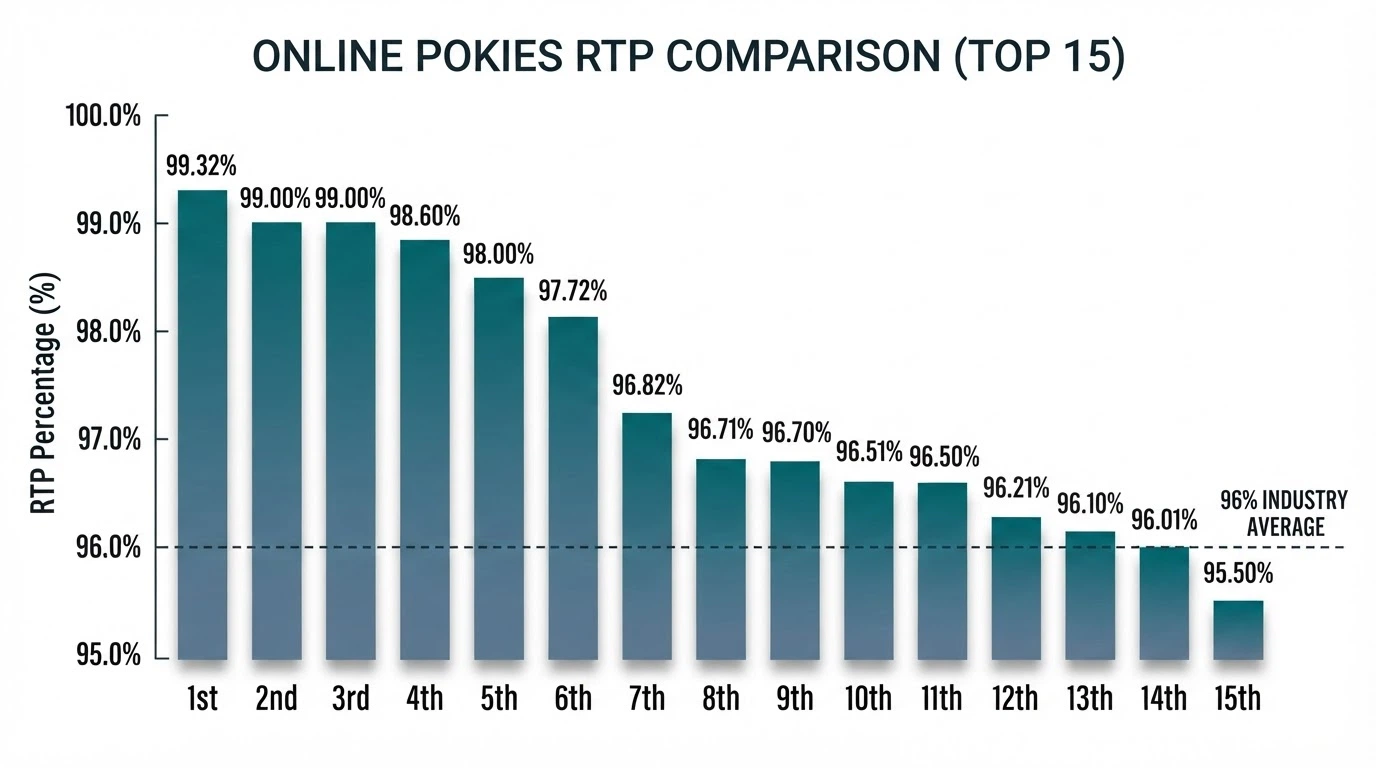
The table below ranks the fifteen highest-RTP online pokies an Australian player can access at the featured operators, sorted by return-to-player percentage. RTP is a long-run average measured over millions of simulated spins, not a session promise — the 99% headline on Mega Joker and Book of 99 is true in the way a weather average is true, and a single session can diverge from it sharply in either direction. The 99% figure on Mega Joker applies only at maximum bet in Supermeter mode; the base game returns closer to 76.9% to 85.1% depending on bet size. That conditional is the one stat that changes what the number means in practice.
| Pokie title | RTP | Provider | Volatility | Max win |
|---|---|---|---|---|
| Goblin’s Cave | 99.32% | Playtech | Ultra-low | — |
| Mega Joker | 99.00% | NetEnt | — | — |
| Book of 99 | 99.00% | Relax Gaming | High | 12,075x |
| 1429 Uncharted Seas | 98.60% | Thunderkick | Low | 670x |
| Blood Suckers | 98.00% | NetEnt | Low | 900x |
| White Rabbit Megaways | 97.72% | Big Time Gaming | — | 13,029x |
| Dead or Alive 2 | 96.82% | NetEnt | Very high | 111,111x |
| Big Bass Bonanza | 96.71% | Pragmatic Play | — | 2,100x |
| Razor Shark | 96.70% | Push Gaming | Very high | 50,000x |
| Sweet Bonanza | 96.51% | Pragmatic Play | High | 21,100x |
| Gates of Olympus | 96.50% | Pragmatic Play | High | 5,000x |
| Book of Dead | 96.21% | Play’n GO | High | 5,000x |
| Money Train 3 | 96.10% | Relax Gaming | Very high | 100,000x |
| Wolf Gold | 96.01% | Pragmatic Play | Medium | 2,500x |
| Mega Moolah (progressive) | — | Microgaming | — | AU$1–20M+ |
The top of the table is dominated by three titles that cross the 98% line: Goblin’s Cave at 99.32%, Mega Joker at 99.00% conditional, and Book of 99 at 99.00%. Goblin’s Cave carries ultra-low volatility and a Hold Reels feature that makes it closer to a video poker variant than a typical pokie, and it is the highest real return on the page for a player who values stability over the chance of a large hit. Blood Suckers and 1429 Uncharted Seas round out the 98%-plus tier with low volatility and modest max wins, which makes them the right call for a player who plans to grind a long session at small bet sizes.
The 96% to 97% band is where the bulk of the games Australians actually play sit. Big Bass Bonanza, Sweet Bonanza, Gates of Olympus, Book of Dead, Wolf Gold, and Razor Shark are the titles that show up in promotional material at every featured operator, and the table makes clear that their 96% to 96.7% RTPs are a tier below the 98% leaders. The trade-off is volatility: Razor Shark, Sweet Bonanza, and Gates of Olympus are high or very high volatility, which is what produces the 21,100x to 50,000x max wins the marketing leans on.
The em-dashes in the volatility and max win columns are not errors. Research carries volatility for eleven of the fifteen titles and max win for thirteen; the gaps mark the four cells where the figure is not confirmed this run, and they are kept empty rather than filled with a guess. The Mega Moolah row carries no fixed RTP because Mega Moolah is a progressive: the base game return is lower than the table suggests, and the headline AU$1 million to AU$20 million+ jackpot is funded by that lower base return. A player chasing the progressive is buying a lottery ticket, not a high-RTP session.
Pokies vs Slots: What Australian Players Need to Know About the Terminology
The same games are called pokies in Australia and slots everywhere else. The machines are identical: reels, paylines, scatter symbols, free spin rounds, the same math, the same providers. The only thing that changes is the word. A reader typing “best paying online pokies Australia” into Google and a reader typing “best paying slots Australia” into Google will land on the same offshore sites and play the same games; the operators simply label their lobbies “slots” because that is the international term, and the players who arrive via the Australian search terms arrive at a page that calls them pokies because that is what Australian readers call them.
For the rest of this guide, pokie and slot are used interchangeably. The RTP table, the volatility discussion, and the provider averages below all refer to the same set of games under two names.
Where Australian Online Pokies Sit in the Global Market
Australia is one of the world’s biggest per-capita gambling markets, and the prohibition on online pokies is the single biggest reason the offshore market exists in the form it does. The Interactive Gambling Act 2001 bans the supply of online casino games, online pokies, and in-play sports betting to people in Australia, and the ban has held for a quarter of a century. What the ban did not do is reduce demand. The ACMA has had 1,564 illegal gambling and affiliate websites blocked by Australian internet service providers since November 2019, and more than 225 illegal services have withdrawn from the Australian market since enforcement was strengthened in 2017. Each blocked site is a site that was actively serving Australian players at the time of the block, and the number keeps growing.
The result is a market that is large, sustained, and entirely served by operators the Australian regulator is trying to shut down. Australian players who want to play real-money online pokies have a single option: an offshore site, accessed by a domain the ACMA may have already tried to block, holding a licence in a jurisdiction the ACMA cannot reach. The market is not grey; it is prohibited at the supply end and unprosecuted at the demand end, and that is the structural reality every other section of this page is built on.
Online Pokies for Real Money: How the Stakes Change Everything
A pokie in demo mode is not the same pokie at stake. The reels, the symbols, the math, and the RTP are identical between a free-play session and a real-money spin, and the difference is the player behind the screen. Real money changes what a spin means. A A$0.20 spin in demo mode is a click; the same spin at a real-money table is a decision, and the decision carries the same house edge that is invisible in free play. The industry-average RTP of 95% to 96% is the same figure either way, but the player’s experience of it is not.
Every featured operator in this guide offers demo mode on most of its pokies, and demo mode is a useful tool for learning a game’s bonus round and pacing before risking real bankroll. What demo mode does not show is the variance of a real-money session: the long stretches without a hit, the temptation to chase a loss, the moment a session budget runs out. The math is the math; the player behaviour is the variable, and behaviour is what makes a 96% RTP title a real-money experience and a 76.9% conditional-RTP title a costly one.
A session plan — a fixed budget, a fixed time, a hard stop on the loss side — is the most reliable difference between a real-money session and a demo session. The arithmetic that follows in the section on cost will show why.
No-Deposit Pokies Offers: What They Are and Which Operators Actually Have One
A no-deposit pokie offer is a small bonus credited without a deposit: a free chip, a handful of free spins, a token entry point. The model is rare in the offshore market because the operators that offer it absorb the cost of giving a new player a session the player did not pay for. In the featured set, only Royal Reels carries a genuine no-deposit offer: the A$10 free chip with 30x wagering and a cashout cap shown at activation.
For every other featured operator, no no-deposit offer was confirmed this run. That does not mean the others do not run one; it means the public record this round did not show one, and the difference is meaningful. A reader comparing Royal Reels to the rest of the set for entry-point cost will find Royal Reels the cheapest by a clear margin, and the A$10 chip is the only way to test any featured site at zero real-money cost.
RTP, Volatility and Why Your Favourite Pokie Keeps Less Than You Think
Return-to-player and volatility are the two numbers that govern every spin on every pokie on this page, and they govern different things. RTP is what the machine pays back over a long run: a 96% RTP title returns A$96 of every A$100 wagered across millions of spins, averaged across every player who ever sits at the machine. Volatility is how that A$96 gets distributed: a low-volatility title pays it back in small, frequent wins; a high-volatility title pays it back in rare, large ones, with long stretches of nothing in between. The industry-average RTP across online pokies sits around 95% to 96%, and the provider averages run from NetEnt’s 96.39% down to Push Gaming’s 96.15% — a narrow band that conceals the much wider volatility difference between the games inside it.
A high-RTP, low-volatility pokie is a slow drip. A 96.5% RTP, very-high-volatility pokie is a different experience entirely: most sessions lose, and the rare winning session can return many multiples of the bet. The math is the math either way, but the player experience of the math is shaped by volatility more than by RTP. A reader comparing Big Bass Bonanza at 96.71% medium volatility to Razor Shark at 96.70% very high volatility is comparing two games that pay back roughly the same amount per dollar wagered, and that pay it back in completely different patterns.
The conditional RTP caveat on Mega Joker is the clearest example of how RTP and play style interact. The 99% figure is real at maximum bet in Supermeter mode, and the 76.9% to 85.1% figure is the actual return for a player not running that strategy at that bet size. The number on the page is true, and the number for the player’s actual session is also true, and the gap between them is the gap between the marketing and the math.
How a Slot Machine’s RTP Is Actually Calculated
The RTP on a pokie’s paytable is the output of a simulation, not a measurement. Independent test houses — eCOGRA, iTech Labs, and Gaming Laboratories International (GLI) are the three the industry names most often — run the game’s random number generator through tens of millions of simulated spins, count the total returned against the total wagered, and publish the ratio. A 96% RTP figure is the result of that simulation, certified by a lab whose business depends on its certification being trusted. The figure is not a guarantee for any single player, and it is not a guarantee for any single session; it is a long-run statistical average that converges on the 96% figure only across the millions of spins the test house ran.
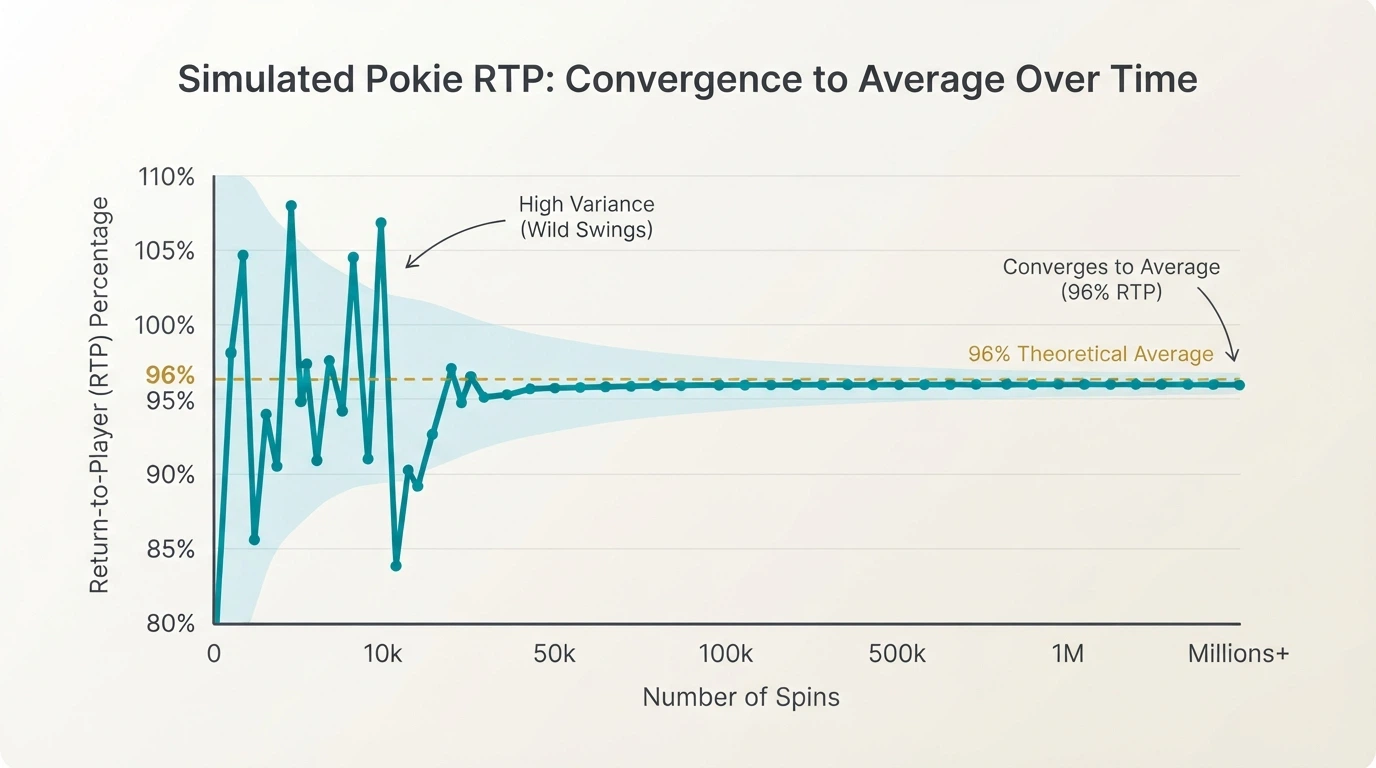
The practical consequence is that a 99% RTP title can drain a balance in 20 minutes. The wins are not distributed evenly across spins, and a player who happens to hit the variance in the wrong direction will lose their bankroll long before the long-run average catches up. A player who happens to hit the variance in the right direction will see a session return well above 99%. The RTP is a statement about what happens across millions of spins, not about what happens in the next hundred.
The conditional RTP on Mega Joker is the clearest illustration of the limit of an RTP figure. At max bet in Supermeter mode, the return is 99%. At minimum bet, it is closer to 76.9% to 85.1%, depending on how the player runs the Supermeter. The 99% number is published and certified, and the 76.9% number is also published and certified, and they are both true for the same game. The difference is the player’s bet size and play strategy, which is what makes a “99% pokie” one of the most conditional entries on the whole RTP table.
Progressive Jackpots and Their Real Odds
A progressive jackpot is funded by taking a small percentage of every spin across a network of machines and adding it to a pooled prize that grows until someone hits the right combination. Mega Moolah’s typical range runs from AU$1 million to AU$20 million or more, and the headline figure is what every promotional banner leans on. The base game RTP is lower than the 96% industry average to pay for the pool, and the difference is the price of the lottery ticket.
A player who treats Mega Moolah as a high-RTP pokie is making a category error. The progressive is a separate product: a small chance of a life-changing payout at the cost of a lower base return, and a base return that the published RTP figures do not always make visible. The Mega Moolah row on the table above carries no fixed RTP for that reason. The jackpot is real, the math behind it is real, and the gap between the two is the price of admission.
Which Game Providers Build the Highest-Paying Pokies
Provider-level RTP averages are a bigger lever than any individual title. NetEnt leads the tracked providers at 96.39% arithmetic mean across its catalogue, followed by Big Time Gaming at 96.25% and Push Gaming at 96.15%. The band is narrow — less than half a percentage point across the top three — and the difference between a NetEnt-heavy lobby and a Pragmatic Play-heavy lobby is small in RTP terms. What changes between the two is the volatility profile, the bonus round design, and the max win potential, not the long-run return.
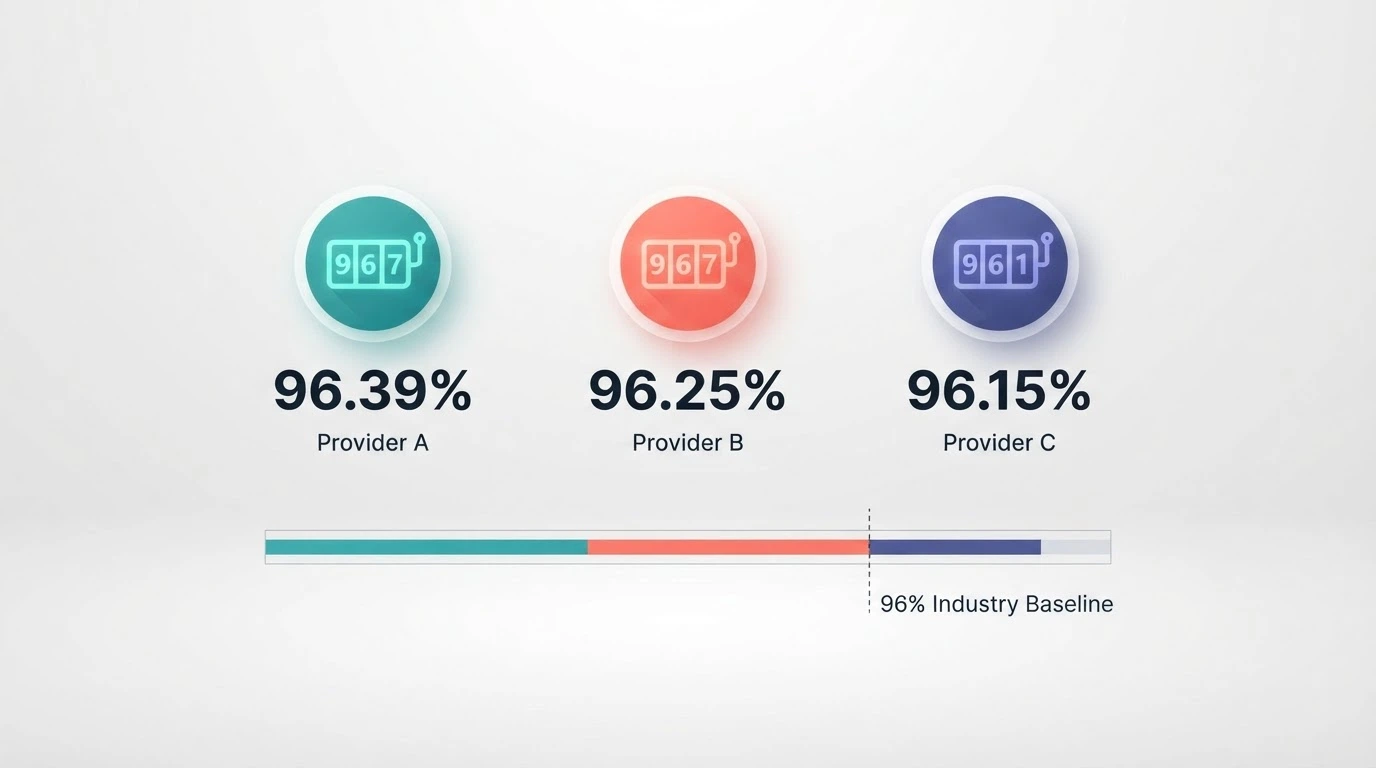
A reader comparing two operators with overlapping titles is comparing two lobbies that pay back roughly the same amount per dollar wagered, and the practical differences between the operators sit in their bonus terms, their payout speed, and the games they exclude from wagering — not in their provider averages. The provider line matters most when a player is choosing which studio to filter on, and for most players the relevant question is which provider carries the high-RTP titles they actually want to play.
What “Real Money” Pokies Actually Cost You
The real-money framing is about cost, not reward. Every spin on a 96% RTP pokie returns 96 cents of every dollar in the long run, and the missing 4 cents is the house edge — the price of admission, paid on every spin, in every session, with no exception. A A$0.20 spin costs A$0.008 in expected house edge; a session of 500 spins costs A$4 in expected house edge; a 5,000-spin session costs A$40. The math is simple, the math is unavoidable, and the only variable the player controls is how many spins they run.
The bonus terms multiply the cost. A Skycrown-style 450% match up to A$8,000 with 40x wagering means a player who takes the full bonus is committing to A$320,000 of wagering — bonus times the multiplier. At an industry-average 96% RTP, that A$320,000 in turnover carries an expected loss of A$12,800. The bonus credits A$8,000 to the account, and the wagering costs A$12,800 in expected house edge to clear. The net expected cost of clearing the full Skycrown welcome bonus, assuming only the bonus amount is wagered, is approximately A$12,800. That figure is the real price of the A$8,000 bonus, and it is the figure the marketing material does not put on the page.
The 40x wagering multiple on Skycrown, the 35x on Royal Reels, the 40x on WinSpirit, and the 40x on Rocket Play are not the same offer because the bonus amounts are not the same offer. The expected cost of clearing A$1,000 at 40x is approximately A$1,600; the expected cost of clearing A$8,000 at 40x is approximately A$12,800. A reader comparing bonus offers by headline size is comparing the wrong number, and the wagering multiple is the figure that turns the comparison honest.
A player who plans to play through the welcome bonus at A$0.20 per spin on a 96% RTP title can estimate the time commitment: A$320,000 of wagering at A$0.20 per spin is 1.6 million spins, which at a 5-second spin interval is roughly 2,220 hours. The 14-day validity per tier is the constraint that turns a 2,200-hour commitment into a 2,200-hour commitment compressed into 14 days, which is not what the bonus headline suggests. The bonus is real money, the wagering is real play, and the time is the price of clearing the offer.
Free-Play Mode vs Real-Money Spins: What the Demo Does Not Show
Demo mode is a learning tool, and it is a poor predictor of a real-money session. The reels behave the same way, the bonus round fires at the same frequency, the math is the math. What changes is the player: a free-play spin is a click, a real-money spin is a decision, and the decision carries the weight of the bankroll behind it. A A$0.20 demo spin that misses for 200 spins in a row is a curiosity; the same 200 spins at a real-money table is a A$40 loss, and the player response to a A$40 loss is not the same as the player response to a curiosity.
The bonus wagering pressure is the second difference demo mode hides. A real-money session during a 40x playthrough is a session where every spin is one of thousands the player must complete to convert the bonus, and the spinning is not free choice — it is the cost of the bonus the player accepted. Demo mode carries no such pressure, and the player who enjoys a pokie in demo mode may find the same pokie under wagering conditions a very different experience.
How Fast Offshore Pokies Sites Really Pay: Tested Times and the Payment Methods That Matter
Payout speed is the second question every Australian player asks after game selection, and the answer depends on the payment method more than the operator. Crypto withdrawals can complete in minutes when the operator’s processing window is short; bank transfers take days, and the limit is the banking system rather than the casino. The two competitor-tested figures that exist in the public record — a four-minute Moonbet withdrawal tested by Nerdbot and a one-hour-eighteen-minute SpinBoss withdrawal tested by Betsquare — come from operators that are not in the featured set, and they are not directly transferable to Skycrown or Royal Reels. They are useful as a lower bound: a well-run offshore operation can pay out inside an hour, and a poorly run one can take days.
The bigger constraint is Australian law. Credit cards and crypto are banned as payment for online wagering in Australia since 11 June 2024, under the Interactive Gambling Amendment (Credit and Other Measures) Act 2023. An operator that takes a credit card deposit from an Australian player, or that accepts crypto and converts to fiat for wagering, is breaking Australian law, and the player is depositing into a service that is already non-compliant with the regulator the player might otherwise complain to. The ban is a detection tool as much as a payment rule: it narrows the field of legal payment methods, and an operator that ignores it is telling the reader something about how it handles the other rules it disagrees with.
For Australian players using a legitimate method, PayID and Osko offer near-instant transfers through the Australian banking system, and BPAY and direct bank transfer cover the slower end. The payment method the player chooses is the payment method that determines payout speed, and the operator’s only role is how long it takes to process the request once the player has asked.
What Slows Down a Pokies Payout — and How to Speed It Up
Four bottlenecks sit between a withdrawal request and money in hand. KYC verification is the first: the operator must confirm the player’s identity, and the upload of a driver’s licence, a proof of address, and a payment-method screenshot takes time the first time around. A player who completes KYC before requesting a withdrawal removes the first bottleneck before it becomes a delay. Wagering completion is the second: a withdrawal request while a bonus is still being cleared is either rejected or queued until the wagering is done, and the player who clears the bonus first avoids the second delay.
Payment-method routing is the third. Crypto is fastest, PayID and Osko are near-instant, and bank transfers are the slowest. A player who deposits by PayID and withdraws by bank transfer is choosing a slower payout than the deposit method supports, and the operator’s processing window is the only variable the player can influence by selecting a faster method. Operator-side processing is the fourth: some operators run 24/7 processing, others batch withdrawals on a schedule, and the difference is anywhere from minutes to days. The processing window is the part the player cannot see until they request the withdrawal, which is why the four-minute and one-hour-eighteen-minute competitor tests are useful — they show what a fast operator looks like, and a slow one stands out against that benchmark.
What Australian Players Lose When They Play Offshore
A list of the protections an Australian wagering customer has, and the offshore pokies player does not, makes the trade-off visible. BetStop, the National Self-Exclusion Register, covers approximately 150 Australian-licensed wagering providers; an offshore casino is not licensed and is not connected to the register. A player who has registered with BetStop and then deposits at an offshore pokies site has not breached their self-exclusion, because the offshore site is not part of the system they registered with — but the protection they thought they had does not extend to the deposit they just made. The 67,480 BetStop registrations and 41,290 active exclusions as at 31 July 2026 are real numbers, and they do not touch a single site on this page.
Australian consumer law is the second protection that does not reach offshore. The Australian Consumer Law, the Australian Securities and Investments Commission, and the state-based gambling regulators each have jurisdiction over Australian-licensed operators and zero jurisdiction over a Curaçao-licensed company. A player who disputes a refused withdrawal, a closed account, or a bonus term applied unfairly has no Australian regulator to complain to and no Australian court that can compel payment. The dispute process is the operator’s own, followed by whatever the Curaçao regulator will do, which is slow and inconsistent.
The ACMA enforcement record is the third gap. The 1,564 sites blocked since November 2019 and the 225+ services withdrawn from the Australian market since 2017 are real numbers, and each blocked site is a site that an Australian player may have had funds on at the time of the block. The blocking is at the DNS level, which means the player’s existing access is cut, and the recovery of any balance on the blocked site depends entirely on the operator honouring it without the player being able to log in. The risk is small for any single block, but it is not zero, and a player with a meaningful balance on an offshore site is exposed to a risk an Australian-licensed operator does not carry.
The credit card and crypto ban is the fourth loss, in a different direction. The ban is an Australian consumer protection: it prevents a player from funding a wagering account with borrowed money or with a volatile asset whose value swings independently of the game. An offshore operator that accepts credit card or crypto deposits from Australian players is breaking Australian law, and a player depositing by those methods is using a payment channel the Australian regulator has decided is unsafe. The protection is real, and the offshore operator is not offering it.
Payment Methods Under the Microscope: PayID, Crypto and the Credit Card Ban
The 11 June 2024 credit card and crypto ban is a litmus test, and a simple one. An operator that accepts credit card or crypto deposits from Australian players is breaking Australian law under the Interactive Gambling Amendment (Credit and Other Measures) Act 2023, and the operator faces penalties of up to A$247,500 for failing to enforce the ban. The ban does not just remove a payment method; it removes the operator’s claim to be operating in compliance with Australian regulation, on the specific question of payment.
PayID and Osko are the Australian-preferred instant methods: transfers clear in seconds through the New Payments Platform, and most Australian banks support them with no fee. BPAY is slower — typically one to two business days — but is widely supported. Direct bank transfer is the slowest of the four, and the limit is the banking system rather than the operator. A player using PayID for both deposit and withdrawal is using the fastest legal method available to an Australian customer at an offshore site, and the operator’s processing window becomes the only remaining variable.
From 1 January 2027, banks and payment providers gain express authority to block transactions to illegal gambling operators. The provision is part of the Interactive Gambling Amendment (Gambling Reform) Bill 2026, which passed Parliament on 19 August 2026. The bank blocking authority does not change the legality of offshore play for the player; it changes the player’s ability to move money to the operator in the first place. A player who has been using PayID to deposit at an offshore site may find that PayID transfer declined in 2027, and the operator’s payment options for Australian players narrow further.
Online Pokies and Australian Law: No Grey Zone, No Licence, No Exceptions
The Interactive Gambling Act 2001 makes it an offence for a gambling provider to offer online casino games, online pokies, and in-play sports betting to a person in Australia. The Act has been in force for a quarter of a century, and the prohibition is total. There is no federal licence for online pokies, no state licence for online pokies, no territory licence for online pokies, and no pathway to one. What is licensed is wagering on races and sport placed before the event begins, lotteries, and keno, each through operators licensed by a state or territory (the de facto national licensor is the Northern Territory Racing and Wagering Commission). Land-based casinos — Crown, The Star — are state-licensed and operate physical premises only.

The IGA targets the provider, not the player. The Act makes it an offence to provide a prohibited interactive gambling service to a person in Australia; the individual player is not prosecuted, and no Australian player has been charged with using an offshore site. The structural choice to prosecute the operator rather than the user is a deliberate one, and it is the reason the offshore market has grown in the form it has: a player using an offshore site is not at risk of criminal prosecution, and the enforcement pressure falls on the operator’s ability to reach Australian customers in the first place.
The grey zone is a fiction. “Licensed in Curaçao” is not a grey zone; it is a foreign licence for a product that is prohibited in the country the player is sitting in. “Offshore” is not a grey zone; it is a description of the regulatory distance between the operator and the regulator who would otherwise have jurisdiction. Every site on this page is an offshore operator offering a prohibited product to Australian customers, and the legal status of each is the same: the supply is illegal in Australia, the demand is not prosecuted, and the protections that apply to a licensed Australian wagering service do not apply to any of them.
ACMA Enforcement: Blocking, Fines and the 2026 Reform Bill
The Australian Communications and Media Authority has had 1,564 illegal gambling and affiliate websites blocked by Australian internet service providers since its first blocking request in November 2019. The number is current to March 2026 and continues to grow; the ACMA issues blocking requests routinely, and the typical interval between request and ISP implementation is measured in days. More than 225 illegal services have withdrawn from the Australian market since enforcement was strengthened in 2017, and the withdrawals are a mix of operators leaving voluntarily and operators being forced out by blocking action.
The Interactive Gambling Amendment (Gambling Reform) Bill 2026 passed Parliament on 19 August 2026, and its measures commence 1 January 2027. AdStop, a national wagering advertising opt-out register administered by the ACMA, gives individuals a single mechanism to opt out of wagering advertising across online platforms. Direct marketing of inducements is prohibited for 14 days after a customer signs up, for three months after a person deregisters from BetStop, and indefinitely for customers identified as at risk of gambling-related harm. The advertising blackout around live sport has been extended from five minutes to 15 minutes before a game. Athletes, celebrities, and influencers are barred from promoting wagering products; broadcasting sporting odds is banned outright; and wagering ads are banned inside sports venues and on the uniforms of players and officials. The new provisions sit in new Parts of the IGA: Part 7C (restrictions on wagering advertising), Part 7D (restrictions on inducements and commissions), and Part 7E (the Wagering Advertising Opt-out Register).
Banks and payment providers gain express authority to block transactions to illegal gambling operators from 1 January 2027. The provision is the most operationally significant part of the reform for offshore pokies players, because it removes the payment-rail workarounds that have kept the offshore market functional. A player who has been moving money to an offshore site via PayID or BPAY may find the transfer declined at the bank level, and the operator’s options for accepting Australian customers narrow accordingly.
The reform does not legalise online pokies. It tightens the prohibition at the advertising, payment, and inducement ends, and it leaves the underlying ban on the product untouched. The market for offshore pokies does not close on 1 January 2027, but the channels through which it has reached Australian players are scheduled to narrow.
Player-Protection: What the Law Does — and Does Not — Cover
An Australian-licensed wagering customer has a defined set of protections: BetStop self-exclusion, customer-set deposit limits, mandatory activity statements, take-a-break functionality, a complaints pathway through the state or territory regulator, and the broader Australian Consumer Law. Each of these is enforceable against an Australian-licensed operator, and each carries the weight of an Australian regulator behind it.
None of them reach an offshore pokies site. BetStop covers approximately 150 Australian-licensed wagering services; an offshore casino is not licensed and is not connected to the register. Deposit limits on offshore sites are voluntary and operator-set, and there is no Australian rule that requires them. Activity statements are a licensed-operator obligation, not an offshore one. The ACMA complaints pathway is for Australian-licensed services; the ACMA’s own published guidance is that it cannot act on complaints about offshore operators. The Australian Consumer Law applies to conduct in Australia, and the contractual relationship between an Australian player and a Curaçao-licensed company is not in Australia for the purposes of the ACL.
The 67,480 BetStop registrations and 41,290 active exclusions as at 31 July 2026 are real, and 78% of registrants were under 40, with 38% choosing lifetime exclusion. Each of those registrations is a player who has asked the Australian system to exclude them from licensed wagering. The exclusion is real, and it does not extend to a single site on this page. A player who has registered with BetStop and then deposits at an offshore pokies site is making a separate decision, and the BetStop registration does not stop them from making it.
When the Spins Stop: Responsible Gambling Help That Actually Works
About 2.1% of Australian adults — roughly 430,000 people — experience problem gambling, and the Australian Institute of Health and Welfare put high-risk gambling at 1.8% in 2022. Among Australian gamblers, 14.7% reported harm on the Gambling Harms Scale (GHS-10), including 1.9% reporting high-level harm. People aged under 25 reported the greatest mean number of gambling harms, with 18- to 19-year-olds at 1.04 and 20- to 24-year-olds at 0.87 — the highest of any age band, and roughly six times the rate for those aged 65 and over, at 0.17. The figures are from the AIHW and the National Study of Australian Adults, and they are the most reliable prevalence data the country has.

The National Gambling Helpline is 1800 858 858 — free, confidential, and staffed 24 hours a day, 7 days a week, by the Department of Social Services. Gambling Help Online, at gamblinghelponline.org.au, offers live chat, email, and self-help tools 24/7 across Australia. Both are Australian Government-funded services, both are outside the offshore operator ecosystem, and both are reachable from a phone or a computer without going through any of the sites on this page. For a player who is worried about their own play or someone else’s, the helpline is the right first call, and it is independent of every other section of this guide.
The gap between licensed-wagering responsible-gambling tools and offshore reality is the practical one. An Australian-licensed wagering customer who wants a deposit limit, an activity statement, or a self-exclusion can set all three through the operator and the BetStop register. An offshore pokies player who wants the same set of tools has to find an operator that offers them, and the offering is voluntary, unenforced, and outside any Australian regulatory check. Four in 10 regular online bettors (39.5%) reported using consumer-protection tools in the past 12 months, according to the Australian Institute of Family Studies — a useful figure, and a figure that applies to the licensed market where those tools exist.
BetStop and the Offshore Blind Spot
BetStop is the single strongest responsible-gambling tool Australia has built for online wagering, and it does not reach a single site on this page. A player who registers with BetStop is excluded from approximately 150 Australian-licensed wagering providers, including every licensed sports book and racing operator in the country. The exclusion is the player’s single action, and it covers the entire licensed market in one step. The 67,480 registrations and 41,290 active exclusions as at 31 July 2026 are the operational scale: tens of thousands of Australians have used the register, and the register works as designed for the operators it covers.
The offshore blind spot is the design, not a failure. BetStop binds Australian-licensed wagering services; an offshore casino is not a licensed Australian wagering service, and it has no obligation to connect to the register. A player who has registered with BetStop and then deposits at an offshore pokies site is not in breach of their self-exclusion — the offshore site is not part of the system they registered with — but the protection they thought they had does not extend to the deposit they just made. 78% of registrants were under 40, and 38% chose lifetime exclusion, which means a large share of the registered population is making a long-term commitment to staying away from licensed wagering. The commitment is real; the offshore gap is real; the two coexist.
A player who has registered with BetStop and is considering an offshore pokies site should treat the offshore site as a separate decision, made on the offshore site’s terms, with the offshore site’s protections (or absence of them). The BetStop registration does not carry over, and the offshore site does not know it has happened.
Deposit Limits, Reality Checks and the Tools Offshore Sites Rarely Offer
Australian-licensed wagering operators must offer deposit limits, activity statements, take-a-break functionality, and reality checks; the obligations are state and territory conditions of licence, and they are enforced. An offshore pokies site is not subject to Australian licence conditions, and the responsible-gambling tools it offers — if any — are voluntary. The featured operators on this page do not publish a consistent set of RG tools in the public record, and the absence of confirmation is itself a signal.
A player who wants deposit limits, reality checks, or activity statements at an offshore site should look for them in the account settings before depositing, and should treat their absence as a data point about the operator rather than an oversight to be fixed later. The 39.5% of regular online bettors who used consumer-protection tools in the past 12 months used the tools that the licensed market made available, and the licensed market is the only market where the tools are reliably available.
How We Picked and Ranked Every Site on This Page
The ten featured operators were selected on three criteria: a measurable Australian market presence, public-record availability of the operator’s terms and licence, and inclusion of at least one high-RTP pokie from the table further up. The market presence figures — 1.28% for Stake and Rainbet, 0.99% for Scream Casino, 0.80% for FairGO, 0.57% for Bizzo and Rocket Casino, and the named-brand presence of the other four — come from independent traffic and market-share tracking, not from the operators themselves. The terms and licence data come from each operator’s published terms page and from publicly searchable Curaçao and other licence registers, cross-checked against reviews and competitor testing where the data was available.
The ranking within the ten follows the public-record depth. Skycrown, Royal Reels, and Stake sit at the top because their licence holder, provider list, and bonus terms are independently confirmable, and the bonus terms are published in enough detail to be checked against the wagering-arithmetic claims on this page. Rocket Play and WinSpirit sit in the middle because their bonus terms are confirmed but the provider lines are narrower or the operator is more recent. The bottom five — Rainbet, Scream Casino, FairGO, Bizzo, and Rocket Casino — are ranked by the single confirmed data point each carries, which is the market share figure, and the write-ups above explain what the absence of additional detail means for a player ranking them against the rest of the set.
The data-gap honesty principle is the operating rule. Where research does not carry a confirmed figure for an operator — a wagering multiple, a max cashout, a licence holder, a provider line — the absence is stated and the cell or sentence carries the no-data marker rather than a guess. The five operators at the bottom of the table are there because the public record carries less for them, and ranking them above the operators with confirmed terms would mean ranking them on data the ranking did not actually use.
The legality framing comes from the Australian Communications and Media Authority, the Department of Social Services, and the Australian Institute of Health and Welfare. The RTP figures come from independent tracking services and from operator-published paytables, cross-referenced where possible. The prevalence figures come from the AIHW and the National Study of Australian Adults. The responsible-gambling data comes from the AIFS, the ACMA, and the Department of Social Services. Each figure on this page is traceable to a named source, and the sources are the same ones a reader can check.
Your 2026 Pokies Playbook: What to Actually Do With Everything You Just Read
Pick by RTP, not by bonus. The table further up shows the fifteen highest-RTP pokies an Australian player can access, and the top of the table is 99.32% on Goblin’s Cave, with three more titles at 98% or above. A player who filters on RTP is choosing a game that returns more per dollar wagered, and the difference between a 99% title and a 96% title across a long session is the difference between A$99 and A$96 back per A$100 wagered. The bonus is the second filter, not the first.
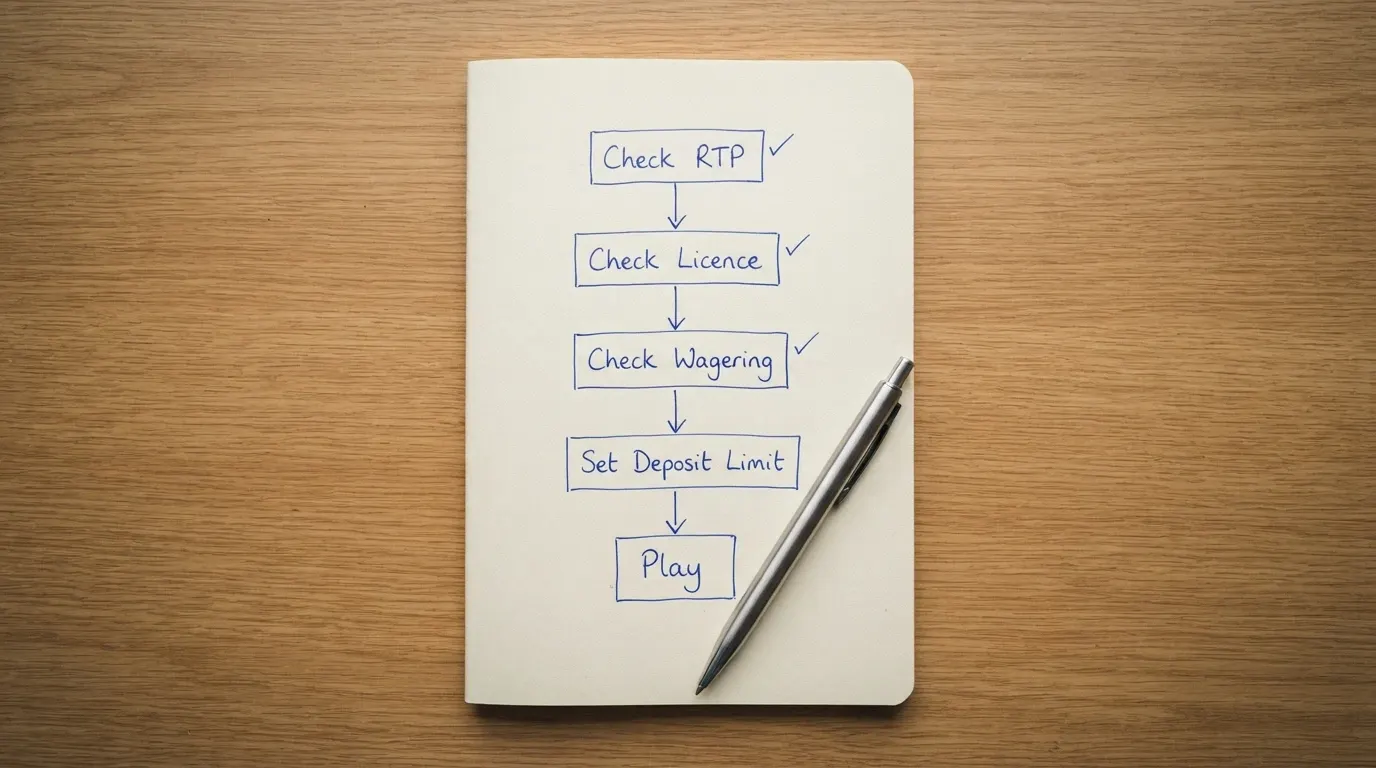
Read the wagering multiple before claiming any bonus. A 35x wagering multiple on Royal Reels is materially easier to clear than a 40x on Skycrown or WinSpirit, and the difference is not the percentage point but the total turnover it implies. The section on cost shows the expected loss from clearing a A$8,000 bonus at 40x on a 96% RTP title is approximately A$12,800, and that figure is the real price of the headline bonus. A player who treats the bonus as a free addition to the bankroll is treating the wagering as a formality, and the arithmetic is the proof that it is not.
Check the licence before depositing, and accept what the check shows. Every featured operator is offshore and holds no Australian licence for the product it offers; that is the structural fact of the market, and pretending otherwise is the mistake the credit-card-and-crypto-ban operators are already making. A player who can accept the offshore status, the absence of BetStop coverage, the absence of Australian consumer-law recourse, and the risk of ACMA blocking with a balance on the account is the player the market is built for. A player who cannot accept those four things should not be on the market at all.
Set a hard session limit before the first spin, and stop at it. The industry-average RTP of 95% to 96% means a session of any length has a mathematical expected loss, and the expected loss grows with every spin. A A$100 budget at A$0.20 per spin is 500 spins, and the expected loss on those 500 spins at 96% RTP is A$4 — small, predictable, and the price of an evening’s entertainment. A player who extends the session to chase a loss is paying more than A$4, and the difference is the budget the limit was set to protect. The session limit is the difference between a real-money session and a real-money problem, and the limit is set before the first spin, not after.
Register with BetStop if the play has stopped being a choice. The 1800 858 858 helpline and Gambling Help Online are the right first calls for a player who is worried about their own play or someone else’s, and the BetStop registration is the right action for a player who has decided to stop. The register covers approximately 150 Australian-licensed wagering services, and the offshore gap is the gap a player has to manage themselves. The decision to stop is the player’s; the tools to support it are real, and they are Australian, and they are outside every other section of this page.
Frequently Asked Questions
What does RTP mean and how does it affect my chances of winning on pokies?
RTP stands for return-to-player, and it is the percentage of all wagered money a pokie pays back over a long run. A 96% RTP pokie returns A$96 of every A$100 wagered, averaged across millions of spins. The figure is certified by independent test houses like eCOGRA and iTech Labs through simulated spin runs. A single session can diverge from the 96% figure in either direction, and the variance is driven by volatility as much as by RTP. The conditional RTP on Mega Joker is the clearest example: 99% at max bet in Supermeter mode, closer to 76.9% at minimum bet.
Can I play online pokies with PayID in Australia?
PayID and Osko are the fastest legal payment methods available to Australian players, and transfers clear in seconds through the New Payments Platform. Offshore pokies sites vary in their PayID support, and the player should check the deposit page before signing up. Credit cards and crypto have been banned as payment for online wagering in Australia since 11 June 2024, and an operator that accepts either from Australian players is breaking Australian law. From 1 January 2027, banks and payment providers gain express authority to block transactions to illegal gambling operators, which may further narrow the payment options at offshore sites.
What is the biggest jackpot ever paid by an online pokie?
The Mega Moolah network progressive jackpot typically runs between AU$1 million and AU$20 million or more, and individual payouts have reached higher figures. The base-game RTP on a progressive pokie is lower than the industry average of 95% to 96% to fund the jackpot pool, which is the price of buying a lottery ticket rather than playing a high-RTP pokie. The headline figure is real; the per-spin return is lower; the trade-off is the player’s to make.
Are online pokies fair and who tests them?
Online pokies are tested by independent labs — eCOGRA, iTech Labs, and Gaming Laboratories International (GLI) are the three named most often — who run the game’s random number generator through tens of millions of simulated spins and certify the RTP and the fairness of the output. A pokie with a published RTP from a recognised lab is fair in the sense that the math is what the lab says it is. The test does not guarantee a session result, and a player can still lose every spin on a 99% RTP pokie across a short session. The test guarantees the long run, not the next spin.
What should I do if I have a gambling problem in Australia?
The National Gambling Helpline is 1800 858 858 — free, confidential, and staffed 24 hours a day, 7 days a week. Gambling Help Online, at gamblinghelponline.org.au, offers live chat, email, and self-help tools 24/7 across Australia. BetStop, the National Self-Exclusion Register, lets a player exclude themselves from approximately 150 Australian-licensed wagering services in a single step. The helpline and the online counselling are the right first calls; the BetStop registration is the right action for a player who has decided to stop; both are outside the offshore operator ecosystem, and both are independent of every other section of this guide.