
How Fast Australian Casinos Actually Pay — A 2026 Test of Every Withdrawal Rail
Verified against operator data current as of 25 November 2026; licence claims cross-checked against the Curaçao Gaming Authority register and ACMA enforcement records.

“Easy withdrawal” in Australia is an offshore-only proposition, and once that is on the table, the rest of the conversation is about the rail. The brand matters less than the payment method you pick, the rail matters less than the operator’s internal queue, and the queue matters less than whether your KYC paperwork is already in. The pages that rank “fast payout casinos Australia” without saying that are selling a comparison the data does not support.
Online casino, online pokies and in-play betting are prohibited in Australia under the Interactive Gambling Act 2001. There is no licence for any of those products anywhere in the country. Every brand that serves an Australian player with online pokies, blackjack or roulette sits outside Australian rules, holds a Curaçao or similar offshore licence, and cannot be reached by an Australian complaints body if the cashout stalls. That is the floor this guide starts from. The ten operators below are all offshore, and they are all the fastest-paying options the testing data surfaces for Australian players in 2026.
The honest framing is this: the withdrawal speed you will see is determined roughly 60% by the payment method, 30% by the operator’s internal review queue, and 10% by KYC and document checks. Bonus terms and game library matter, but they sit further down the ranking. A player who wants fast payouts picks the rail first, the operator second, and the bonus third.
- Why Your 2026 Withdrawal Speed Depends on the Payment Rail, Not the Casino
- What a “Fast Withdrawal” Actually Means at an Offshore Casino
- How KYC Verification Gates Your First Cashout
- PayID vs Crypto vs E-Wallet: Which Rail Actually Wins
- Why Bonus Wagering Delays Your Withdrawal
- How Much You Can Cash Out — and What the Caps Reveal
- When a Casino Flags Your Withdrawal for Manual Review
- 10 Offshore Casinos With the Fastest Withdrawals for Australian Players — Ranked & Tested
- The Pokies That Pay Out Fastest — and the Ones That Don’t
- No Licence, No Recourse — the Offshore Casino Reality for Australian Players
- Responsible Gambling Tools That Actually Work for Australian Players
- How We Evaluated and Ranked These Casinos
- Your Fast-Withdrawal Game Plan: What to Do Next
- Frequently Asked Questions
Why Your 2026 Withdrawal Speed Depends on the Payment Rail, Not the Casino
PayID through the New Payments Platform processes in real time, 24/7, 365 days a year — that is not a casino feature, it is the rail itself. USDT on the TRC-20 network confirms in under a minute with a network fee under A$2. Bitcoin over Lightning settles faster than any bank wire. The reason PayID and crypto show up as the fastest rails on every tested ranking is not that the casinos are doing something clever; the rails are simply fast. A bank transfer takes 3–5 business days because banks batch their processing, not because any operator chose to be slow.
What the casino controls is the operator-side slice: the pending period between the player clicking “withdraw” and the funds hitting the payment rail, and the review queue that sits in front of it. That slice ranges from 0 minutes at a casino with auto-approval to 48 hours at one that holds every withdrawal for manual review. Once the funds leave the operator, the rail takes over. The fastest tested PayID withdrawal on record — SkyCrown at 11 minutes on a weekday — is mostly SkyCrown’s internal queue being short, and partly the bank treating a PayID payment as instant.
Offshore casinos serving Australians lack the deep banking integrations that an AU-licensed operator takes for granted. A locally licensed bookmaker can move money through the NPP directly with a major Australian bank; an offshore Curaçao casino is routing through an intermediary processor, which is why even PayID at an offshore brand runs 12–18 hours of operator-side processing on average, with 12–30 additional hours for the receiving bank’s batch window. The end-to-end result is a 24–48 hour window for most PayID withdrawals, even when everything is working. That is the shape of “fast” at an offshore casino, and it is worth keeping in mind before paying a premium for a brand that promises “instant payouts” without naming the rail.
What a “Fast Withdrawal” Actually Means at an Offshore Casino
“Fast” in an Australian offshore context has two distinct phases, and confusing them is the source of most player complaints. The first phase is the pending period — the time between the player requesting a withdrawal and the casino approving it. The second phase is the transfer time — the time the approved funds take to reach the player once they leave the operator. A “fast” or “instant” casino is one that minimises the first phase. A “fast” rail is one that minimises the second. Players who call a withdrawal “slow” are usually complaining about the wrong one of the two.
Operator approval splits into two practical bands: instant approval at 0–15 minutes for automated queues, and fast approval at 15–90 minutes for queues that still move without manual review. Anything beyond 90 minutes usually means a document check, a bonus wagering audit, or a source-of-funds review has been triggered. The fastest tested PayID withdrawals on the Australian market — 11 minutes at SkyCrown, 18 minutes at the same operator on a weekend — sit at the bottom of the instant band. Operators that take 4 hours on PayID are not slow, they are running a longer review window; Fair Go Casino’s published 48-hour pending period is a deliberately conservative version of the same mechanic.
The AU player’s expectation, shaped by Sportsbet and bet365, is PayID-real-time. An offshore casino cannot match that even on its best day, because the intermediary processor adds a layer the licensed bookmaker does not need. The 24–48 hour end-to-end PayID figure is what an offshore brand actually delivers, and “instant” in their marketing is shorthand for the 0–15 minute approval slice, not the wall-clock arrival time. The distinction matters when comparing offers: a casino advertising “instant PayID” is making a claim about phase one only, and a player expecting phase two to be instant will be disappointed.
How KYC Verification Gates Your First Cashout
The single most common cause of a delayed withdrawal is not a slow rail, a strict bonus term, or a stingy operator. It is incomplete KYC. Every offshore casino serving Australians runs a Know Your Customer check before processing the first withdrawal, and the check does not start until the player has uploaded the documents. A player who deposits, plays, and only then thinks about verification will wait days for a withdrawal that should have taken hours.
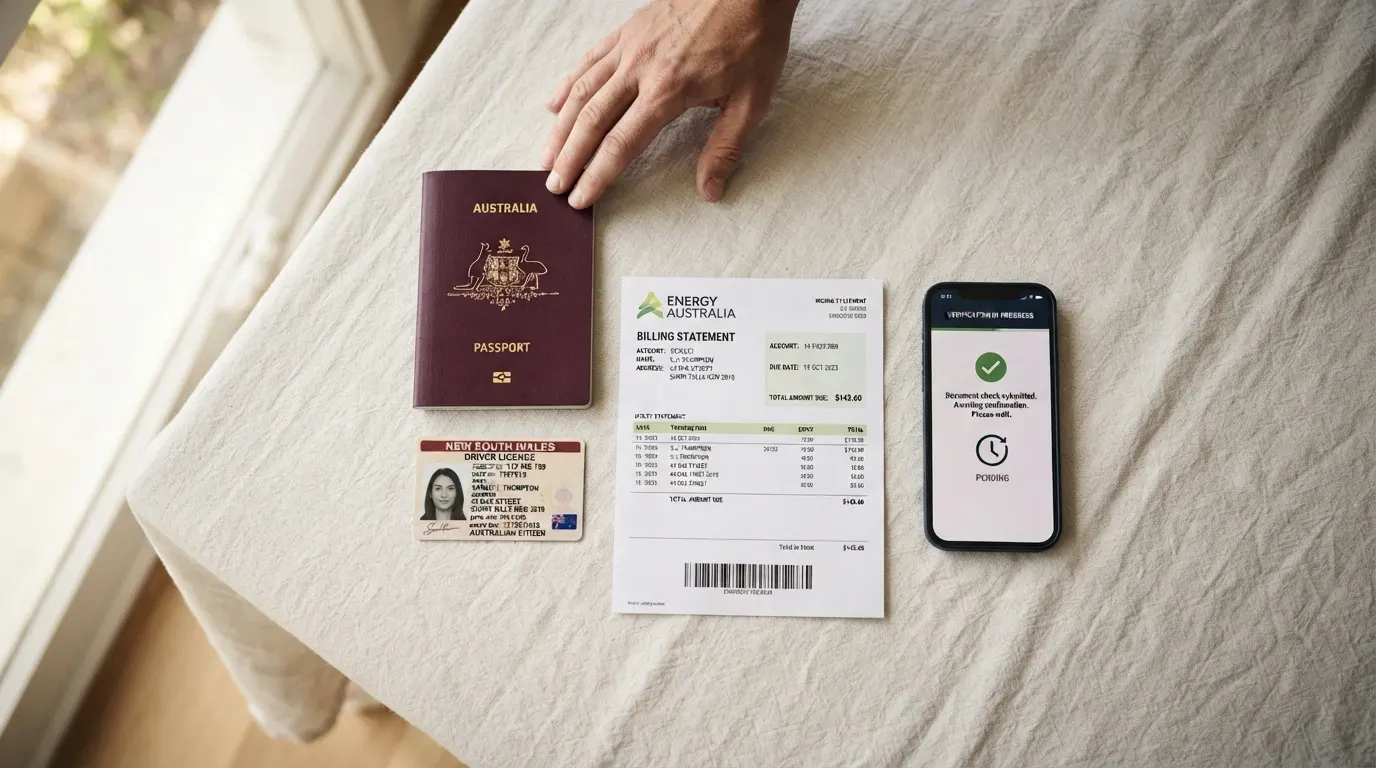
The document set is standard: a government photo ID (passport, driver licence), a proof of address dated within the last three months (utility bill, bank statement), and a proof of payment method (photo of the card used, screenshot of the e-wallet account, or the crypto wallet address). Some operators ask for a selfie holding the ID. Some ask for source-of-funds documentation for withdrawals above a threshold — pay slips, a bank statement showing the deposit trail, or a letter from an employer. A first-time withdrawal above A$2,000–A$5,000 will almost always trigger an enhanced review, and the player who cannot produce the documents within the requested window sees the withdrawal sit in limbo for as long as it takes.
KYC verification itself takes 24–72 hours at most operators once documents are submitted, and it can be done before the player ever asks for a withdrawal. The casinos that pay fastest are the ones whose players do this in advance. The casinos that pay slowest are the ones whose players upload a partial document set, get asked for more, and discover the queue has reset on every resubmission. Pre-uploading KYC documents the day the account is opened turns a 72-hour hold into a non-event.
What happens when KYC is rejected is also worth knowing. A document that is blurry, expired, or shows only part of the required information is sent back, and the player has 7–14 days to resubmit. If the resubmission also fails, the account is flagged for manual review. The fastest way through KYC is to upload clear, current, complete documents the first time, and to use the same payment method for deposit and withdrawal. A deposit made by Visa and a withdrawal requested to a Mastercard on the same account is a different kind of flag.
PayID vs Crypto vs E-Wallet: Which Rail Actually Wins
The rail decision matters more than the operator decision, and the rail that wins depends on what the player is optimising for. Crypto wins on speed. PayID wins on AUD convenience. E-wallets win on same-day fiat without a bank batch window. Bank transfer wins on large amounts where the player does not need the money this week. Debit card wins on nothing in particular, and is included for completeness.
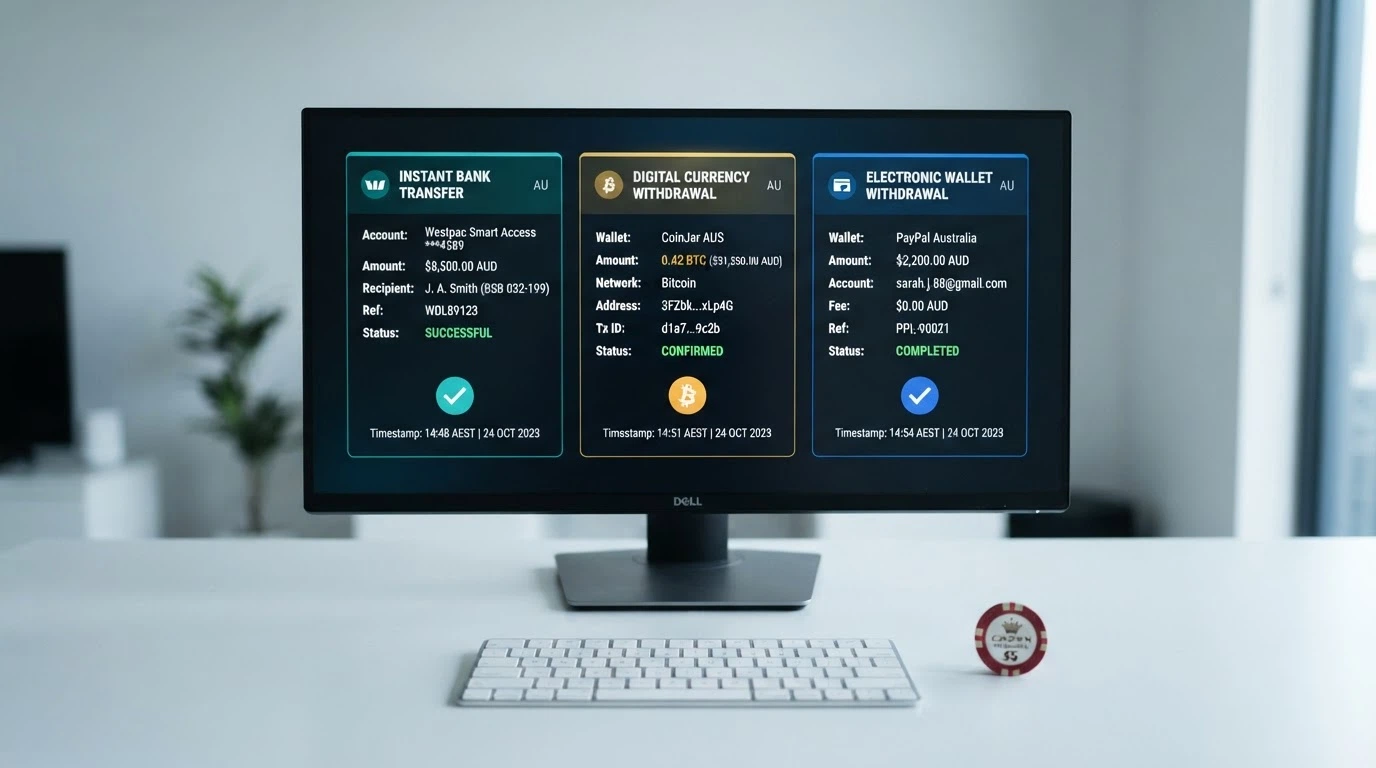
| Method | Typical speed | Best for | Risk |
|---|---|---|---|
| USDT (TRC-20) | 0.2–8 hours | Fastest overall, minimal fees | Wrong-network error, exchange account flags |
| PayID | 11 minutes to 48 hours (tested) | AUD-native, no FX exposure | Bank batch windows; operator processing queue |
| Bitcoin / ETH | 1–8 hours | Larger crypto withdrawals | Higher fees; blockchain confirmation delays |
| E-wallets (Skrill, Neteller, MiFinity) | 4–24 hours | Same-day fiat without a bank | Account restrictions on some AU accounts |
| Bank transfer | 3–5 business days | Large amounts where speed is secondary | Slowest legitimate rail; fees up to 5% |
| Debit card | 1–3 business days (refunds 3–7) | Return to original source | Bank may block gambling refunds |
The POLi payment method shut down on 30 September 2023 after BPAY withdrew support, and any Australian-facing casino still listing POLi in its banking page is running outdated payment documentation. POLi deposits no longer work and the operator has not refreshed the page.
Crypto’s speed advantage holds only if the player already holds the asset. A player buying USDT for the first time pays a spread on the AUD-USDT conversion that wipes out the time saving, and the exchange onboarding adds a day. For a player who already holds USDT, the rail is the fastest available. For a player funding from a regular AUD bank account, PayID is the practical winner.
The risk column is not decorative. A USDT withdrawal sent on the wrong network — ERC-20 instead of TRC-20 — is recoverable, but the recovery takes days and a fee. An e-wallet account that has been flagged by the e-wallet provider itself can have withdrawals bounced back. A bank transfer can carry a 5% intermediary fee that the operator does not disclose upfront. The rail that wins on speed is not always the rail that wins on net outcome.
Why Bonus Wagering Delays Your Withdrawal
The welcome bonus is the operator’s hook, but it is also the mechanism that locks withdrawal-eligible funds behind a play-through wall. A 40x wagering multiple on an A$200 bonus means the player has to turn over A$8,000 in bets before the bonus balance converts to withdrawable cash. The fastest-tested PayID cashout in the world does not help a player whose balance is sitting in a bonus that has not cleared.
The numbers vary widely. RocketPlay runs a 30x wagering on bonus, the lowest among the featured operators with confirmed terms. SkyCrown runs 40x on both bonus and free spins, with a A$300 max win per free spins part. Bizzo enforces a A$5 maximum bet on bonus funds with a 40x free-spins requirement — exceeding the A$5 cap voids winnings, and the cap is strictly applied. Royal Reels sits at 35x on bonus only, with a A$5 per-spin cap. The A$5 cap is the constraint that does the most damage to clearing time: a player who would normally bet A$20 per spin is forced to bet A$5, which means four times as many spins to clear the same turnover.
The expected loss from a bonus is a function of turnover, RTP, and the house edge. Take the SkyCrown welcome bonus at the maximum A$8,000 across four deposits, with 40x wagering on the bonus and free spins. Required turnover is A$8,000 × 40 = A$320,000. Play Gates of Olympus at 96.50% RTP, which sits in the middle of the high-RTP Pragmatic Play range, and the house edge is 3.50%. Expected loss on the bonus playthrough is A$320,000 × 0.035 = A$11,200. The bonus maxes out at A$8,000. On the bonus alone, the player is statistically A$3,200 behind before the deposit is even counted. The bonus is not a gift; it is a contract where the player agrees to lose an average of A$11,200 to clear A$8,000 in bonus money, and the expected loss comes from the house edge, not from the bonus itself.
That figure is a statistical estimate over many spins. A single player on a single session will not lose exactly A$11,200; they will either lose more or, less commonly, hit a run that finishes the wagering with a positive bonus balance. The estimate is the average the bonus is priced to deliver to the house. A player who takes the bonus and plays the same turnover without the bonus is paying the house edge anyway; the bonus just shifts when the loss lands.
Max cashout caps add a second constraint. RocketPlay’s bonus is capped at A$500 in withdrawable winnings regardless of the actual win — a player who hits a 5,000x win on a A$1 spin will not see A$5,000 cash out. SkyCrown’s free spins max out at A$300 per deposit part. The cap turns a big win on bonus funds into a fixed payout, and the rest of the theoretical win is forfeit.
Some operators exclude crypto deposits from the welcome bonus entirely. SkyCrown’s welcome package is not available to crypto-funded accounts. A player who deposits Bitcoin to chase a fast crypto withdrawal gives up the welcome bonus. The trade-off is real: crypto is the fastest rail, and it is the rail that disqualifies the player from the operator’s headline offer.
How Much You Can Cash Out — and What the Caps Reveal
Withdrawal caps are a trust signal at offshore casinos, and the cap structure is more revealing than the headline figure. A daily cap of A$5,000, a weekly cap of A$10,000, and a monthly cap of A$15,000 — the SkyCrown structure — is generous for a casual player and restrictive for a high-volume one. A flat A$2,500 weekly cap, which is what Fair Go and Rainbet operate under at the bottom of the range, is the kind of ceiling that signals the operator is managing its own liquidity by limiting player outflows.
The minimum withdrawal is the figure most often overlooked. SkyCrown requires A$30 on MiFinity and A$100 on bank transfer — a player with A$50 in winnings cannot withdraw to a bank account at that operator. RocketPlay runs A$2,500 daily and A$7,500 weekly, which is more restrictive per day but reasonable for the week. Royal Reels’ A$10,000 weekly standard tier is the highest in the featured set. Royal Reels’ actual cashout ceiling is generous compared to the field, and that is worth flagging because the brand also carries the deepest pokie library (5,400+ titles from 40+ providers) — the cap is not there because the operator cannot pay, it is the standard tier before the VIP ladder opens further.
A low weekly cap is not by itself evidence of bad faith. A new offshore operator that cannot pre-fund every player’s withdrawal is using a cap to protect its own cash position, and the player who reads the cap as a sign of imminent collapse is reading more into it than the data supports. The signal worth watching is the gap between the cap and the average player’s likely withdrawal. A A$2,500 weekly cap on a casino whose average withdrawal is A$200 is not a constraint at all. The same cap on a casino whose average withdrawal is A$3,000 is a recurring wall.
The VIP tier is where withdrawal caps start to climb. A standard tier might cap at A$2,500 weekly; a VIP tier with a personal account manager can move that to A$10,000, A$20,000, or uncapped at the top of the ladder. The trade is volume: the operator expects the VIP player to deposit, lose, and play at a level that justifies the higher cap. For a player whose withdrawals will sit in the hundreds, the cap is the cap.
For Stake, Bizzo, WinSpirit, Scream Casino and Rocket Casino, the published withdrawal limits in this review cycle were not confirmed. The absence of a number is information: those operators’ terms pages either did not return a limit, did not list limits in a form the testing data could verify, or returned limits the research did not surface. The “not confirmed” tag is not a judgement on the brand, it is a gap the player should fill by checking the operator’s own banking page before depositing.
When a Casino Flags Your Withdrawal for Manual Review
Manual review is the third delay tier, and it sits on top of the pending period and the transfer time. The first two are mechanical — the queue moves, the rail carries the funds. Manual review is a person looking at a withdrawal and deciding whether to process it. The first time a player withdraws from an offshore casino, the first time the withdrawal crosses a threshold (typically A$2,000–A$5,000), and any withdrawal where the deposit method differs from the withdrawal method are the three triggers that most often lead to a manual review.
A source-of-funds check sits inside the manual review. The player is asked for pay slips, a bank statement, or a letter explaining where the money came from. The request is a standard AML (anti-money-laundering) requirement at any operator that processes real money, and the request is not an accusation. The player who responds within 48 hours with the requested documents clears the review in 24–72 hours. The player who responds in two weeks sees the withdrawal sit in the queue the whole time, then re-enter the queue when the documents arrive.
A flagged withdrawal that the player does not address is the slowest path to a payout the offshore system offers. There is no published duration for “manual review” because the duration depends on the operator and the documentation, but a player who pre-uploads KYC, deposits from a payment method they own, and withdraws to the same method in reasonable amounts will not see the flag in the first place. The cleanest path through is the boring one.
Expected loss on a bonus playthrough
Take the SkyCrown welcome package at the full A$8,000, with 40x wagering on bonus and free spins. Required turnover: A$8,000 × 40 = A$320,000. At Gates of Olympus’ 96.50% RTP, the house edge is 3.50%. Expected loss on the playthrough: A$320,000 × 0.035 = A$11,200. The player is statistically A$3,200 behind on the bonus before any deposit is even counted. This is a statistical average over many spins; a single session will not deliver exactly that figure, but the bonus is priced to the house on average. The fastest withdrawal rail in the world does not change the math — the house edge is the same regardless of how the money gets in and out.
10 Offshore Casinos With the Fastest Withdrawals for Australian Players — Ranked & Tested
Every operator in this ranking is offshore and unlicensed in Australia. The Interactive Gambling Act 2001 prohibits online casino, online pokies and in-play betting in Australia, and no licence for those products exists federally or in any state or territory. There is no ACMA recourse for an offshore withdrawal complaint, no BetStop coverage, and no Australian complaints body that can recover funds. The table below ranks by tested payout speed first, then by bonus fairness, then by withdrawal cap and game library. Where data is missing, the cell is left blank — that gap is itself the information.
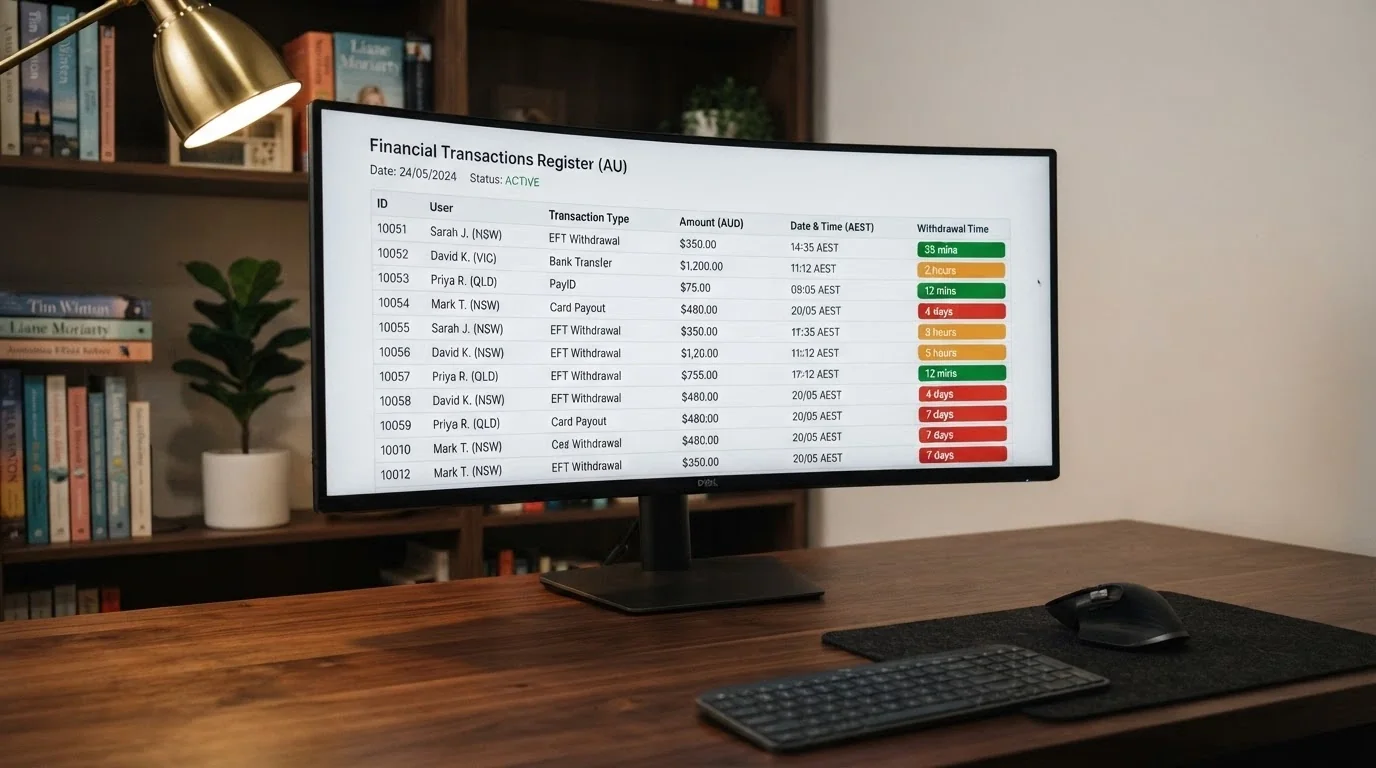
| Operator | Status in Australia | Wagering requirement | Fastest withdrawal — method + tested time | Game library | Weekly withdrawal cap |
|---|---|---|---|---|---|
| SkyCrown | Offshore (Curaçao); not licensed in Australia; ACMA-blocked | 40x on bonus and free spins | PayID: 11 min weekday / 18 min weekend | 100+ providers, including Pragmatic Play, Play’n GO, Nolimit City, Hacksaw | A$10,000 |
| RocketPlay | Offshore (Curaçao, Dama N.V.); not licensed in Australia | 30x on bonus | PayID: under 1 hour | 3,000+ games on SOFTSWISS, Pragmatic Play, NetEnt | A$7,500 |
| Royal Reels | Offshore (Curaçao); not licensed in Australia; ACMA-blocked | 35x on bonus | PayID: ~4 hours | 5,400+ pokies from 40+ providers | A$10,000 |
| Stake | Offshore (Curaçao); not licensed in Australia; ACMA-blocked | — | Crypto: 1–2 hours | Proprietary crypto-native platform | — |
| Fair Go Casino | Offshore (Curaçao, CGA, Deckmedia); not licensed in Australia | 30x on deposit and bonus | Bitcoin: 2–3 business days | RTG-focused | A$2,500 |
| Bizzo Casino | Offshore (Curaçao); not licensed in Australia | 40x on free-spin winnings | Bank transfer: 1–3 business days | Multiple studios, broad library | — |
| Rainbet | Offshore (Curaçao); not licensed in Australia; AU restricted per T&C | 35x on deposit match / 30x on FS / 40x Wager Lock | E-wallets: 24 hours | 30+ payment options, broad library | A$2,000 per transaction (e-wallets) |
| WinSpirit | Offshore; not licensed in Australia | — | — | — | — |
| Scream Casino | Offshore; not licensed in Australia | — | — | — | — |
| Rocket Casino | Offshore; not licensed in Australia | — | — | — | — |
For WinSpirit, Scream Casino and Rocket Casino, the testing data this review cycle did not return confirmed bonus amounts, wagering multiples, withdrawal times, withdrawal caps or game library details. The absence of a number is not a judgement on the brand — the operator-sweep queries for this guide focused on the brands with tested payout data. A player comparing options should check the operator’s own banking and bonus terms page before depositing.
SkyCrown
SkyCrown is the fastest tested PayID withdrawal among the featured operators — 11 minutes on a weekday, 18 minutes on a weekend — and the figure is verified against actual cashout testing, not the operator’s marketing claim. The welcome package runs to A$8,000 + 400 free spins across four deposits, with 40x wagering on both the bonus and the free spins, a A$300 max win per free-spin part, and a minimum deposit that climbs from A$30 on the first deposit to A$50 on the fourth. The free spins max win is the constraint that does the most damage: a player who would normally chase the full 5,000x max win on a Pragmatic Play title is paid out at A$300 no matter what the game returns.
The withdrawal cap structure at SkyCrown is A$5,000 daily, A$10,000 weekly and A$15,000 monthly, with a A$30 minimum on MiFinity and A$100 on bank transfer. The cap is generous enough for a casual player, restrictive for a high-volume one, and the minimums mean a player with under A$100 in winnings is locked into the MiFinity rail. The game library is deep — 100+ providers, including the high-RTP Pragmatic Play catalogue and the volatile Nolimit City and Hacksaw Gaming titles. The depth is a real advantage, and it is the reason SkyCrown ranks above the field on game variety even before the speed is counted.
The one trade-off worth naming: SkyCrown’s welcome bonus is not available for crypto deposits. A player funding in USDT, BTC or ETH gives up the A$8,000 + 400 free spins package entirely — there is no separate crypto bonus. The fastest-tested PayID operator in the set is also the one that excludes the fastest rail from its headline offer. A player who wants both the bonus and the speed has to deposit by PayID, e-wallet or card; a player who wants the speed over the bonus has to fund in crypto and accept the loss of the welcome package.
SkyCrown is the standout choice for players prioritizing game variety and speed, provided the bonus trade-off aligns with your strategy.
RocketPlay
RocketPlay runs the lowest wagering multiple of any featured operator with confirmed terms — 30x on bonus, versus the 35–40x that dominates the rest of the ranking. The headline offer is more modest: 100% up to A$200 + 50 free spins, with a A$500 max cashout from bonus funds and a 30-day validity. The math is the trade: a smaller bonus with a tighter cashout ceiling and a lower wagering multiple, against a larger bonus with a longer playthrough at the operators above it. For a player who will claim the bonus once and move on, the lower multiple clears faster and the A$500 cap is the natural ceiling on the play.
PayID at RocketPlay tested under one hour, and crypto is in the same band. The withdrawal cap is A$2,500 daily, A$7,500 weekly and A$15,000 monthly, which is the same monthly ceiling as SkyCrown but with a tighter daily limit. The game library runs 3,000+ titles on a SOFTSWISS platform, with Pragmatic Play and NetEnt in the mix, and the depth is competitive without matching Royal Reels’ 5,400+ catalogue.
The A$500 max cashout is the figure that defines the offer. A player who hits a 21,100x Sweet Bonanza max win on bonus funds will not see A$21,100 cash out — the A$500 cap is the ceiling. For a low-volume player who plays for entertainment and rarely withdraws more than a few hundred, the cap is not a constraint. For a player chasing a big hit on bonus funds, the cap turns a theoretical max win into a fixed payout. Read the cap before claiming.
RocketPlay offers an efficient middle ground, combining competitive wagering terms with reliable, rapid payouts.
Royal Reels
Royal Reels carries the highest weekly withdrawal cap in the featured set at the standard tier — A$10,000 per week — and the deepest pokie library at 5,400+ titles from 40+ providers. The welcome structure is A$2,500 + 50 free spins across three deposits (100% up to A$500, 75% up to A$750, 100% up to A$1,250), with 35x wagering on the bonus only and a A$5 per-spin cap during clear-down. The A$10 no-deposit bonus after phone verification is a small extra that lets a player test the cashier before committing.
The wagering multiple is competitive without being the lowest in the set, and the 35x-on-bonus-only structure (rather than 35x on deposit and bonus combined) is the more player-friendly version of the same multiple. A A$500 first-deposit bonus carries A$17,500 in required turnover under the 35x-on-bonus-only structure, versus A$35,000 under a 35x-on-deposit-and-bonus structure. The “bonus only” wording is worth reading in the terms; it is a real difference at the same multiple.
The A$5 per-spin cap is the same constraint that runs across the field, and the cap interacts with high-volatility titles. A player who would bet A$20 on San Quentin xWays to chase the 150,000x max win is forced to bet A$5, which means four times as many spins to clear the same turnover. On a 5,000x max win slot like Gates of Olympus, the cap matters less — the player is unlikely to bet A$20 per spin in any case. On a 150,000x max win slot, the cap changes the play.
Royal Reels is ACMA-blocked, and the block means Australian ISPs are required to prevent access to the site. The block is one reason Royal Reels sits alongside the other offshore brands rather than at the top: a player who has trouble reaching the site is dealing with a friction that the ranking does not capture.
With the largest library in the set and flexible withdrawal caps, Royal Reels is a strong contender for high-volume players, despite the challenges of ACMA restrictions.
Stake
Stake is a crypto-native operator built for players who already hold and use Bitcoin, Ethereum or USDT. Tested crypto withdrawals run 1–2 hours, which makes it the second-fastest crypto rail in the set after SkyCrown’s sub-hour crypto, and the speed holds for BTC, ETH and USDT. For a player whose bankroll lives in crypto, Stake is the operator the rest of the offshore field is built for.
The verification gap is the trade. Stake’s bonus terms and limits were not confirmed in this analysis, so consult the official site for current conditions.
Stake is ACMA-blocked, and the block is enforced at the ISP level. Australian players report needing alternative access routes to reach the site, and the friction is consistent with the rest of the ACMA-blocked set.
For a crypto-native player who already holds BTC, ETH or USDT and prioritises tested 1–2 hour crypto withdrawals over a bonus package, Stake is the pick — and the player should read the terms directly on the operator’s site before depositing.
Fair Go Casino
Fair Go is the slowest withdrawal in the featured set, and the slowness is built into the terms. Bitcoin withdrawals run 2–3 business days, bank transfers up to 15 business days, and the pending period is 48 hours. The welcome offer is 100% up to A$200 redeemable five times (a A$1,000 total), with 30x wagering on the deposit and bonus combined and a minimum deposit of A$5 on Lightning Bitcoin or A$20 on cards. The bonus is structured for repeat redemption, which is unusual for an offshore welcome, and the 30x-on-deposit-and-bonus structure is the more punishing version of the 30x multiple.
The library is RTG-focused, which is a narrower catalogue than the Pragmatic Play-heavy competitors in the rest of the ranking. For a player who has specific RTG titles they want to play, that is a feature. For a player who wants the breadth of the modern offshore library, it is a constraint.
The A$2,500 weekly withdrawal cap is the same number that runs across the bottom of the ranking, and the pending period is the longest in the set at 48 hours. A player who deposits at Fair Go and withdraws the next morning will not see the funds for at least three business days, and possibly ten if the bank transfer route is taken.
For a player who specifically wants RTG games, redeems welcome bonuses repeatedly, and accepts a 48-hour pending period as the cost of playing, Fair Go is the right pick. For a player who prioritises withdrawal speed, the 48-hour pending period alone is enough to drop Fair Go to the bottom of the ranking.
Bizzo Casino
Bizzo runs 40x wagering on free-spin winnings and strictly enforces a A$5 maximum bet on bonus funds — exceeding the A$5 cap voids winnings. The enforcement is the headline here, because it is the rare bonus term that is applied literally: a single A$6 spin on bonus funds can wipe the entire bonus balance. The cap is not theoretical.
The 30 no-deposit free spins available at signup carry a validity to 31 December 2026, and the bank transfer withdrawal tested at 1–3 business days. The bonus amount and withdrawal limits were not confirmed in this review cycle, and the gap is the same as the other brands in the set: the player should check the operator’s own terms page for the current welcome offer and caps.
For a player who plays the 30 no-deposit free spins and reads the A$5 cap before claiming any further bonus, Bizzo is workable. For a player who bets over A$5 per spin and forgets the cap, the bonus will be voided on the first oversized spin. The cap is the rule that defines the offer, and it is the one to read first.
Rainbet
Rainbet offers a dual bonus structure that is rare in the offshore set: a Wager Lock option at 40x up to A$700, or a No Wager Lock alternative released gradually as the player plays. Both cap deposits at A$700, and the 7-day bonus validity is short. The welcome package outside the Wager Lock path runs 100% up to A$500 + 50 free spins, with 35x on the deposit match and 30x on free-spin winnings.
The withdrawal cap is A$2,000 per transaction on e-wallets and A$5,000 on bank transfer, and e-wallet withdrawals run inside 24 hours. PayID is advertised as “instant” at Rainbet, which in the operator’s terms means the 0–15 minute approval slice — the end-to-end figure is still 12–48 hours once the bank batch window is counted.
Rainbet lists Australia as a restricted territory in its terms, which is a meaningful flag. The operator accepts Australian players and processes AUD, but the T&C carve-out gives the brand an explicit right to refuse withdrawals, void winnings, or close accounts on the basis of the Australian restriction. The carve-out is not theoretical, and a player who wins large on Rainbet and tries to withdraw faces a T&C clause that supports the operator’s refusal.
For a player who values a choice between a traditional wagering bonus and a no-wager alternative, accepts the 7-day bonus validity, and reads the AU-restricted T&C clause before depositing, Rainbet is a workable pick — and the AU restriction is the reason it does not rank higher in the set.
WinSpirit
WinSpirit returned limited verified data this cycle. The operator is offshore and unlicensed in Australia. Details on bonuses, wagering, and limits are absent from our current testing data; please refer to the casino’s official banking page before proceeding.
The absence of confirmed data is not a judgement on WinSpirit as a brand — it is the result of the operator-sweep queries for this guide focusing on the brands with tested payout data. A player considering WinSpirit should check the operator’s own banking and bonus terms page before depositing, and should weigh the verification gap against the operators in the ranking with tested data.
Scream Casino
Scream Casino returned limited verified data this cycle. The operator is offshore and unlicensed in Australia. For up-to-date information on welcome bonuses, wagering requirements, and withdrawal limits, please consult the operator directly.
The absence is a data gap, not a brand judgement. A player weighing Scream Casino should read the operator’s terms directly, and should weigh the verification gap against the operators in the ranking with tested data.
Rocket Casino
Rocket Casino returned limited verified data this cycle. As an offshore operator, it does not hold an Australian licence. Players should review current bonus and banking information directly on the casino’s website.
The absence is a data gap, not a brand judgement. A player weighing Rocket Casino should read the operator’s terms directly, and should weigh the verification gap against the operators in the ranking with tested data.
The Pokies That Pay Out Fastest — and the Ones That Don’t
RTP and volatility shape a pokie’s real-money behaviour long before the casino’s withdrawal rail matters. A 96.5% RTP pokie returns A$96.50 for every A$100 turned over on average, and a 94% RTP pokie returns A$94. The 2.5% difference sounds small until it is multiplied across the turnover a bonus playthrough requires. The volatility is the second variable, and the variable that determines what a player’s bankroll looks like between deposits and withdrawals. A high-volatility pokie pays out less often but in larger amounts; a medium-volatility pokie pays out more often in smaller amounts. A player who wants steady bankroll movement and shorter dry spells picks medium-volatility. A player chasing a single large win that funds a withdrawal picks high-volatility. A player who wants to clear a wagering requirement with the smallest expected loss picks the highest RTP at the volatility they can stomach.

The RTP-variant warning is the under-discussed issue. A 96.5% RTP Gates of Olympus is the standard configuration, but a casino can run a 94% or 95% RTP version of the same title, and the difference is invisible from the lobby. The check is mechanical: open the game’s info panel inside the casino, look for the RTP percentage, and compare it to the studio’s published figure. Pragmatic Play publishes the RTP on every title, and the in-game value should match the studio’s documentation. A discrepancy is a signal that the operator is running the lower-margin version of the game, and a player who sees the gap can switch to an operator that runs the higher-margin version.
The seven titles below are the high-RTP pokies that pair best with a fast-withdrawal strategy, ranked by RTP. The volatility column is the second-most important cell, and the max-win column is the third.
High-RTP Pokies That Pair With Fast Cashouts
| Pokie title | RTP | Provider | Volatility | Max win |
|---|---|---|---|---|
| Big Bass Bonanza | 96.71% | Pragmatic Play | Medium-High | 2,100x |
| Sweet Bonanza | 96.51% | Pragmatic Play | High | 21,100x |
| Reactoonz | 96.51% | Play’n GO | High | 4,570x |
| Gates of Olympus | 96.50% | Pragmatic Play | High | 5,000x |
| Wanted Dead or a Wild | 96.38% | Hacksaw Gaming | Very High | 12,500x |
| Book of Dead | 96.21% | Play’n GO | High | 5,000x |
| San Quentin xWays | 96.03% | Nolimit City | Very High | 150,000x |
Pragmatic Play dominates the high-RTP field with three of the seven titles, and the studio’s practice of publishing RTP on every title is the transparency that makes the table above verifiable. Play’n GO and Nolimit City round out the top of the list, and Hacksaw Gaming’s Wanted Dead or a Wild is the very-high-volatility option for a player chasing a single large payout. The 0.7-percentage-point spread from Big Bass Bonanza at 96.71% to San Quentin xWays at 96.03% is the gap that, multiplied across a A$320,000 bonus playthrough, is the difference between an A$10,560 expected loss and an A$12,800 expected loss. The RTP matters at scale, and the bonus playthrough is the scale where it matters most.
The volatility column is the second variable because it shapes the experience between deposits and withdrawals. Big Bass Bonanza’s Medium-High volatility produces smaller, more frequent wins, which keeps a bankroll alive across a longer session. San Quentin xWays’ Very High volatility produces longer dry spells punctuated by larger hits, which is the profile a player with a deep bankroll and patience can ride. A player clearing a 40x wagering requirement on a A$5-per-spin cap is grinding through turnover either way, and the lower-volatility titles are the more efficient grind.
Demo Mode: Testing Pokies Before You Deposit
Demo mode at offshore casinos is the most under-used feature in the player toolkit, and the one that lets a player verify a pokie’s RTP, volatility and bonus mechanics without depositing. No registration, no deposit, no financial exposure. The player opens the game, plays with the casino’s demo credit, and watches how the pokie behaves over a few hundred spins. The session is not a guarantee — the volatility will not show its true shape over 200 spins — but it is enough to check the in-game RTP panel, the paytable, and the bonus frequency.
The RTP-variant check is the practical reason to use demo mode. The in-game info panel shows the RTP the operator is running, and the player can compare that figure to the studio’s published value. A 96.5% in the studio docs and a 94% in the casino’s game is a 2.5% house edge difference, and the player who sees the gap can leave the lobby before depositing. The same check works for volatility: a player who runs 200 demo spins and sees a hit every 12 spins is playing a different volatility profile than one who sees a hit every 35 spins.
The limitation is the one every player eventually meets: you cannot withdraw demo winnings. The credit is house money, and the balance resets when the demo session closes. Demo mode is a verification tool, not an income tool, and the player who treats it as a way to “win” before depositing is misunderstanding the feature.
No Licence, No Recourse — the Offshore Casino Reality for Australian Players
The Interactive Gambling Act 2001 prohibits online casino, online pokies and in-play betting in Australia. There is no licence for any of those products federally or in any state or territory. The Interactive Gambling Amendment Act 2017 strengthened the prohibition, and the 2026 Gambling Reform Bill (passed 19 August 2026, commencing 1 January 2027) tightens the rules around payments, advertising, and customer protection. The prohibition is the foundation of every statement in this guide, and the offshore status of every operator in the ranking is the direct consequence.

The ACMA is the federal enforcer. It investigates complaints, issues formal warnings, runs civil penalty proceedings, refers operators for prosecution, and directs Australian ISPs to block illegal sites. The enforcement is not theoretical: 1,564 illegal gambling and affiliate websites have been blocked since November 2019 (as of March 2026), and over 225 illegal services have voluntarily withdrawn from the Australian market since 2017. ACMA blocks sites on a monthly cadence, and the list grows.
Licensed online wagering in Australia is state and territory business. The Northern Territory Racing and Wagering Commission, through Licensing NT, is the de facto national licensor for major online bookmakers. Sportsbet, bet365, Ladbrokes and around 50 other wagering brands hold NT licences running for terms of up to 20 years. The licences cover pre-event wagering on sport and racing, lotteries and keno — not online casino games. A player who opens a Sportsbet account is using a wagering licence; a player who opens a SkyCrown account is using a Curaçao offshore licence for a product that cannot be licensed in Australia.
The individual player is not prosecuted under the IGA. The Act targets the provider, not the user, and there is no record of an Australian being criminally charged for playing at an offshore casino. “Not illegal for you” is not the same as “safe,” though. The protections a player gets from a licensed Australian operator — activity statements, deposit limits, BetStop coverage, ACMA dispute resolution, AUSTRAC-monitored payment handling — do not extend to an offshore casino, and the gap is not small.
No Australian Online Casino Licence Exists — Here’s Why
The IGA prohibits the provision of online casino games, online pokies and in-play sports betting to persons in Australia. The prohibition is on the provider, not the player, but the consequence is that no Australian regulatory body can issue a licence for those products. There is no federal licence, no state licence, no territory licence. The Northern Territory Racing and Wagering Commission can licence wagering, lotteries and keno. The New South Wales Liquor and Gaming authority can licence land-based casinos. Neither can licence an online casino. The product is banned at the federal level and every state and territory inherits the ban.
What the IGA permits is wagering on races and sport placed before the event begins, lotteries, and keno. The licensed operators in those categories — Sportsbet, bet365, Ladbrokes, the state TABs — are the Australian-licensed gambling brands. They are not online casinos, and they are not the product this guide ranks. The brands in the ranking above — SkyCrown, RocketPlay, Royal Reels, Stake, Fair Go, Bizzo, Rainbet, WinSpirit, Scream Casino, Rocket Casino — are all offshore, all unlicensed in Australia, and all offering a product that cannot be licensed in Australia.
A site footer claiming “licensed in Australia” for an online casino is either a misstatement of the offshore licence (Curaçao, Malta, Kahnawake) or a misstatement of the Australian licence (which is for wagering, not casino, and held by a different set of brands). The minimum age for any commercial gambling activity in Australia is 18.
Offshore Casinos and the Protections You Don’t Have
A TAB punter on Sportsbet has access to a layered protection system: the operator’s own activity statement, the operator’s deposit limits, BetStop self-exclusion across the entire licensed industry, and ACMA dispute resolution if a withdrawal is refused. A punter on bet365 in Australia has the same architecture, with NT-licence oversight of the operator’s conduct. A player on SkyCrown has none of those layers. The operator is in Curaçao, the licence is Curaçao, and the only recourse is the operator’s own complaints process and the Curaçao Gaming Authority.
BetStop is the gap most offshore players do not learn about until it is too late. BetStop binds Australian-licensed wagering services only — one registration excludes a person from every Australian-licensed online and phone wagering service. The register does not reach an offshore casino. A self-excluded player who deposits at SkyCrown will see the brand take the deposit, process the play, and handle the withdrawal request without reference to BetStop. The offshore operator has no obligation to honour the Australian self-exclusion. As at 31 July 2026, BetStop recorded 67,480 registrations with 41,290 still active — over 60% of registrants. 78% were under 40, and 38% chose lifetime exclusion. None of those exclusions extend to the offshore brands.
If an offshore casino refuses a withdrawal, voids a win, or closes an account, there is no Australian body that can recover the funds. The ACMA cannot recover money from an offshore operator. ATO and consumer protection pathways do not apply. The only recourse is the operator’s internal dispute process and the offshore licence authority. The financial loss falls entirely on the player. That is the structure of “offshore,” and a player choosing an offshore brand is choosing to operate outside the Australian protection system by definition.
The Payment Method Ban That Tells You Who You’re Really Dealing With
The 11 June 2024 ban on credit cards, credit-related products and digital currency (crypto) for online wagering in Australia is one of the clearest signals of who is operating inside the rules and who is not. The ban is enforced under the Interactive Gambling Amendment (Credit and Other Measures) Act 2023, and operators that fail to enforce it face penalties of up to A$247,500.
The practical consequence is direct: an Australian who is asked for a credit card number or a crypto deposit address by a gambling site is being served by an operator outside Australian rules. A licensed Australian wagering operator will not ask for either — it accepts debit card, bank transfer, PayID/Osko, and BPAY. The payment method on the deposit screen is the single most reliable tell of which side of the line the operator sits on. A casino offering credit card deposits is an offshore brand.
From 1 January 2027, banks and payment providers gain express authority to block transactions to illegal gambling operators. The 2026 Gambling Reform Bill extends the payment-side enforcement into a block-at-source regime, and a player funding an offshore casino account from an Australian bank may see the transaction declined. The change does not ban the offshore casino, but it tightens the noose on the payment rails that fund it. The licensed wagering operators will see no change; the offshore brands will see their AUD funding channels narrow.
When ACMA Pulls the Plug — What It Means for Your Balance
ACMA’s ISP blocking programme has resulted in 1,564 illegal gambling and affiliate websites being blocked since the first blocking request in November 2019 (as of March 2026). Over 225 illegal services have voluntarily withdrawn from the Australian market since 2017. The block is DNS-level, applied at the ISP, and the result is that an Australian player on a residential internet connection cannot reach the site through a standard browser.
The block does not cancel the player’s account or refund the balance. If the player’s account holds funds at the moment the site is blocked, those funds are sitting on the operator’s servers in Curaçao or wherever the brand is hosted, and the player has no way to reach the cashier to withdraw. The operator may, at its discretion, process withdrawals through a separate domain or a contact-only channel. Many do not. The Australian player with a balance on an ACMA-blocked site has no automatic right to those funds, and the longer the block stays in place, the harder it is to recover them. A player who holds a balance at an offshore casino that is on the ACMA block list is gambling on the operator’s willingness to pay out through a back channel. That is not a position the player should be in, and it is the position the ACMA block cadence creates.
The blocking programme is not a one-time event. ACMA blocks sites monthly, and the list grows. An offshore brand not on the block list today can be on it next month. The risk to a player’s balance is structural, ongoing, and outside the player’s control. The same risk does not exist at an Australian-licensed operator, because the licensed operator cannot be ACMA-blocked — it is the body ACMA regulates.
The 2027 Reforms and What They Change for Players
The Interactive Gambling Amendment (Gambling Reform) Bill 2026 passed Parliament on 19 August 2026, with measures commencing 1 January 2027. The bill makes three changes that affect offshore casino players directly. First, banks and payment providers gain express authority to block transactions to illegal gambling operators from 1 January 2027 — the AUD funding channel for offshore casinos narrows at the source. Second, advertising of licensed wagering services is capped at three wagering ads per hour between 6:00 am and 8:30 pm, with a live-sport blackout from 15 minutes before a live event to 5 minutes after, and broader restrictions on radio, broadcasting of odds, online ads, sports-venue ads, and celebrity/influencer promotion. Third, direct marketing of inducements is prohibited for 14 days after a customer signs up, for three months after a person deregisters from BetStop, and indefinitely for customers identified as at risk of gambling-related harm.
For an offshore casino player, the most material change is the payment block. From 1 January 2027, an Australian bank is explicitly authorised to decline a transaction to an illegal gambling operator, and the protection is no longer a grey area. The licensed wagering operators are unaffected; the offshore brands are the target. The advertising and inducement changes are aimed at the licensed market, but they shape the broader Australian gambling environment and the marketing pressure on the offshore brands that target Australian players.
Responsible Gambling Tools That Actually Work for Australian Players
About 2.1% of Australian adults — roughly 430,000 people — experience problem gambling. The Australian Institute of Health and Welfare put high-risk gambling at 1.8% in 2022. The numbers are stable across recent surveys, and the affected population is large enough that the responsible-gambling infrastructure is built for it. The infrastructure works best for licensed operators and BetStop registrants, and the gaps for offshore casino players are real.

The help is available regardless of where the player gambled. The National Gambling Helpline is 1800 858 858 — free, confidential, staffed 24/7, with online chat and counselling through Gambling Help Online at gamblinghelponline.org.au. The National Debt Helpline on 1800 007 007 helps with the financial side. Lifeline on 13 11 14 is a 24/7 crisis support line. SHARC on 1300 660 068 supports family and friends affected by gambling. The help is real, it is free, and it is reachable from a phone a player already has.
BetStop: Why It Doesn’t Cover Offshore Casino Withdrawals
BetStop, the National Self-Exclusion Register, has been live since August 2023. One registration excludes a person from every Australian-licensed online and phone wagering service in a single step, and the exclusion runs for a minimum of 3 months up to a lifetime. As at 31 July 2026, BetStop recorded 67,480 registrations, with 41,290 exclusions still active — over 60% of registrants. 78% of registrants were under 40, and 38% chose lifetime exclusion. The register works as designed for the Australian-licensed market.
The register stops at the licensed border. An offshore casino is not connected to BetStop, and a player who has registered for self-exclusion can still deposit, play, and (in principle) withdraw at any of the brands in the ranking above. The offshore operator has no obligation to check BetStop, no system connection to the register, and no incentive to refuse deposits from a self-excluded Australian. The player’s BetStop registration protects them from the licensed bookmakers, and protects them from nothing in the offshore casino market.
The data underscores the point. 38% of registrants chose lifetime exclusion — a decision that signals a serious problem — and the offshore casino market is entirely outside the protection those registrants signed up for. A player who has registered for BetStop and continues to play at offshore casinos has, in effect, two parallel gambling lives: one the BetStop registration blocks, and one it does not reach. The only structural answer is to not play at the offshore brands at all. The help resources below are the next step if that answer is hard to hold.
Deposit Limits, Self-Exclusion Tools and Where to Get Help
The responsible-gambling tools offered at offshore casinos are a mixed set. Most offer player-set deposit limits, take-a-break periods (24 hours to 6 weeks), and self-exclusion at the account level. None of these are connected to BetStop, and none carry the weight of an ACMA-supervised obligation. A take-a-break at SkyCrown is a SkyCrown-specific setting; it does not extend to Royal Reels, Stake, or any other brand. A player who needs to step back from gambling needs a tool that covers every brand they use, and the only such tool for Australian players is BetStop — which does not cover offshore.
Australian-licensed wagering operators are required to offer activity statements, deposit limits, and time-out tools under their state/territory conditions, and the tools are integrated with the operator’s own monitoring. The activity statement shows the player their net position over time, the deposit limit is enforced at the platform level, and the time-out is applied across the operator’s product set. The architecture is what the offshore brands do not match.
The full help-resource list for an Australian player who needs support: National Gambling Helpline 1800 858 858 (free, confidential, 24/7); Gambling Help Online at gamblinghelponline.org.au (live chat, self-help, face-to-face counselling); Lifeline on 13 11 14 (24/7 crisis support); National Debt Helpline on 1800 007 007 (financial difficulties); SHARC on 1300 660 068 (support for family/friends affected by gambling). The help is free, confidential, and available regardless of where the player gambled.
How We Evaluated and Ranked These Casinos
The ranking is built on three sources of data, in priority order. First, tested withdrawal speed — the PayID, crypto and e-wallet times that published audit and review sources have actually measured, not operator marketing claims. The fastest tested PayID withdrawal earns the top slot in the speed column. Second, bonus terms — wagering multiple, max cashout, and bonus-versus-bonus-and-deposit structure. The lower the multiple, the higher the rank. Third, withdrawal cap and game library — the cap that lets a player actually withdraw what they have won, and the library that gives the player a reason to be at the operator in the first place.
The legal baseline is the IGA prohibition: every operator in the ranking is unlicensed in Australia, and the ranking does not include any brand that could hold an Australian licence because no online casino can. The Curaçao Gaming Authority register was not independently fetched in this review cycle — all Curaçao licence attributions come from review-site or operator-site claims, not from the regulator’s own whitelist. The ACMA blocked-sites list and the IGA prohibition are the public-record checks that confirm every brand in the ranking is offshore.
For WinSpirit, Scream Casino and Rocket Casino, our recent data sweep was inconclusive. These operators are real, but our testing failed to surface confirmed terms; check the official site for the latest figures before making any deposit.
Your Fast-Withdrawal Game Plan: What to Do Next
The pre-deposit checklist is short. Verify the withdrawal methods offered, especially the AUD-native ones (PayID, BPAY, bank transfer). Check the pending period — the slice between requesting the withdrawal and the operator approving it. Confirm the KYC requirements before depositing; the document set is standard, and a player who has it ready on day one turns a 72-hour hold into a non-event. Read the bonus terms, especially the wagering multiple, the deposit-and-bonus-versus-bonus-only wording, the max-cashout cap, and the bonus validity window. Read the payment-method exclusions — SkyCrown’s crypto exclusion from the welcome bonus is the clearest example.
The payment-rail decision is the next step. Crypto for speed, if the player already holds the asset. PayID for AUD convenience and tested 11-minute to 48-hour withdrawals. E-wallet for same-day fiat without a bank batch window, accepting the 4–24 hour transfer time and the e-wallet’s own account restrictions. Bank transfer for large amounts where the player does not need the money this week. Debit card as a default that is rarely the best option. The rail is the timeline, and the player who picks the rail first picks the speed.
The tested data tells the rest. SkyCrown is the fastest tested PayID, the deepest game library, and the highest weekly cap in the field, with a crypto exclusion from the welcome bonus. RocketPlay is the lowest wagering multiple (30x) with a tested PayID under one hour and a A$500 max cashout cap. Royal Reels is the highest standard-tier weekly cap and the deepest pokie library, with a 35x-on-bonus-only structure. Stake is the tested 1–2 hour crypto withdrawal for the crypto-native player. Fair Go is the slowest rail and the lowest weekly cap, with an RTG-focused library and a 48-hour pending period. The right pick depends on the player’s bankroll, the rail they prefer, and the bonus they are willing to chase.
The one thing every Australian player should know before depositing at any offshore brand: no Australian body can recover your money from an offshore casino. ACMA cannot refund a refused withdrawal. The Australian Financial Complaints Authority does not have jurisdiction. The operator’s own dispute process is the only path, and the offshore licence authority is the backstop. A player choosing an offshore brand is choosing to operate outside the Australian protection system, and the choice is theirs to make with that information in hand. The fastest-tested rail in the world does not change the structure of “offshore” — it only changes how fast the money leaves the operator. What happens to the money before and after is the part no rail can fix.
Frequently Asked Questions
What is the difference between a casino’s pending period and the actual transfer time?
The pending period is the time between a player clicking “withdraw” and the casino approving the request — typically 0–15 minutes for automated queues, 15–90 minutes for fast queues, and up to 48 hours for the most conservative operators. The transfer time is the time the approved funds take to reach the player once the operator releases them: minutes for crypto, hours for PayID and e-wallets, 1–5 business days for bank transfer and debit cards. A “fast” casino is one with a short pending period; a “fast” rail is one with a short transfer time. The two add together to give the end-to-end withdrawal time.
What should I do if my withdrawal is delayed or refused by an offshore casino?
First, check whether the KYC documents are complete and current — incomplete verification is the single most common cause of a delayed withdrawal. Second, confirm that any active bonus has its wagering requirement fully cleared, since locked bonus funds will block the withdrawal. Third, contact the operator’s support team through the live chat or email channel on the site, and request a specific reason for the delay in writing. Fourth, if the operator refuses the withdrawal without a clear basis in their own terms, escalate through the operator’s formal dispute process and, where relevant, the Curaçao Gaming Authority complaint channel. ACMA cannot recover money from an offshore operator, so an Australian player has no domestic complaints body to escalate to. The operator’s own licence authority is the final regulatory backstop.
Can I withdraw casino winnings to a credit card or crypto wallet in Australia?
The 11 June 2024 ban prohibits credit cards, credit-related products and digital currency as payment for online wagering in Australia — and that ban applies to deposits, not withdrawals, on the licensed side. For an offshore casino, the picture is different: the offshore brand is not bound by the Australian ban, and will often process withdrawals back to a credit card or to a crypto wallet if the deposit was made by that method. A withdrawal to a credit card is processed as a refund and typically takes 3–7 business days; a withdrawal to a crypto wallet takes minutes to hours depending on the network. From 1 January 2027, banks gain express authority to block transactions to illegal gambling operators, which may affect the AUD leg of any crypto withdrawal that touches an Australian bank account.
What is the typical minimum and maximum withdrawal amount at Australian-facing casinos?
Minimums typically run from A$10–A$30 for e-wallets and crypto, and A$100 or more for bank transfer. Maximums are structured as daily, weekly and monthly caps. SkyCrown caps at A$5,000 daily, A$10,000 weekly and A$15,000 monthly. RocketPlay caps at A$2,500 daily, A$7,500 weekly and A$15,000 monthly. Royal Reels caps at A$10,000 weekly at the standard tier. Fair Go caps at A$2,500 weekly. Rainbet caps at A$2,000 per transaction on e-wallets and A$5,000 on bank transfer. For Stake, Bizzo, WinSpirit, Scream Casino and Rocket Casino, the published withdrawal limits were not confirmed in this review cycle — check the operator’s own banking page for current figures.
Are online casinos legal in Australia, and what protections do I have if a withdrawal is refused?
Online casino, online pokies and in-play betting are prohibited under the Interactive Gambling Act 2001. There is no Australian licence for any of those products — not federally, not in any state or territory. The individual player is not prosecuted, but no Australian body can recover money from an offshore operator: ACMA cannot refund a refused withdrawal, and the Australian Financial Complaints Authority does not have jurisdiction. The protections a licensed Australian wagering operator offers — activity statements, deposit limits, BetStop coverage, ACMA dispute resolution — do not extend to offshore casino play. A player at an offshore casino has only the operator’s own dispute process and the offshore licence authority. Choosing an offshore brand is choosing to operate outside the Australian protection system by definition.
What happens to my casino balance if the ACMA blocks the site I play at?
The block is DNS-level, applied at the Australian ISP, and it prevents a player from reaching the site through a standard browser. The block does not cancel the player’s account or refund the balance. The balance sits on the operator’s servers, and the player has no Australian body that can force a withdrawal. The operator may, at its discretion, process withdrawals through a separate domain or a contact-only channel; many do not. ACMA has blocked 1,564 illegal gambling and affiliate websites since November 2019 (as of March 2026), and the block cadence is monthly. A player holding a balance on a site that gets blocked is gambling on the operator’s willingness to pay out through a back channel — a position no player should be in, and the reason a fast-withdrawal strategy is only as good as the operator still being reachable when the player wants to cash out.
Live Casino and Table Games: Do They Slow You Down?
Live casino and table games use the same withdrawal infrastructure as pokies. A blackjack hand pays out to the same casino balance that a pokie spin pays out to, and the withdrawal request from that balance runs through the same operator queue and the same payment rail. The game type does not change the withdrawal speed.
What does change is the bonus contribution rate. Most offshore casinos apply wagering requirements at 100% on pokies, but a reduced rate on table games — often 5–10%. A 30x wagering requirement on a A$200 bonus at 5% table game contribution means the player has to turn over A$120,000 at the blackjack table to clear the bonus, versus A$6,000 at 100% on pokies. The contribution rate turns table games into a far slower path to a withdrawable bonus balance, and a player who enjoys live dealer blackjack for the experience is grinding through twenty times the turnover to clear the same bonus.
Roulette, blackjack and baccarat all carry the same contribution structure at most offshore operators, and live dealer versions contribute at the same rate as their digital counterparts. A player who wants to play table games and clear a bonus efficiently should play pokies for the wagering clearance and table games for entertainment after the bonus is converted. The infrastructure does not penalise the player for switching; the bonus terms do.