
Same-day payout casinos in Australia: how fast they really pay, and what that speed is worth
“Same-day payout” is a phrase built to sell. It sits at the top of affiliate pages, in the headline offers of offshore casinos and in the welcome email that arrives after a first deposit. It also implies a guarantee the operator has never actually made. No offshore casino contracts to a specific payout window. What it offers is a fastest path under ideal conditions, and the gap between that and the worst-case experience is where most of the marketing lives. This page is about the gap: what same-day payouts really take at Australian-facing casinos, which methods actually clear in hours, and what the speed costs in protections the player gives up to get it.
Data current as of 25 November 2026; licence claims verified against the ACMA register and the Curaçao Gaming Control Board public register.
- Why “same day payout” almost never means same day
- The 10 fastest-paying casinos for Australian players in 2026
- Australia’s online casino ban: what it means for your withdrawal
- The withdrawal methods that actually clear in hours
- Which pokies let you cash out fastest (and which don’t)
- When fast payouts meet fast losses: staying safe
- How we ranked these same-day payout casinos
- Same-day payouts in 2026: worth the gamble?
- Frequently asked questions about same-day payout casinos
Why “same day payout” almost never means same day
The phrase covers three distinct things operators call the same name. An “instant” withdrawal means the casino fires the transaction as soon as a human or an algorithm approves it — the funds then settle at whatever speed the payment rail allows. A “same-day” withdrawal means the operator commits to clearing the request inside one calendar day, subject to verification, banking hours and weekends. A “fast” withdrawal is a vaguer claim with no time anchor at all. Affiliate pages use them interchangeably, which is why a player comparing two sites can read the same word and find different expectations underneath it.

The honest picture sits further away from any of those words. In Betsquare’s August 2026 measurement of real withdrawal times across Australian-facing operators, crypto payouts cleared in a median of 42 minutes — with a worst case of four hours. PayID took a median of two hours and stretched to eight in the worst case. E-wallets cleared in a median of six hours and ran as long as eighteen. None of those three is instant in the colloquial sense. All three sit inside a single calendar day, which is where the marketing finds its room.
Australia adds friction the offshore comparison pages rarely name. Credit cards and crypto have been banned as payment methods for online wagering since 11 June 2024, so the fastest deposit rails are technically off-limits to a player using a domestic bank. Every casino on this list is itself prohibited under the Interactive Gambling Act 2001, which means the operator is the one breaking Australian law by serving the player — not the player. That distinction matters, because it explains why the ACMA’s enforcement targets the provider, why the site can be blocked while a balance is still on it, and why “regulated” on an offshore footer does not mean what an Australian reader might think it means.
“Same day” is a marketing promise, not a guarantee
The fastest withdrawal any of the featured operators can deliver, once a request is approved, is what the underlying payment rail supports. USDT TRC20 and Solana settle in under five minutes after the casino releases the funds. Bitcoin takes longer — 30 to 60 minutes once you account for the three to six network confirmations. PayID is technically instant on Australia’s New Payments Platform: the Osko transfer between banks is a one-minute event, and most of the wait is the casino sitting on the request before sending it. E-wallets clear in one to six hours. Debit and credit cards, if a casino still allows them, take one to three business days. Bank transfers take three to five.
The marketing phrase “same day payout” refers to none of those windows in particular. It refers to the ceiling — the worst case an operator is willing to admit to. The floor, the speed the player actually sees on a clean first withdrawal with documents already on file, is usually much faster. The middle, the request that lands on a Friday night before a long weekend, the request that flags a KYC review, the request that exceeds a weekly cap and has to be split, is what most players meet in practice. Same-day is a ceiling. The page should read with that in mind.
The four steps between you and your money
Every withdrawal goes through the same pipeline, regardless of which casino or which method: pending review, KYC verification if it has not already happened, processor approval, and finally the payment rail settlement. Each step adds its own delay, and the casino controls three of the four.
The pending period is the queue inside the operator. Most featured casinos advertise internal processing in hours, but the queue is human for large withdrawals and algorithmic for small ones, and queues stack at weekends. KYC verification is the gate that triggers on the first withdrawal or when a withdrawal pattern changes — proof of identity, proof of address, sometimes proof of source of funds. Submitting documents before the first withdrawal is the single biggest thing a player can do to control speed. The biggest cause of delayed withdrawals across the market is failing to complete KYC before cashing out, which forces a review that runs in parallel with the request and usually blocks the payment until it clears.
Processor approval is the operator’s finance team or its payment provider signing off. This is where weekly caps, bonus wagering checks, deposit-turnover requirements and anti-fraud flags live. A player who has not met a 3x deposit wagering rule, or whose withdrawal exceeds the daily cap, sees this step drag. The payment rail itself — the bank transfer, the crypto network, the PayID message — is usually the fastest step. The bottleneck sits inside the casino, not on the wire.
What real withdrawal tests actually found in 2026
Independent measurement is the difference between reading a marketing line and reading the truth. Betsquare’s August 2026 runs put crypto — across BTC, LTC and USDT — at a median of 42 minutes with a worst case of four hours. PayID took a median of two hours and stretched to eight in the worst case. E-wallets, including Skrill, Neteller and eZeeWallet, cleared in a median of six hours and ran as long as eighteen hours. The spread between the fastest method and the slowest in the same test cycle is a factor of nine, and the spread between the median and the worst case inside one method is a factor of three.
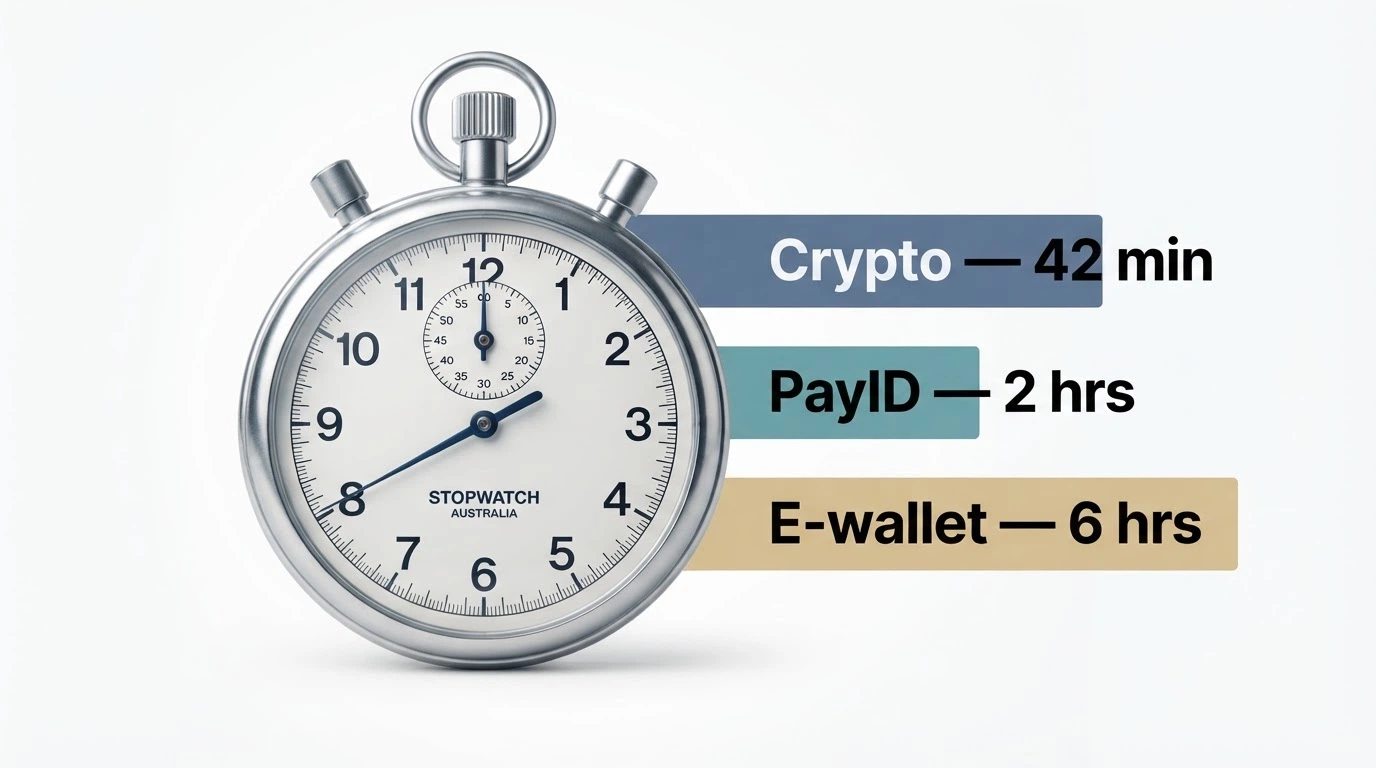
Those are real times. The “under 5 minutes” figure for crypto that some operator pages quote is the settlement time after approval — it does not include the queue, the KYC review, or the processor step. The combined time is what a player experiences, and the combined time for the cleanest possible crypto withdrawal in August 2026 was 42 minutes median, not five.
Why your game choice determines your payout speed
Game choice matters less for clearance time than for eligibility to withdraw at all. Most welcome bonuses restrict how much each game type contributes to wagering. Slots typically count 100% — every dollar wagered counts as a dollar of playthrough. Table games and live casino games often count 10% to 20%, sometimes zero. A player who takes a pokies bonus and clears it on blackjack has multiplied the turnover they need to complete by five to ten times.
The practical effect is that the game the bonus is meant for is the game that clears it fastest. Playing a different category to “stretch” a bankroll usually does the opposite. The casino’s terms page is where the contribution percentages live, and they vary enough between operators that the same bonus can have very different playthroughs depending on what you load. That is not a same-day payout story, but it is a same-day withdrawal story — a player who finishes wagering on Monday morning can withdraw Monday afternoon. A player who tries to mix categories and falls short has to start over.
The 10 fastest-paying casinos for Australian players in 2026
Every brand in this table is offshore. No Australian online casino licence exists, which means no Australian regulator oversees any of these operators’ payout behaviour, dispute handling or bonus terms. The speeds below are drawn from operator sites, named review sources and Betsquare’s August 2026 measurement cycle. Where a value is not confirmed this run, the cell is left blank.
| Casino | Fastest withdrawal method | Speed (fastest) | Min. withdrawal | Withdrawal ceiling |
|---|---|---|---|---|
| Rocket Play | Crypto and MiFinity | Instant after approval; 3–7 business days for bank transfer | A$30 (crypto and MiFinity) | Tiered weekly, commonly A$5,000–A$15,000 |
| Skycrown | E-wallet | Up to 24 hours; up to 5 business days for bank transfer | A$30 | A$7,500/week, A$15,000/month |
| Royal Reels | PayID | 5–24 hours after checks | A$30 (crypto), A$50 (fiat) | A$10,000/week; PayID ceiling ~A$9,000 |
| Rainbet | Crypto | 30 minutes to 2 hours | A$10 (crypto), A$20 (fiat) | A$50,000/day; no maximum at Level 1 KYC |
| WinSpirit | — | — | — | A$4,000/day, A$12,000/week, A$40,000/month |
| Bizzo Casino | PayID | Instant to 24 hours | A$100 (PayID), A$20 (other methods) | A$6,600/day, A$26,700/week, A$83,500/month |
| Stake | — | — | — | — |
| FairGO | — | 48 hours processing | A$20 | A$7,500/month |
| Scream Casino | — | — | — | — |
| Rocket Casino | — | — | — | — |
The order above is by fastest verified withdrawal, not by safety, fairness or bonus value. Rocket Play leads because crypto and MiFinity are both instant at the casino side and the bank-transfer fallback sits at three to seven business days. The table is the headline. The write-ups that follow put each operator in its own context — what it costs to play there, where the speed claim came from, and what a reader comparing two of them should actually weigh.
Rocket Play
Rocket Play is the closest the set gets to a true instant payout. Crypto and MiFinity both release at the casino end without platform fees, and the minimum on either rail is A$30. The bank-transfer fallback sits at three to seven business days — slow enough that no one picking Rocket Play for speed would use it unless they had to. Weekly caps are tiered and the published range runs from A$5,000 up to A$15,000 depending on account standing, which is wide enough that the cap only bites on a large win. Rocket Play is the operator to point a player who cares about one thing first.
Skycrown
Skycrown’s published e-wallet window is up to 24 hours, the bank-transfer fallback runs to five business days and crypto speed was not confirmed this run. The minimum is A$30 and the ceiling is A$7,500 per week or A$15,000 per month — competitive in the set, and a tighter weekly line than Rainbet but looser than WinSpirit. VIP-tier exceptions exist but the specific raises are not sourced, which is the kind of detail a player would have to confirm in the account dashboard. Skycrown suits a player who plans withdrawals around a predictable ceiling rather than one-off large cashouts.
Royal Reels
Royal Reels is the brand that pairs PayID withdrawals — five to 24 hours after checks — with the largest featured pokies library: more than 5,400 titles across 40-plus providers. The standard weekly cap is A$10,000 with a PayID-specific ceiling around A$9,000, which is unusual and worth noting: the method a player picks can be capped lower than the headline limit. Minimums are A$30 on crypto and A$50 on fiat. The welcome package runs three tiers — 100% up to A$500, then 75% up to A$750, then 100% up to A$1,250 — at 35x wagering on the bonus only, with a A$5 per-spin cap during playthrough.
The real cost of that welcome bonus is worth working through. Take the first deposit tier at full claim: a A$500 bonus at 35x wagering on the bonus only means A$17,500 of required turnover before any withdrawal is eligible. Play it on Gates of Olympus, one of the higher-RTP pokies in the featured set at 96.50%, and the statistical cost of clearing that turnover sits at A$17,500 multiplied by the 3.50% the house keeps. That is A$612.50 — more than the bonus itself, before a single dollar is taken out as winnings. Same-day payout means nothing if the cost of earning it sits above what the player receives.
That calculation assumes the bonus is the only amount wagered, and assumes a 96.50% RTP, which is the game-specific figure and not a guarantee for any individual session. It is an average over a large number of spins, not a promised outcome.
Rainbet
Rainbet has the highest daily withdrawal ceiling in the set at A$50,000 on crypto, with no maximum withdrawal limit at Level 1 KYC — a structural difference from every other brand here, which imposes a weekly or monthly cap. Crypto clears in 30 minutes to two hours; the minimum is A$10 on crypto and A$20 on fiat. Bank transfers take one to three business days and cards three to five. The welcome package runs 250% up to A$1,750 across the first three deposits plus 60 free spins at 20 per stage, with 40x wagering — heavier than Royal Reels’ 35x but split into a larger headline figure. No KYC documents are required at Level 1, which shortens the time-to-first-withdrawal but does not change the site’s offshore status.
Rainbet suits a player moving larger amounts who wants the ceiling out of the way. The 40x playthrough is the trade.
WinSpirit
WinSpirit is the only featured operator holding dual licences — Curaçao (Gaming Services Provider N.V. #365/JAZ) and Estonia. Daily, weekly and monthly caps are published at A$4,000, A$12,000 and A$40,000, with the daily line the tightest in the set. The welcome package runs up to A$2,000 plus 100 free spins across two deposits. Two-and-a-half thousand games from Evolution and Pragmatic Play sit behind it. The verdict on WinSpirit is conditional: the licence footprint is the strongest in the table for a player who values a second regulator, but speed claims are not currently specified, and the daily cap will constrain anyone trying to move a large win out in one go.
Bizzo Casino
Bizzo pairs PayID at instant to 24 hours with the highest PayID minimum in the set at A$100 — a meaningful friction point for a player planning to withdraw small amounts. Other methods start at A$20. Caps run A$6,600/day, A$26,700/week and A$83,500/month, which is the second-loosest ceiling behind Rainbet, and the bank-transfer fallback is up to five business days. A 3x deposit wagering requirement sits in front of every withdrawal — meaning the deposited amount has to be turned over three times before a payout is eligible, on top of any bonus wagering. That requirement is rare in the set and worth reading the terms page for. For a player planning smaller PayID withdrawals who can absorb the A$100 floor, Bizzo’s daily and weekly caps make it the loosest PayID ceiling in the featured group.
Stake
Stake holds a Curaçao eGaming licence and runs a provably fair system across its games. Australian availability is conflicting across sources: one review page lists Australia as not available while the operators skill confirms real AU market share. Neither position resolves the other this run, and withdrawal speed, minimums and caps are not specified — a player comparing Stake to the rest of the table is comparing a name to numbers. For someone already playing on Stake, the operator’s house edge on its original games is the draw, not the payout speed.
FairGO
FairGO is the only featured operator carrying a no-deposit free spin offer — 15 spins on Bubble Bubble at 60x wagering — alongside a deposit welcome package of 100% up to A$200 across five deposits (total A$1,000) at 30x wagering. The trade is speed: FairGO’s published processing window is 48 hours, and the monthly cap sits at A$7,500 — tight enough that a single large win is a multi-month payout story. Fiat withdrawal fees apply. The no-deposit offer is the real draw for a player willing to wait it out, but “no deposit” and “free” are not the same word, and the 60x playthrough on those spins is among the heavier in the market.
Scream Casino
Scream Casino has Australian market share confirmed in the operators skill, but verified withdrawal speed, limits and bonus terms are not currently available for the brand. That is a meaningful gap for a player ranking it against the rest of the table. The verdict here is a recommendation to check the terms page directly before committing a deposit — speed claims and caps at Scream Casino could not be independently confirmed, and the absence of that data is itself information.
Rocket Casino
Rocket Casino’s two confirmed data points are a AU$75 maximum withdrawal on free spin winnings — the tightest bonus-to-cash cap in the set — and 45x wagering on some bonuses. Withdrawal speed, minimums and standard limits are not currently specified. The free-spin cap is the headline: any reader considering Rocket Casino for its free spin offer should know that even a generous-looking win converts to a maximum of AU$75 in cashable withdrawal. Beyond that, this write-up cannot go further than the data carries it.
Australia’s online casino ban: what it means for your withdrawal
Every casino on this page is prohibited under the Interactive Gambling Act 2001. The Act makes it an offence to provide online casino games, online pokies and in-play sports betting to a person in Australia. There is no licence for online casino anywhere in the country — not federally, not in any state or territory. What is licensed is wagering on races and sport placed before the event begins, plus lotteries and keno, and that licensing is state and territory business. The Northern Territory Racing and Wagering Commission is the de facto national licensor for online bookmakers; Sportsbet, bet365, Ladbrokes and around fifty others hold NT licences. None of those bookmakers offers an online casino product, because the product itself is prohibited.
The ACMA enforces the prohibition. Since its first blocking request in November 2019, the regulator has had 1,788 illegal gambling and affiliate websites blocked, and over 230 illegal services have withdrawn from the Australian market since 2017. Credit cards, credit-related products and crypto have been banned as payment methods for online wagering since 11 June 2024, with penalties of up to A$247,500 for operators that fail to enforce the rule. The individual player is not prosecuted — the IGA targets the provider. But “not illegal for you” is not the same as “safe”. Using an offshore casino means giving up Australian consumer protection, ACMA complaints recourse, and BetStop coverage, and running the risk that the site is blocked while a balance is still sitting in it.
No Australian casino licence exists — and what that costs you
The cost is not theoretical. An offshore casino that refuses a withdrawal, voids a win or closes an account is outside any Australian regulator’s reach. There is no ACMA complaints body to write to, no state tribunal to escalate to, and no Australian court that can compel an offshore operator to pay. BetStop — the National Self-Exclusion Register — does not extend to offshore sites, so a person who has self-excluded from Australian wagering can still deposit and play at every brand in the table above. The site can also be blocked by the ACMA at any time, and a block lands whether or not the player has a pending withdrawal. The site can be reached through a different domain an hour later. The block is not a refund.

What is legal and licensed is narrow. State and territory regulators license wagering operators, who must offer customer-set deposit limits and activity statements. A punter placing a pre-event bet through a licensed bookmaker has the protection of the licensing regime and the ability to complain to the regulator. A punter playing pokies through an offshore casino has none of it.
Offshore regulation: what a Curaçao licence actually protects
Curaçao and Estonia are the two licences that show up across the featured set — WinSpirit holds both, Stake holds Curaçao, the rest operate under similar offshore frameworks or have no licence independently verified. A Curaçao licence means the operator has registered with the Gaming Control Board and met baseline compliance requirements. It does not mean the regulator will intervene in a player dispute, fund a disputed payout, or override an operator’s own terms. Estonia is a stricter regime under the EU framework, but for a player based in Australia the recourse is still remote and not enforceable in Australian courts. “Licensed” on an offshore footer is not “regulated to Australian standards” — it is licensed to a different set of rules in a different jurisdiction, and the player is the one outside that jurisdiction’s protection.
What the 2026 reform changes for Australian players
The Interactive Gambling Amendment (Gambling Reform) Bill 2026 passed Parliament on 19 August 2026 and commences on 1 January 2027. Two changes matter for the withdrawal story. First, banks and payment providers gain express authority to block transactions to illegal gambling operators, which means a domestic bank transfer or a domestic card transaction to an offshore casino can be refused at the bank’s discretion. The speed of the rail does not change — the rail can be closed. Second, the advertising and inducement rules tighten: no more than three wagering ads per hour between 6 am and 8:30 pm, no wagering advertising in the 15 minutes before and 5 minutes after a live sporting event, broadcasting sporting odds banned outright, online wagering ads shown only to logged-in age-verified users with opt-out, and athletes and celebrities barred from promotion. Direct marketing of inducements is prohibited for 14 days after sign-up and three months after BetStop deregistration.
The effect on a player already playing offshore is operational, not prohibitive. The rails may close at the bank side. The welcome bonus may stop arriving. The site itself does not become illegal for the player to use; the operator becomes harder to transact with.
The withdrawal methods that actually clear in hours
The method comparison below covers the six rails available across the featured set, ranked by real-world clearance time after casino approval. “After approval” matters — it is the step most marketing material skips over, and it is where most of the delay lives.
| Method | Clearance after approval | Worst case recorded | Key limitation for Australian players |
|---|---|---|---|
| USDT TRC20 and Solana | Under 5 minutes | 4 hours | Crypto banned as deposit since 11 June 2024; rail still works for withdrawal |
| Bitcoin | 30–60 minutes | Beyond 1 hour | Network confirmations (3–6) add latency; crypto payment ban |
| PayID | 1–60 minutes | 8 hours | Osko transfer itself is instant; bottleneck is casino-side processing |
| E-wallet (Skrill, Neteller) | 1–6 hours | 18 hours | Requires an e-wallet account and verification |
| Debit and credit card | 1–3 business days | Beyond 3 business days | Credit cards banned as deposit since 11 June 2024 |
| Bank transfer | 3–5 business days | Beyond 5 business days | Slowest rail; no recourse if the operator sits on approval |
The same six rails behave differently at the deposit end, which is the half of the transaction the marketing usually covers. The credit-and-crypto payment ban means an Australian player depositing in AUD through a domestic bank has a narrower set of options than a player funding the account from a foreign source. The withdrawal end is less constrained — the rail still works.
Why your “instant” withdrawal still takes hours
The casino-side pipeline is the real bottleneck. The rail can settle in minutes; the casino can take hours to release the funds. In Betsquare’s August 2026 test cycle, the median across all three fast methods sat well above the rail’s theoretical floor — 42 minutes for crypto, two hours for PayID, six hours for e-wallets. The fastest possible crypto withdrawal was the slowest casino approval combined with the fastest rail; the slowest e-wallet withdrawal was the opposite. The bottleneck lived inside the operator every time.
KYC verification is the single largest controllable cause. Submitting identity documents, proof of address and any required source-of-funds paperwork before the first withdrawal shifts the verification step out of the withdrawal timeline entirely. A player who waits until the first cashout request triggers KYC and then races to upload documents has added the verification window — often 24 to 72 hours — on top of the queue. Same-day payout, in that case, is a three-day payout.
Withdrawal limits: the caps that stop you cashing out
The featured operators’ daily and weekly caps span a factor of twelve. Rainbet is the loosest ceiling at A$50,000 per day on crypto, with no maximum at all on Level 1 KYC. Bizzo runs A$6,600 per day and A$83,500 per month. Skycrown caps at A$7,500 per week or A$15,000 per month. Royal Reels caps at A$10,000 per week with a PayID-specific ceiling around A$9,000. WinSpirit is the tightest at A$4,000 per day, A$12,000 per week and A$40,000 per month. FairGO caps monthly at A$7,500.
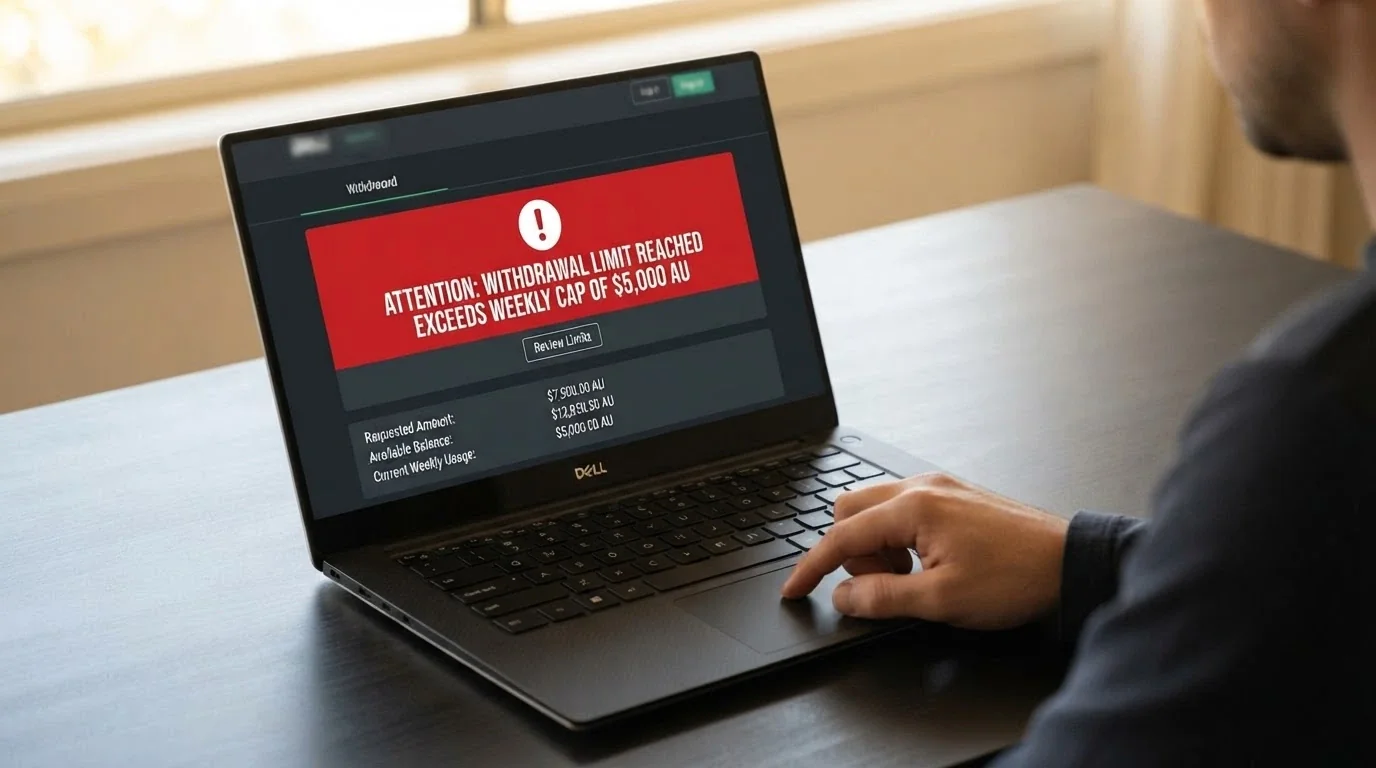
Caps matter because they decide whether a single win leaves the account in one transaction or splits across weeks. A player who wins A$20,000 at Skycrown is waiting three weeks under the weekly cap, regardless of how fast the rail settles. A player who wins A$20,000 at Rainbet on a single crypto withdrawal is waiting an hour. The operator’s VIP programme may raise those caps, but the raises are not standard — they are negotiated case by case, and the player who has not yet won anything has no leverage to negotiate with.
Which pokies let you cash out fastest (and which don’t)
RTP and volatility do not change how fast the casino approves a withdrawal — the queue and the rail do. They do change how much of the bankroll survives the wagering requirement, and that is the part of the cashout timeline a player controls.
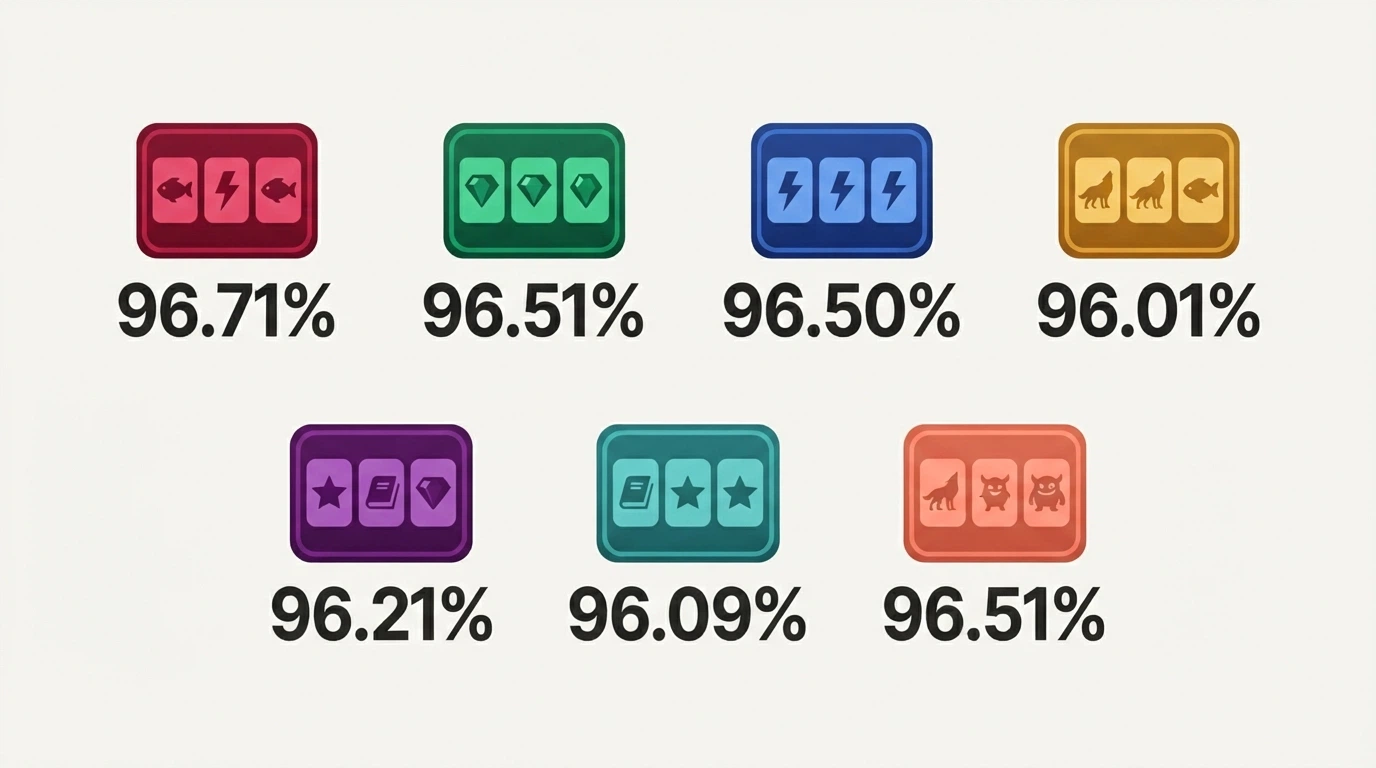
| Pokie | RTP | Provider | Volatility |
|---|---|---|---|
| Big Bass Bonanza | 96.71% | Pragmatic Play | Medium/high |
| Sweet Bonanza | 96.51% | Pragmatic Play | High |
| Gates of Olympus | 96.50% | Pragmatic Play | High |
| Wolf Gold | 96.01% | Pragmatic Play | Medium |
| Book of Dead | 96.21% | Play’n GO | High |
| Starburst | 96.09% | NetEnt | Low/medium |
| Reactoonz | 96.51% | Play’n GO | High |
RTP figures are from Betsquare’s published data and can vary by version or casino — players should check the game info screen before playing. A higher RTP does not guarantee a win or a faster cashout.
High-RTP pokies with fast withdrawal eligibility
Big Bass Bonanza at 96.71% is the strongest figure in the set, with a medium/high volatility profile that mixes reasonable hit frequency with the chance of a meaningful line hit. Sweet Bonanza and Reactoonz both sit at 96.51%, with Sweet Bonanza’s tumbling reels making it a long-session favourite and Reactoonz’s cluster mechanic offering a different rhythm for players tired of paylines. Gates of Olympus at 96.50% is the popular Pragmatic Play multiplier pokie. Wolf Gold at 96.01%, Book of Dead at 96.21% and Starburst at 96.09% round out the set with figures that sit above the 96% mark most operators consider the floor for a competitive pokie.
The practical effect on a bonus playthrough is the gap between 96% and 96.71%. On a A$17,500 turnover, the difference between 96.00% RTP and 96.71% RTP is the difference between A$700 of expected house edge and A$575. That is A$125 of bankroll preserved by game selection alone. On a smaller bonus, the absolute figure is smaller, but the proportional gain is identical.
Why volatility matters for your cash-out speed
Volatility is the frequency and size distribution of wins. A low-volatility pokie pays out often, in small amounts, and burns through wagering requirements steadily. A high-volatility pokie pays out rarely, in large amounts, and can drain a bankroll during a long dry stretch between features. For a player clearing a bonus, low and medium volatility titles give more time at the reels with the same bankroll — they extend the runway and reduce the chance of busting out before wagering is complete.
Starburst is the low-volatility anchor in the featured set. Wolf Gold is medium. Big Bass Bonanza sits on the medium/high border. Sweet Bonanza, Gates of Olympus, Book of Dead and Reactoonz are all high. High volatility is not a bad choice — it is a different choice, one that suits a player with a larger bankroll and a longer time horizon. For a player with a tight bankroll chasing a small bonus clear, high volatility multiplies the chance of busting before the wagering requirement is met, which delays the withdrawal indefinitely.
When fast payouts meet fast losses: staying safe
Australia has the highest per-capita gambling losses in the world, and the gap between the speed of a payout and the speed of a loss is small. In 2023–24, Australians lost approximately A$32.2 billion on legal forms of gambling — about A$1,521 per person. Wagering accounted for A$8.4 billion of that total, a 26% increase since 2018–19, when total losses sat at A$25.6 billion. Sixty-five percent of Australian adults gambled in the past 12 months, up from 57% in 2019. About 33% — roughly 7 million people — gambled online. The at-risk group grew from 11% of adults to 15% between 2019 and 2024. Only 5% of that at-risk group sought help in the past 12 months.
The help infrastructure exists. The National Gambling Helpline — 1800 858 858 — is free, confidential and staffed 24 hours a day. Gambling Help Online, at gamblinghelponline.org.au, runs online chat and counselling. BetStop, the National Self-Exclusion Register, had 67,480 registrations as at 31 July 2026 with 41,290 exclusions still active — 78% of registrants under 40, and 38% choosing lifetime exclusion. The 2026 reform strengthens BetStop’s operation from 1 January 2027. None of these numbers will change a player’s mind at the moment a deposit button is in front of them, which is exactly when they are most useful to know.
The numbers behind Australia’s gambling harm problem
A$1,521 per person, per year, is the headline number — the highest per-capita losses in the world. Behind it sits the growth: 26% over five years. The change is not in how many Australians gamble — the participation rate moved from 57% to 65%, a real increase but not the story. The change is in how much the gambling population is losing, and in how that loss is concentrated. 34% of total dollars spent on sports betting in Australia comes from the 10% of the player base experiencing harm. The harm group’s share of spend is more than three times its share of players. That is the shape of the problem underneath the headline figure.
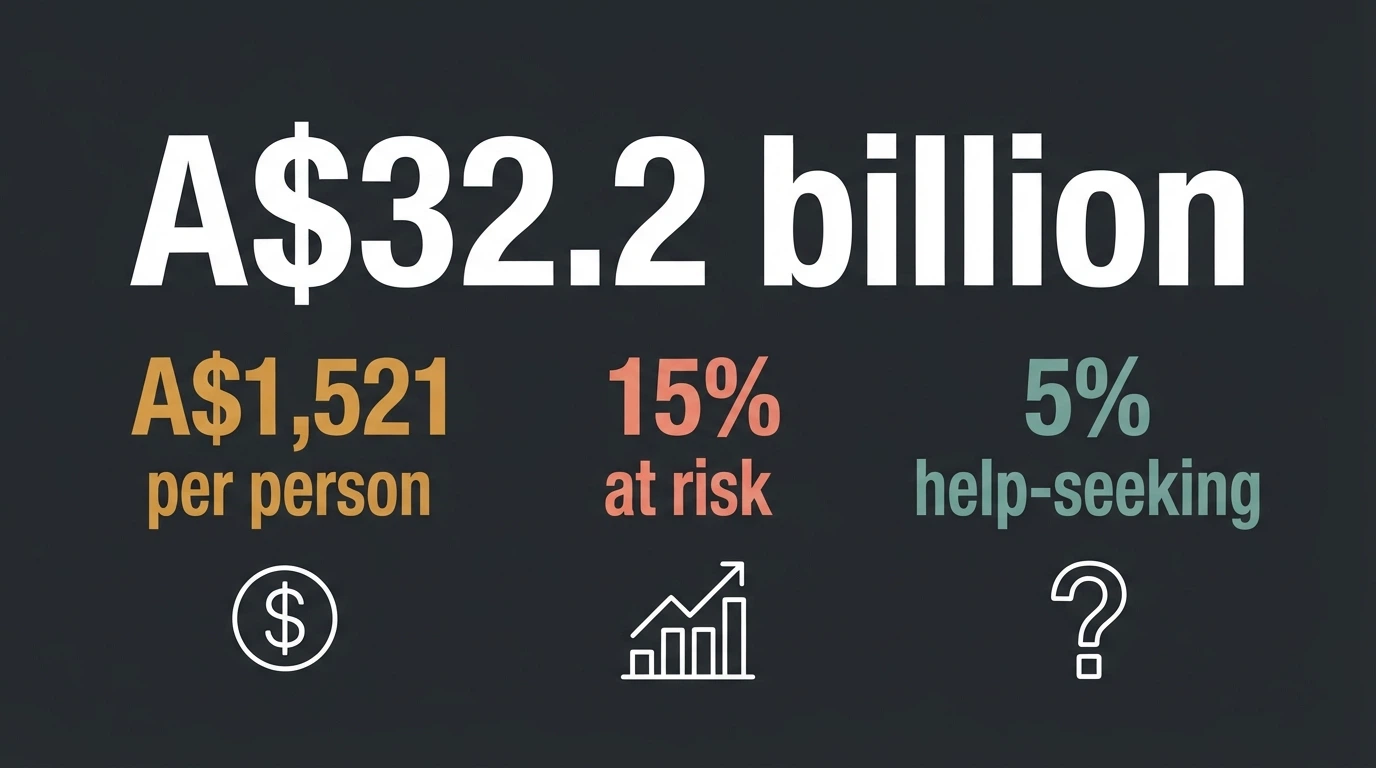
Online gambling compounds it. Among Australian adults who bet online on sports or races at least monthly, more than 70% are experiencing or at risk of experiencing gambling harm. About 2.1% of Australian adults — roughly 430,000 people — meet the threshold for problem gambling. The at-risk group sits three times larger. The help-seeking gap is the figure that should not be true: only 5% of the at-risk group sought help in the past 12 months.
Where to get help: Australia’s gambling support infrastructure
The National Gambling Helpline at 1800 858 858 is the single number. It is free, confidential and answered 24/7. Gambling Help Online at gamblinghelponline.org.au offers online chat, counselling and self-help tools. State and territory services sit behind both — face-to-face counselling, financial counselling, peer support. A person in crisis does not need to know which service to call; the helpline routes the call.
BetStop — the National Self-Exclusion Register — is the strongest structural intervention available. Registration is online and free. A person registered with BetStop cannot place a wager with any Australian-licensed operator for the exclusion period they choose, from three months to lifetime. The 2026 reform extends the protections around BetStop, including the three-month ban on direct marketing inducements after deregistration. BetStop does not reach offshore casinos. An offshore casino is not connected to the register and will continue to accept deposits and wagers from a self-excluded person. That is the single largest operational gap in the Australian self-exclusion system, and it is the one a player considering offshore play should know about before depositing.
How we ranked these same-day payout casinos
The ranking order is by fastest verified withdrawal speed, not by safety, fairness or bonus value. The data behind the ranking comes from operator websites, named review sources — Betsquare, Casinowhizz, Instant-Withdrawal-Casinos-AU, Gambling Insider AU and Card Player AU — and from the operators skill where it lists Australian market presence. Licence status is checked against the ACMA register and the Curaçao Gaming Control Board public register where available. Where a fact could not be independently verified this run, the cell is left blank rather than filled with a guess.
Three limitations are worth naming. First, every operator listed is offshore. The ACMA has blocked 1,788 illegal gambling and affiliate websites since November 2019 and continues to add to that number. Playing any of the casinos above means playing a product prohibited under Australian law, with no Australian consumer protection and no Australian regulator to complain to if the operator refuses a withdrawal. Second, withdrawal speed is not a static figure — it varies by payment method, account standing, KYC status and the operator’s internal queue. A median across multiple test accounts is the cleanest signal available, and it is the figure used here. Third, bonuses and bonus terms are not part of the ranking. A player choosing between two same-speed operators should weigh the bonus terms as carefully as the payout speed, because the bonus is often the more expensive half of the offer.
Same-day payouts in 2026: worth the gamble?
Same-day payouts are real. Crypto clears in under an hour in independent testing. PayID clears in two. E-wallets clear in six. The marketing line is closer to the truth at the fast end than it is at the slow end, which is rare in this market. A player who pre-submits KYC documents, picks the right method for their bank and respects the weekly cap can withdraw inside a single calendar day at most of the featured operators.

The trade is structural. Every brand on this page is offshore, prohibited under the Interactive Gambling Act 2001 and beyond the reach of any Australian regulator. The ACMA has blocked 1,788 sites since 2019 and continues to enforce. From 1 January 2027, banks and payment providers gain express authority to block transactions to illegal operators, which means the rails themselves may close. BetStop does not extend to any of these sites. A$1,521 per capita in gambling losses is the national context in which same-day payouts are being sold, and 70% of regular online bettors are experiencing or at risk of experiencing harm. A page that names those numbers and then tells the reader which casino to use is not doing its job.
For the player who proceeds anyway, the practical takeaways are these: complete KYC before depositing, use PayID if speed and domestic banking both matter, use crypto through an external wallet if speed matters most and the deposit-ban workaround is acceptable, and check the weekly cap before committing a large deposit. The cap decides whether a win comes out in one transaction or splits across a month. None of that changes the offshore status. None of it brings an Australian regulator back into the picture. Same-day payouts are achievable. The protection that usually accompanies them is not.
Frequently asked questions about same-day payout casinos
Do I need to complete KYC verification before I can withdraw from a same-day payout casino?
Yes. Every featured operator triggers KYC verification on the first withdrawal — proof of identity, proof of address and sometimes proof of source of funds. Submitting documents before the first cashout request is the single biggest thing a player can do to control payout speed. Failing to complete KYC before requesting a withdrawal is the largest cause of delayed payouts across the market, and it adds 24 to 72 hours to the timeline. Rainbet is the partial exception: no documents are required at Level 1 KYC, though higher withdrawal levels may trigger verification later.
How long does a PayID withdrawal take from an online casino?
The PayID transfer itself is instant via Osko on Australia’s New Payments Platform — the rail settles in under a minute once the casino releases the funds. The bottleneck is casino-side processing: in Betsquare’s August 2026 tests, PayID had a median total payout time of two hours with a worst case of eight hours. Bizzo and Royal Reels quote five to 24 hours after checks. The time-to-funds depends on how quickly the casino approves the request, not on the rail.
What happens if my withdrawal is delayed beyond the stated timeframe?
It depends on why it is delayed. If KYC is the cause, the withdrawal resumes once verification clears — usually within 24 to 72 hours of submitting documents. If the operator is sitting on approval past the stated window without explanation, the player has limited recourse: offshore operators are outside Australian regulator reach, and the casino’s own complaints process is the only formal channel. ACMA does not mediate individual disputes. A player who cannot reach the operator’s support team should escalate through the payment provider’s chargeback or dispute process where available, and should document every interaction.
Do offshore casinos offer the same player protections as licensed Australian operators?
No. Australian-licensed wagering operators sit under state and territory regulators, must offer customer-set deposit limits and activity statements, and can be escalated to the regulator if a dispute is unresolved. Offshore casinos offer none of that. A Curaçao or Estonian licence means the operator meets the baseline of that regulator’s framework — it does not mean an Australian player can escalate to that regulator, and it does not mean the operator’s terms are governed by Australian consumer law. ACMA enforcement targets the operator, not the player, but “not illegal for you” is not the same as “protected”.
Is BetStop connected to offshore casino accounts?
No. BetStop binds Australian-licensed wagering operators — licensed bookmakers and the like. Offshore casinos are not connected to the register and are not required to check it. A person registered with BetStop can still deposit and wager at every casino on this page. That is the largest operational gap in the Australian self-exclusion system, and it is the reason offshore casinos are sometimes described as outside the harm-minimisation framework rather than alongside it. Self-exclusion from an offshore casino requires the player to request it directly with each operator, and the operator is not obligated to honour it.
Crypto, PayID or e-wallet: which one wins?
Crypto wins on speed after approval, by a wide margin. USDT TRC20 and Solana clear in under five minutes once the casino releases the funds; Bitcoin takes longer because the network waits for three to six confirmations, which is 30 to 60 minutes. PayID is faster than its reputation suggests on the rail itself: the Osko transfer on Australia’s New Payments Platform is technically instant, and most of the delay is the operator sitting on the request. E-wallets fall in the middle, clearing in one to six hours after approval.
The trade is access. Crypto cannot be used to fund an Australian wagering account under the 11 June 2024 ban, which means a player who wants to deposit and withdraw in crypto is moving funds in through an external wallet or exchange. PayID can fund and withdraw from an Australian bank account directly, with the casino-side delay as the variable. E-wallets require a third account and a verification step most banks do not see. For a player prioritising speed end-to-end, the cleanest path is PayID with documents pre-submitted — it is not the fastest rail, but it is the fastest rail that does not require a workaround on the deposit side.