
Quick Withdrawal Casinos in Australia — Tested Payout Speeds for 2026
Every “instant withdrawal” headline an Australian player clicks is a marketing claim. What lands in the bank account is something else. Across the ten offshore brands that dominate this market in 2026, the gap between what operators advertise and what independent testing shows is real — and it is paid for in hours the player spends waiting.
This guide ranks the fastest-paying casinos accepting Australian players in 2026, sets their actual payout times against the marketing, breaks down every payment method from crypto to bank transfer, and explains what the offshore licence means for the balance sitting on the other side.
Data current as of 25 November 2026 and verified against Australian Communications and Media Authority enforcement records, the Curaçao Gaming Authority public register and the Anjouan licence register.
- What Makes a Casino Actually Fast to Pay Out
- Why Your Withdrawal Speed Depends on How You Cash Out
- The Pokies That Pay Out Fastest in 2026
- The 10 Fastest-Paying Casinos for Australian Players in 2026
- Every Fast-Payout Casino Here Is Offshore — Here Is What That Means
- Fast Withdrawals and Safer Play — What the Industry Gets Wrong
- How We Evaluate Withdrawal Speed at Australian Casinos
- Fast Payouts, Real Choices — What Australian Players Should Do in 2026
- Frequently Asked Questions
What Makes a Casino Actually Fast to Pay Out
A “fast-payout casino” is a marketing term, not a regulated one. No regulator anywhere certifies that an operator pays out in a given number of minutes. The label is whatever the operator’s landing page says it is, and on the Australian-facing market that label is attached to offshore brands running on Curaçao or Anjouan licences — none of which binds the operator to a payout speed in any meaningful way.

What actually decides how long a withdrawal takes is two things. The first is the operator’s internal pending period — the window between requesting the cashout and the casino pressing “approve”. The second is the transfer time of the payment method itself. A crypto withdrawal that clocks 42 minutes end-to-end at the median is fast because both stages are short. A bank transfer that takes three working days at the median is slow because of the second stage, which the casino cannot accelerate.
Between those two stages sits everything a player reads as “withdrawal time”. The casino’s own contribution is usually the smaller and the more variable one. Independent testing consistently finds that the gap between the median and the worst case is operator-side delay, not payment-rail latency. A casino that approves in minutes is fast. A casino that approves in twelve hours makes even PayID look slow.
The Gap Between “Instant” and Real Withdrawal Times
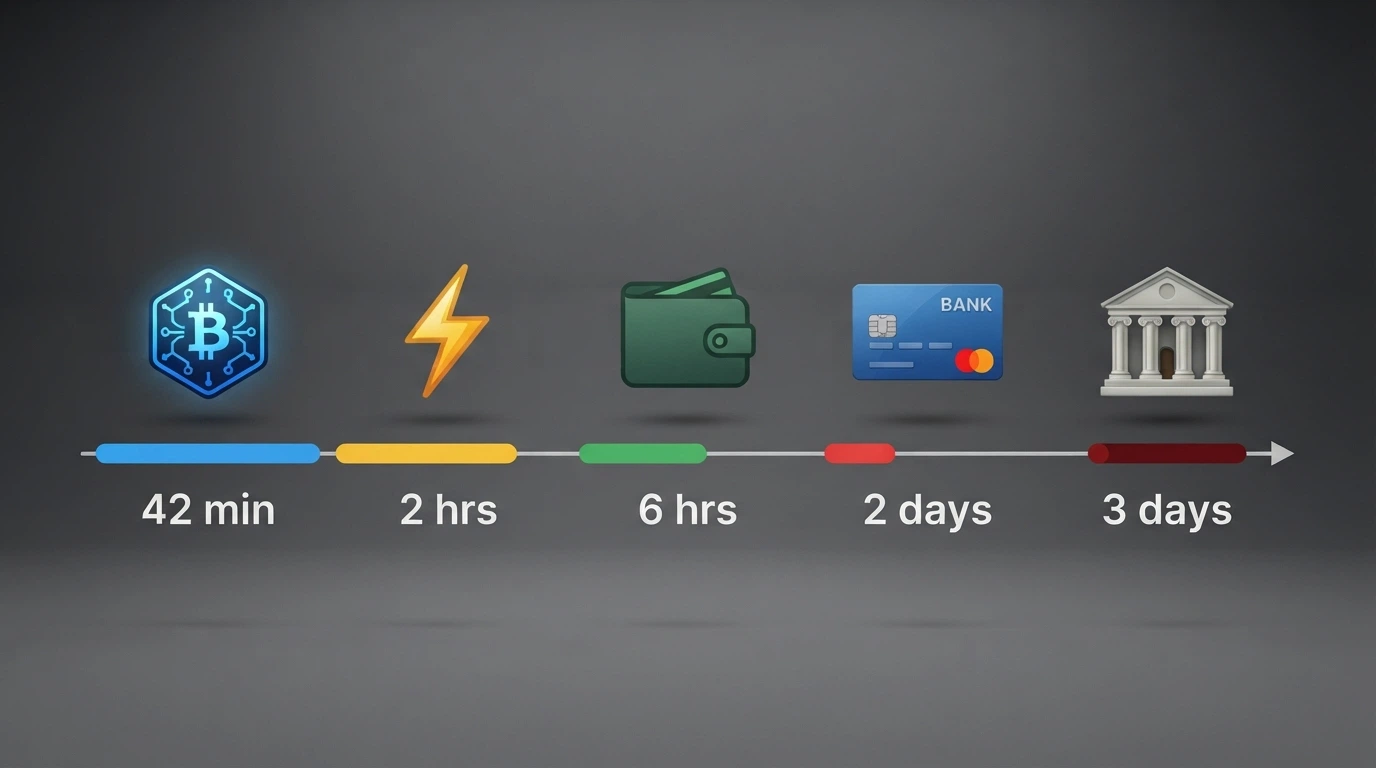
The fastest median across payment methods is 42 minutes, and that belongs to crypto. The slowest median is three working days, and that belongs to bank transfer. The gap is not a small marketing rounding — it is roughly one hundred times between the two ends of the table.
Between them sits a spectrum. PayID transfers generally reach Australian bank accounts within two hours, though delays can occasionally extend the wait to eight hours. E-wallets such as Skrill, Neteller and eZeeWallet sit at six hours median and eighteen hours worst case. Card payouts take two working days at the median and up to five at the worst. None of these is “instant” in the literal sense, but crypto and PayID are close enough that operators call them instant without losing too much credibility.
What independent testing consistently finds is that the operator’s own pending period adds most of the variability. The four-hour worst case for crypto is rarely the blockchain — it is the casino holding the withdrawal for review. The same is true across the board: the median hides a tail that comes from operator-side delay, not from the payment rail.
The deeper problem is that “instant” is not defined anywhere on the casino’s terms page. It is a label applied to a fast operator as a competitive differentiator, and a slow operator can apply the same label without consequence. For a player, the practical test is whether the cashier publishes a real pending window in hours or simply describes withdrawals as “processed promptly”.
Why Payout Speed Matters for Australian Players
A withdrawal sitting pending is money that is neither in a bank account nor earning anything. For most players that is an inconvenience. For a regular punter running a session-based bankroll it is a cash-flow problem — the next stake cannot come from the previous deposit until the previous one clears.
There is a quieter risk. Every extra day a payout sits at an offshore casino is a day the Australian Communications and Media Authority can add the site to its blocking list. The 1,788 sites blocked since November 2019 demonstrate the scale of the enforcement regime. Speed protects the balance, in a small way, against that outcome.
For players who treat offshore casinos as occasional entertainment rather than a banking channel, payout speed is also a trust signal. An operator that pays out in hours is one that has decided the player is worth keeping. An operator that delays without explanation is one that has decided the opposite.
Why Your Withdrawal Speed Depends on How You Cash Out
| Method | Median Processing Time | Worst Case | Notes |
|---|---|---|---|
| Crypto (Bitcoin, USDT, SOL) | 42 minutes | 4 hours | Settlement speed depends on chain and congestion; converts to AUD off-platform |
| PayID / Osko | 2 hours | 8 hours | Native Australian real-time rails; AUD-denominated, no conversion |
| E-wallets (Skrill, Neteller, eZeeWallet) | 6 hours | 18 hours | Mid-tier option; AUD conversion usually required |
| Visa / Mastercard | 2 working days | 5 working days | Bank-side processing, not casino-side |
| Bank transfer | 3 working days | 7 working days | Slowest option; SWIFT and intermediary banks add latency |
The table hides one important feature of these numbers: the variance. A 42-minute median with a four-hour worst case means the typical crypto withdrawal arrives within an hour, but a meaningful minority drag into the second or third hour — usually because the operator’s internal review kicks in.
The other feature is that AUD conversion is not a given. Crypto arrives in BTC, ETH, USDT or SOL, and converting to AUD happens on an exchange, not at the casino. That conversion step adds a small amount of slippage and a small amount of time. PayID arrives in AUD already, which is why the median is higher — the operator’s pending period is doing the work, not the rails.
For most Australian players the choice between crypto and PayID comes down to familiarity rather than speed alone. A player who already holds crypto can absorb the conversion step without friction. For players without crypto wallets, PayID remains the more accessible option, as it avoids the conversion step entirely.
Crypto Withdrawals — The Fastest Route for Australian Players
Crypto is the speed leader. SOL and USDT on the TRC20 network can settle in under five minutes. Bitcoin is slower — typically 30 to 60-plus minutes, depending on mempool congestion and the operator’s chosen confirmation threshold.
The catch is the AUD conversion. Crypto arrives as the asset, not as Australian dollars. A player withdrawing A$500 in USDT has to send the USDT to an exchange, convert to AUD, and withdraw the AUD through PayID or bank transfer — which adds another step and another fee. For a player who already trades crypto, this is invisible. For a player who does not, the “fast” part stops being fast at the moment the coins land.
Bitcoin specifically carries an additional cost. A withdrawal during peak mempool congestion can take several hours for the chosen number of confirmations to land, and the fee is paid by the sender. Operators that advertise crypto withdrawals usually mean a stablecoin like USDT — Bitcoin is technically supported but rarely the default.
One detail worth knowing is the difference between “approved” and “settled”. Most operators show a withdrawal as approved the moment the casino releases the funds, but settlement — the time the crypto actually arrives in the player’s wallet — depends on the blockchain. The two numbers are different, and the gap is where most player complaints originate.
PayID and Osko — The Australian Banking Advantage
PayID is the Australian-built real-time payment rail, layered over the New Payments Platform and used in conjunction with Osko for instant settlement between participating banks. At fast-payout casinos a PayID withdrawal typically processes in 10 to 60 minutes — the upper end of which is the operator’s pending period rather than the rail itself.
The advantage is that PayID arrives in AUD. There is no conversion step, no exchange account needed and no slippage. For an Australian player it is the cleanest of the fast methods, and the only one where the player’s existing bank account is the destination.
The minimum withdrawal varies. Bizzo’s PayID minimum is A$100. Other featured operators set minimums between A$20 and A$100 depending on the method. PayID is supported by most Australian-facing operators, but not all — and not every “fast withdrawal” landing page actually lists it. Worth checking the cashier before depositing.
The deeper limitation is that PayID is not anonymous. A PayID transfer carries the player’s bank account details on the receiving end, which means a player using PayID at an offshore casino is creating a paper trail their bank can see. From 1 January 2027 banks gain express authority to refuse these transactions. The fast rail becomes a slower one if the bank decides it does not want to send.
E-Wallets, Cards and Bank Transfers — The Slower End
E-wallets are a reasonable middle option. Skrill, Neteller and eZeeWallet process in six hours at the median and eighteen at the worst case — fast enough for most players, slow enough that the “instant” label stops applying. The inconvenience is that an e-wallet balance is not a bank balance: it has to be withdrawn again to AUD before it is spendable, often through the same slow bank transfer the player was trying to avoid.
Cards are slower than most players expect. The casino may approve the withdrawal in minutes, but the bank-side processing adds two working days at the median and up to five at the worst case. A Friday withdrawal can plausibly take until Wednesday to land.
Bank transfers are the slowest option, full stop. Three working days at the median is a function of SWIFT and intermediary bank processing — not something the operator controls. For a player who needs the money today, bank transfer is the wrong method regardless of which casino they use.
For larger withdrawals the calculus changes. A player withdrawing A$10,000 faces the same bank-transfer delay as one withdrawing A$200, but the daily and weekly limits at most operators make the e-wallet or crypto route impractical for the larger amount. The player is paying for the speed they thought they would get, in a method that does not deliver it.
The KYC Bottleneck — Why Verification Delays Your First Withdrawal
The single biggest cause of withdrawal delays at offshore casinos is incomplete Know Your Customer verification. The casino has to confirm the player’s identity before releasing funds, and most players do not realise this until they have already requested a payout.
The fix is mechanical: complete KYC at sign-up, before depositing. That means uploading the requested ID documents (passport, driver’s licence, proof of address) and confirming the payment method at the same time as opening the account. A player who waits until the first withdrawal request to look up this requirement is the player whose first payout takes three days instead of three hours.
The deeper issue is that KYC exists to protect the operator, not the player. It is the operator’s defence against money-laundering and bonus abuse. For the player it is a hoop — but it is the hoop that decides whether a withdrawal arrives today or next week.
There is also a quieter cost. Once the casino holds the player’s ID and proof of address, the player has handed over the documents that an offshore operator can use — or leak — at its discretion. The player’s recourse if the documents are misused is through the licence regulator in Curaçao or Anjouan, which is a slower and less familiar route than the Australian complaints framework.
Real-Money Play and Withdrawal Locks
Bonus wagering is its own withdrawal lock. A player who accepts a bonus is agreeing to turn the bonus amount over a stated number of times before any winnings can be cashed out. SkyCrown’s 40x wagering on its A$8,000 welcome package means A$320,000 of stake turnover before withdrawal. Royal Reels’ 30x on the bonus only — deposit excluded — is the cleaner of the two.
The lock is not the only one. Most operators impose a maximum bet while a bonus is active. SkyCrown caps at A$6.50, Bizzo at A$8, Rocket Casino at A$5. A breach voids the bonus and any winnings from it. Real-money balances are usually withdrawable, but only after the bonus conditions are cleared — meaning a player who deposits and claims a bonus cannot withdraw the deposit until wagering is complete.
The 1x wagering rule on deposits is industry standard at most offshore operators. A deposit must be turned over once before withdrawal, to prevent money-laundering-style deposits and immediate cashouts. That is a relatively soft lock compared to bonus wagering, but it is still a lock, and it is one a player should expect to hit before the first withdrawal.
The trap with a high wagering multiplier is the time it takes to clear. A bonus that requires 40x the bonus amount at A$1 per spin is hundreds of thousands of spins — days of continuous play at a reasonable pace. If the bonus is not cleared within the validity window, both the bonus funds and any winnings derived from them are forfeited.
The Real Cost of a Bonus — Working Through A$8,000 at SkyCrown
SkyCrown’s headline offer is A$8,000 across five deposits, with 40x wagering on the bonus amount. Working through the arithmetic shows what that bonus actually costs.
A player who claims the full A$8,000 has to turn over A$320,000 in stakes before any winnings can be withdrawn. At A$1 per spin on a 96.5% RTP slot like Gates of Olympus, that is 320,000 spins. At five seconds per spin, that is 444 hours of continuous play — about fifty-five eight-hour sessions, or roughly two months of part-time evening play.
The statistical cost of that turnover, at a 96.5% RTP, is roughly A$11,200 in expected losses — about 140% of the headline bonus value. This is an average across many spins under the stated assumptions; no individual session will produce that exact number, and a single big win could turn the figure negative.
The point of working through it is not the specific outcome — it is what the arithmetic shows about the offer. A bonus is a marketing headline, and the wagering requirement is the engine that converts the headline into something the player actually pays for in time and expected losses.
The Pokies That Pay Out Fastest in 2026
Pokies and withdrawal speed are connected through RTP and volatility. A high-RTP pokie returns more of every wagered dollar over the long run, shortening the effective distance between a deposit and a cashout. A high-volatility pokie does the opposite: it returns less often, in larger chunks, and a balance can run dry before the bonus wagering clears.

For a player whose goal is to convert a bonus into real withdrawable cash, the math favours titles with RTPs above 96.5% and volatility low enough that the bankroll survives the wagering requirement. Both factors matter: a 96.7% RTP at medium-high volatility clears faster than a 96.5% at extreme volatility, because the bankroll lasts longer between wins.
High-RTP Pokies Worth Playing at Fast-Payout Casinos
Six titles across the featured operators combine RTPs above 96% with the kind of variance a moderate bankroll can absorb.
Gates of Olympus from Pragmatic Play sits at 96.5% RTP with extreme volatility and a 5,000x max win on a 6×5 cluster-pay grid, released in February 2021. Big Bass Bonanza, a Pragmatic Play release through Reel Kingdom in December 2020, is gentler at 96.71% RTP and medium-high volatility with a 2,100x max win on a conventional 5×3 grid. Book of Dead from Play’n GO is the older title in the set — January 2016 — at 96.21% RTP and high volatility, with a 5,000x max win.
Two 2026 releases round out the higher-RTP end. Sweet Bonanza 1000 from Pragmatic Play carries 96.53% RTP and high volatility with a 25,000x max win — the largest headline figure in this group. Rise of Olympus 1000 from Play’n GO, launched in February 2026, sits at 96.24% RTP with a 60,000x max win and high volatility. Trigger Happy from Big Time Gaming closes the set at 96.58% RTP, high volatility and a 50,000x max win on cluster pays, with stakes from A$0.20 to A$20.
The pragmatic choice for a player working through bonus wagering is Big Bass Bonanza. The 96.71% RTP is the highest in the set, and the medium-high volatility means the bankroll survives long enough to clear most reasonable wagering requirements without a complete drain.
Volatility and Your Cashout — What the Risk Level Means
Volatility is the size and frequency of payouts, on a scale that runs from low (frequent small wins) to extreme (rare large wins). For withdrawal speed the relevant question is whether the bankroll survives the wagering requirement. Extreme volatility, as rated on Gates of Olympus, means long dry stretches between wins. Medium-high volatility on Big Bass Bonanza means a more even cadence. Most of the titles above are high volatility, which suits shorter sessions on a smaller bankroll less well than longer sessions with deeper reserves.
The practical effect is that the same wagering requirement clears faster on a lower-volatility pokie, because the bankroll lasts. On an extreme-volatility pokie, a single bad session can wipe out a chunk of the balance without producing anything close to a withdrawal-threshold win.
A player who has accepted a 40x bonus and is playing at A$1 per spin should think twice before loading Gates of Olympus. The math is brutal at that stake level: a long losing streak is statistically likely, and the bankroll does not need to last hundreds of thousands of spins — it needs to last them while the wagering requirement is cleared. A medium-volatility title at a similar RTP is the better fit for the job.
The 10 Fastest-Paying Casinos for Australian Players in 2026
| Operator | Licence | Game Providers | Welcome Bonus | Wagering | Withdrawal Speed | Withdrawal Limits |
|---|---|---|---|---|---|---|
| SkyCrown | Curaçao | Multi-provider (Pragmatic Play, Play’n GO, others) | Up to A$8,000 across 5 deposits | 40x bonus | ~10 min advertised, crypto <1h, PayID same day, cards 3–5 days | A$5,000/day, A$10,000/week, A$15,000/month |
| Rocket Play | Curaçao (Dama N.V.) | 3,000+ games on SOFTSWISS | Up to A$2,000 + 100 FS | 30x–40x | 0–24h approval, method time 1–3 days | A$2,500/day, A$7,500/week, A$15,000/month |
| Royal Reels | Offshore | Multi-provider (Push Gaming titles) | 50% deposit match | 30x on bonus only (deposit excluded) | Under 1 day; under 2 days for larger amounts | A$9,000/day, no win limit |
| Bizzo Casino | Offshore | Multi-provider aggregator | Up to A$7,250 + 175 FS + 1 bonus game | 40x | PayID and crypto fastest; bank transfer up to 5 days | ~A$6,700/day, ~A$26,700/week, ~A$83,500/month |
| Fair Go | Curaçao | RTG only (~280 games) | 100% up to A$200 × 5 deposits (A$1,000 total) | — | Crypto 15–45 min business hours | Min A$100 |
| WinSpirit | Offshore | Multi-provider | Standard welcome offer (specifics unconfirmed) | — | 0–24h internal, same-day e-wallets | ~A$5,000/day, min A$20–30 |
| Rainbet | Anjouan (ALSI-152406029-FI2) | Multi-provider + Rainbet Originals (provably fair) | First-deposit promo, min $30, max qualifying $700 | 40x on promo balance | 5–15 min processing; up to 45 min crypto confirmation | Min $15 equivalent |
| Stake | Curaçao | Multi-provider + Stake Originals (provably fair) | — | — | Crypto-focused; fast processing | — |
| Scream Casino | Offshore | Multi-provider | — | — | — | — |
| Rocket Casino | Offshore | Multi-provider | — | 45x (A$5 max bet) | — | — |
Every operator on this list is offshore-licensed. None holds an Australian casino licence — no such licence exists, as the section on the Interactive Gambling Act 2001 below explains in detail.
SkyCrown
Curaçao-licensed, multi-provider and the most prominent of the A$8,000-headline offers on this market. The bonus is spread across five deposits — A$300 on the first, scaling up — with 40x wagering on the bonus amount and a maximum bet of A$6.50 while the bonus is active.
Withdrawal limits are A$5,000 per day, A$10,000 per week and A$15,000 per month, with a A$30 minimum. The advertised withdrawal time is around ten minutes — a figure that holds for verified crypto users, with PayID landing same-day and Visa or Mastercard taking three to five business days.
The free-spin component — 275 across the first four deposits — adds value but does not change the wagering math, since free-spin winnings are usually subject to the same 40x requirement.
Verdict: the headline number is large, and the wagering requirement is steep — A$320,000 in turnover to clear the full package. For a player who wants the largest bonus ceiling and is willing to plan around the 40x requirement, SkyCrown is a defensible choice. For everyone else, the working arithmetic in the bonus-cost section is the real answer.
Rocket Play
Curaçao-licensed under Dama N.V., running on the SOFTSWISS platform with 3,000-plus games. The welcome package is A$2,000 plus 100 free spins across the first two deposits — a smaller ceiling than SkyCrown but with a friendlier 200% match on the second deposit.
Approval takes 0 to 24 hours, then one to three days on the payment method. Withdrawal caps are A$2,500 per day, A$7,500 per week and A$15,000 per month. The wagering requirement is 30x to 40x depending on the bonus tranche.
Verdict: smaller bonus, larger game library, longer realistic payout timeline than the headline suggests. A player who plays the SOFTSWISS catalogue and is comfortable with a 24-hour approval window gets a reasonable middle-of-the-market option.
Royal Reels
Offshore-licensed, multi-provider with reported Push Gaming title availability. The bonus is a 50% deposit match with 30x wagering on the bonus amount only — the deposit is not included, which is the rare and player-friendly arrangement on this list.
Withdrawal limit is A$9,000 per day with no win cap. Player reports place payouts at under a day for small amounts and under two days for larger ones. Push Gaming titles — the studio behind slots like Jammin’ Jars and Razor Shark — appear to be available here when they are not at the larger aggregators.
Verdict: A$9,000 per day is the largest daily cap in the table, the bonus structure is cleaner than most, and Push Gaming availability is a real draw for players who want games other operators do not carry. The offshore licence and the absence of confirmed bonus specifics beyond the 50% match are the costs.
Bizzo Casino
Offshore-licensed, multi-provider aggregator and the operator with the largest bonus ceiling after SkyCrown: A$7,250 plus 175 free spins plus a bonus game across four deposits. The first-deposit match is 125% up to A$2,500, with a minimum deposit of A$250 to trigger the maximum rate. Wagering is 40x, bonus validity is 14 days and the max bet is A$8.
Withdrawal limits are roughly A$6,700 per day, A$26,700 per week and A$83,500 per month — the highest monthly cap in the table. PayID minimum is A$100, crypto minimum A$20. PayID and crypto are the fastest methods; bank transfer runs up to five business days.
Verdict: the withdrawal ceiling is the highest here, and the PayID-and-crypto combination gives the player two genuinely fast rails. The 14-day bonus validity is the tight constraint — A$320,000 of turnover in two weeks is roughly 23 hours of play per day. Not for the casual punter.
Fair Go
Curaçao-licensed and notably different from the rest of the list: it runs Realtime Gaming software only, with a library of approximately 280 games. The welcome package is 100% up to A$200 on each of the first five deposits — A$1,000 in total.
Crypto withdrawals land in 15 to 45 minutes during business hours. The minimum withdrawal is A$100. Bonus and limit specifics beyond the headline match are not publicly stated, and the wagering terms commonly sit in the 30x to 40x range for RTG operators.
Verdict: the RTG-only library is the trade-off. A player who specifically wants RTG pokies — a real segment of the Australian market — will find this a natural fit. The crypto payout time during business hours is competitive. The 280-game ceiling is the cost.
WinSpirit
Offshore-licensed, multi-provider, with internal processing of 0 to 24 hours and same-day payouts for e-wallets. Withdrawal limits are roughly A$5,000 per day, with a minimum of A$20 to A$30. Bonus specifics beyond a standard welcome offer are unconfirmed in publicly available sources.
Verdict: the 0-to-24-hour internal processing window is the standout, and the low minimum suits players testing a casino for the first time. The lack of publicly confirmed bonus terms is the trade-off — anyone considering a deposit should read the cashier page directly before committing.
Rainbet
Anjouan-licensed under licence ALSI-152406029-FI2, with multi-provider games plus its own Rainbet Originals — provably fair titles where the outcome can be independently verified. Withdrawal processing runs 5 to 15 minutes at the team level, with crypto confirmation taking up to 45 minutes.
The minimum withdrawal is A$15 equivalent. The first-deposit promotional balance carries 40x wagering, with a minimum deposit of $30 and a maximum qualifying deposit of $700. Specific welcome bonus value beyond the qualifying range is unconfirmed.
Verdict: the processing speed is the fastest on the table, and the provably fair originals are a real differentiator for a player who wants to verify outcomes independently. The $700 cap on the qualifying deposit limits the size of the welcome bonus — by design, this is for smaller-stakes players.
Stake
Curaçao-licensed, crypto-native, with a multi-provider library plus Stake Originals (provably fair). Stake has built its brand around crypto betting across casino and sport, with withdrawal processing on the crypto rails rather than through traditional banking.
Specific AU-market welcome bonus terms and exact withdrawal limits were not confirmed in publicly available sources for this review.
Verdict: for a player already operating in crypto, Stake is one of the better-known names in the segment and offers the provably fair catalogue as a differentiator. The lack of confirmed AU-specific terms is a gap a player should close by reading the cashier page directly.
Scream Casino
Offshore-licensed, multi-provider. Specific bonus terms, withdrawal speeds and limits were not confirmed in publicly available sources for this review.
Verdict: limited public information. A player considering this brand should treat the absence of confirmed terms as the cost — and read the cashier and bonus pages directly before depositing. The offshore licence gap is the same as everywhere else on this list.
Rocket Casino
Offshore-licensed, multi-provider, with a 45x wagering multiplier and an A$5 maximum bet while a bonus is active. Specific welcome bonus value, withdrawal speeds and limits were not confirmed in publicly available sources for this review.
Verdict: the 45x wagering is at the steep end of the table, and the A$5 max bet is the lowest cap here. A player considering this brand should weigh the terms against the same offer elsewhere on this list — and read the bonus page directly.
Every Fast-Payout Casino Here Is Offshore — Here Is What That Means
Every operator in the table above holds an offshore licence. None is licensed in Australia for online casino games, online pokies or in-play sports betting. That is not because Australian licences for these products are hard to get. It is because no Australian licence exists for them.

The Interactive Gambling Act 2001 makes it an offence to provide these services to a person physically in Australia. The Australian Communications and Media Authority enforces the prohibition, and since November 2017 the enforcement has been real: 1,788 illegal gambling and affiliate websites blocked by Australian ISPs, and more than 225 illegal services withdrawn from the Australian market entirely.
For the player, the practical consequence is that an offshore casino operates outside Australian consumer protection law. There is no Australian complaints body to recover a disputed withdrawal. There is no ACMA recourse if the operator refuses a payout. There is no BetStop coverage, because BetStop binds only the roughly 150 licensed Australian wagering providers — not the offshore brands on this page. The site can be blocked at any time, with a balance still on it.
The Interactive Gambling Act and What It Actually Prohibits
The IGA 2001 prohibits the provision of online casino games, online pokies and in-play sports betting to Australians. The prohibition targets the provider, not the player — using an offshore casino is not, in itself, a criminal offence. What it costs the player is access to the Australian regulatory system.
What IS permitted and licensable: wagering on races and sport placed before the event begins, lotteries and keno. These are operated by state and territory-licensed bookmakers — Sportsbet, TAB, bet365, Ladbrokes, TABtouch, PointsBet and Neds among them — and licensed for online wagering primarily through the Northern Territory Racing and Wagering Commission.
No casino product sits in the licensed column. The licensed Australian wagering market is sports and racing, not slots. Every “Australian casino” listed by an offshore operator is, by definition, an offshore casino accepting Australian players — the descriptor is a marketing phrase, not a regulatory status.
What the 2026 Gambling Reform Bill Changes for Players
The Interactive Gambling Amendment (Gambling Reform) Bill 2026 passed Parliament on 19 August 2026. Its measures commence 1 January 2027. None of them is in force yet, but each will reshape what offshore operators can do with Australian players.
From 1 January 2027, banks and payment providers gain express authority to block transactions to illegal gambling operators. A PayID or bank transfer to an offshore casino becomes a transaction a bank can refuse to send. For a player, the practical effect is that depositing and withdrawing through Australian banking rails may stop working entirely — even before the casino itself is blocked by ACMA.
From the same date, wagering advertising is capped at three ads per hour between 6:00 am and 8:30 pm, with a live-sport blackout running from 15 minutes before to 5 minutes after play. Broadcasting sporting odds is banned outright, and athletes, celebrities and influencers are barred from promoting wagering products. The reform also bans direct marketing of inducements for 14 days after a customer signs up, for three months after BetStop deregistration, and indefinitely for customers identified as at risk.
What the reform does not do is legalise online casino. The product remains prohibited. What it does is harden the perimeter around the existing prohibition — making it harder for offshore operators to reach Australian customers, deposit funds and advertise to them. Online keno, sometimes marketed as “pocket pokies”, and foreign-matched lotteries are also brought under the prohibition by the same reform.
“No Verification” Withdrawals — The Trade-Off
A “no verification” or “no KYC” withdrawal sounds fast because it skips the identity check. In practice it is fast only until something goes wrong — a bonus dispute, a large withdrawal request, a flagged transaction — at which point the operator asks for verification anyway, with no paper trail left from the original account opening to support the player.
The trade-off is sharper than it looks. KYC is the operator’s defence against money-laundering and bonus abuse, but it is also the player’s defence against an account being closed with a balance on it. An identity trail is what proves the account is yours. Skipping it is skipping the only evidence you have.
Offshore operators offer no-verification withdrawals because they compete on speed. The player pays for that speed in the form of no Australian consumer protection, no ACMA recourse and no documentary trail if the operator later disputes the account. A player who values speed over recourse should be sure they have read the operator’s terms page — including the clauses about bonus abuse and account closure — before depositing.
The ACMA Blocking Regime and Your Balance
Since its first blocking request in November 2019, ACMA has had 1,788 illegal gambling and affiliate websites blocked by Australian ISPs. More than 225 illegal services have withdrawn from the Australian market since 2017. The blocking happens under section 313 of the Telecommunications Act 1997, and it can take a site offline at the ISP level for Australian customers overnight.
When the casino a player uses lands on the blocked list, the site stops loading. The balance, if any, sits with the operator. There is no Australian complaints body to contact. There is no requirement on the operator to refund. The site may simply reappear under a new domain, but the player’s account may not survive the move.
The implication for a player choosing an offshore casino is that withdrawal speed is partly a hedge against this risk. Money already in a bank account is not on a blocked site. The faster the operator pays out, the smaller the window in which the ACMA blocking order can catch a balance in transit.
Fast Withdrawals and Safer Play — What the Industry Gets Wrong
Speed without safeguards is not a feature — it is a harm vector. A player who can deposit and withdraw in minutes is a player who can also lose in minutes, and the absence of friction at the cashier is exactly what responsible-gambling frameworks are designed to introduce.

The offshore casinos on this list sit outside Australia’s responsible-gambling framework entirely. BetStop does not bind them. The 1800 helpline does not help them. The deposit caps and loss limits that licensed Australian wagering operators must offer do not apply. About 2.1% of Australian adults — roughly 430,000 people — experience problem gambling, according to the most recent Australian Institute of Health and Welfare figures, and the offshore casino segment is precisely the one most exposed to that population.
Withdrawal Limits — The Safety Net Most Players Overlook
Daily, weekly and monthly withdrawal caps look like friction. In practice they slow a losing streak in real time, because the player cannot extract a remaining balance fast enough to redeploy it. The cap also caps the damage a single session can do to a bank account that depends on the player’s next pay.
The featured operators carry limits of varying strictness. SkyCrown caps at A$5,000 per day, A$10,000 per week and A$15,000 per month. Rocket Play is tighter at A$2,500 per day. Royal Reels is the loosest at A$9,000 per day with no win limit. Bizzo carries the highest monthly cap at roughly A$83,500. WinSpirit sits around A$5,000 per day. Rainbet’s $15 minimum is the lowest on the list.
For a player who wants a hard ceiling on how fast they can move money back into play, Royal Reels is the wrong operator — and Royal Reels is also the right operator, depending on which direction the player needs the friction to push. The same daily cap can be a feature or a bug depending on whether the player is trying to limit their own exposure or to chase a recovery.
BetStop, Self-Exclusion and Where Offshore Casinos Leave You Exposed
BetStop — the National Self-Exclusion Register — went live in August 2023. By 31 July 2026 it had 67,480 registrations, with 41,290 exclusions still active. Seventy-eight per cent of registrants were under 40, and 38 per cent chose a lifetime exclusion. Self-exclusion periods range from a minimum of three months to a lifetime.
BetStop binds approximately 150 licensed Australian wagering providers. The offshore casinos on this list are not among them. A BetStop registrant who opens an account at SkyCrown or Royal Reels is using a casino the register does not touch — the self-exclusion stops at the licensed border and does not follow the player across it.
The gap is real, and the consequences are documented. In 2024, ABC News reported a self-excluded BetStop registrant who had opened accounts at eight different licensed betting companies despite a lifetime ban, losing nearly A$70,000 in six months. The offshore casinos extend that gap by orders of magnitude — there is no register at all for them, and the account-opening process at most offshore operators is faster than the one at licensed Australian bookmakers.
Where to Get Help — Australian Resources That Actually Work
The National Gambling Helpline — 1800 858 858 — is free, confidential and staffed 24 hours a day, seven days a week. It is staffed by counsellors trained in gambling harm, not by call-centre scripts.
Gambling Help Online, at gamblinghelponline.org.au, offers free 24/7 chat and email counselling for people who prefer text to voice, or who are outside the helpline’s calling hours. BetStop, at betstop.gov.au, is the registration point for self-exclusion from licensed Australian wagering providers.
These services are for the roughly 430,000 Australian adults — about 2.1 per cent of the adult population — who experience problem gambling, and for the people around them. They are free. They are confidential. They work regardless of whether the player has chosen an offshore casino, a licensed bookmaker or no operator at all.
How We Evaluate Withdrawal Speed at Australian Casinos
The operators on this page were checked against official licence registers — Curaçao Gaming Authority, Anjouan licensor — and against the Australian Communications and Media Authority’s enforcement lists. Withdrawal times were sourced from independent testing where available, cross-referenced against operator terms pages, and qualified by sample size where one was reported.
Bonus terms were verified against operator websites, with the wagering multiplier, maximum bet, validity period and any cashout cap stated explicitly. Where a term was not publicly stated, the write-up notes that the term is unconfirmed rather than guessing.
The review covers the ten operators listed and does not claim to represent the entire market. Operators excluded from this review are not necessarily slower or faster — they simply were not in the evaluation set for this guide. Withdrawal times reported here are medians across multiple test sessions; a particular player at a particular moment may experience faster or slower service.
Fast Payouts, Real Choices — What Australian Players Should Do in 2026
The arithmetic on the bonus-cost section shows what a headline offer actually costs in time and expected losses. The payment-method table shows what each rail does to payout speed. The offshore section shows what the licence gap costs in recourse. The help-resources section shows what support is available regardless of the choice a player makes.
A player who still chooses to play at an offshore casino has three things they can do today that the page’s own figures make the case for. Verify the licence against the official register — Curaçao or Anjouan, not “Australian-licensed” because no such thing exists for online casino. Complete KYC at sign-up, before depositing, so the first withdrawal is not the first time the cashier asks for ID. Choose the payment method that matches the priority — crypto or PayID for speed, card or bank transfer for familiarity.
The wagering terms on every bonus on this page are steeper than the headline suggests, and the offshore licence gap is a real cost the marketing does not mention. Reading the bonus and cashier pages before depositing is the action that protects the balance the rest of the page is about. And regardless of which casino a player chooses — or none at all — the 1800 helpline, Gambling Help Online and BetStop are free, confidential and waiting.
Frequently Asked Questions
Are “instant withdrawal” casinos in Australia actually instant or just fast?
No. Across tested AU-facing casinos, the fastest median crypto withdrawal is 42 minutes, with a worst case of 4 hours. “Instant” on the landing page is a marketing claim, not a regulator-defined standard. PayID is closer to instant than any other AUD method — typically 10 to 60 minutes at fast operators, with a median of two hours and a worst case of eight.
Do offshore casinos connected to BetStop protect self-excluded Australian players?
No. BetStop binds approximately 150 licensed Australian wagering providers. Offshore casinos are not connected to the register. A self-exclusion registered with BetStop does not extend to any of the ten operators on this page — SkyCrown, Royal Reels, Bizzo, Stake and the rest are not covered, which is why the help-resources section sits beside the ranking rather than after it.
Do wagering requirements slow down my casino withdrawal?
Yes. Bonus funds cannot be withdrawn until the wagering requirement is met. SkyCrown’s 40x on its A$8,000 bonus means A$320,000 in turnover before withdrawal is possible — roughly 444 hours at A$1 per spin. Royal Reels’ 30x on the bonus only, deposit excluded, is the cleanest structure on this list.
What happens to my balance if the ACMA blocks the casino I play at?
The site stops loading at Australian ISPs, but the balance sits with the offshore operator. There is no Australian complaints body with authority over an offshore casino, and no requirement for the operator to refund. The 1,788 sites blocked since 2017 illustrate how common this is — and why payout speed is, in part, a hedge against it.
What is the fastest withdrawal method at Australian online casinos?
Crypto is fastest at the median — 42 minutes across tested operators, worst case 4 hours. SOL and USDT on TRC20 can settle in under five minutes; Bitcoin typically takes 30 to 60-plus minutes. PayID is the fastest AUD-denominated method, with a median of two hours and a worst case of eight hours at AU-facing casinos.
How long does a PayID casino withdrawal take in Australia?
PayID withdrawals typically process in 10 to 60 minutes at fast operators, with a median of two hours and a worst case of eight hours across tested AU-facing casinos. The minimum varies — A$100 at Bizzo, A$20 to A$100 elsewhere. Card and bank transfer are slower regardless of the operator.